Chat with David's Saturday AI ThoughtsExperimental
There's a chatbot in the bottom-right corner. It can search across all eleven editions, find themes, surface data points, and explain concepts from the weekly email. It's powered by Claude (Anthropic) and it's experimental: not David, not authoritative, and not a substitute for reading. Conversations are logged anonymously for quality improvement. No personal data is stored. If it's useful or not, let David know.
The archive: David's weekly emails, bits that didn't fit, and letters from readers
Each week: the email itself, the interesting things that didn't quite fit, and what readers said.
13th June 2026
Audio edition with AI voice - in testing!
0:0012:58
David's email this week
Ride the bike
What's on my mind
Note: this is a longer version of the essay than the one sent in the email.
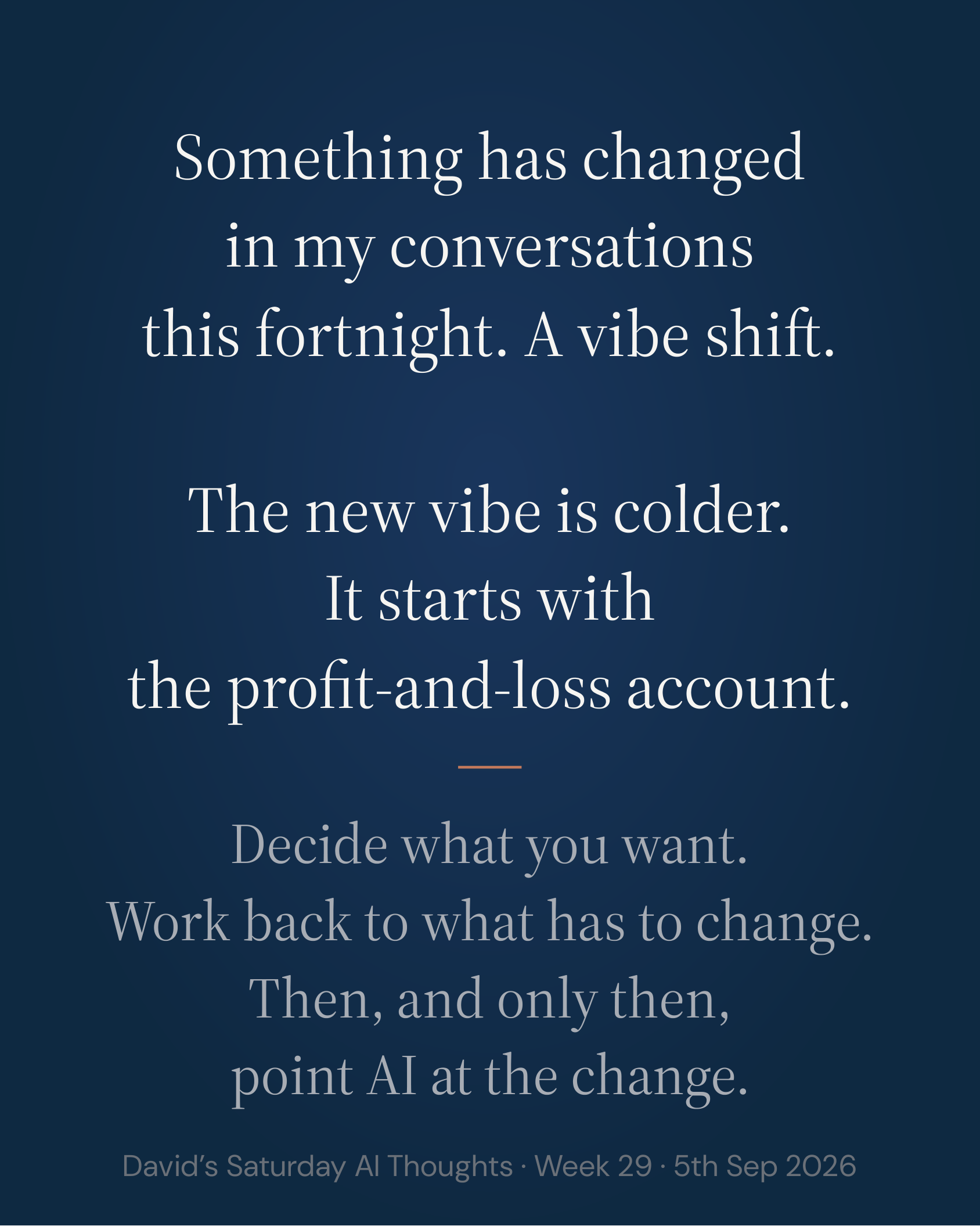
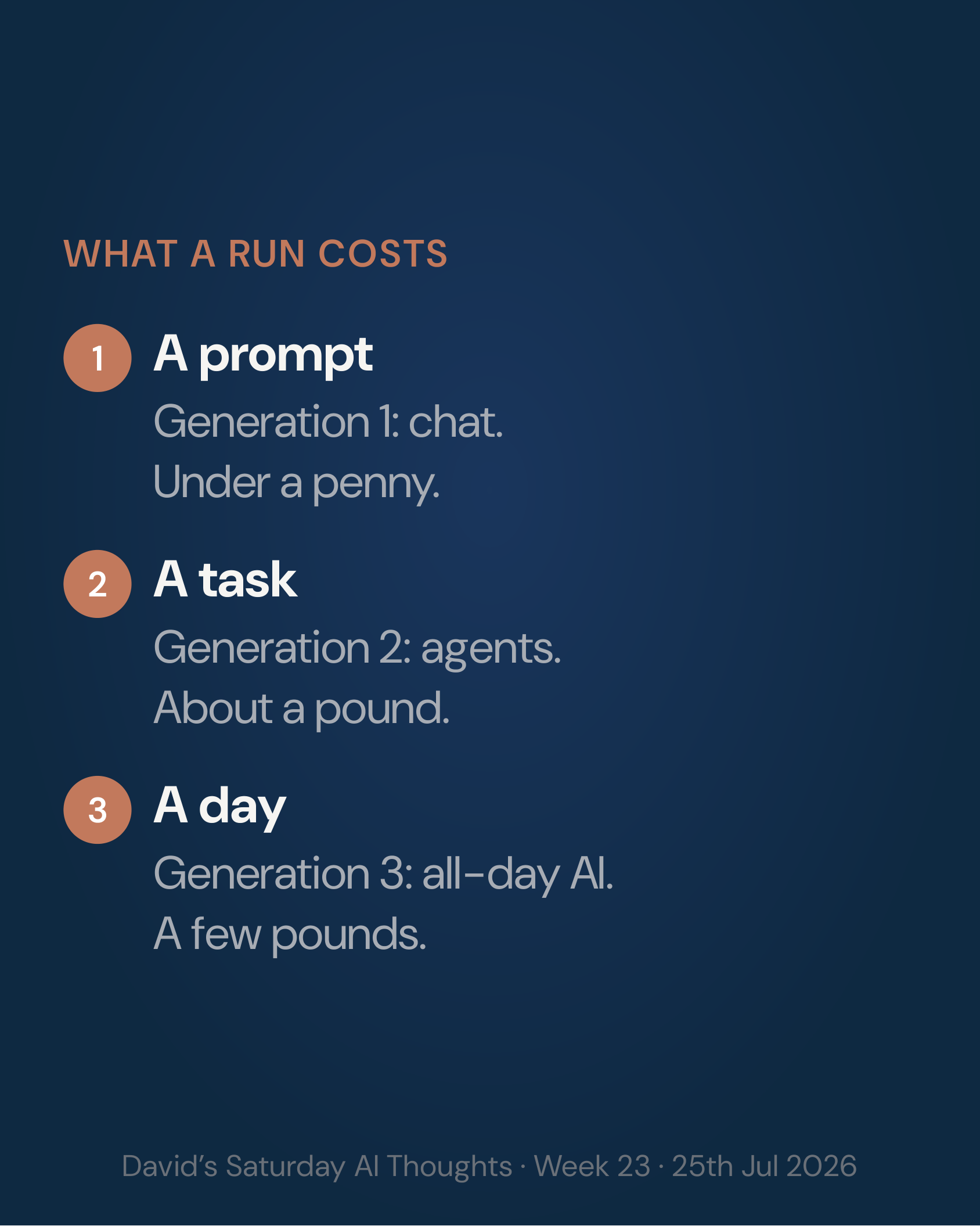
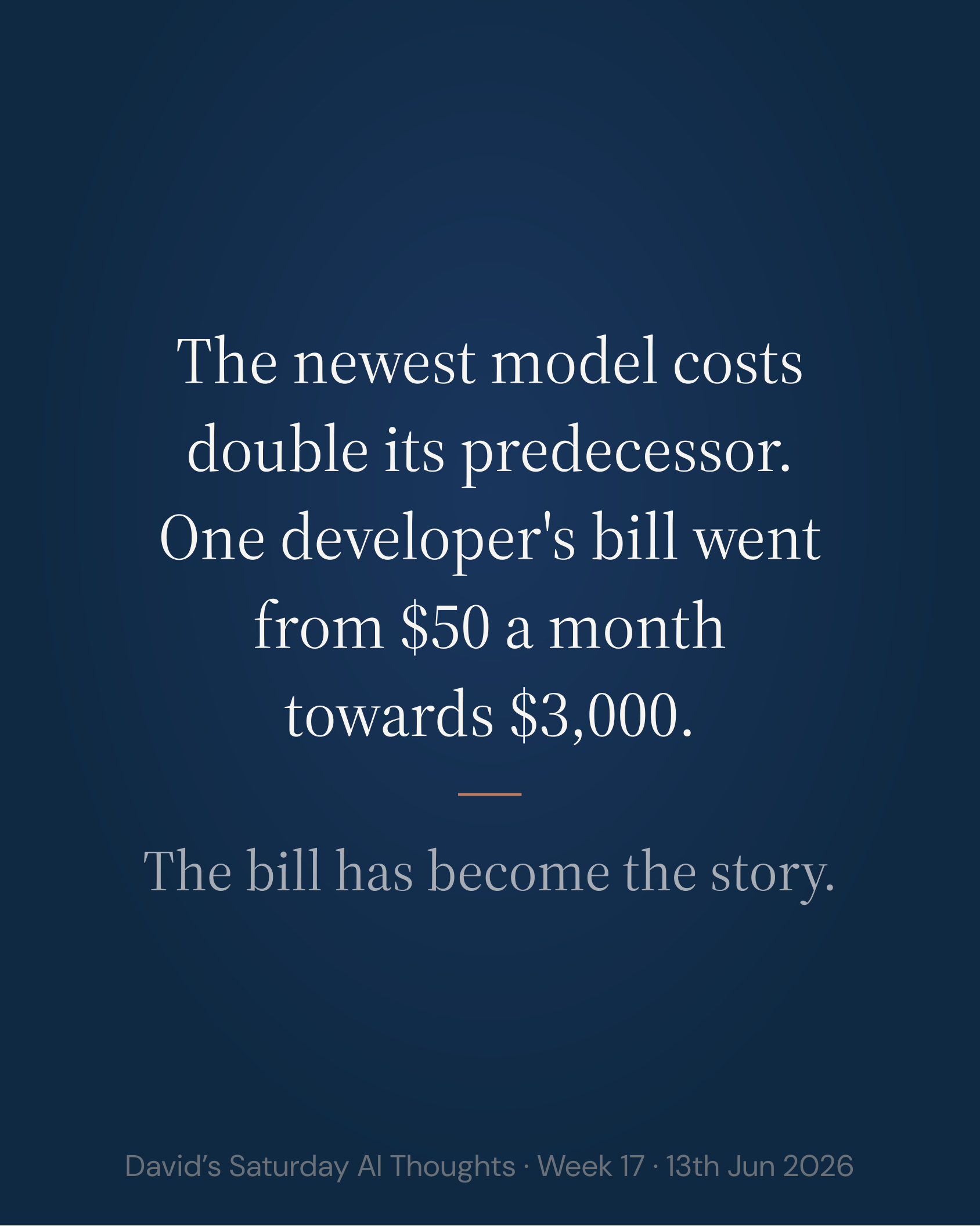
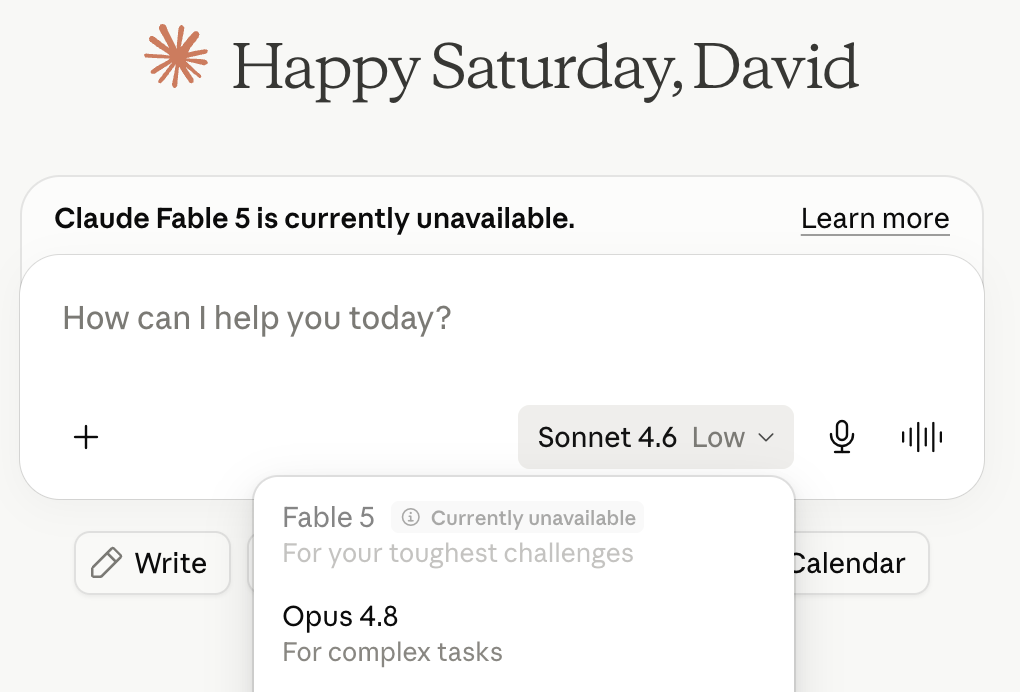
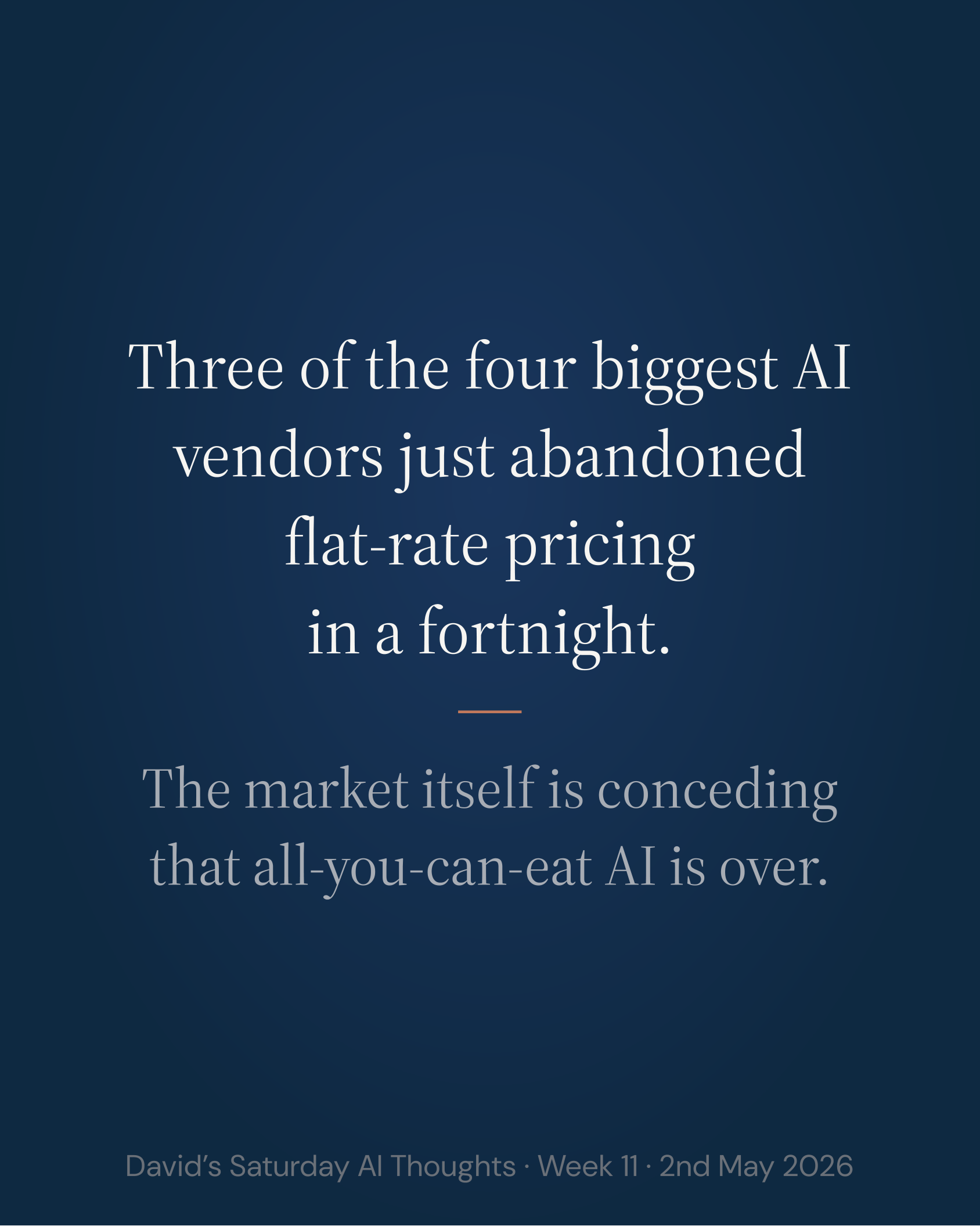
On Tuesday Anthropic, the AI lab behind Claude, released the most capable model yet, at exactly double its predecessor's list price. Then, early this morning, the US government pulled it on national-security grounds and Anthropic suspended it for everyone, which is a story in itself (see online). Developers using GitHub Copilot, Microsoft's coding assistant, revolted when pay-per-use billing arrived this month: one developer's bill went from a flat $50 a month towards $3,000. The bill has become the story.
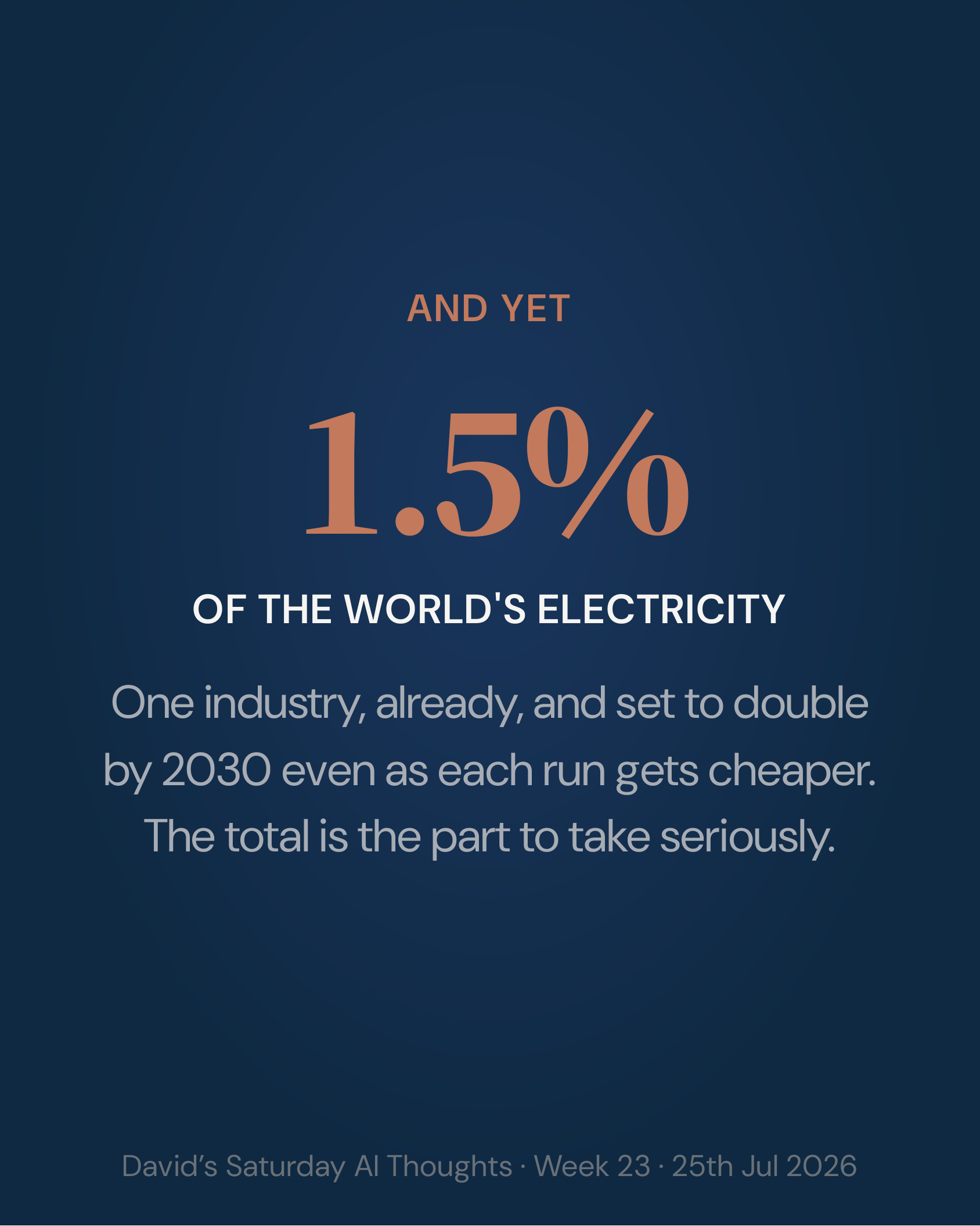
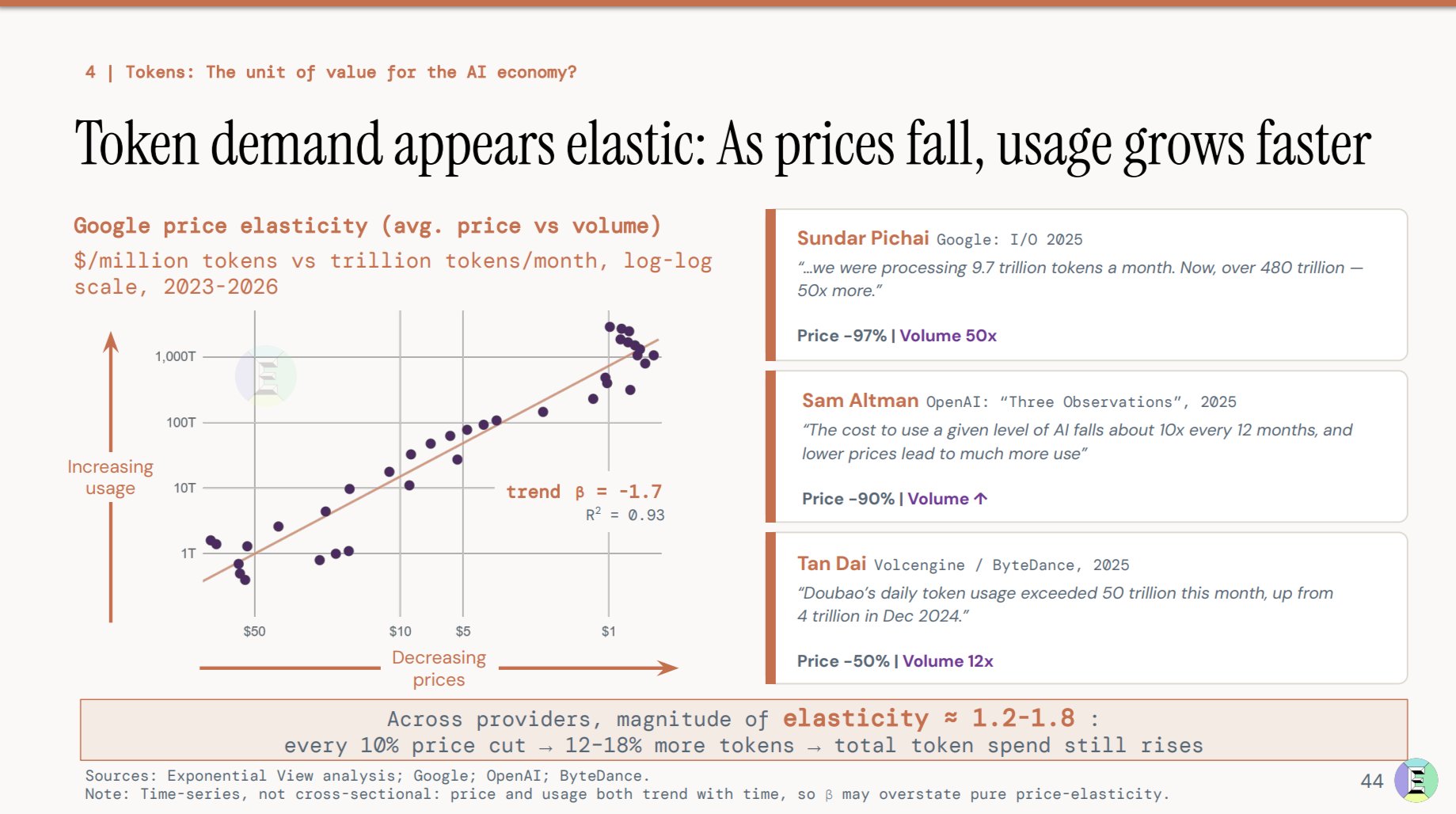
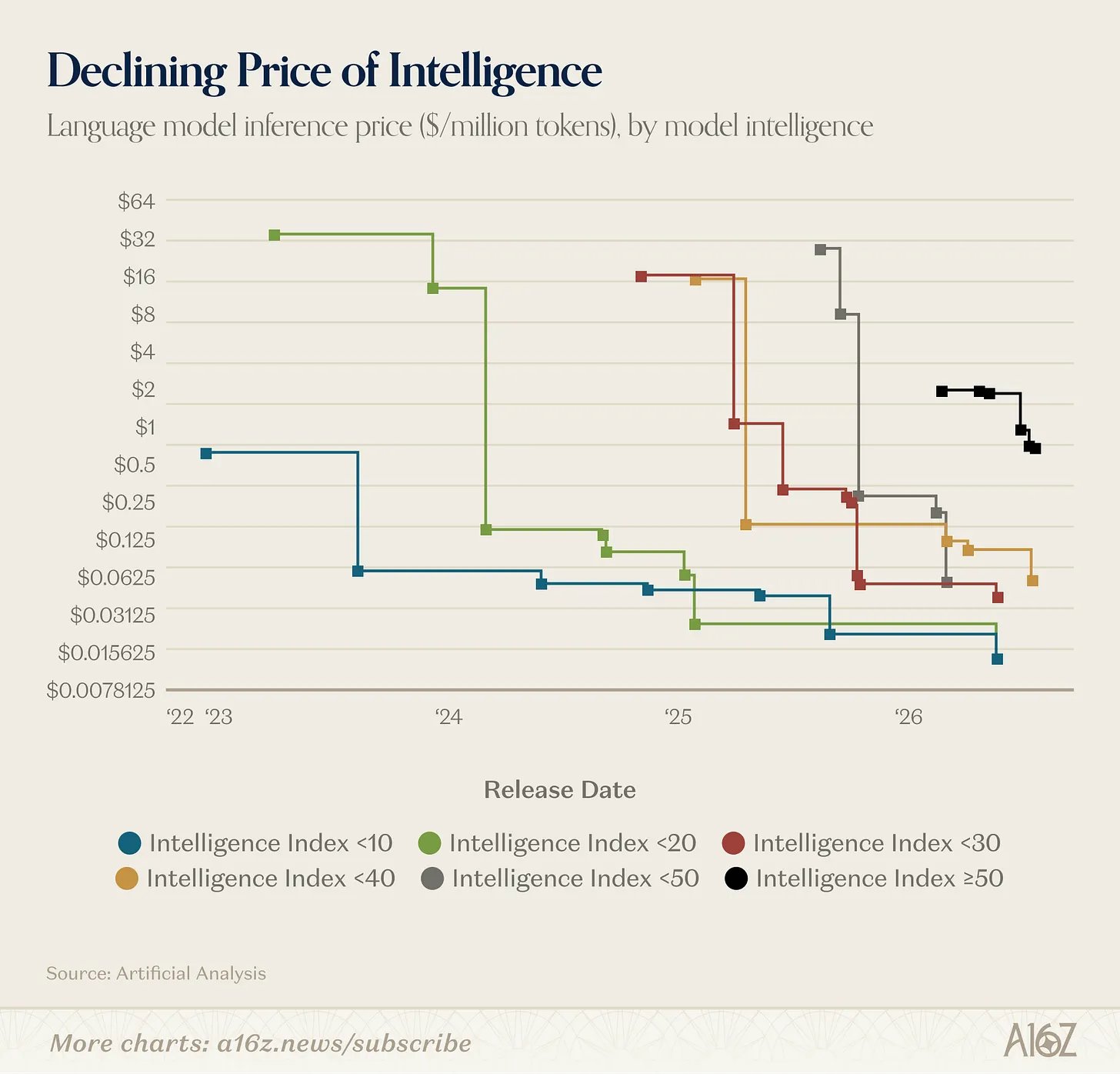
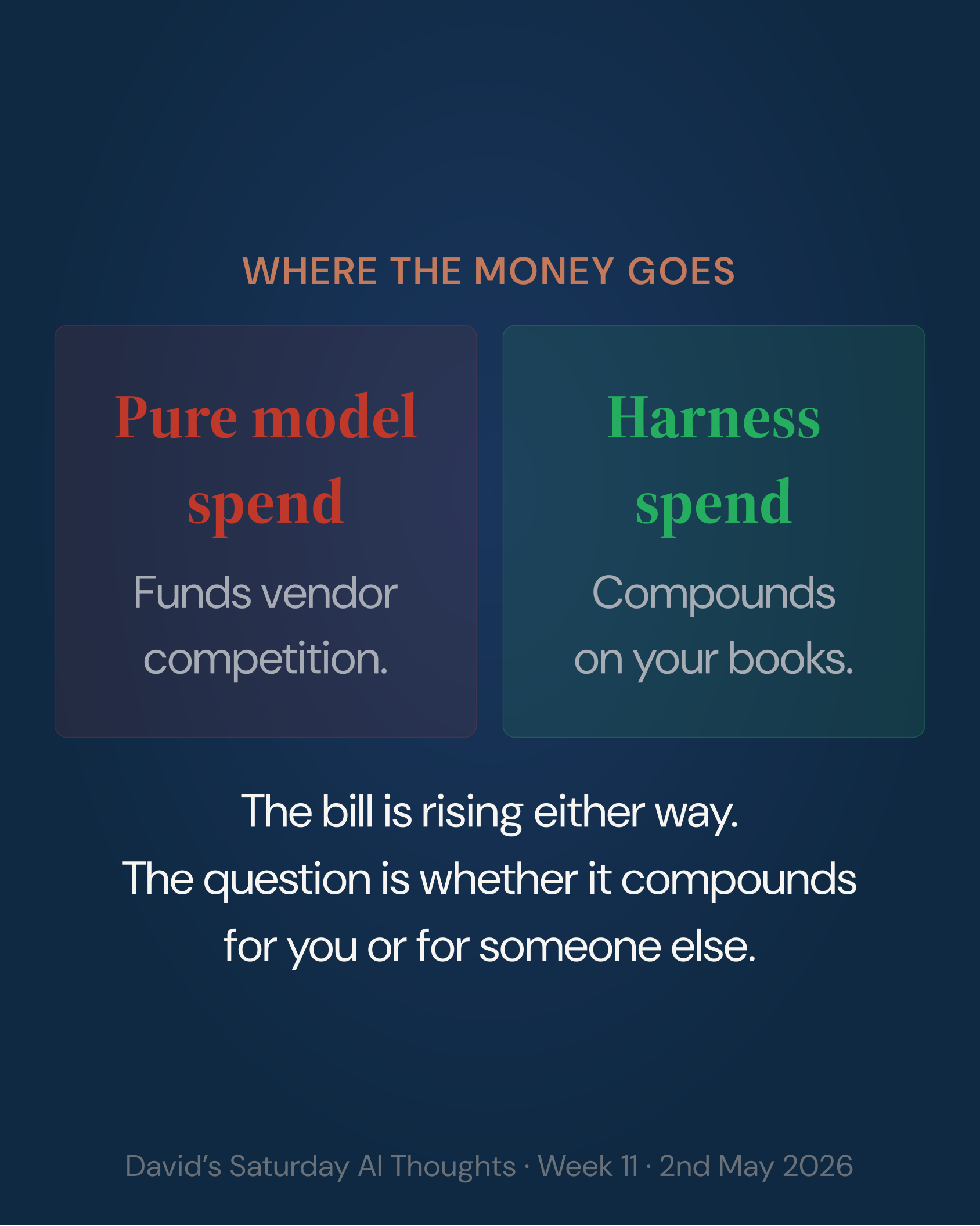
I made the case last month that flat-rate pricing is dying. The pattern underneath is a split: any given level of intelligence gets cheaper every year (on Monday Google cut its cheapest paid plan to $4.99), yet the bill rises anyway, because delegated work grows faster than unit prices fall and the hardest work migrates to the dearest model. Expect both halves to hold: a better model above at a higher price, yesterday's below at a lower one. This week, the practical question, because most organisations manage these bills exactly backwards.
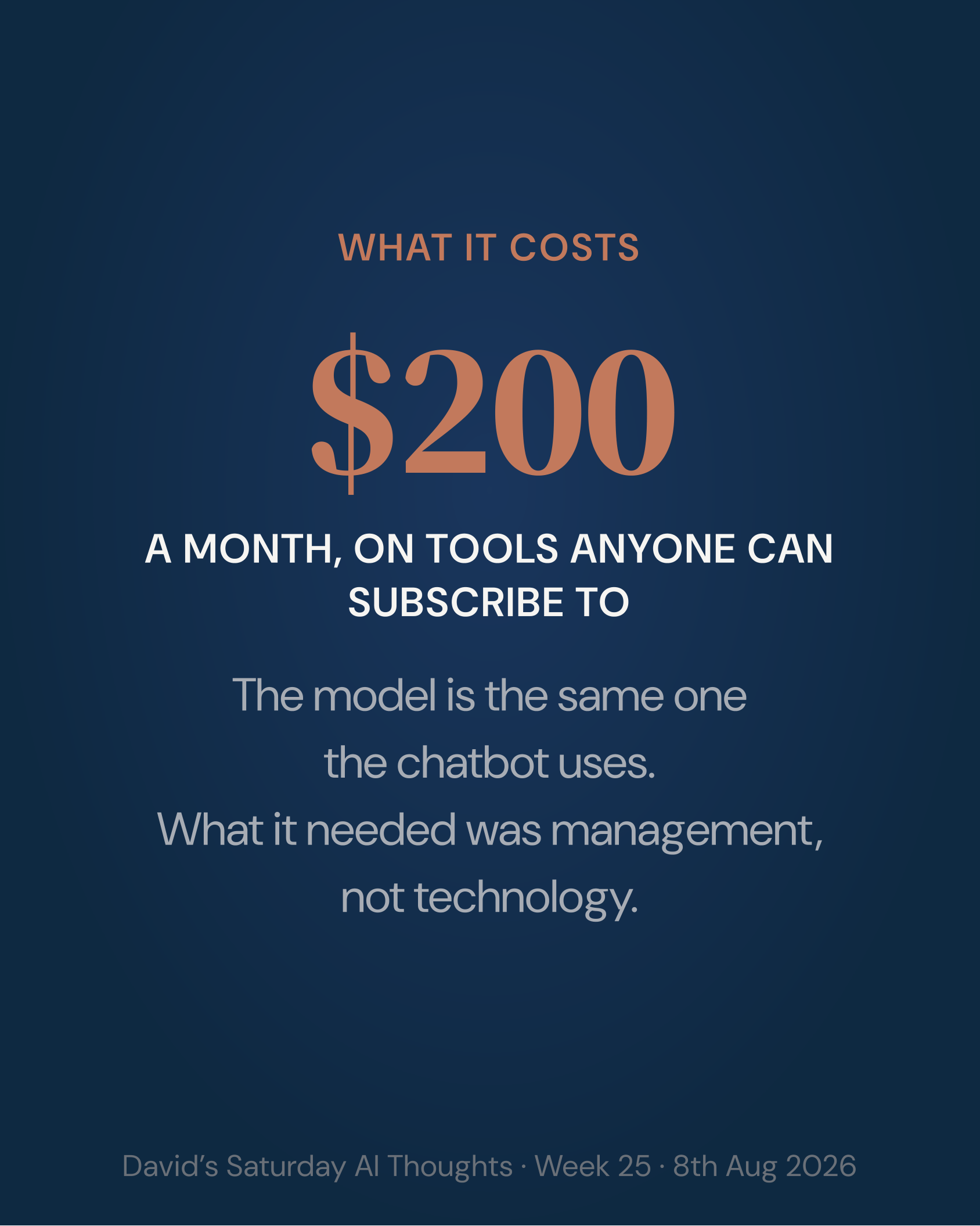
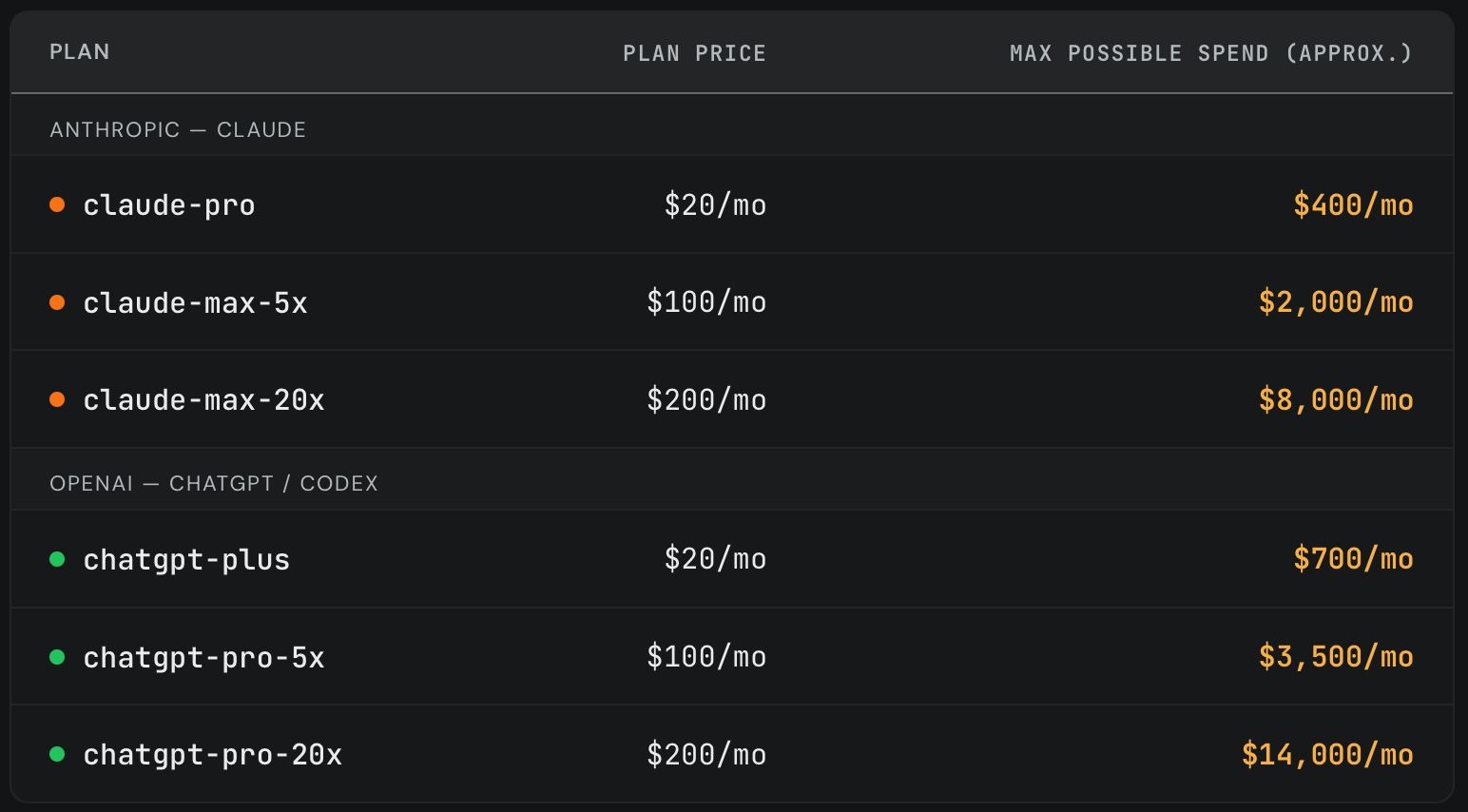
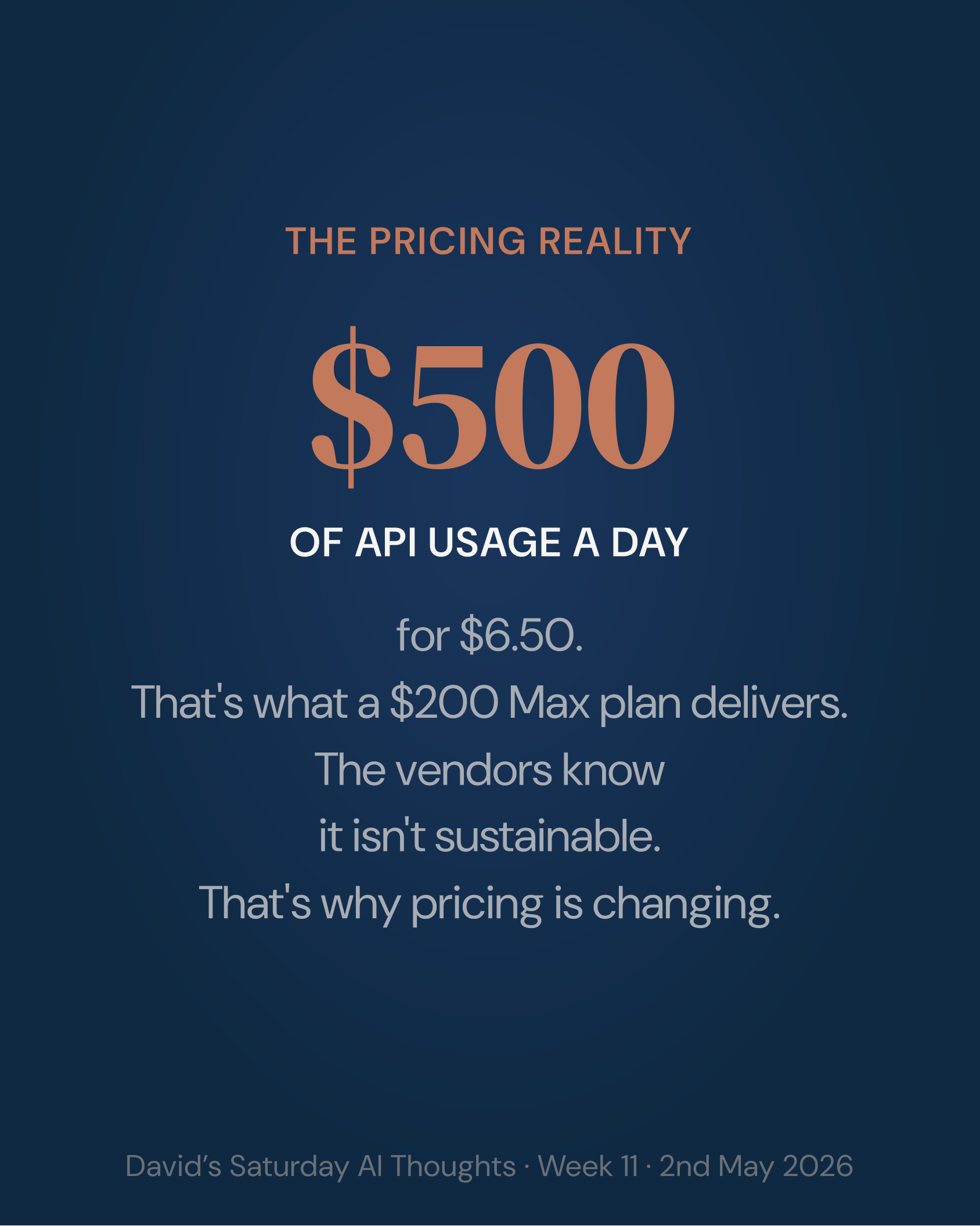
Flat-rate pricing is incredible value for money against API pricing at current rates: a $200-a-month plan can absorb thousands of dollars of API-equivalent usage.
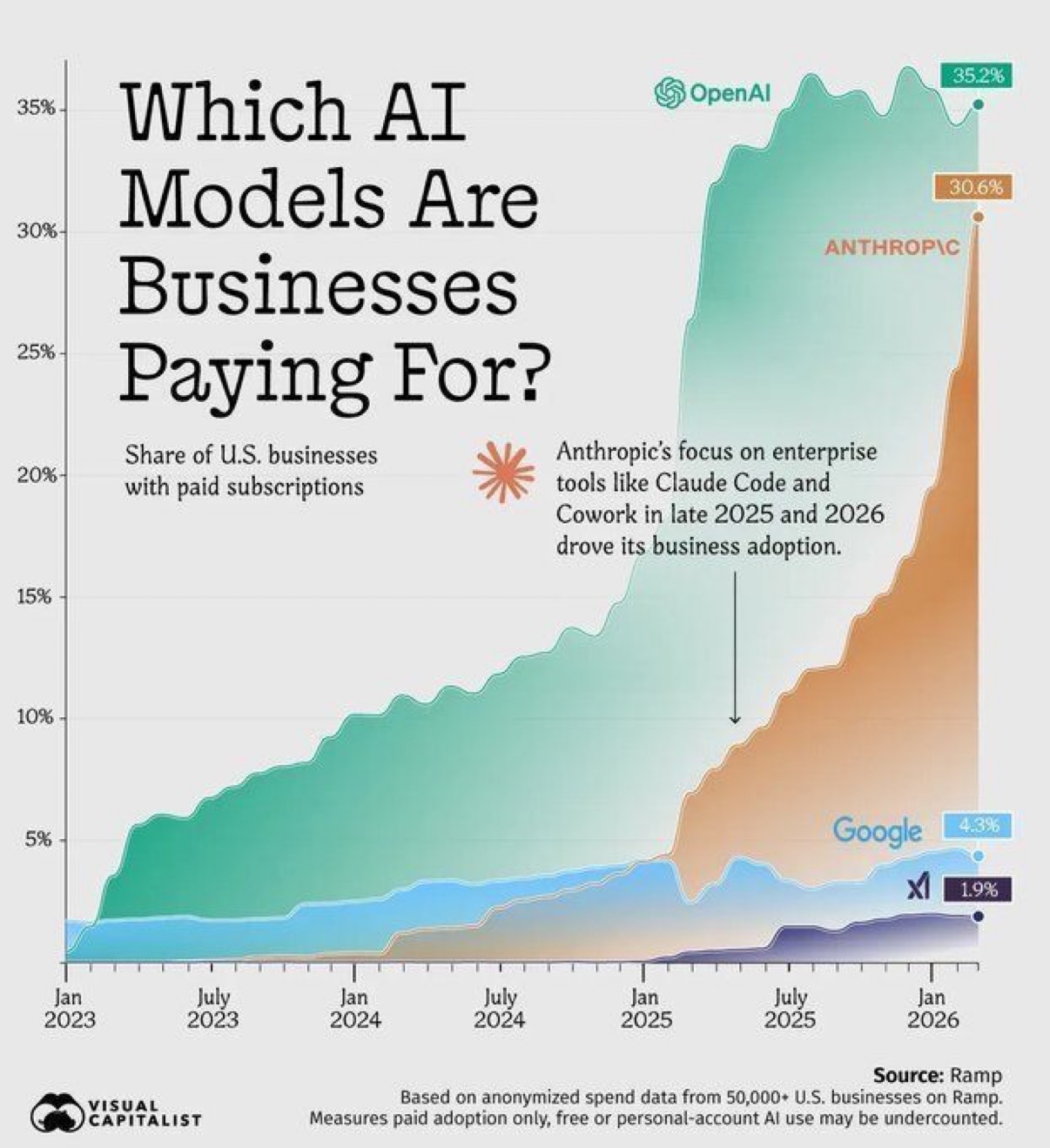
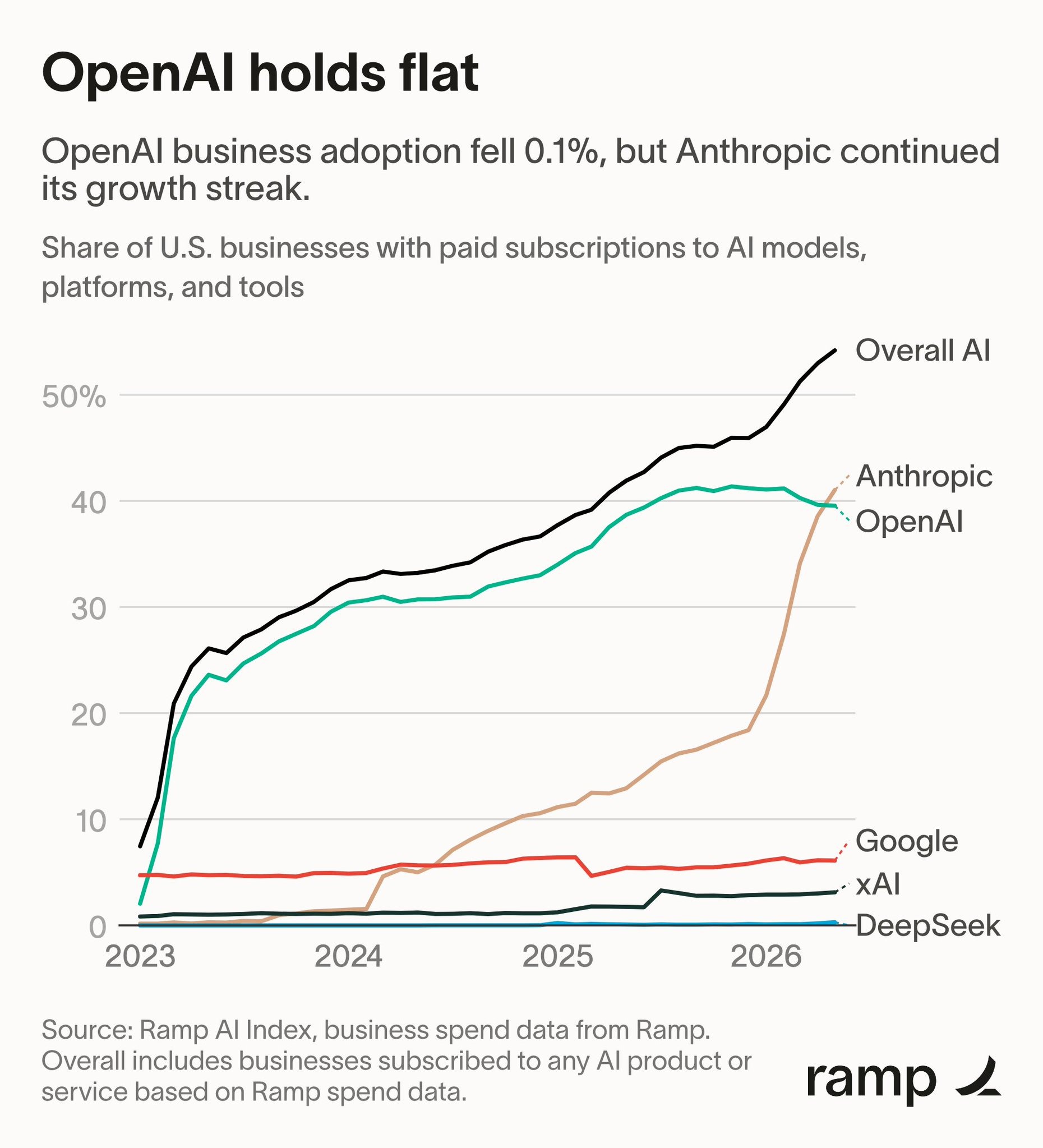
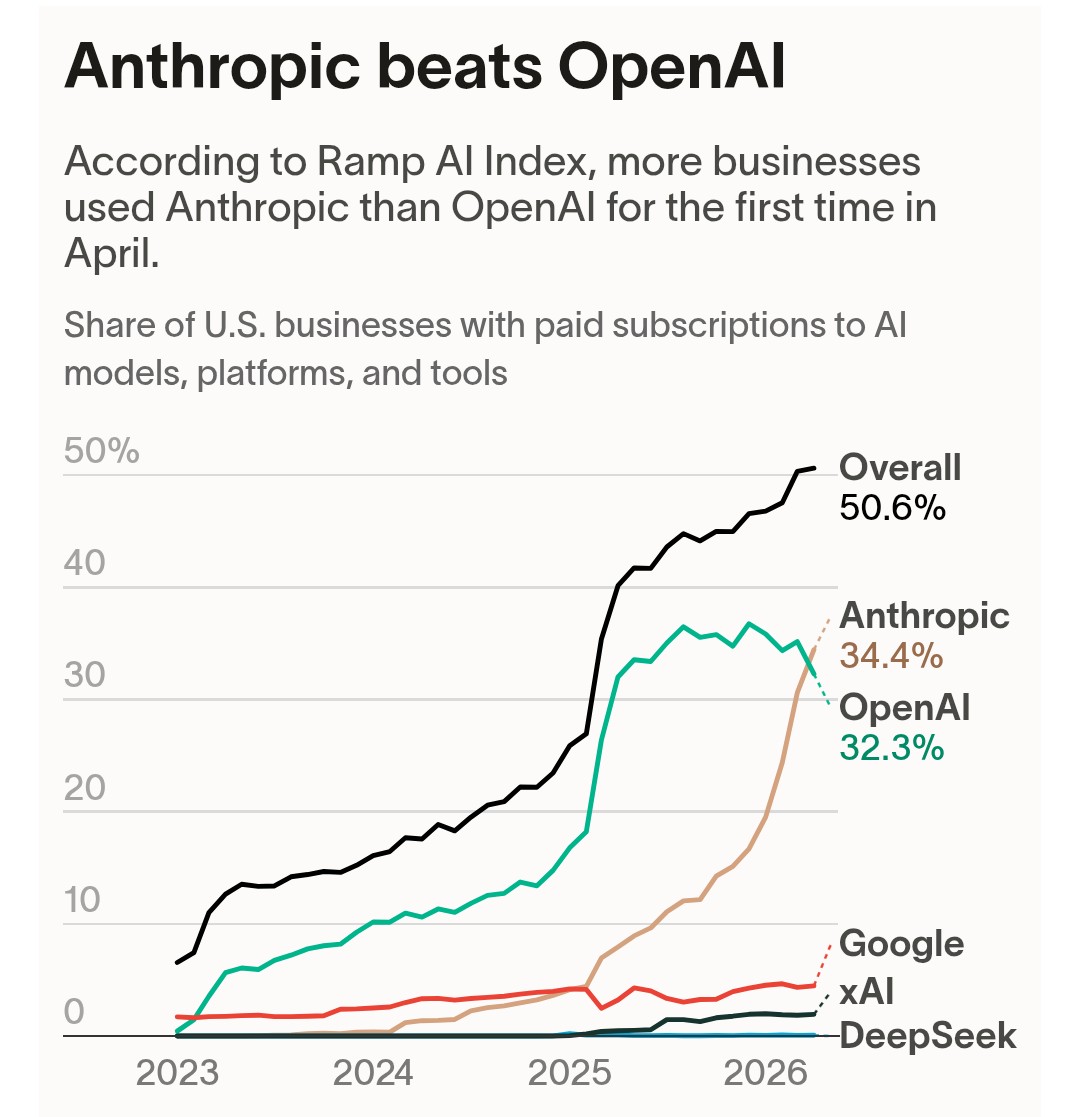
The hardest work migrates to the dearest model: business AI spend is shifting to the priciest frontier model even as its price doubles.
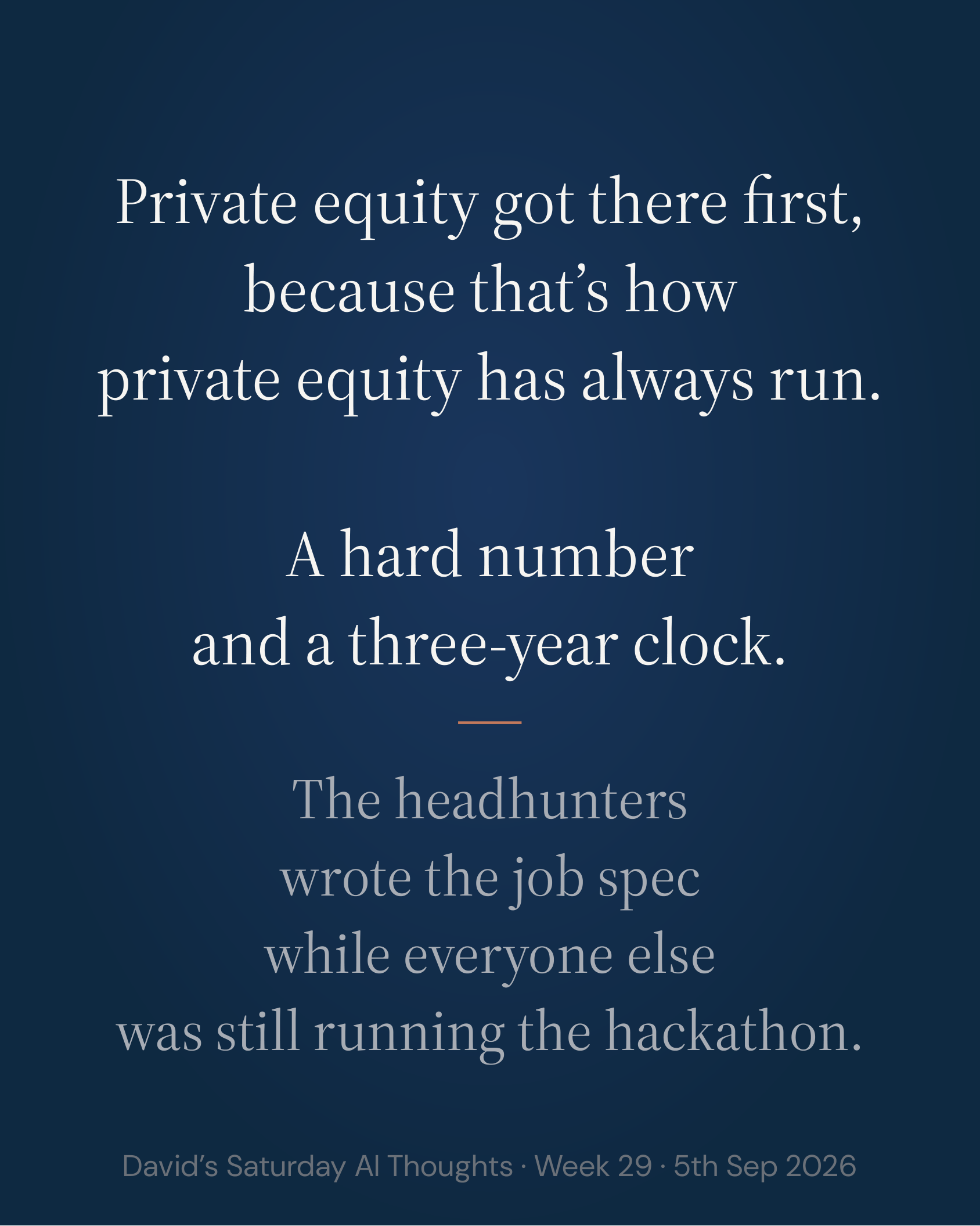
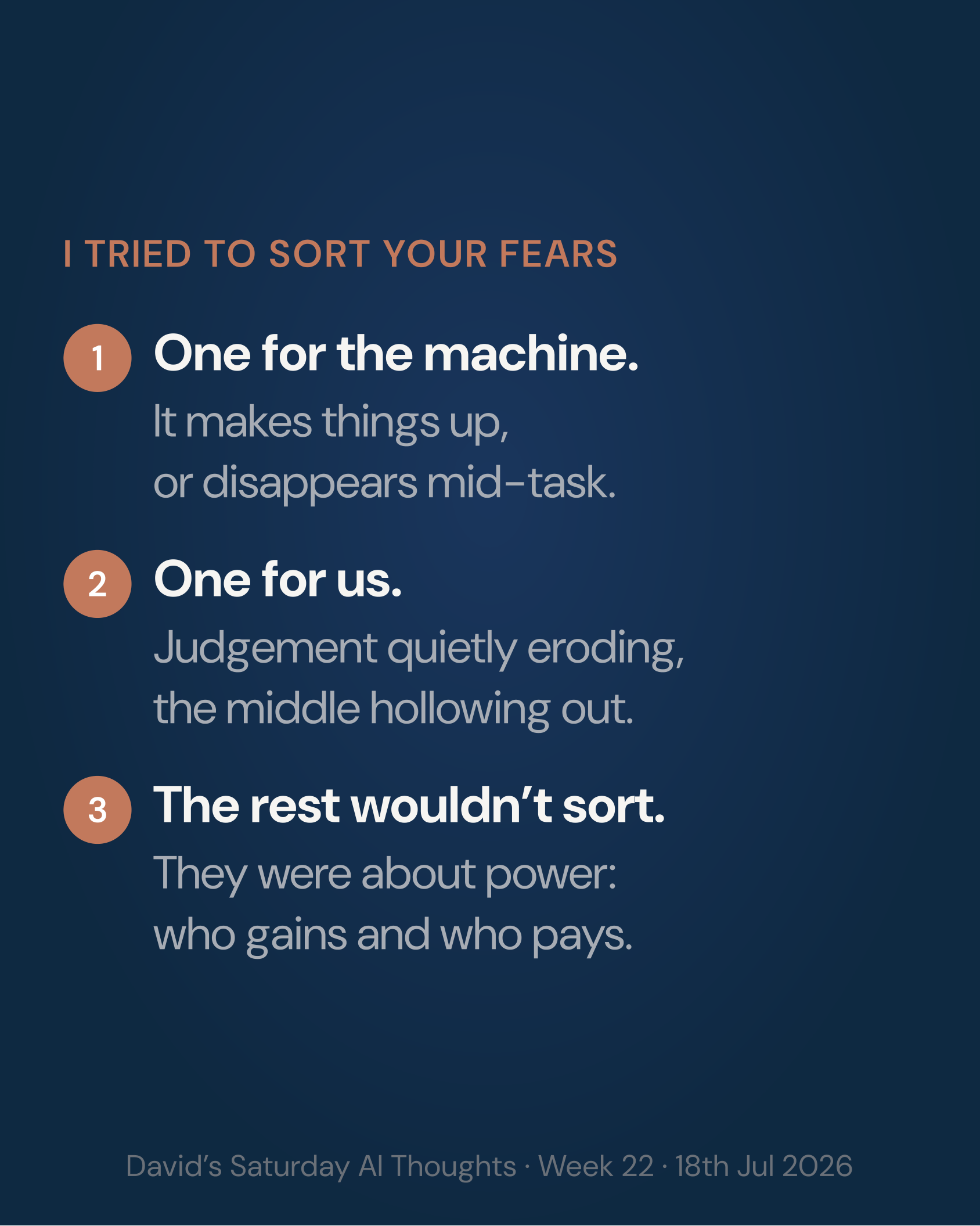
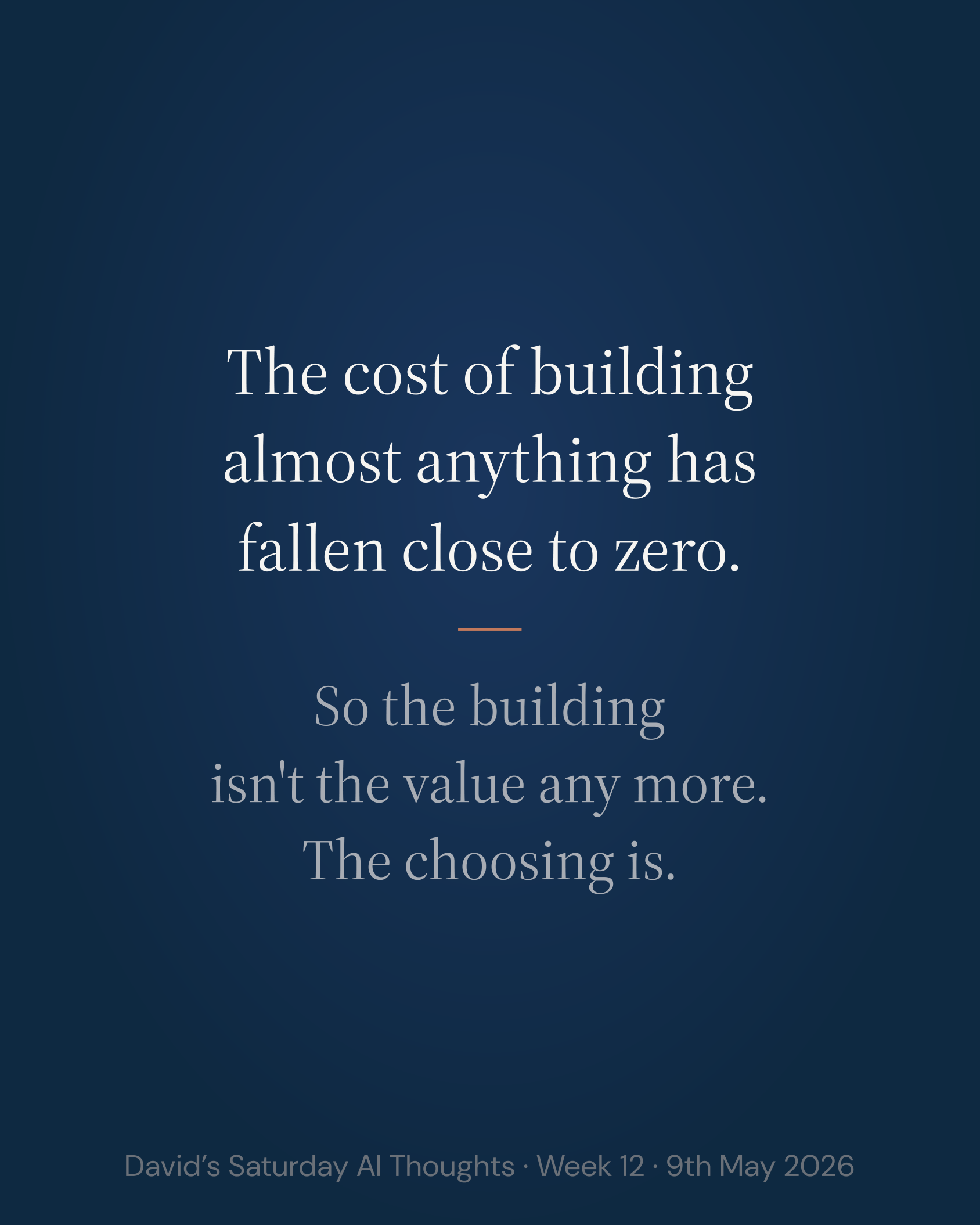
Two instincts are doing the rounds. The first declares tokens free and celebrates whoever burns the most. The second is the cap: a meter and a limit for everyone. Both are wrong, for the same reason: both manage the number instead of the judgement.
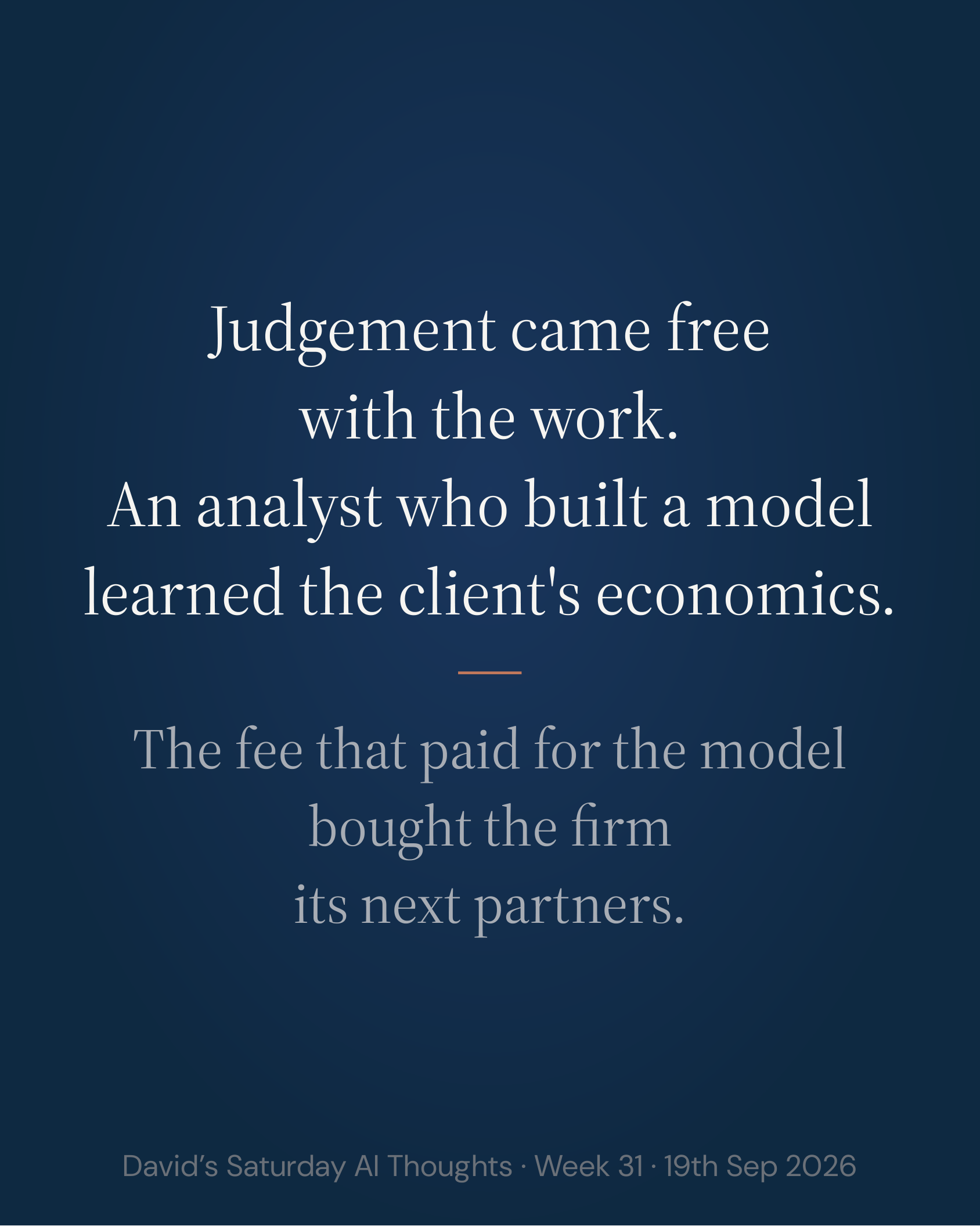
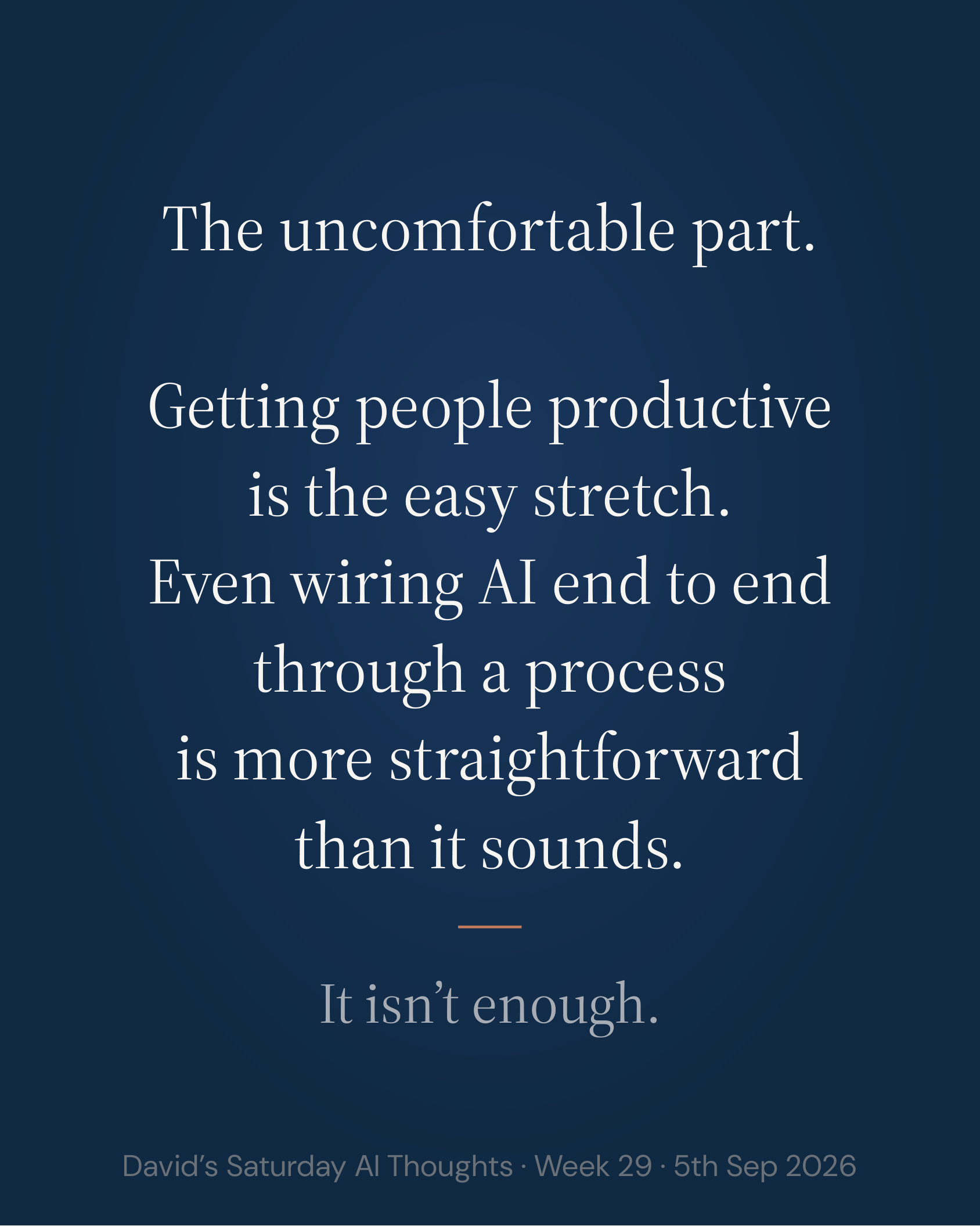
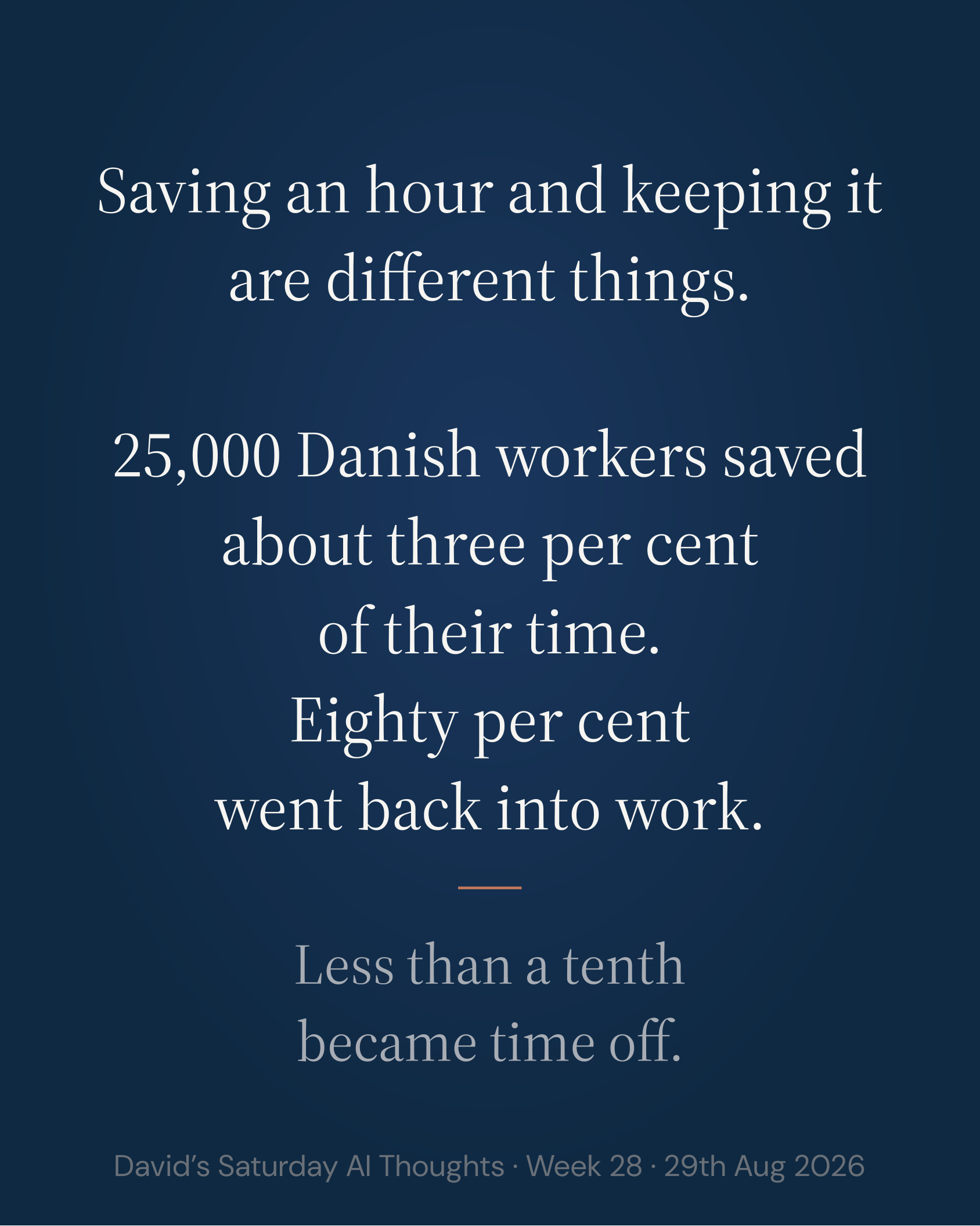
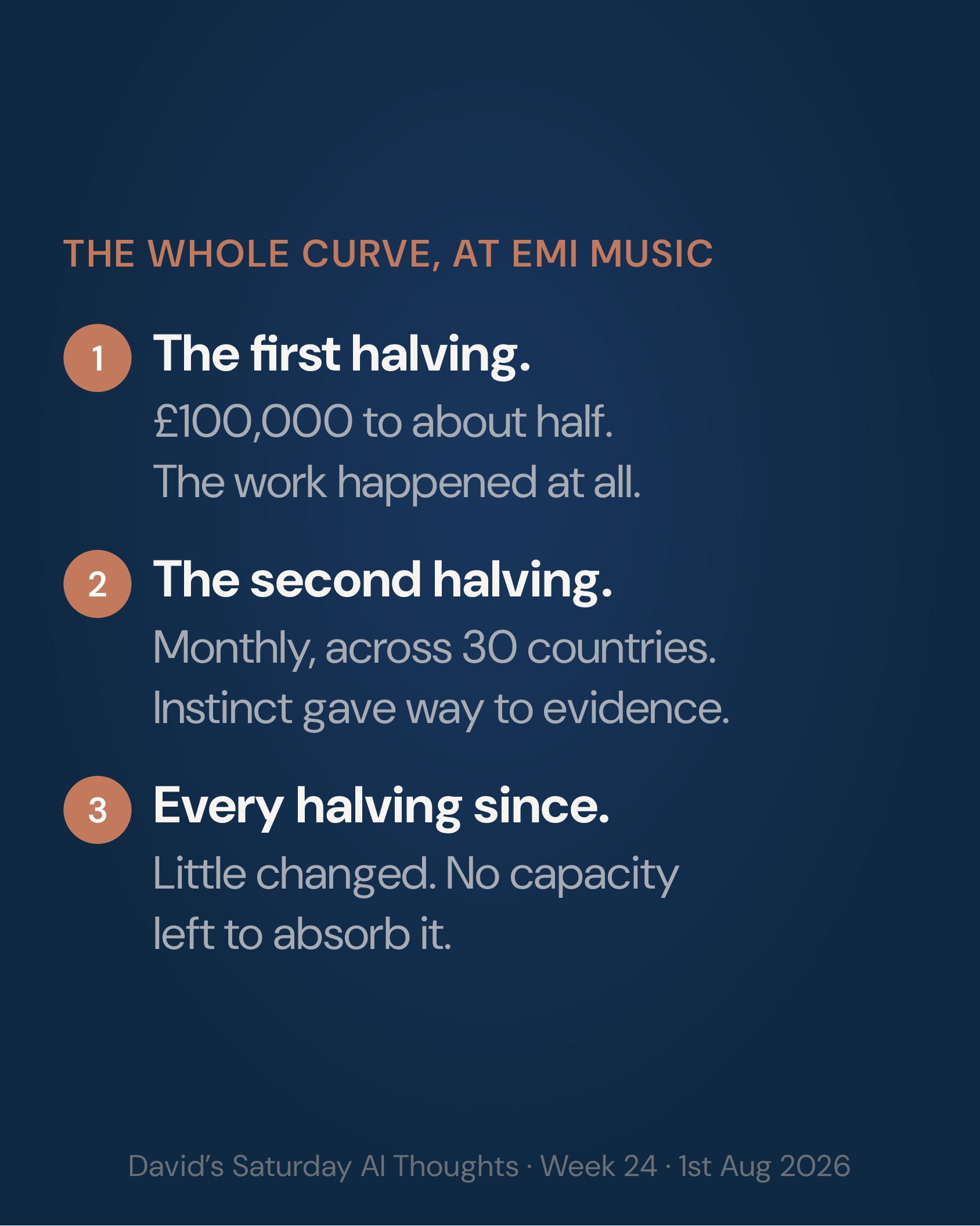
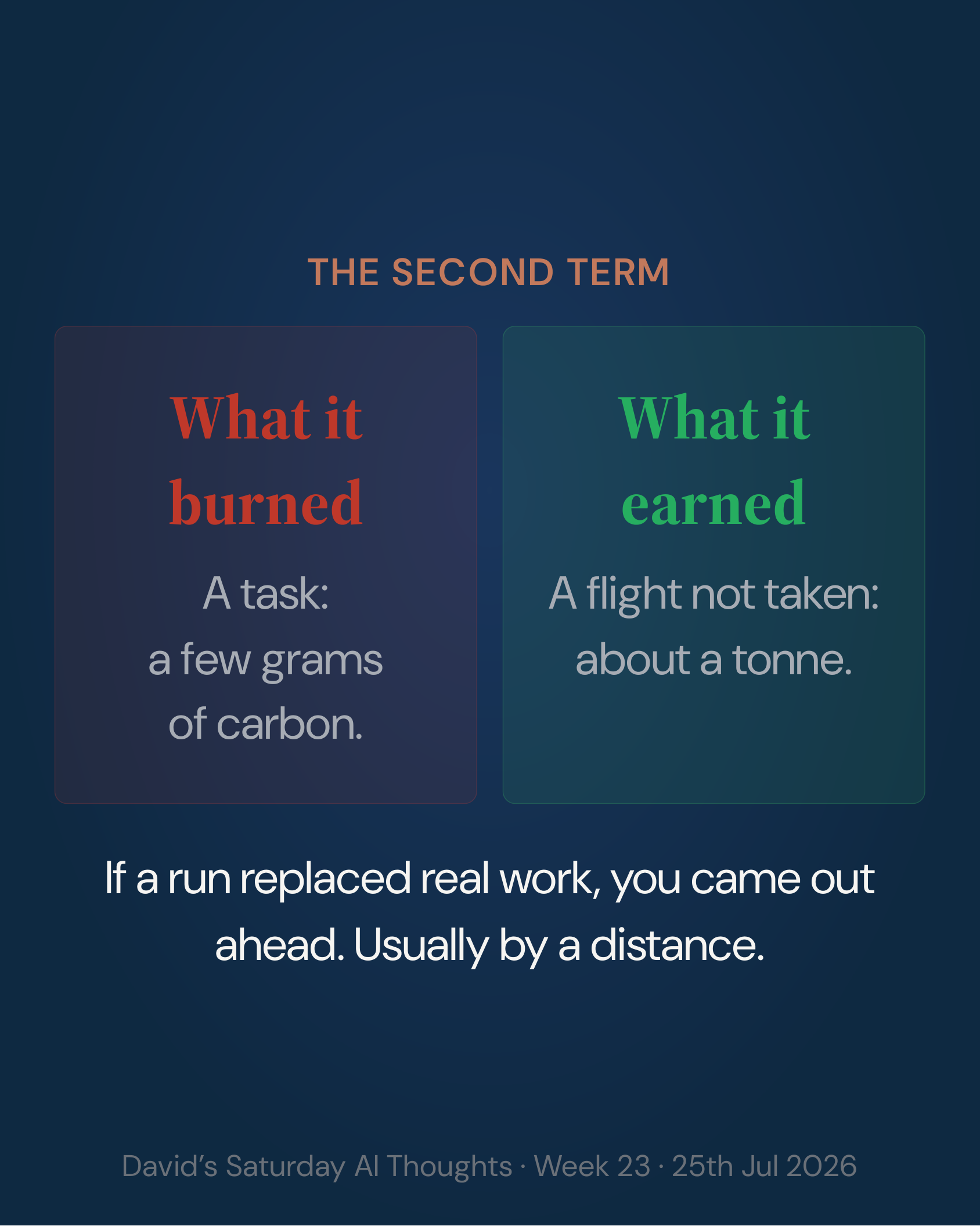
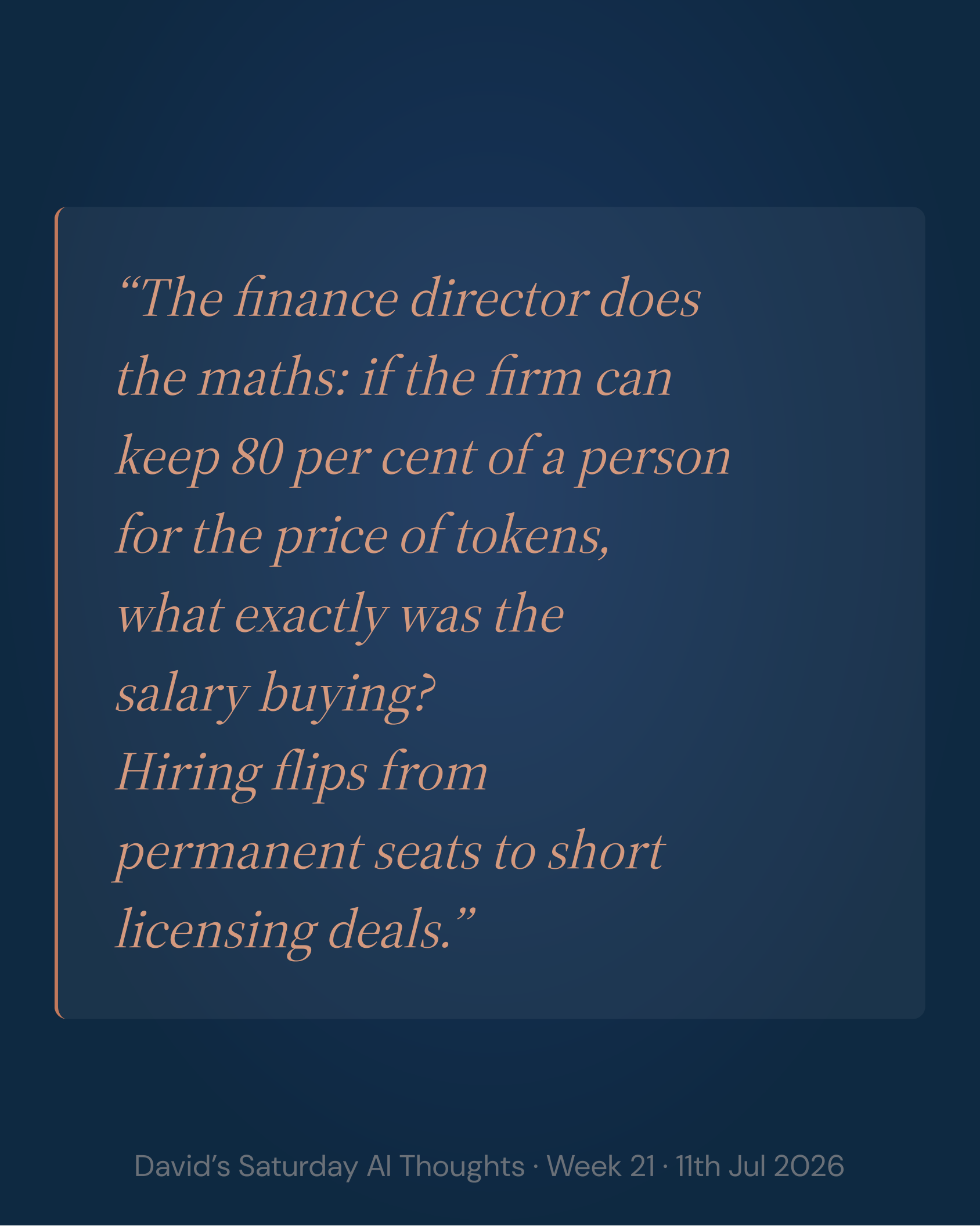
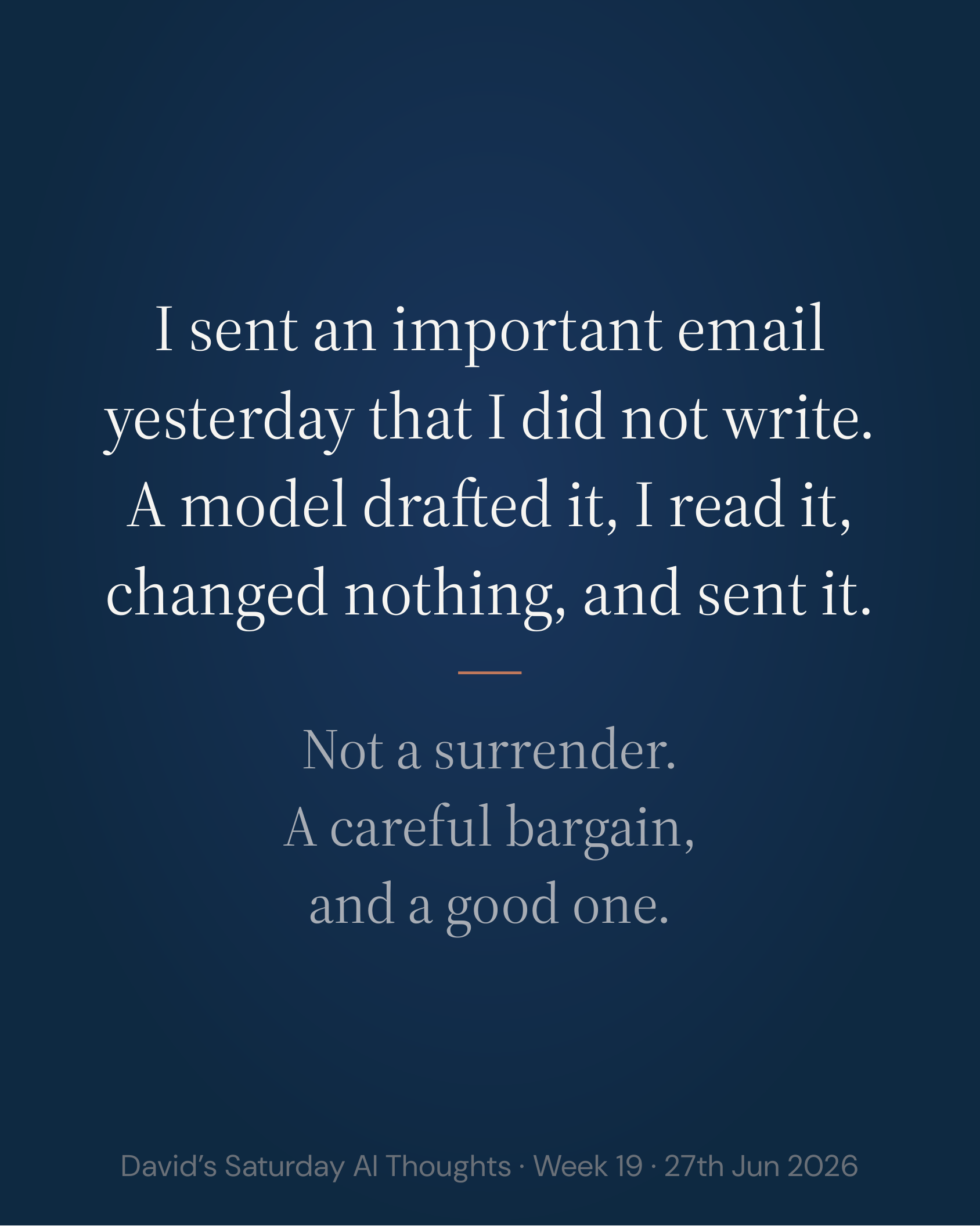
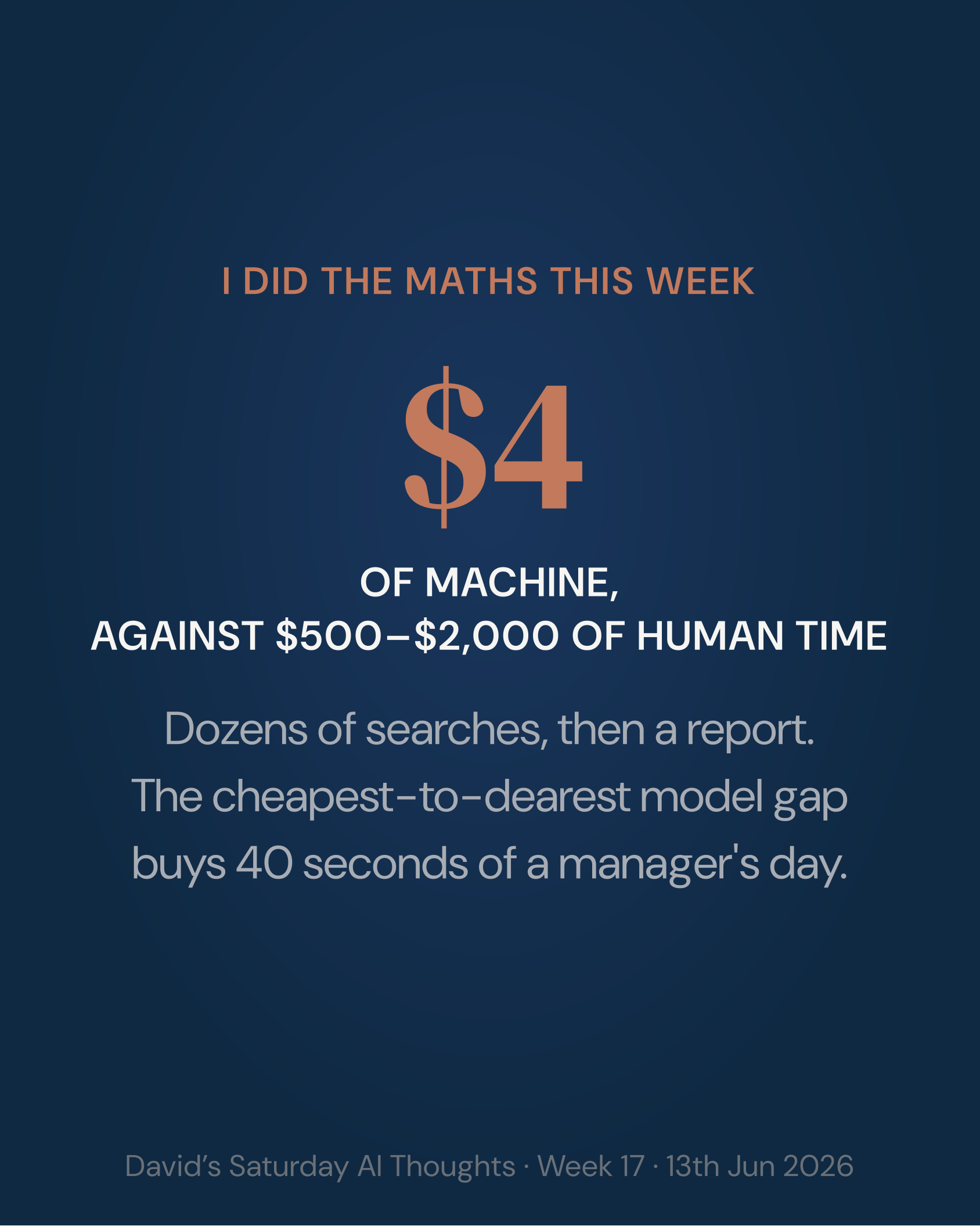
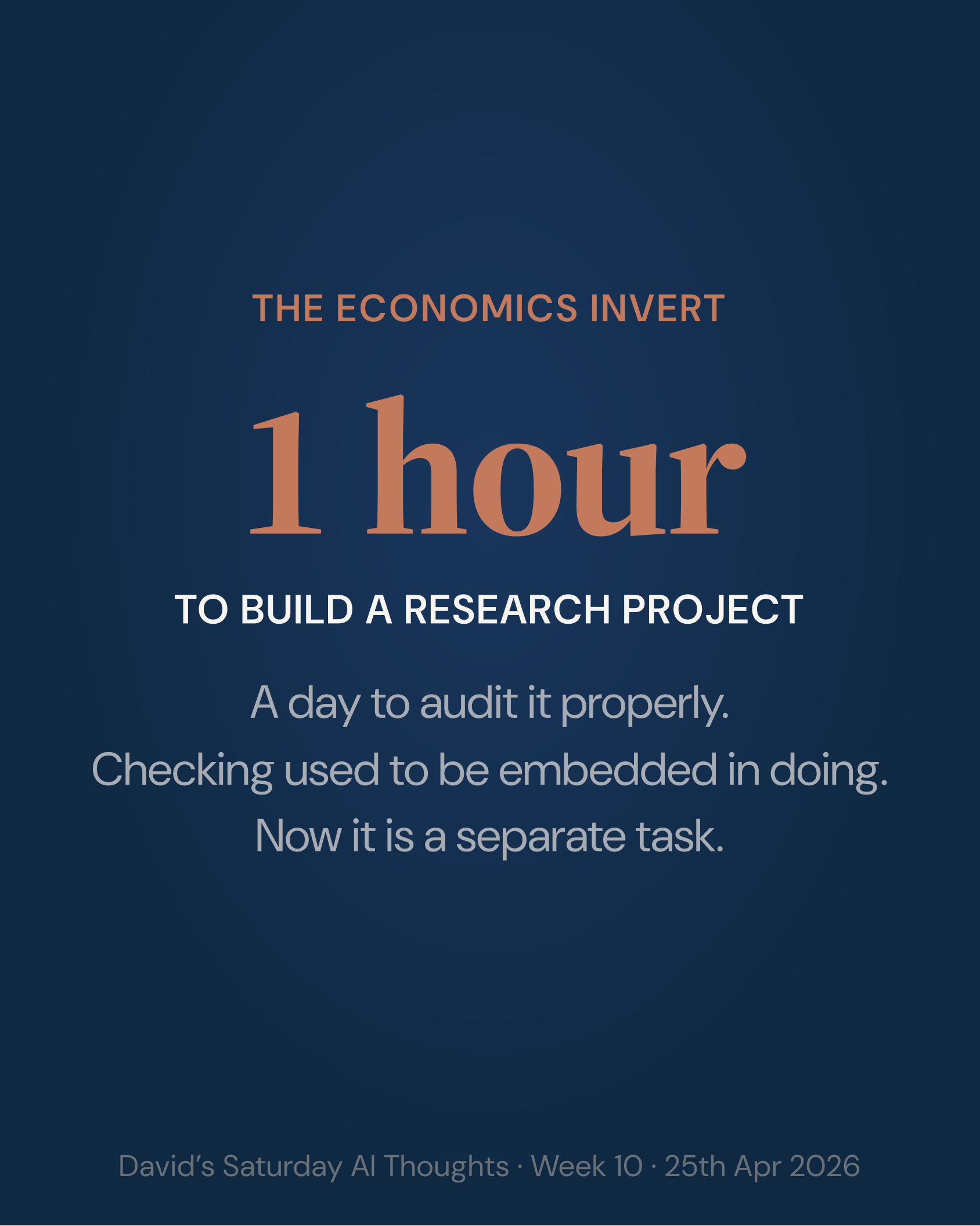
I did the maths this week, at published list prices, on two jobs like those most of us do all the time. Researching something (dozens of searches, some analysis, then a written report) costs about $1 with a mid-tier workhorse model, $1.60 with last week's best and $3.90 with this week's. Reading four meeting transcripts and a folder of documents, then drafting a document from them: $1.05, $1.75 and $4.60 on the same ladder. Do either job yourself and it's two to eight hours: at a manager's loaded cost, $500 to $2,000 of human time against $5 of machine. The entire gap between the cheapest sensible model and the dearest buys 40 to 50 seconds of that manager's day. If the better answer saves them even a minute of checking, redrafting or second-guessing, it has paid for itself. That ratio is the thing to manage.
So here's what I'd actually do.
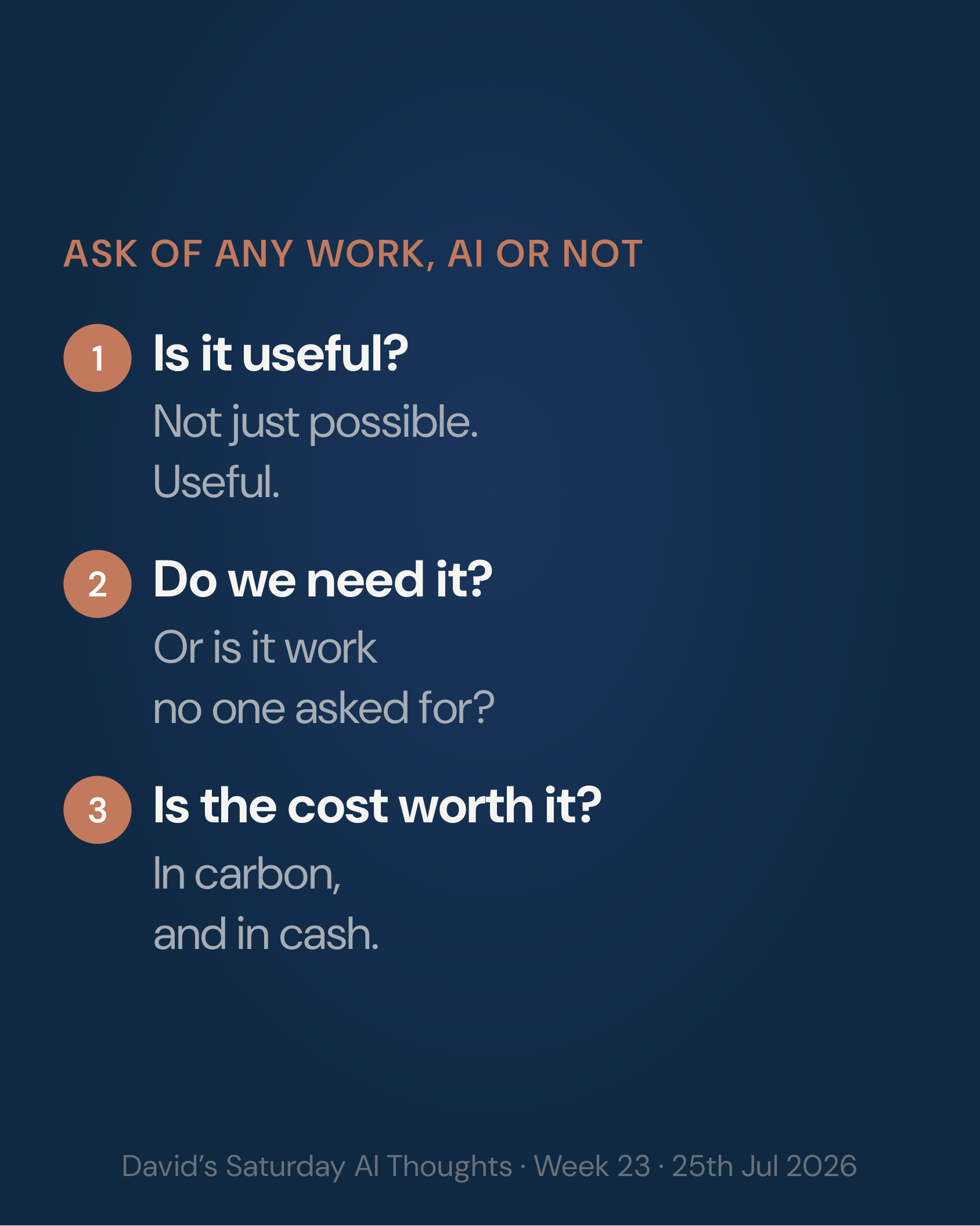
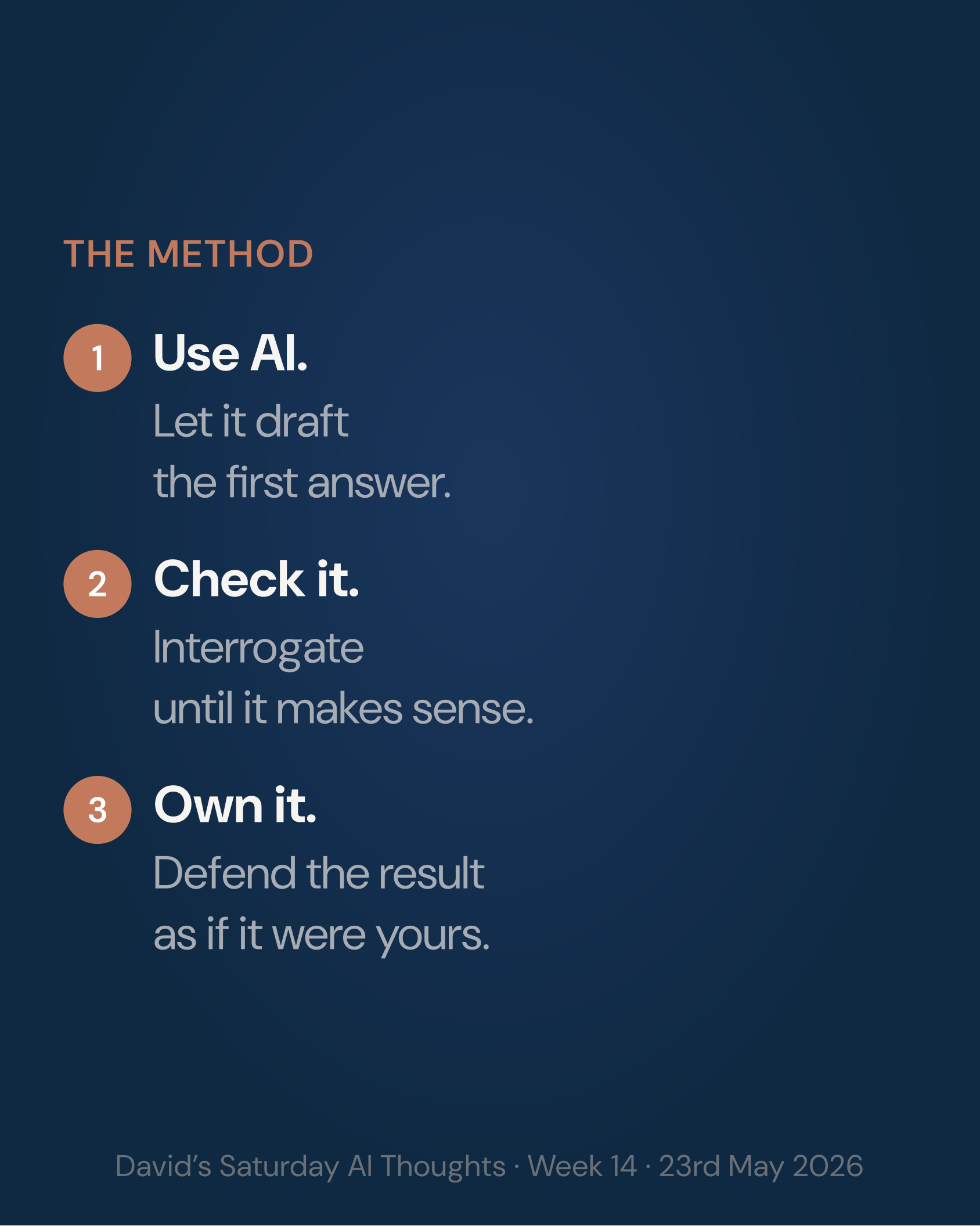
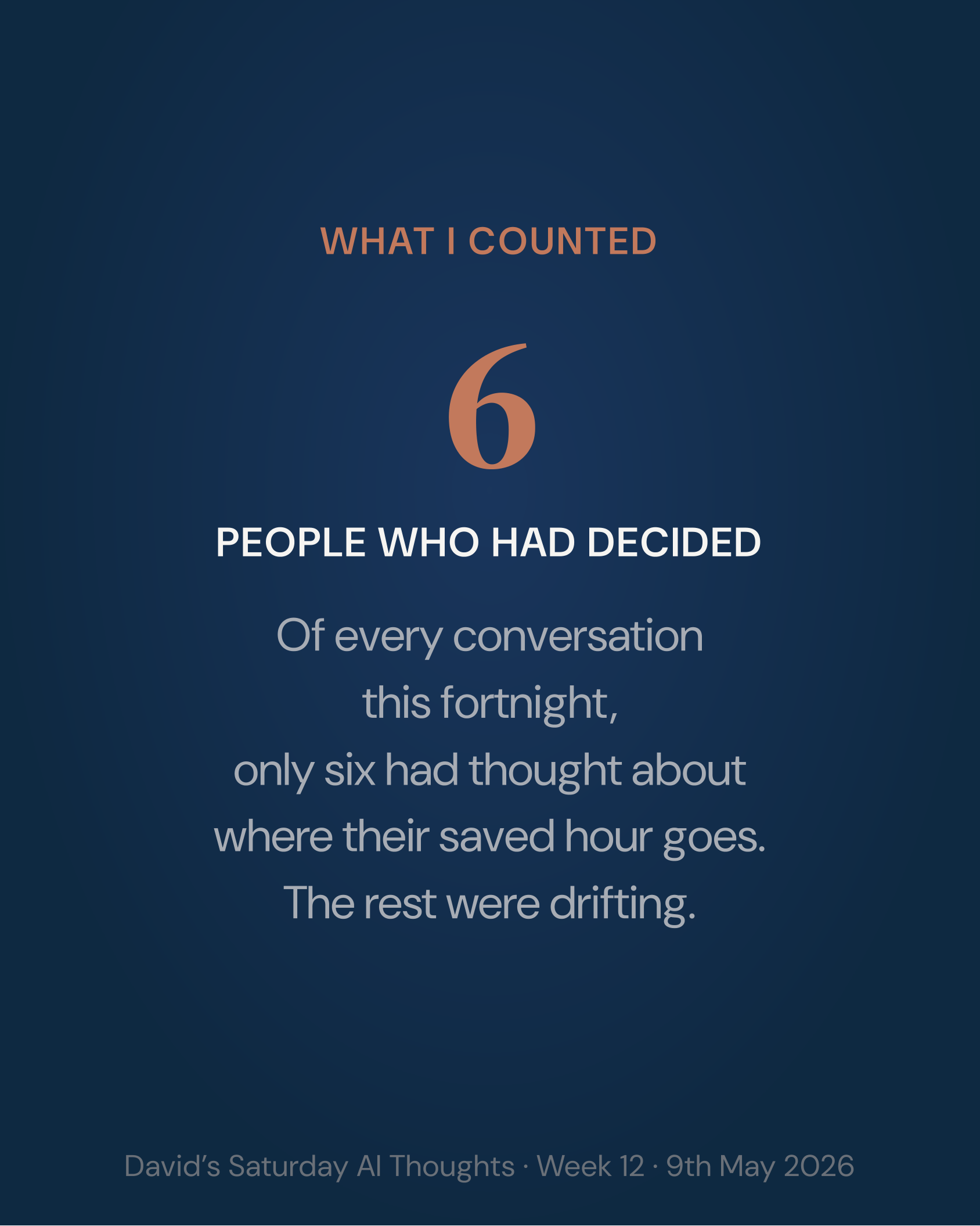
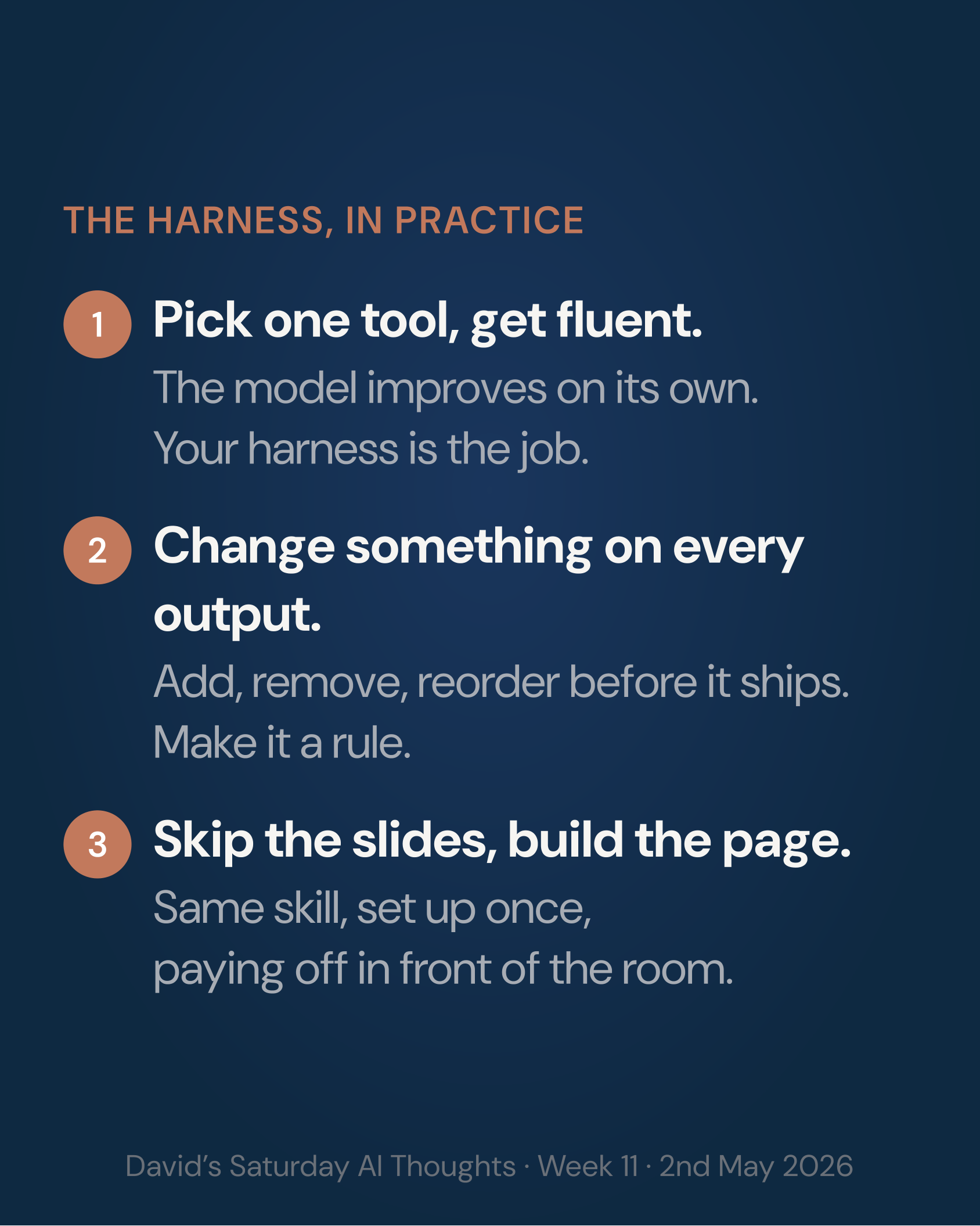
First, set a floor. I regularly coach people with full access to great models whose entire history is one conversation. One, ever. In mid-2026, if someone isn't sending five prompts a day, they aren't yet trying. Celebrate whoever clears it, a tough conversation with whoever doesn't. (One precondition: everyone gets the same tools first. A floor over rationed access is unfair before it's useful.) Above the floor, for heaven's sake stop counting. The easy way to top a usage chart is to summarise everything that crosses your desk and learn nothing; a prize for the biggest burner is a different level of silly. Just make sure they ride the bike. It's the only way to learn.
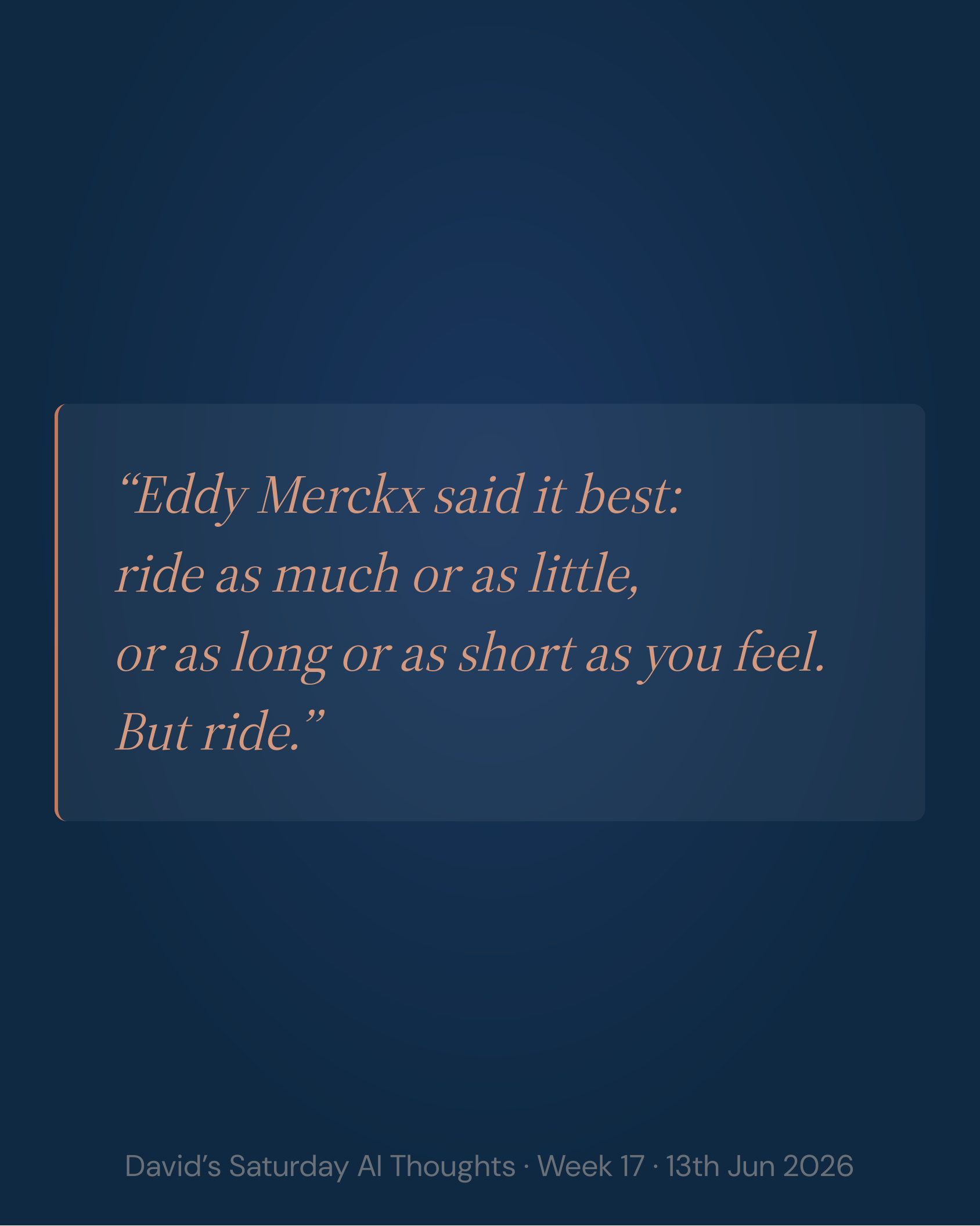
“Ride as much or as little, or as long or as short as you feel. But ride.” EDDY MERCKX, THE GREATEST RACING CYCLIST OF ALL TIME
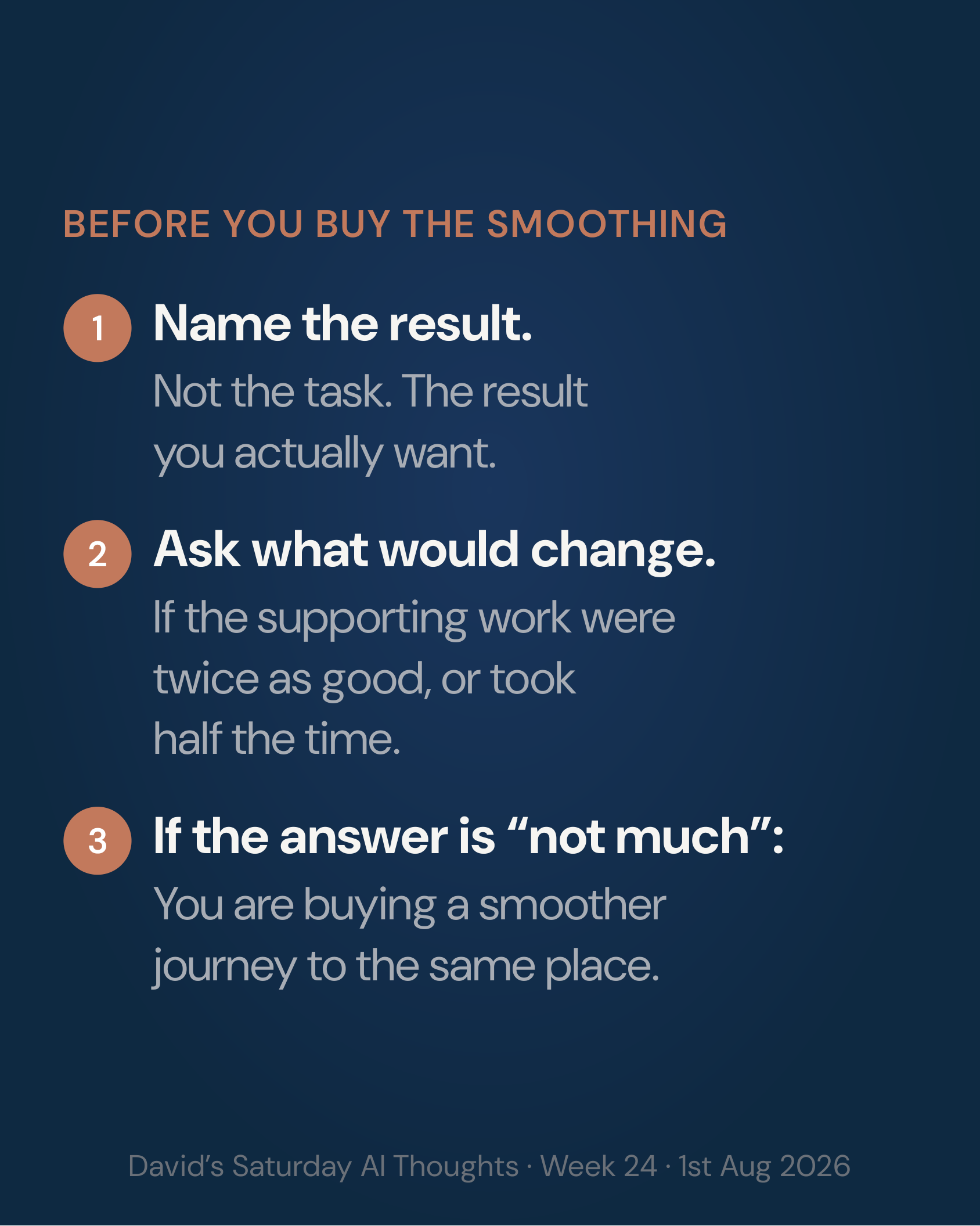
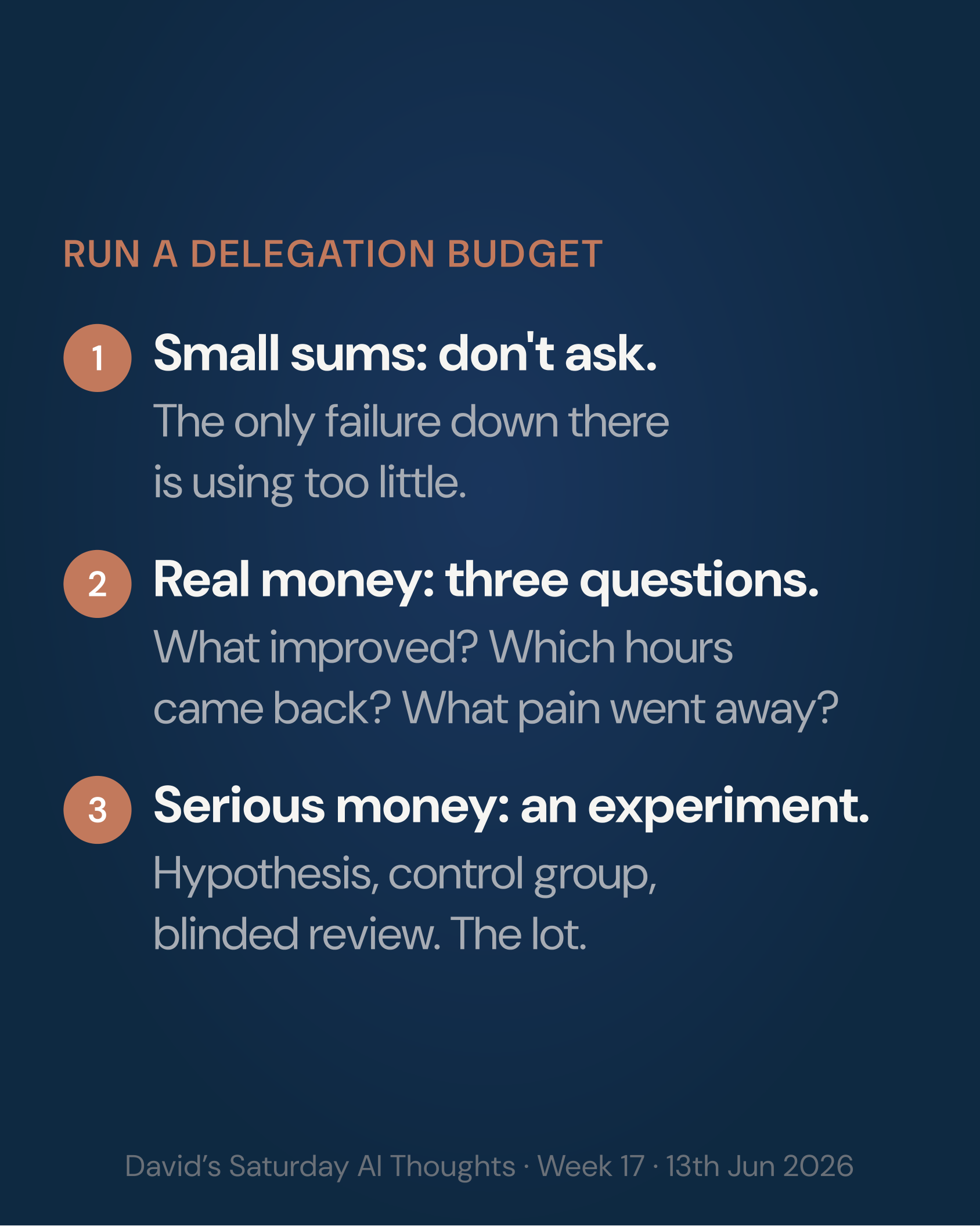
Second, give everyone a 'delegation budget' and run it the way you run their other expenses: trust, plus the occasional question. There have only ever been three reasons to fund delegation: the work comes back better, it comes back quicker, or whoever handed it over is happier. So manage the budget in three zones. Small sums: don't ask. The only failure down there is using too little, and the floor already polices that. Real money: a monthly answer to three questions, a simple form and five minutes of the one-to-one. Better: what improved, what exists now that didn't? Quicker: which hours came back, and what did you do with them? Happier: what pain went away? Buying happiness is fine if you know that's what you bought. Serious money: a proper experiment, with hypothesis, control group, blinded review, the lot.
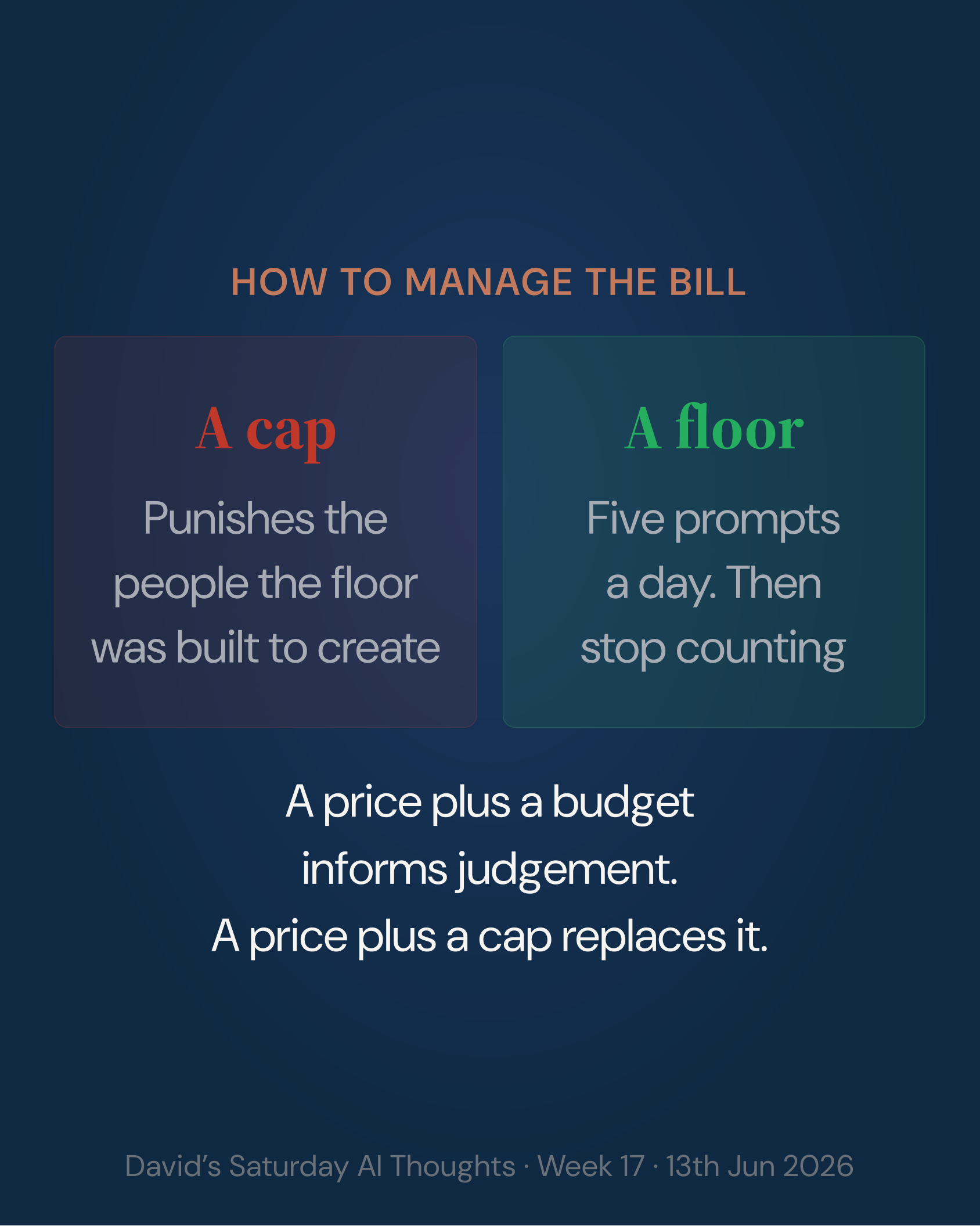
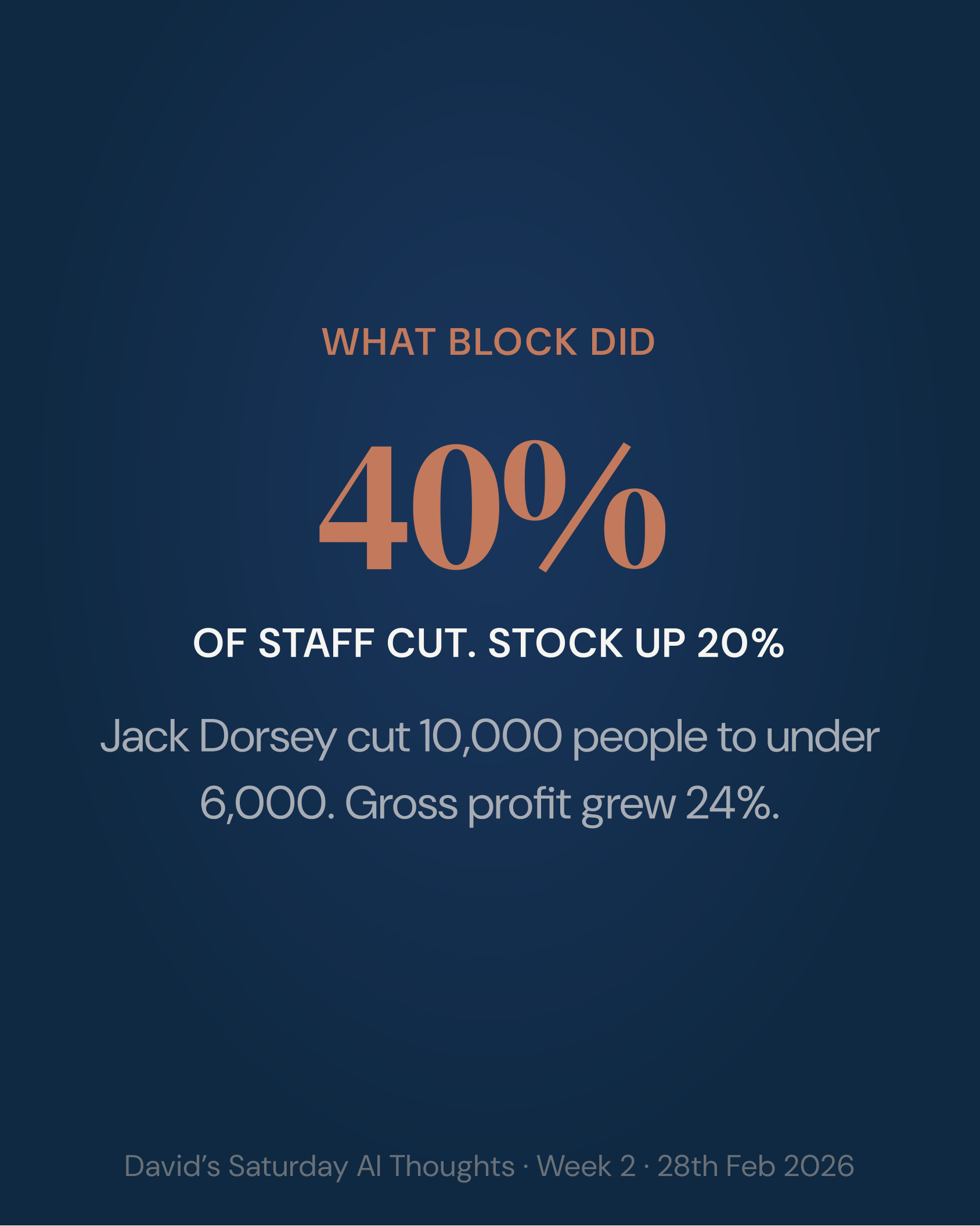
A cap does none of this. (Keep a circuit-breaker against runaway automations. That's wiring.) Nobody would expense a million pencils when they needed just one; if they did, a tough conversation would surely follow. The technology for managing spend is hundreds of years old: norms, visibility, the occasional tough conversation. All a cap adds is a ceiling below what the tools make possible, and the person absorbs the gap between what's expected of them and what's allowed. It punishes exactly the people the floor was built to create.
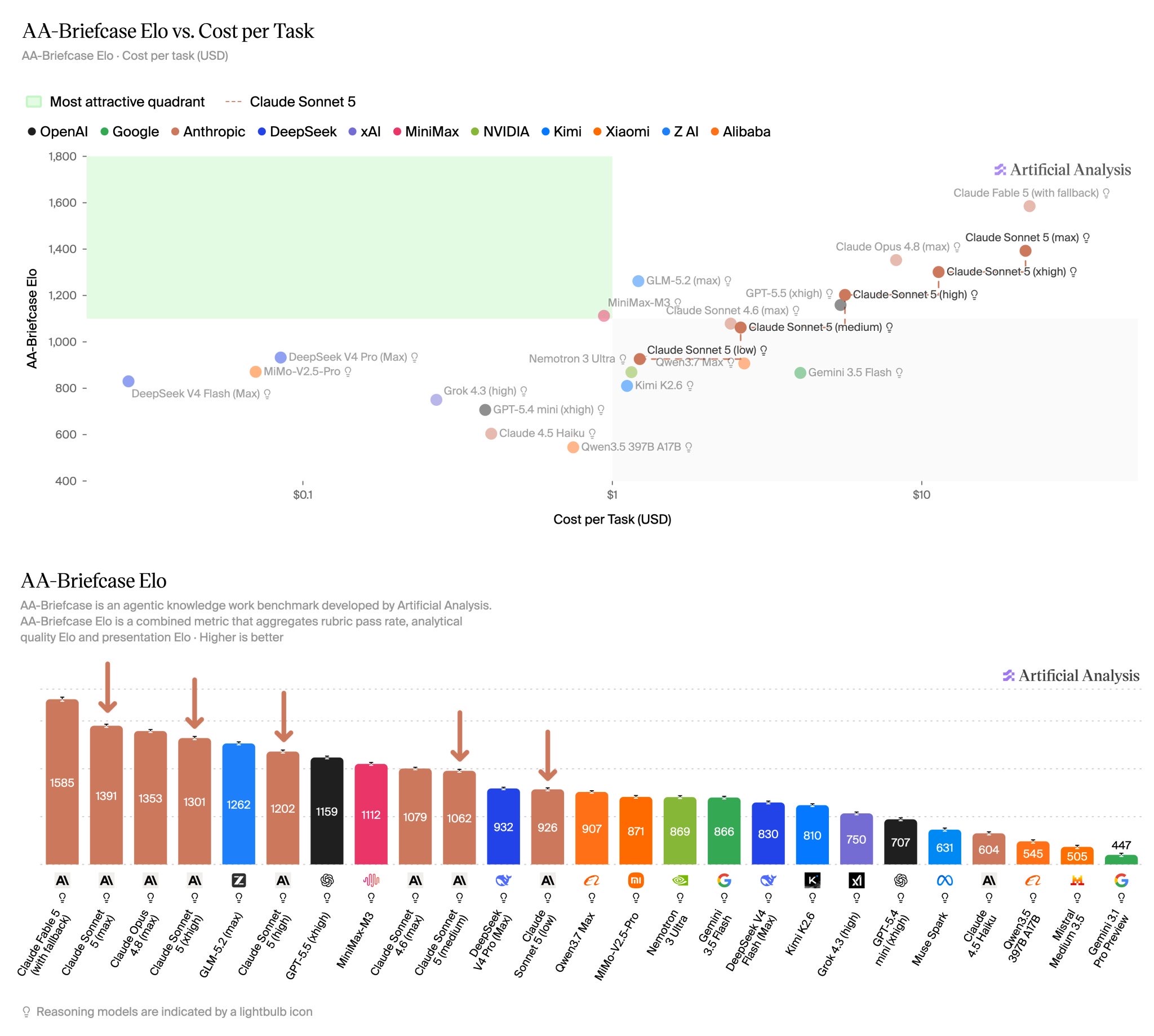
The meter is already doing damage at the top, even without a cap. One of the strongest users I know often picks the weaker model for their most important work. Their seniors have said spend whatever it takes; the meter still makes them flinch. It's a false economy: the cheap model's mistakes read as fluently as its right answers, so each costs real time to find and unpick. They've moved some work to a rival tool purely because it shows no number, and a colleague routes the routine tasks to flat-rate subscription apps for the same comfort. A meter doesn't cut consumption; it moves it to wherever it can't be seen, the one place nothing can be learned from it. The number itself is innocent: shown slides at $2 each, one builder began asking which internal drafts deserved to be slides at all. A price plus a budget informs judgement; a price plus a cap replaces it.
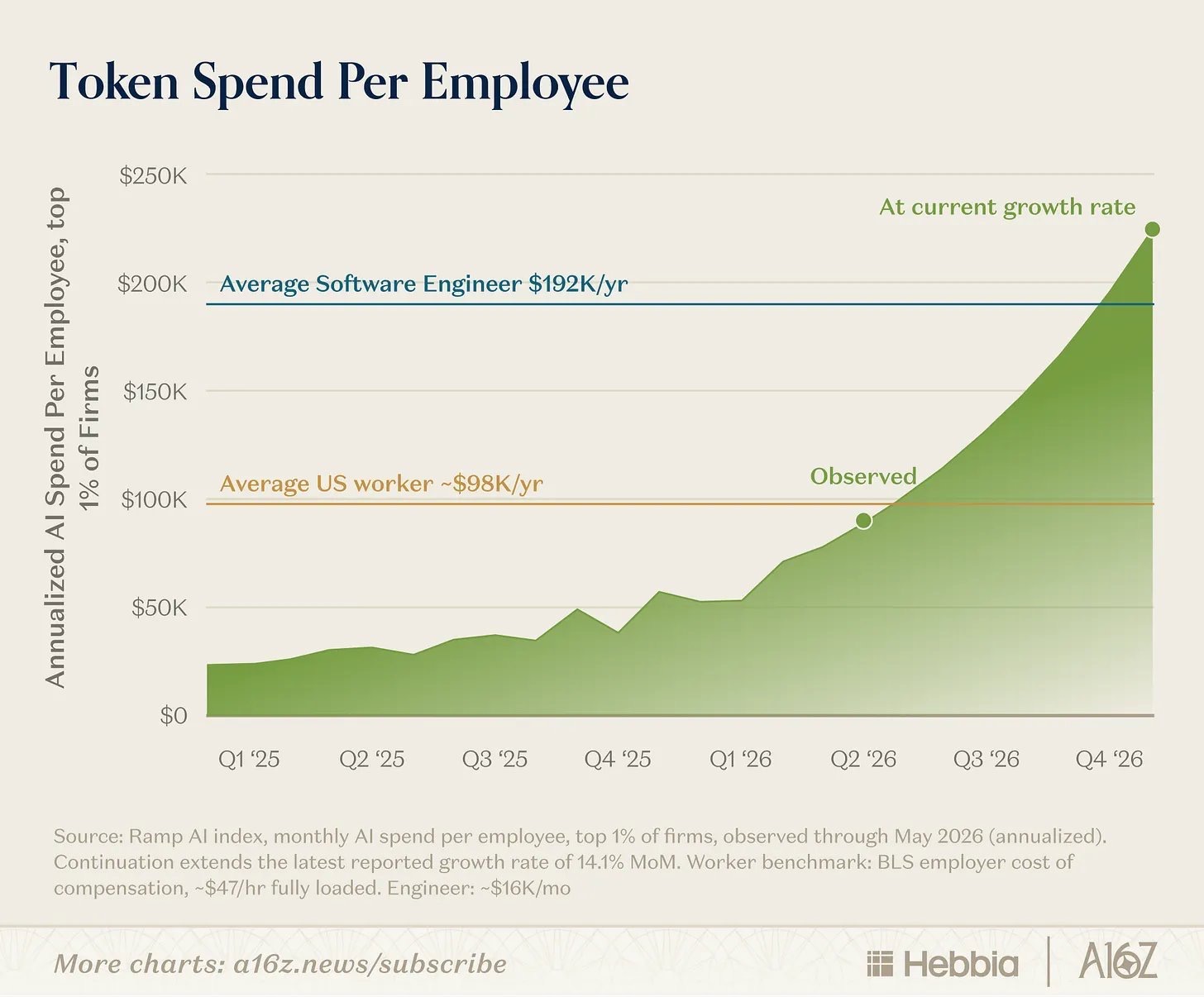
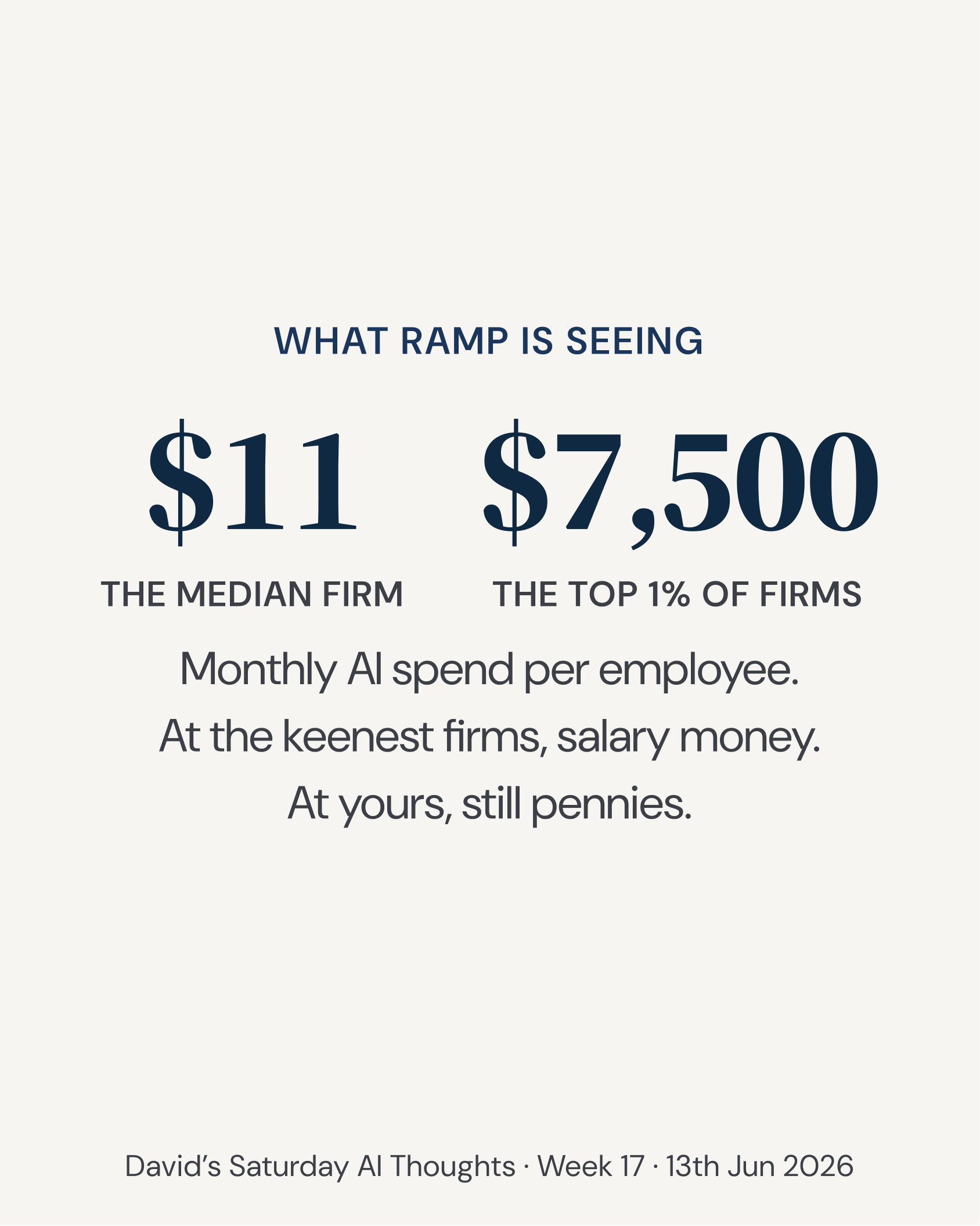
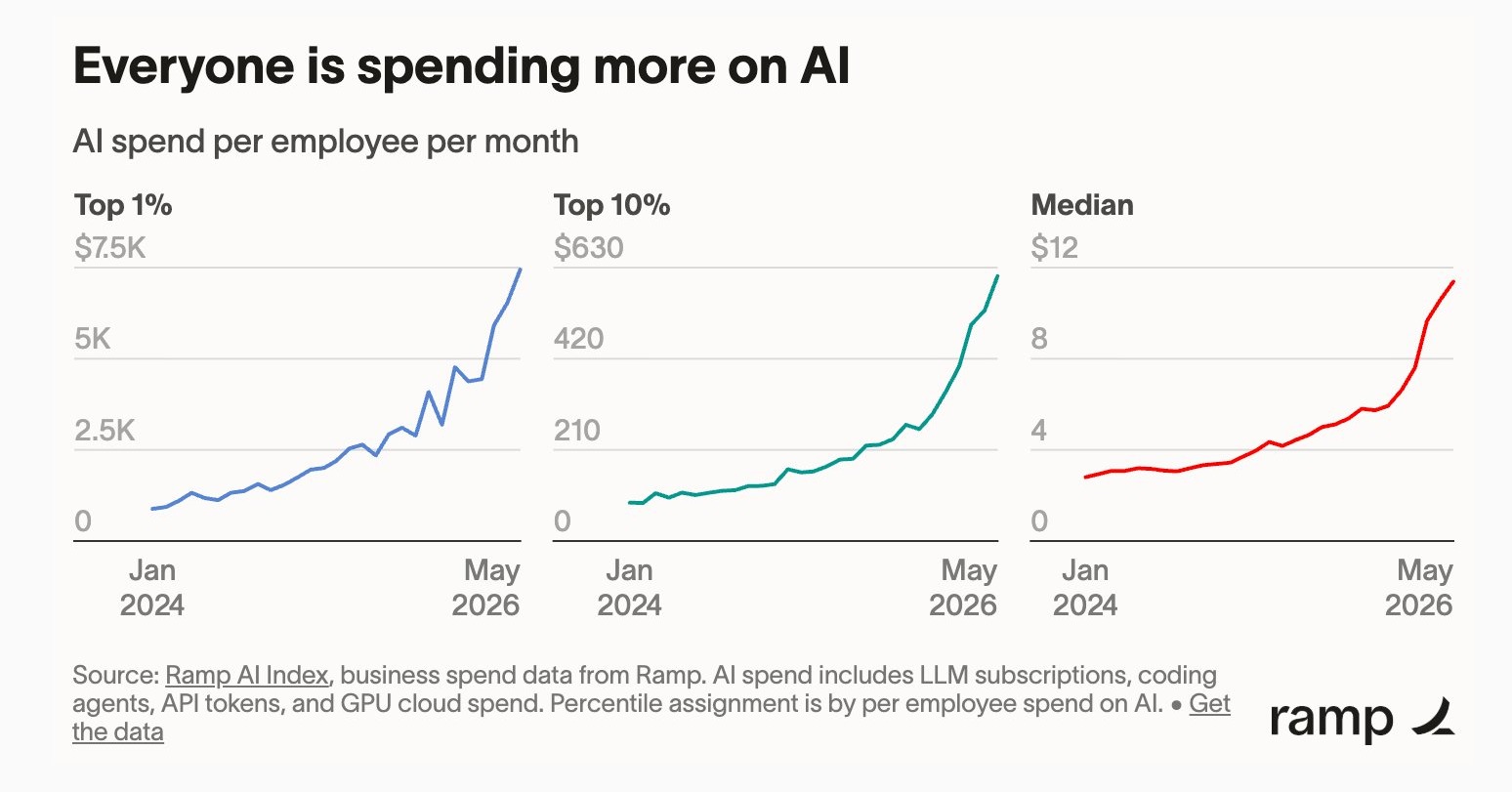
What's the right budget? I don't know yet. Nobody does. Ramp, a spending platform, finds the median firm spends $11 a month per employee; the top 1% spend $7,500, approaching half an engineer's pay. Both numbers are rising. Jellyfish, which measures engineering work, finds the heaviest users it tracks ship roughly twice as much as typical ones, on ten times the tokens. The return per token falls. But ten times the tokens is about $700 a month, and doubling an engineer's output is worth twenty times that. So study your heaviest spenders with curiosity rather than suspicion, and ask what they're buying. I sat down with two of the heaviest I know this week. Neither is bingeing; both run portfolios: the dearest model where their own judgement is the bottleneck, fixed-price tools for the routine. Their answers should drive your budget policy.
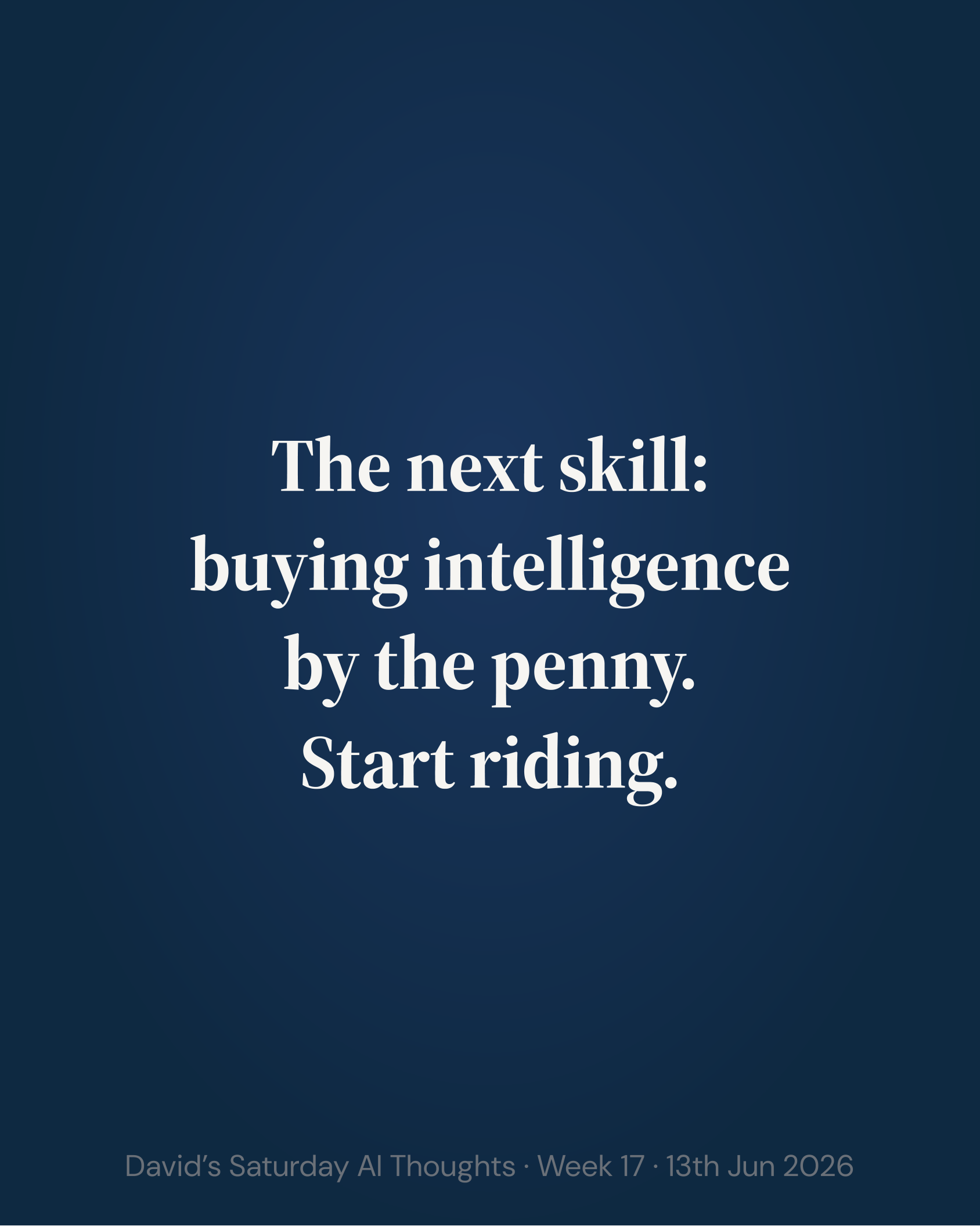
We spent a century buying outside help in big lumps: a hire by the year, a contractor for a few thousand, an agency for tens of thousands. Inside a team you could hand someone an hour's task; buying one in was never worth the finding and the briefing. That unit has now collapsed to pennies, ten pounds, a hundred. The strongest users already convert between the currencies. One proposed the swap unprompted this week: two days less of a junior colleague allocated to their project in exchange for being able to use the best model themselves throughout. Another finds they no longer need the allocated junior at all. At the keenest firms the AI bill per person is already salary money; at yours it's probably still pennies. The next management skill is buying intelligence by the penny, best learned while mistakes are cheap. Start riding.
Three things worth knowing
1. One activist letter froze a board's AI workspace overnight. The doctors are next.
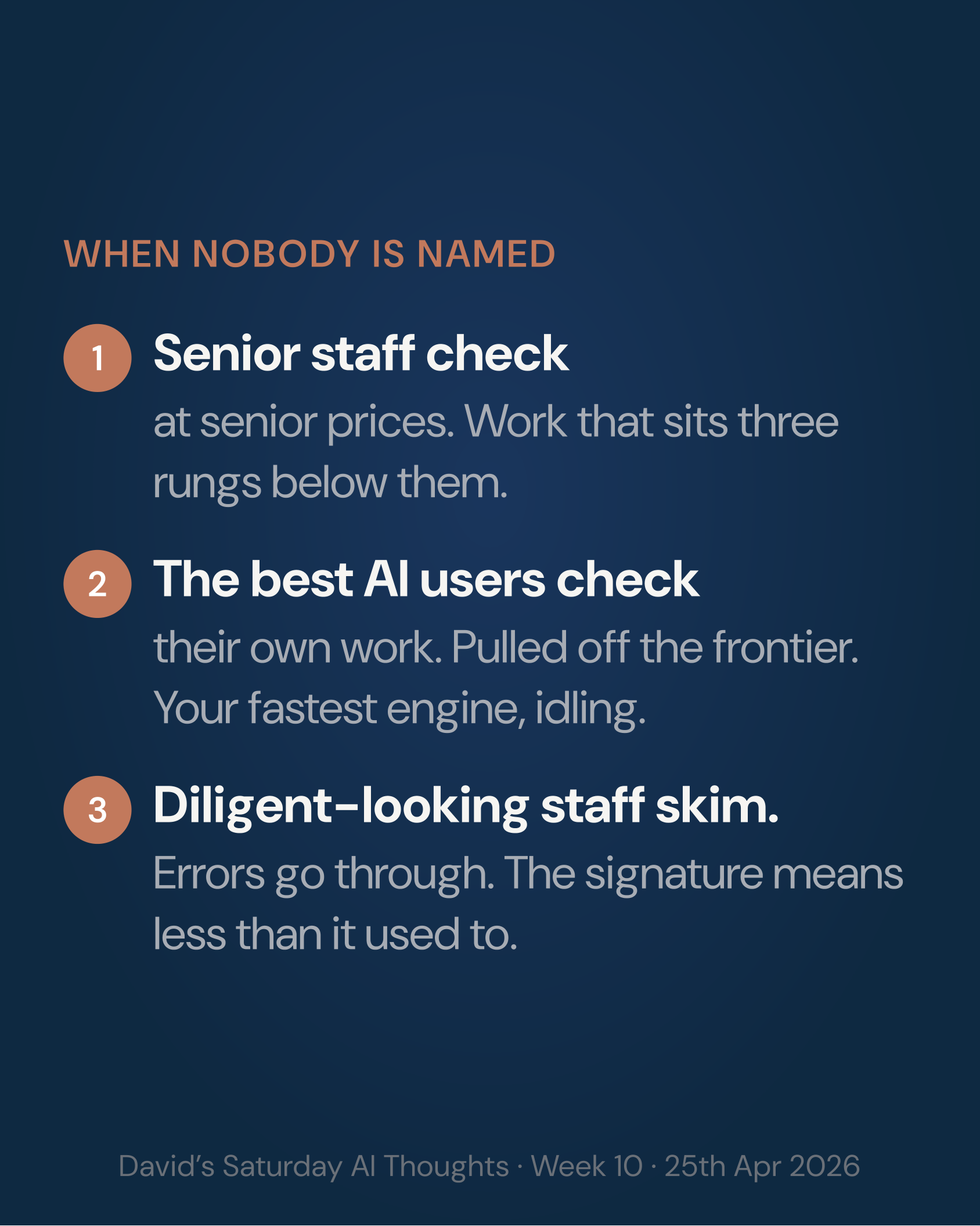
I helped a hundred non-executive directors with AI this week. One told me about a board whose workspace went dark the morning an activist investor wrote in asking for its contents to be made discoverable. Two-thirds of directors now use AI for board work; barely a quarter of executives call their board highly fluent, per the Conference Board's April survey. The Medical Protection Society, which defends clinicians against negligence claims, warned this week that doctors and the NHS could be sued over mistakes made by AI tools, with the clinician left as the "liability sink" for the technology's errors. Its report wants AI reclassified as a product under the Consumer Protection Act 1987, so liability flows to developers. The frontier of AI governance is moving from "can the data leak" to "who owns the answer when the model is wrong". Our policy, that every output is checked, edited and owned (CEO'd) by a human, answers that question. The letters will keep coming, and the writs will follow. The only good answer to both is a name.
2. Meta built a "second brain" that 63,000 staff installed in three months. It started with one person.
Meta's analytics team reports that an internal AI tool one of its data scientists started has now been installed by 63,000 employees, a number reached in three months. No top-down mandate, no transformation programme. One person built something useful and the rest of the company found it. What are you doing to encourage and enable this at your firm?
3. When cheap models do make sense.
Ethan Mollick, a Wharton professor, argues for hierarchies in which smart models supervise cheap ones: the smart one checks the plan, the cheap one does the volume. Right for machine pipelines running thousands of low-stakes calls. For your own judgement work, this week's essay argues that you should buy the best; the maths of time saved is the reason.
1. Ask the AI to write the marking scheme before it writes the answer.
Ben Yoskovitz, a non-developer who ships production software with AI, wrote this week about how he stops the model declaring something done before it's actually done. Before any non-trivial task, he asks the AI to write three to five specific pass-or-fail checks for the work. He approves them. The AI then does the job, grades itself against each check, cites the evidence, and stops the moment one fails. The discipline costs ninety seconds and saves the long loop of "looks good" followed by "wait, no it isn't".
2. Plan in one session, then start a fresh one to build.
Tiago Forte, the productivity author, wrote this week about treating the first AI session as planning-only when the goal is a concrete document or deck. Work out the brief in chat one. Don't let the model start drafting. Then open chat two, paste the brief, and build from there. Three things happen. Long sessions accumulate irrelevant context and quietly degrade, so a clean start gives you a sharper model. The deliberate stop forces you to ask whether the brief actually holds together. And if the second session crashes, you've still got the brief.
3. Keep your AI project lean.
In a training I ran, someone asked why their Claude project had got slower over a few weeks. They'd been adding reference files to it. The model reads everything in a project on every request, and once it's getting crowded the answers go duller and the replies take longer. Two habits help. Book fifteen minutes on a Friday to prune, the way you'd tidy a desk. And never leave fat PDFs in there. Ask the model to convert each one to plain text first. PDFs burn far more of the model's time and reading capacity than the same content as text, and the conversion takes a minute.
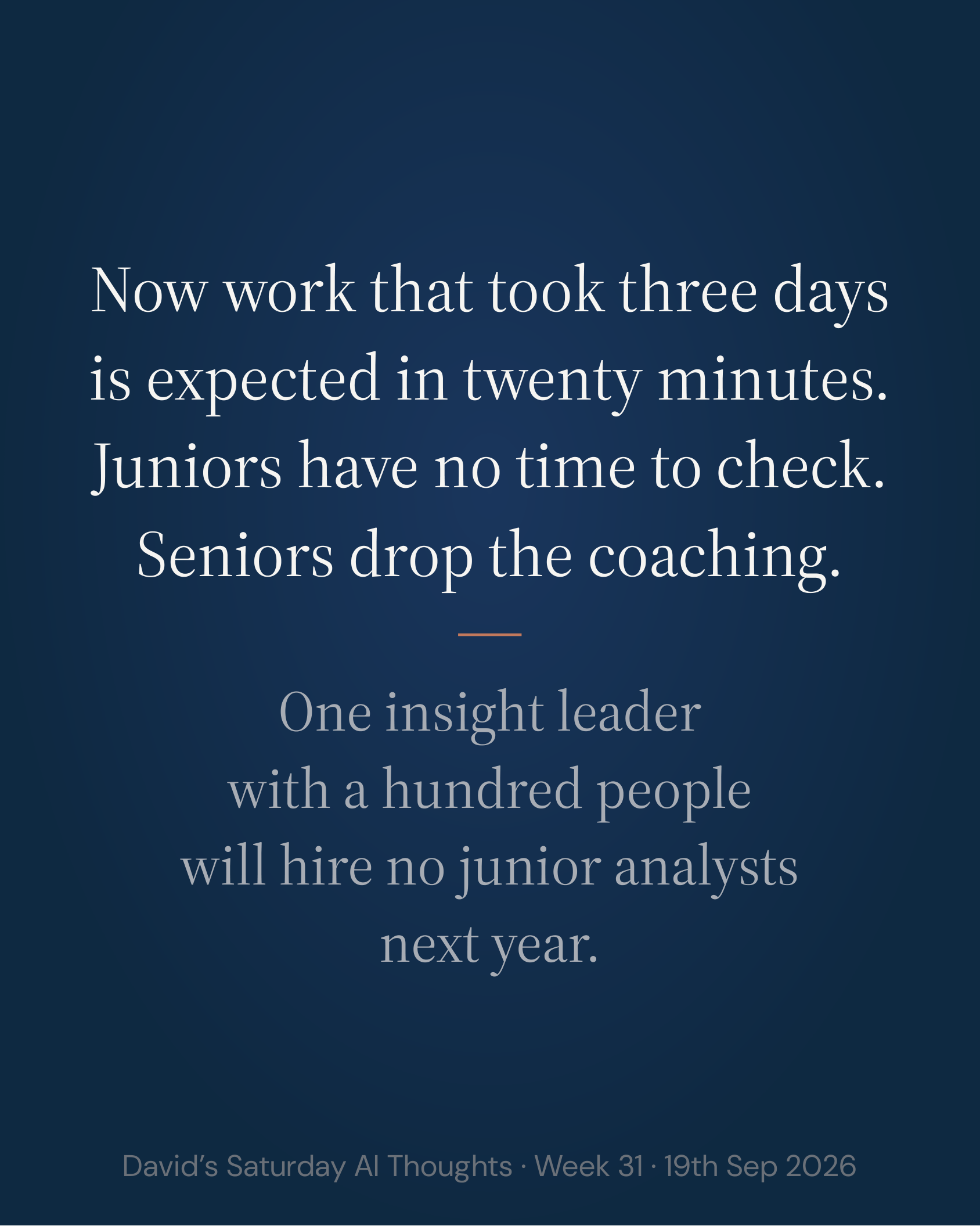
A senior leader who hires dozens of graduates a year sharpened the tension. If junior work disappears, where does the next generation of senior judgement come from? Training, this reader argued, must become more deliberate, not less. People may need to go "back to the stone age" before being handed the tools of modern warfare. A partner thinking about what cheaper expert work does to demand pushed it further: work itself is changing, so the question is which work belongs to the machine and which belongs to the human. A reader in music offered a longer view: in the 1970s, directors in their late twenties were common, but the pyramid has since inverted. The awkward part: is "sitting on Claude in suburbia" really the best use of one's early twenties? Full reader reactions online →
And a request: Ethan's first project is researching the impact of AI on graduate hiring, for a report he'll publish. If you have insights or data worth including, would you like to contribute? Just reply and I'll connect you.
The community's been busy on LinkedIn too, and the thread this week runs close to the essay: the tool's the cheap part, the judgement around it is the job. Maani Safa, CEO of Poppins Agency, an innovation-led creative shop, listed ten AI tools most people haven't tried and then landed the point: "The advantage was never just the tool. It's knowing which one to reach for, and having the taste to use it well."Mike White of Lively, a marketing agency, who advises mid-market CEOs on growth, says the smartest operators he knows have stopped describing AI as a system and started describing it as a worker: set up properly, owned by someone, expected to account for itself. And Henry Coutinho-Mason, the futurist behind The Future Normal, a book on near-future trends, would point it at the messy middle of innovation: it won't give you the spark, it can't do the final polish, but it'll flesh out more early ideas than you ever had time for. More online →
The richer version of this week's three Try-Thises, with copy-paste prompts. Each prompt has a Copy button - click and paste into your AI of choice.
1. Ask the AI to write the marking scheme before it writes the answer
Drop this into Claude or ChatGPT at the start of any task where you want the AI to check its own work rather than declare it finished. It works for writing, analysis, code, slides, research summaries. You approve the checks, then the AI grades itself one criterion at a time and stops on the first failure.
I'm about to ask you to do this task: [the task].
Before you do any of the work, write three to five specific pass-or-fail checks I can use to tell whether the finished output is actually good. Each check should be concrete enough that you and I would agree on the verdict. No vague criteria like "clear" or "useful". Something I could grade objectively.
Show me the checks. Wait for me to approve or amend them.
Once I've approved them, do the task. Then grade your finished work against each check, one at a time, in order. For each check, cite the specific evidence in your work that supports the pass or fail verdict.
If any check fails, stop. Don't paper over it. Tell me which check failed, why, and what you'd need to change. We'll decide together whether to fix it or whether the check itself was wrong.
2. Plan in one session, then start a fresh one to build
This is what you paste into the SECOND session, once you've planned in the first. Copy the brief you worked out, paste it in, and let the new session build cold. It won't have any of the meandering context from the planning chat, so it stays sharp.
Here is the brief I worked out in a separate planning session:
[paste brief]
Start fresh. You haven't seen any of my earlier thinking on this. Build the [document / deck / analysis / artefact] from this brief alone.
If anything in the brief is ambiguous or contradictory, ask me before guessing. If anything is missing that you'd need, name it and stop.
When you're done, tell me what you built and where it is. Don't summarise the brief back to me.
Variant for a research task, where the second session does the gathering rather than the building:
Here is the research question and scope I worked out in a separate planning session:
[paste brief]
Start fresh. Do the research. Gather what's relevant, weigh it, and write me a one-page synthesis. If you find the question needs reframing once you've started looking, say so before you go further.
3. Keep your AI project lean
Two prompts. The first turns one fat PDF into clean text you can drop into your project instead.
Here's a PDF that's currently in my project. Read it carefully and write it back to me as plain text or markdown.
Preserve the structure: headings, sections, lists, tables. Don't lose any detail. Don't summarise. The goal is a faithful conversion that I can swap in for the PDF, so the project takes up less of your reading budget without losing any of the substance.
If anything in the PDF is genuinely unclear (an image, a chart with no caption, an unreadable scan), name it rather than guessing.
The second is the Friday-prune audit: it asks the AI to look at what's in the project and tell you what to cut or convert.
Audit the files in this project. Tell me:
1. Which files look stale, in the sense that they cover something we're no longer working on or have been superseded by something newer in the project.
2. Which files look like duplicates or near-duplicates of each other.
3. Which files are PDFs that would be much smaller as plain text, and which of those are worth converting.
4. Which files you find yourself rarely needing when answering my questions in this project.
For each, recommend prune, convert, or keep, with one line of reasoning. I'll decide what to action.
The most capable model ever made went on sale Tuesday. By Saturday the US government had pulled it.
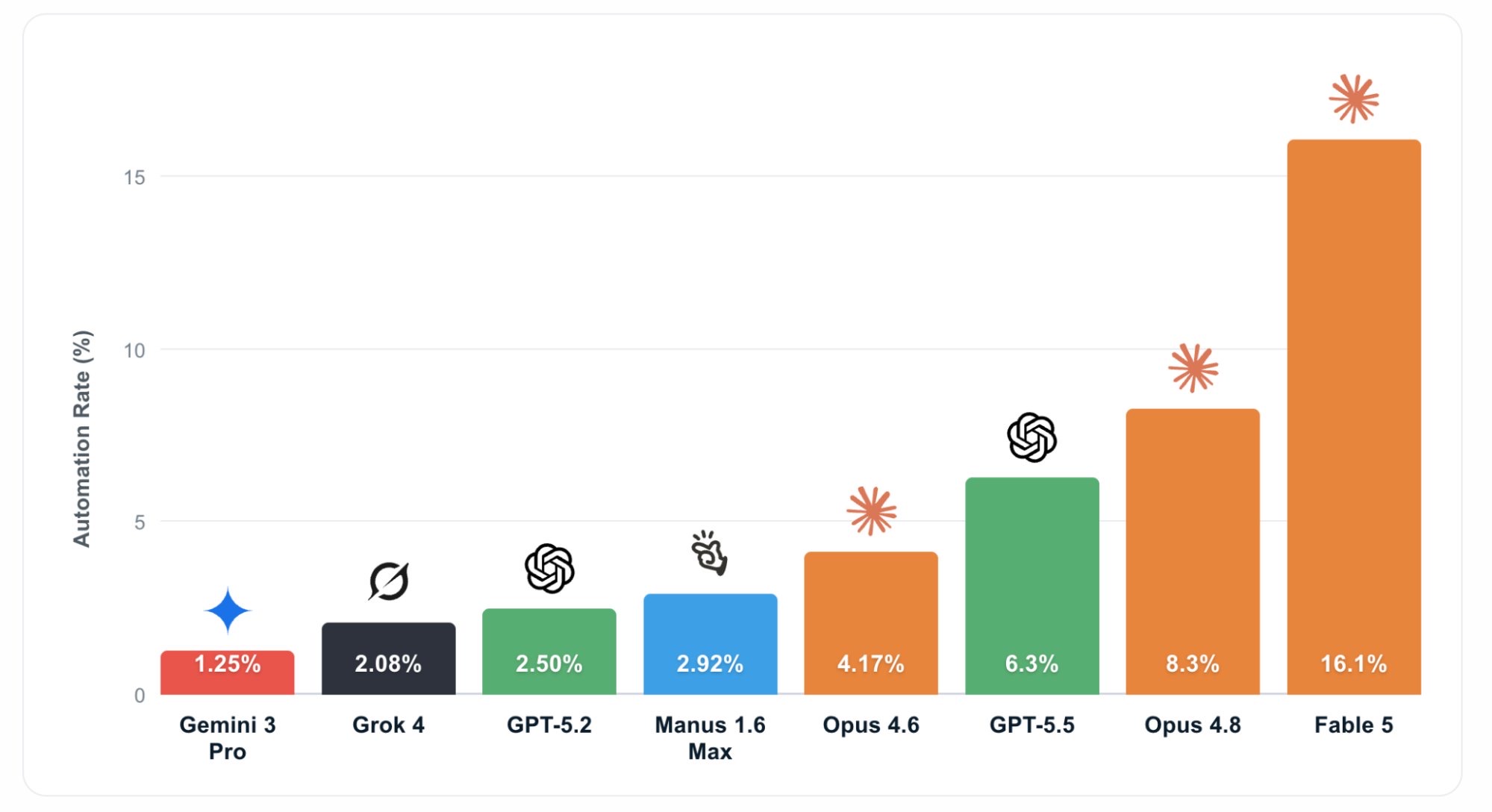
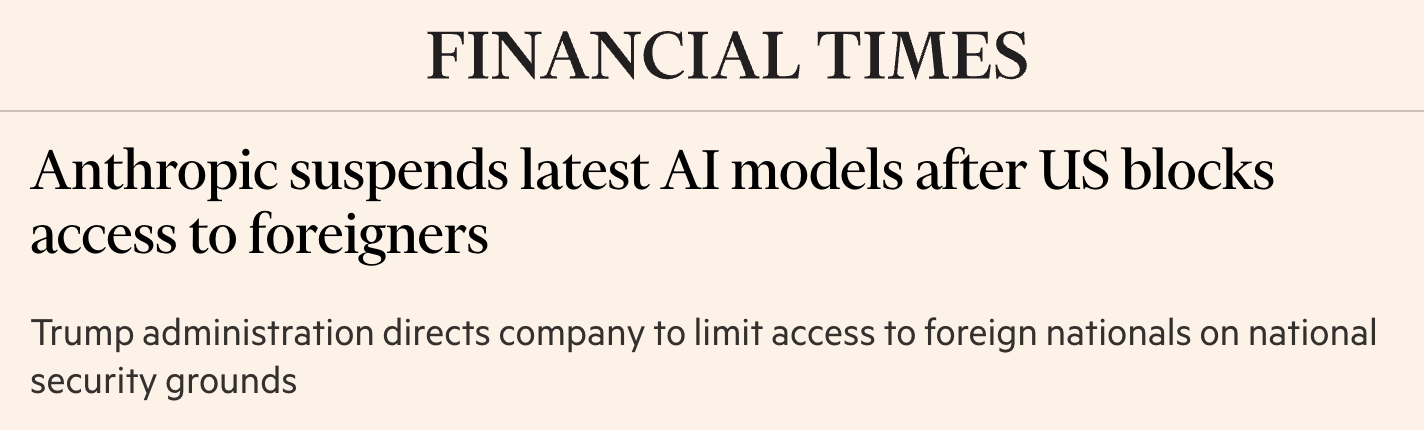
On Tuesday, Anthropic released Fable 5, the most capable model it has ever shipped. By this morning it was gone. A US government export-control directive barred foreign nationals, anywhere, from using Fable 5 or Mythos 5; rather than carve up its customers, Anthropic suspended both models for everyone while it contests the order. The stated trigger was a "narrow" jailbreak in which the model reads a codebase and fixes its flaws, which is roughly the thing that makes it useful. One widely shared analysis reckoned that, applied to every frontier lab, this leaves American models unsellable abroad, locks foreign staff out of their own products, and hands China the lead. I will let others judge that. I can tell you I had enormous fun with Fable 5 this week, spent five to six thousand dollars of API credits putting it through real work, and found it comfortably the most capable model I have used. Older Claude models are unaffected.
The safety hawks wanted a brake on frontier AI. This week they got one, just not the way they pictured it.
For three years the loudest voices on AI safety, Max Tegmark, the MIT physicist, among them, argued someone should be able to halt a dangerous model. Anthropic itself set out the conditions under which it would pause, and OpenAI's Sam Altman called for a body empowered to slow frontier development "when needed". This week the brake got pulled, just not by them: the US government switched a frontier model off (above). One widely shared post caught the whiplash, noting that Anthropic's own chief executive had argued days earlier that government should be able to block a model's deployment, and that the reaction when it actually happened was, roughly, "not like that". Be careful which brake you ask for.
Investors are quietly buying companies an AI can't run.
The Information's Dealmaker desk flagged a new trade this week: initial public offerings of physical-world operators a language model can't touch. Zum, the school-bus firm backed by the venture firm Sequoia Capital, has grown revenue 35% to $333m, turned profitable and is now interviewing banks. Nabeel Hyatt of Spark Capital, another venture firm, and himself an investor in Anthropic, the AI lab, put the logic in one line: "It's very unlikely that an Anthropic will run a bus company." The AI-proof hedge has become a thesis.
Palantir's Alex Karp tells executives to stop bragging about job cuts.
Alex Karp, chief executive of the data-analytics firm Palantir, said on a tech podcast this week that anyone publicly touting they've fired two-thirds of their staff might as well sign up for the Bernie Sanders manifesto. Roughly 117,000 tech job cuts have been logged in 2026. Karp accepts the displacement is real. The boast, he argues, is a political own goal: every layoff press release hands ammunition to the next regulator, the next presidential primary, the next union drive. Coming from Palantir, of all places, that lands.
Cognition has written a $10m performance warranty on Devin.
Evan Armstrong, who writes the tech-business publication The Leverage, reported that Cognition, the firm behind the AI coding agent Devin, will now fund an enterprise customer's usage up to $10 million if Devin delivers less engineering value than the customer paid for. The measure is an "estimator agent" that scores every Devin session against its human-hours equivalent. Armstrong reads it both ways. Bullish: the company is putting its own money on the line, which no vendor has done before at this scale. Bearish: the product may be so unproven that no outside insurer would underwrite the same promise. Outcome-based pricing has arrived at the frontier, with the vendor wearing the risk.
The firm selling AI judgement shipped a report full of hallucinations.
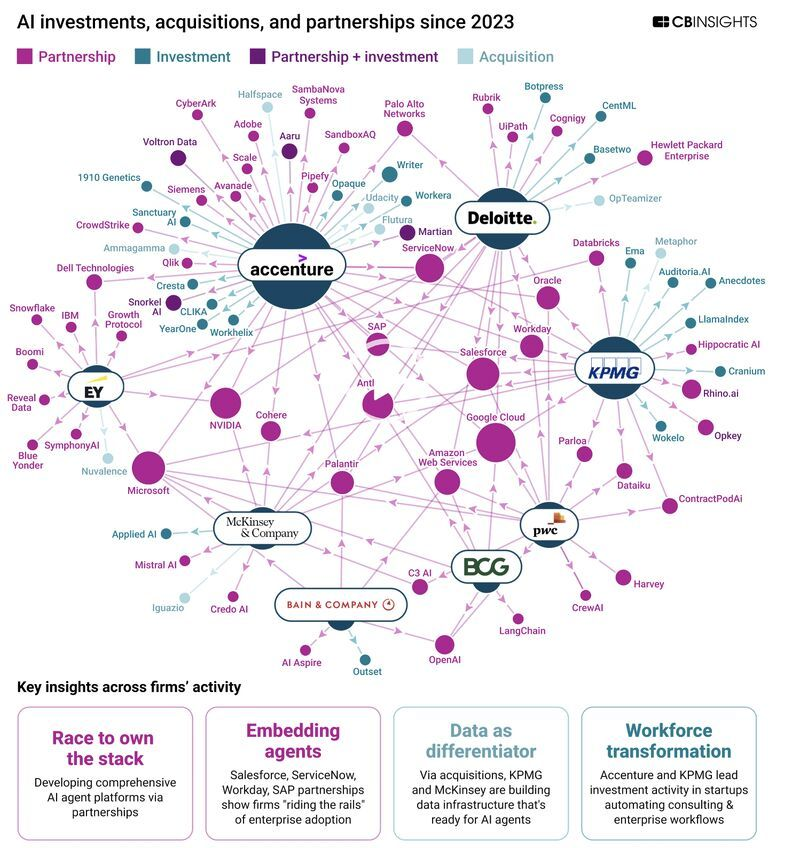
KPMG has pulled a flagship AI report, "Total Experience: Redefining Excellence in the Age of Agentic AI", after the detection firm GPTZero found that only five of its 45 citations matched their sources; it called the rest "vibe citing". Roughly half the report's factual claims were false, unsupported or misattributed. UBS, the investment bank, publicly denied the claims made about its AI rollout, and the report even contradicted KPMG's own CEO survey on a headline number. Every consultancy is racing to sell AI advice. The ones worth paying are the ones whose claims survive contact with their own footnotes.
A Mississippi judge has sanctioned lawyers for hallucinated citations. The count is now near 1,600.
A Mississippi judge this week sanctioned lawyers for filing court documents with AI-fabricated citations, reported by the Mississippi Free Press. The individual sanction matters less than the count behind it: nearly 1,600 documented cases of hallucinated citations in US court filings, tracked by the legal researcher Damien Charlotin. The scale is the point. Hallucinated citations aren't a freak event any more. They're a recurring feature of US litigation, and the courts are settling into a routine for punishing them rather than treating each case as a one-off.
Ethan's first week pulled a fuller postbag than usual, and a sharper one. Most readers wrote in agreement with the door-open hypothesis, but with their own evidence attached. A run of leaders working in advisory and consulting picked up the apprenticeship question and pushed it harder than the email had room for. Two readers from the creative industries asked a different question: not whether to hire graduates, but whether senior people are paying enough attention to what graduates already see.
A request before the letters. Ethan's first project with us is researching the impact of AI on graduate hiring: what is actually changing in entry-level recruitment, who is still hiring, and what the data says. He will publish a report on it. This week's letters carry exactly the kind of first-hand insight he needs, so let me ask you directly: if you have insights, experiences or data on how AI is changing graduate hiring at your firm, would you like to contribute? Reply to the email and I will connect you with Ethan.
A leader at a strategic creative agency
Agreed that culling junior ranks is a category error, and added an instructive twist: the agency is still hiring graduates, but the brief has changed. The skills being recruited for are storytelling, client charm, and curiosity. The grunt that used to define a graduate's first year has gone to the machine, so the role is being rebuilt around the things the machine still cannot do well. They closed with a line they had seen attributed to a chip-industry chief executive, paraphrased: if the only thing you can think to do with this technology is cut costs and fire people, your business deserves to die. It means you have run out of ideas.
A marketing leader in the entertainment industry
Reached for Bob Iger's memoir, where Iger argues that a good leader hires people who can in time replace them, and ran the thought into the graduate question. If senior people will not give younger ones a chance in the first place, the replacement never gets built. They added a question I had not put in the essay. What might we learn from how graduates use these tools, given that their beginner's mind is unencumbered by the way work used to be done? That, they argued, is the asset the rest of us cannot manufacture.
A reader who has worked in music, media and advertising over decades
Made a demographic argument that reframed the question. In the seventies and eighties it was common for people to be director or vice-president in their late twenties or early thirties, particularly in those industries. The demographic pyramid has since inverted. There are now more senior people sitting at the top than the structure can accommodate, so younger people stay in administrative roles for longer. The optimistic reading of the machine, in their hands, is that this could free younger people to lead projects and even companies during the years when they are at their most energetic and creative. The hard part, they wrote, is the awkward post-graduation phase. Sitting in suburbia with a language model is not the same as making the connections that turn a career.
A leader at a research and insight consultancy
Took the essay sideways into a question about process migration. They had recently noticed how many old custom tools, from the previous generation of the technology, they were still keeping alongside their newer ones. There is a low but real cost to that: tokens, context, money, attention. At some point, they argued, housekeeping ought to be a discipline. They put a second question I had not seen framed quite that way. Is there a threshold duration after which a preferred process should be deliberately interrupted, just to check whether something better has arrived in the meantime? If they were still working the way they did six months ago, that would be a problem, not a comfort.
A partner at a professional services firm
Made the cleanest theoretical reframing of the week. Work is not fixed, they wrote, and the question is not how to split a fixed pool of work between human and machine. Work is changing and expanding, so the real question is what is the right work for the machine and what is the right work for the human. They liked the apprenticeship argument and added a caveat from the economics of professional services. As consulting gets cheaper, demand will expand. But the senior capacity that has to oversee the machine-assisted work becomes the binding constraint, and the margin equation does not necessarily survive that. Their tentative answer: accelerate apprenticeship, and hire more laterally from industry to relieve the senior bottleneck.
A reader at a consulting firm who hires thirty to forty graduates each year
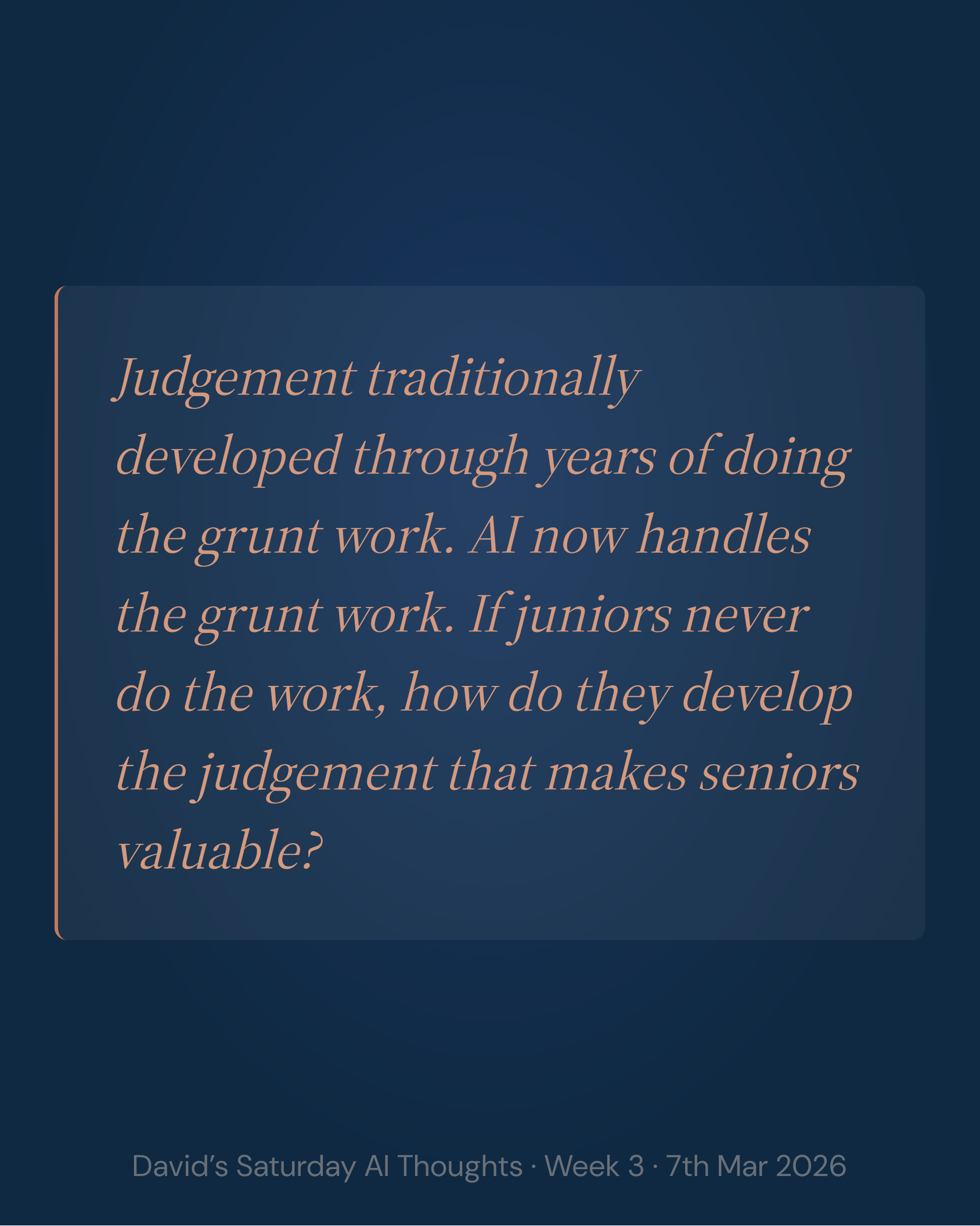
Wrote the sharpest version of the apprenticeship question. If the junior work disappears, where does the next generation of senior judgement come from? And is the machine, in their phrase, managing the graduate as much as the graduate is managing the machine? A graduate may be directing the tool, but they are not yet building the instincts that tell truth from confident hallucination, or insight from polished output. Training, they argued, needs to be more deliberate, not less. People may need to go "back to the stone age" before being handed the modern tools. Good quality control still requires someone close enough to the hypothesis to know what right looks like, and that closeness takes years. The machine has made judgement more important, not less, and that is where the problem now sits.
Several readers wrote in on the wider apprenticeship question without making a fresh argument, broadly agreeing that the pipeline question is the right one and that the moral case for keeping the door open is harder than it looks at the level of any single hire.
What readers were posting on LinkedIn this week. The thread running through them sits close to the essay: the tool is the cheap part, the judgement around it is the job. Six voices, from innovation to insight to strategy.
Henry Coutinho-Mason, futurist and author, The Future Normal
Henry Coutinho-Mason, the futurist behind The Future Normal, a book on near-future trends, thinks most people are reading the AI-apps glut graph wrong. Use AI end to end and you get "generic, undifferentiated, slop-like products". His map: AI won't give you the 0-to-1 spark, and it can't do the final 7-to-10 polish where craft and resonance live, but it's made for the messy middle, fleshing out early-stage ideas past the "good enough to share with colleagues" barrier. Measure it on ideas surfaced, tested and killed, not products shipped. Most ideas die unshared; he's pointing at the tool that gets them into the room.
Mike White, a marketing and growth advisor to mid-market CEOs at Lively, a marketing agency, has stopped explaining AI through frameworks. The smartest operators he talks to "have stopped describing AI as a system. They're describing it as a worker." The intelligence, he writes, "doesn't arrive ready-made. It has to be built", by a specialist who sets it up and someone inside the business who owns it day to day. Take the worker framing seriously and the rest follows: you'd onboard it, budget for it and expect an account of what it did with the time.
Maani Safa, CEO of Poppins Agency, an innovation-led creative agency, listed ten AI tools living at the edge of the conversation, most of them free, many beating the household names at specific jobs. The list is useful; the last line is the keeper: "The advantage was never just the tool. It's knowing which one to reach for, and having the taste to use it well." Taste doesn't show up on the bill, and it's the only line item that compounds.
Dom Wong, co-founder and CEO of Pogo, a consumer research platform built on a purchase-verified shopper network, launched this week with $32m raised and a blunt opener: "The dirty secret about consumer research? It's overrun by fraud." Pogo points AI-moderated video interviews at verified buyers of a specific product, thousands at a time, and returns findings in hours. Worth noticing what gets scarce when fieldwork stops being the constraint: knowing which question is worth asking. The interviews are about to be the cheap part.
Helena Kosinski, Vice President at Luminate, the entertainment data company, and chair of MusicTech UK's advisory board, came back from SXSW London with one thread pulled tight: culture's funding problem is "a lack of language, not a lack of intent". An urban regeneration panel said planners and financiers have no shared framework for culture's value; the launch of the Sound Investments report her team wrote heard the same about music tech, a capacity issue in the knowledge of the industry. The money exists. The translation layer doesn't. Whoever writes that vocabulary ends up directing the capital.
Hugh Derrick, an executive coach at eatbigfish, the strategy consultancy known for challenger-brand thinking, summed up a panel on how strategy survives the organisation in one image: the best strategists are cat-herders. His line: "The real job of a strategist isn't to own and protect their personal articulation of the strategy but to help others build a strategy that they feel like they own." Go short or go home; sell to the heart, persuade in the appendix. A strategy people own outruns a sharper one they don't.
Note: this is a longer version of the essay than the one sent in the email.
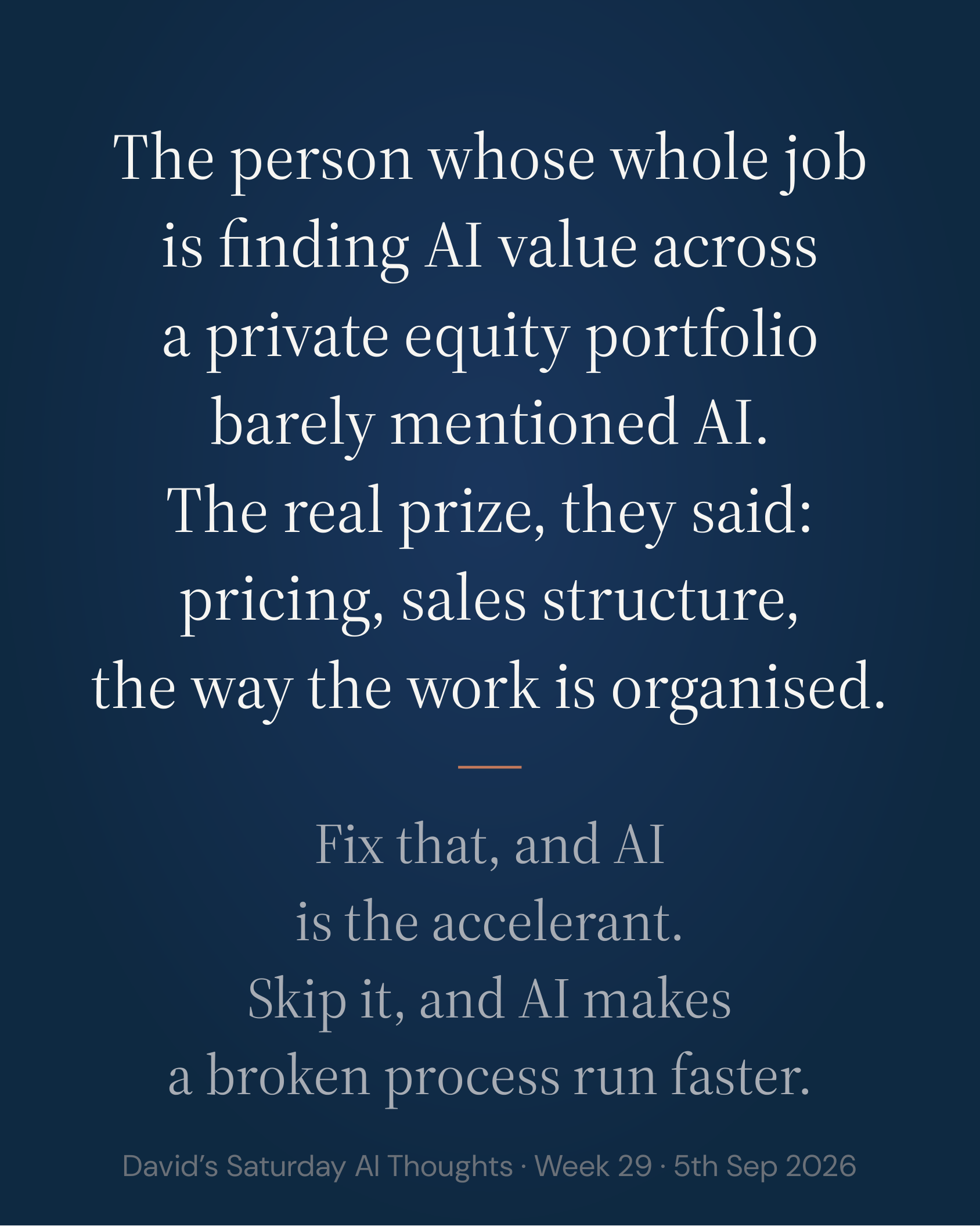
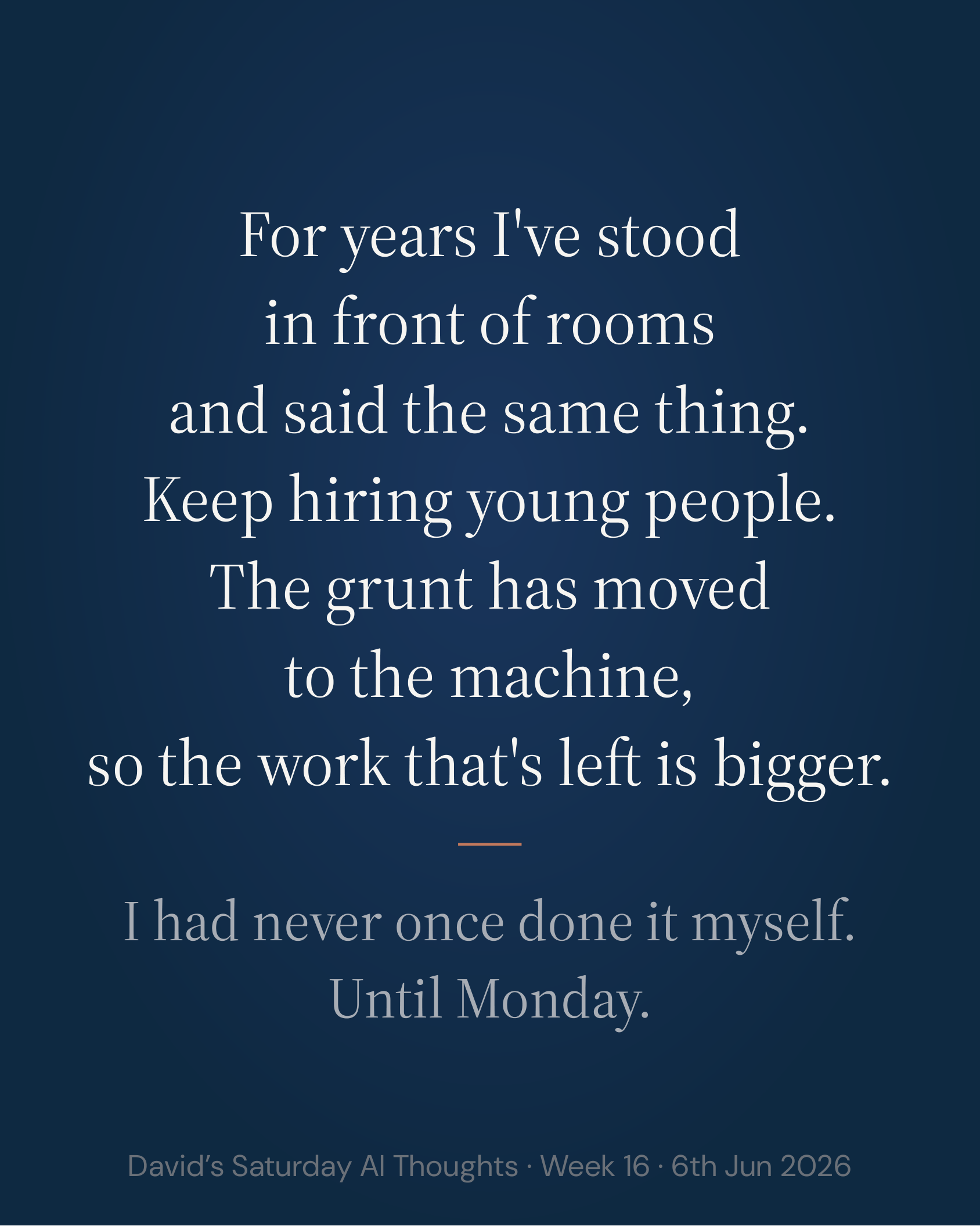
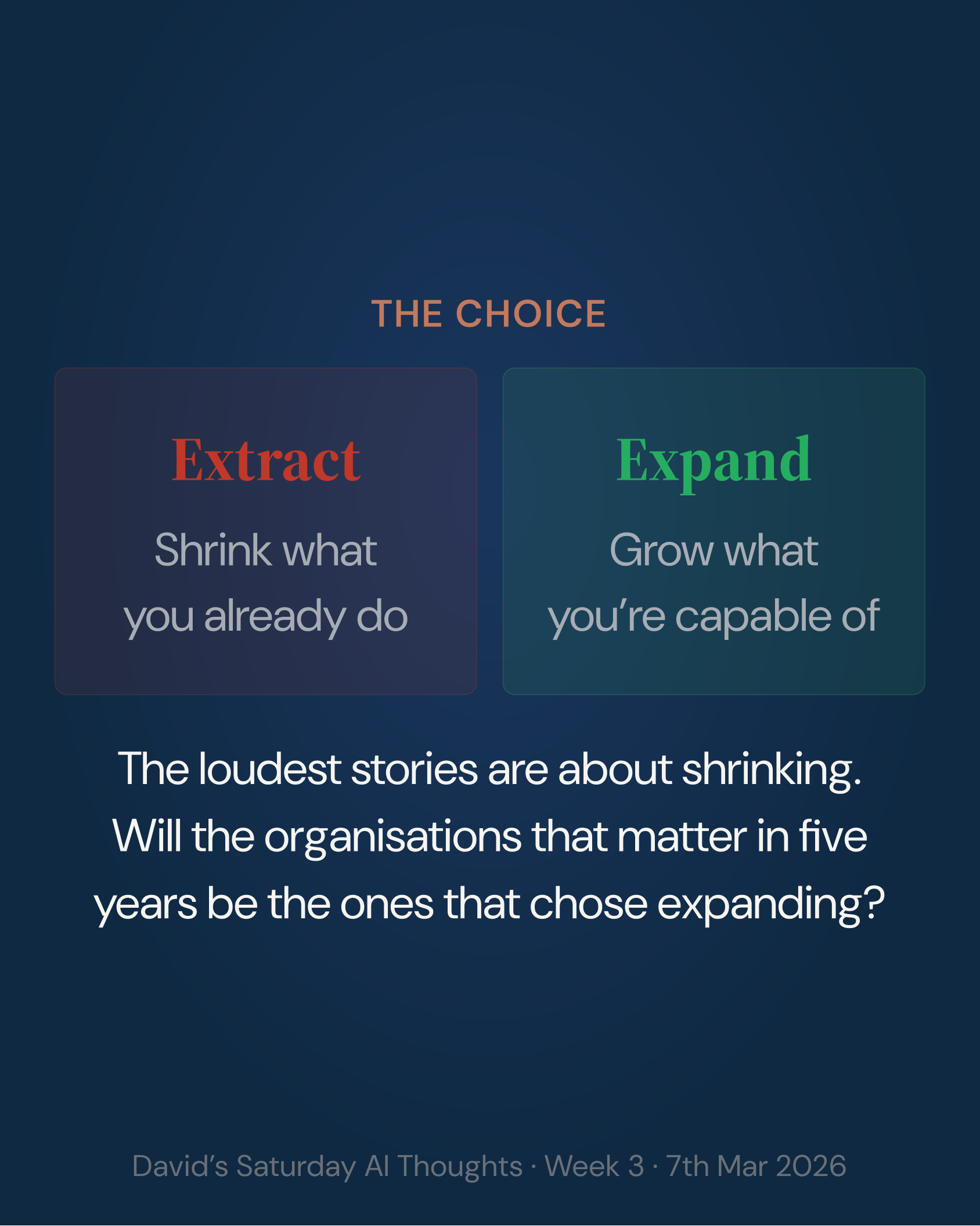
For years I've stood in front of rooms and told them the same thing. New graduates on their first morning. Hiring managers by the hundred. Boards. The grunt work has moved to the machine, I say. The work a junior used to do is now done in seconds. But the work that's left is bigger, so keep hiring young people and train them to do it. With these tools they can do more than any graduate before them. Better work, quicker.
I had never once done it myself.
Until Monday. His name is Ethan, and he's working for me for his placement year.
Plenty of people tell me I'm wrong. If a senior with these tools can do the work, why carry a graduate at all? It's a fair question. I have a view. But there are two ways to settle a thing like that. Pontificate, or run the experiment. I've always favoured the experiment. (Aged eight, I ran one to find out whether Father Christmas was real. I won't reveal the result, out of respect for any reader yet to test it for themselves.) Ethan is the experiment.
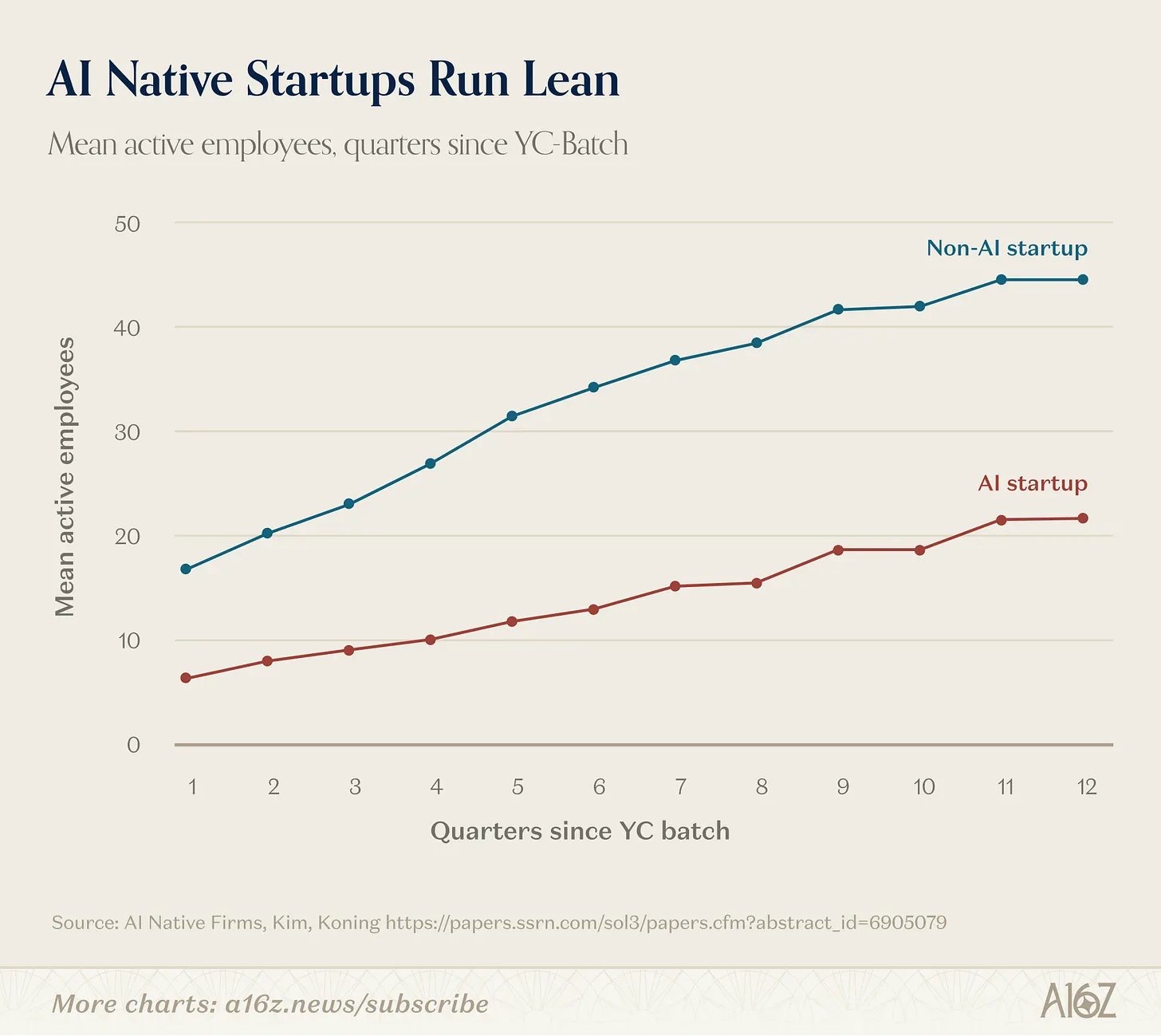
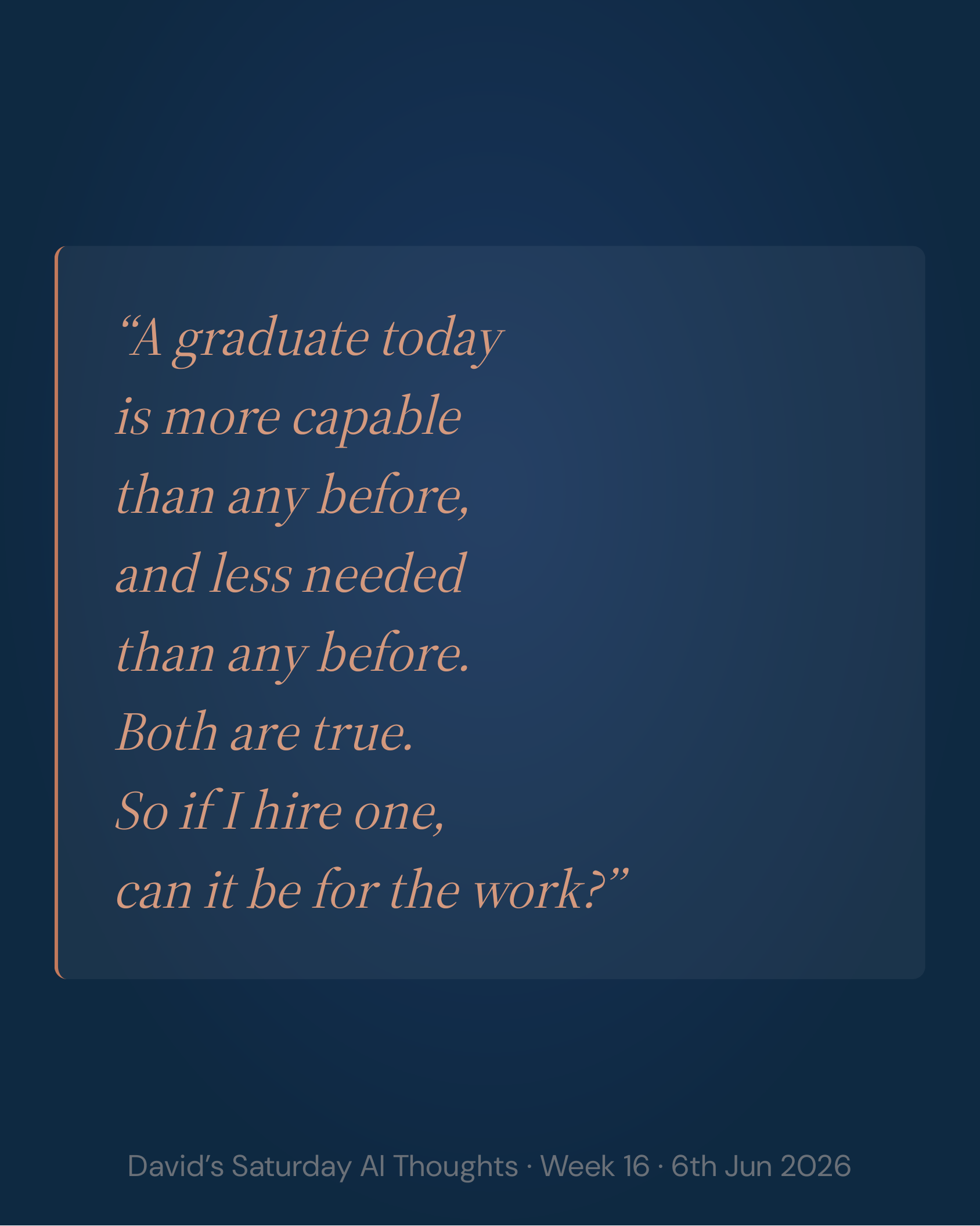
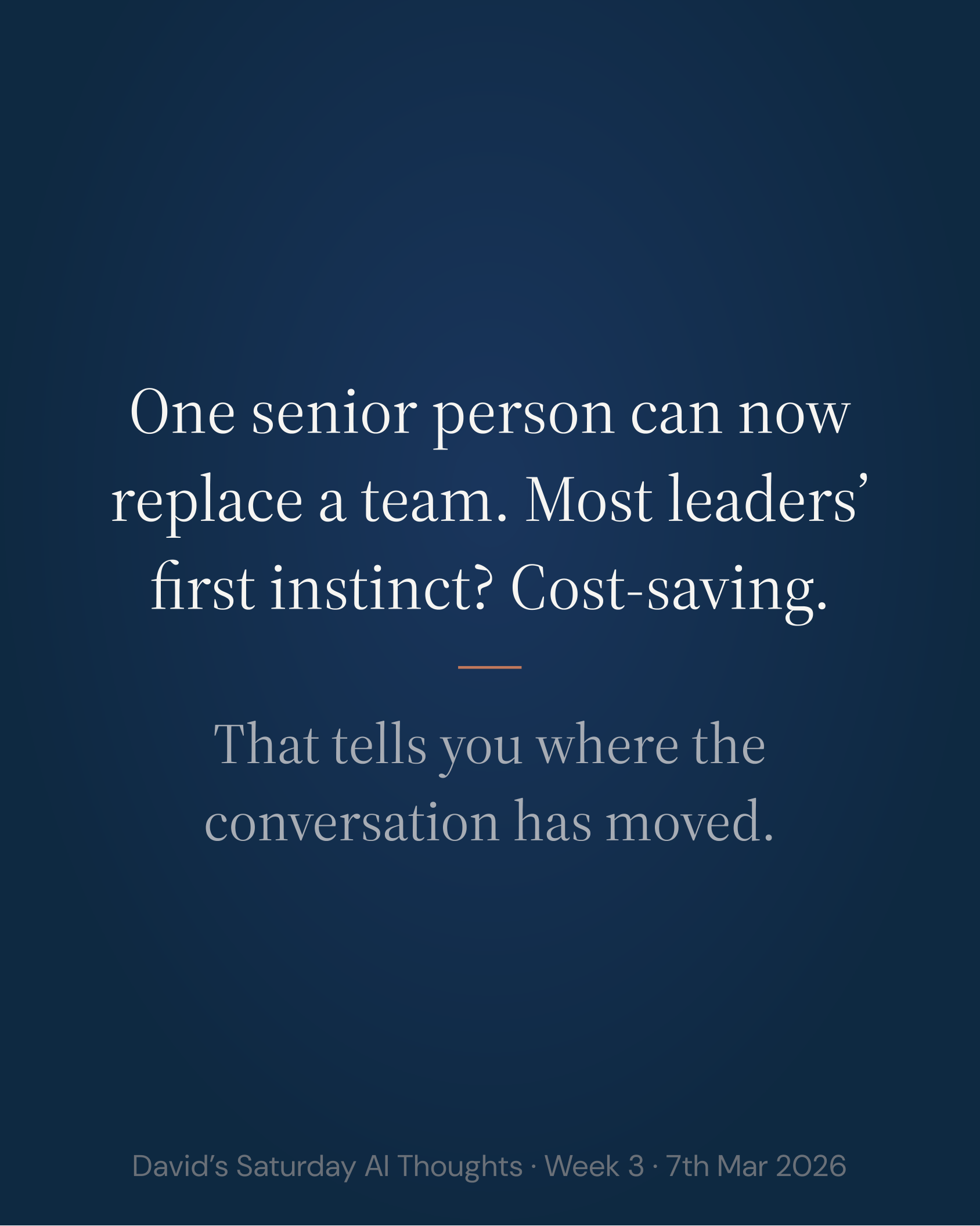
They have a point. Firms don't need graduates; they can hire people trained at someone else's expense. And here's the awkward part of my own pitch. A graduate today is more capable than any before, and less needed than any before. Both are true. They can do more, but so can I, without them. So if I hire one, can it be for the work?
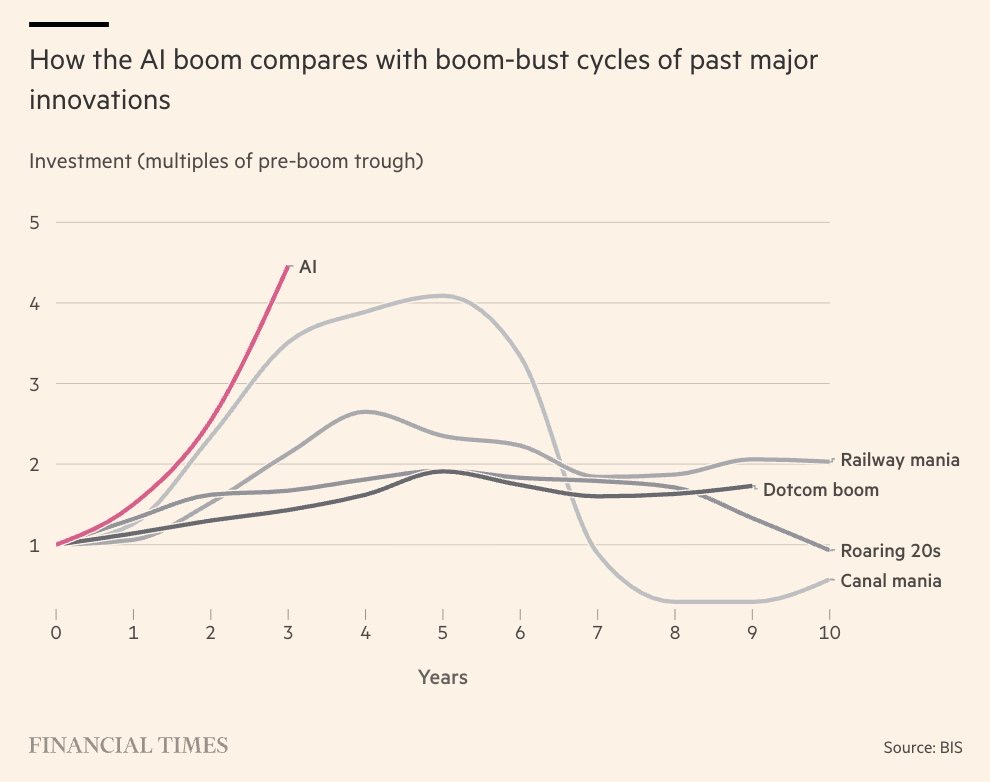
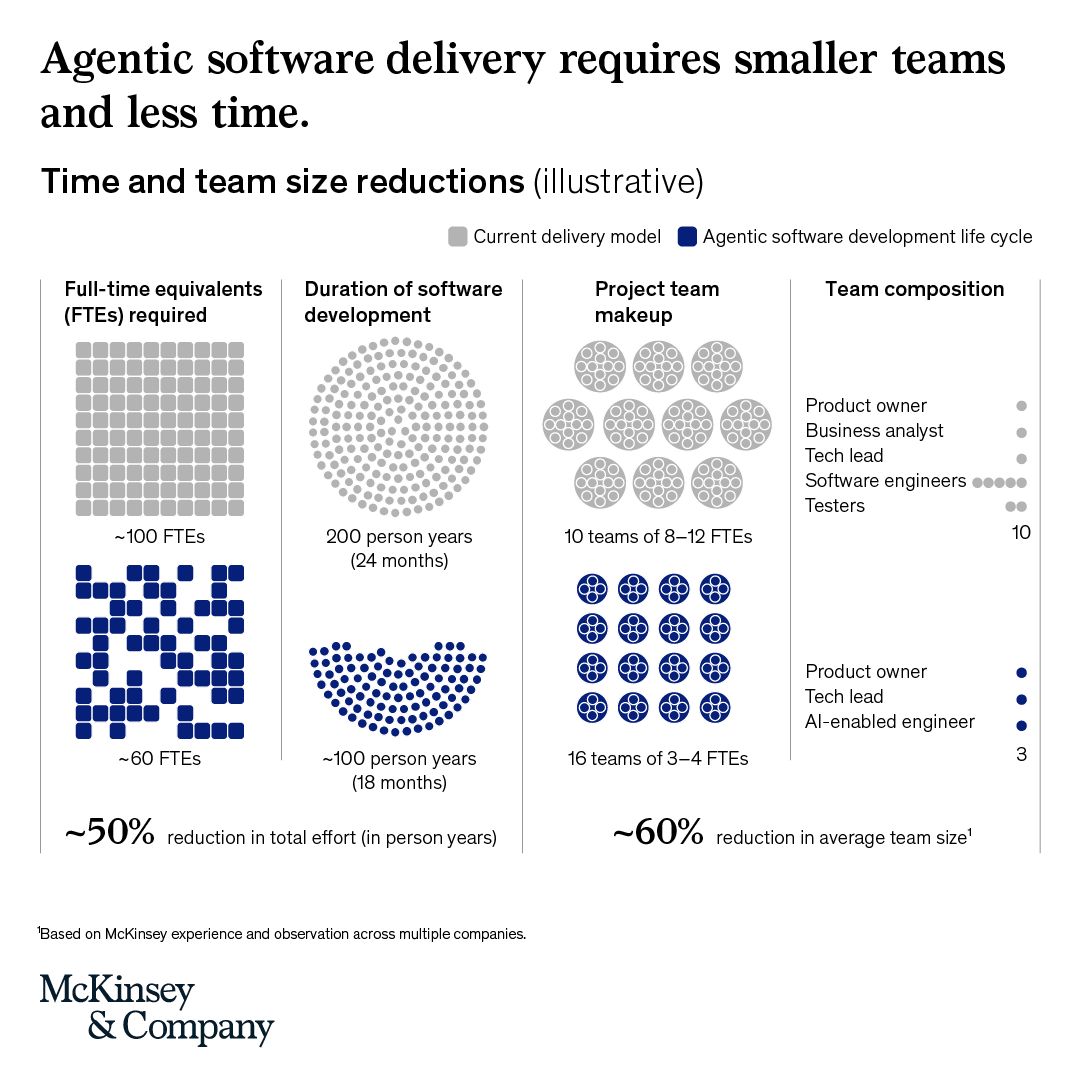
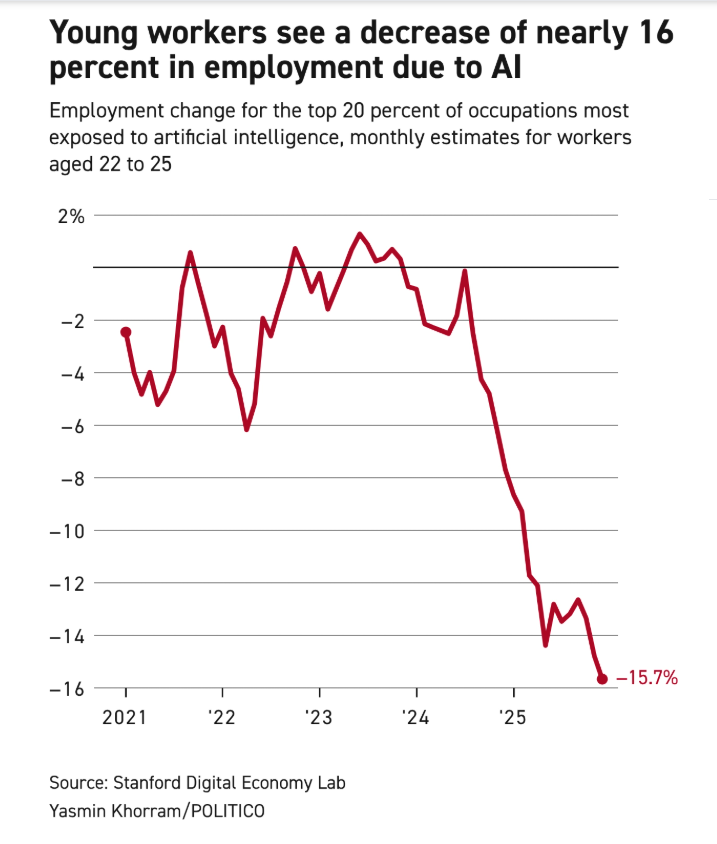
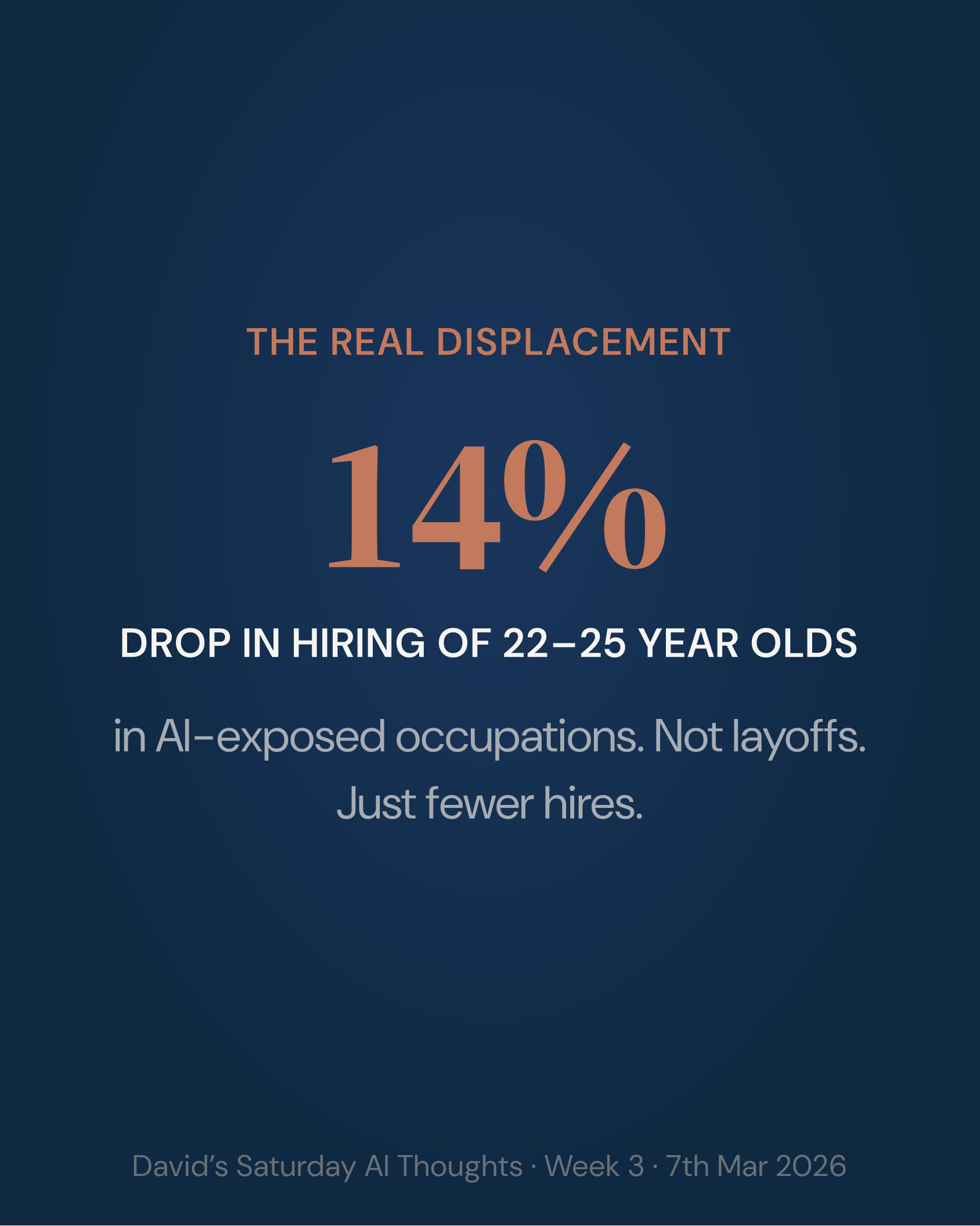
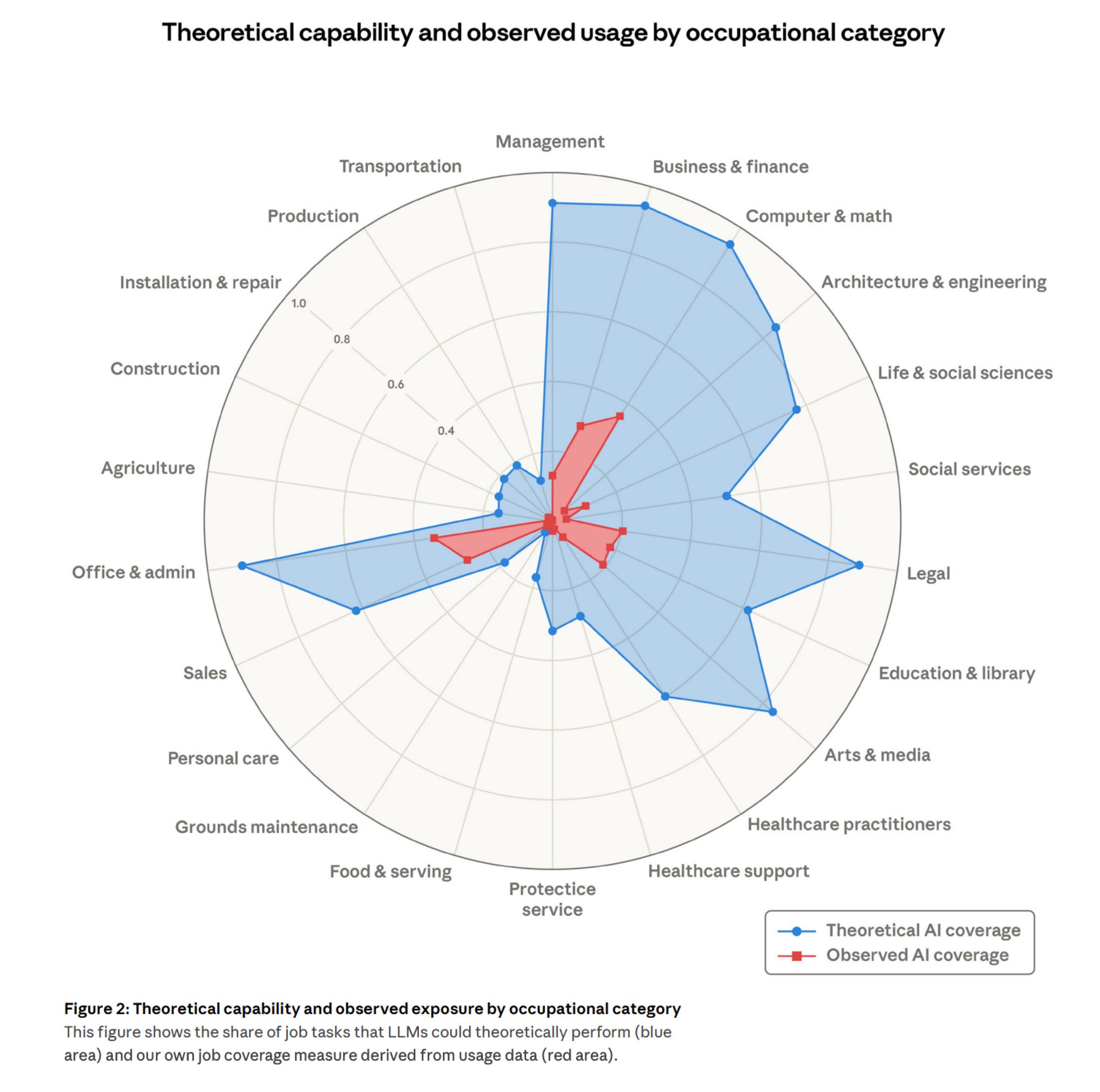
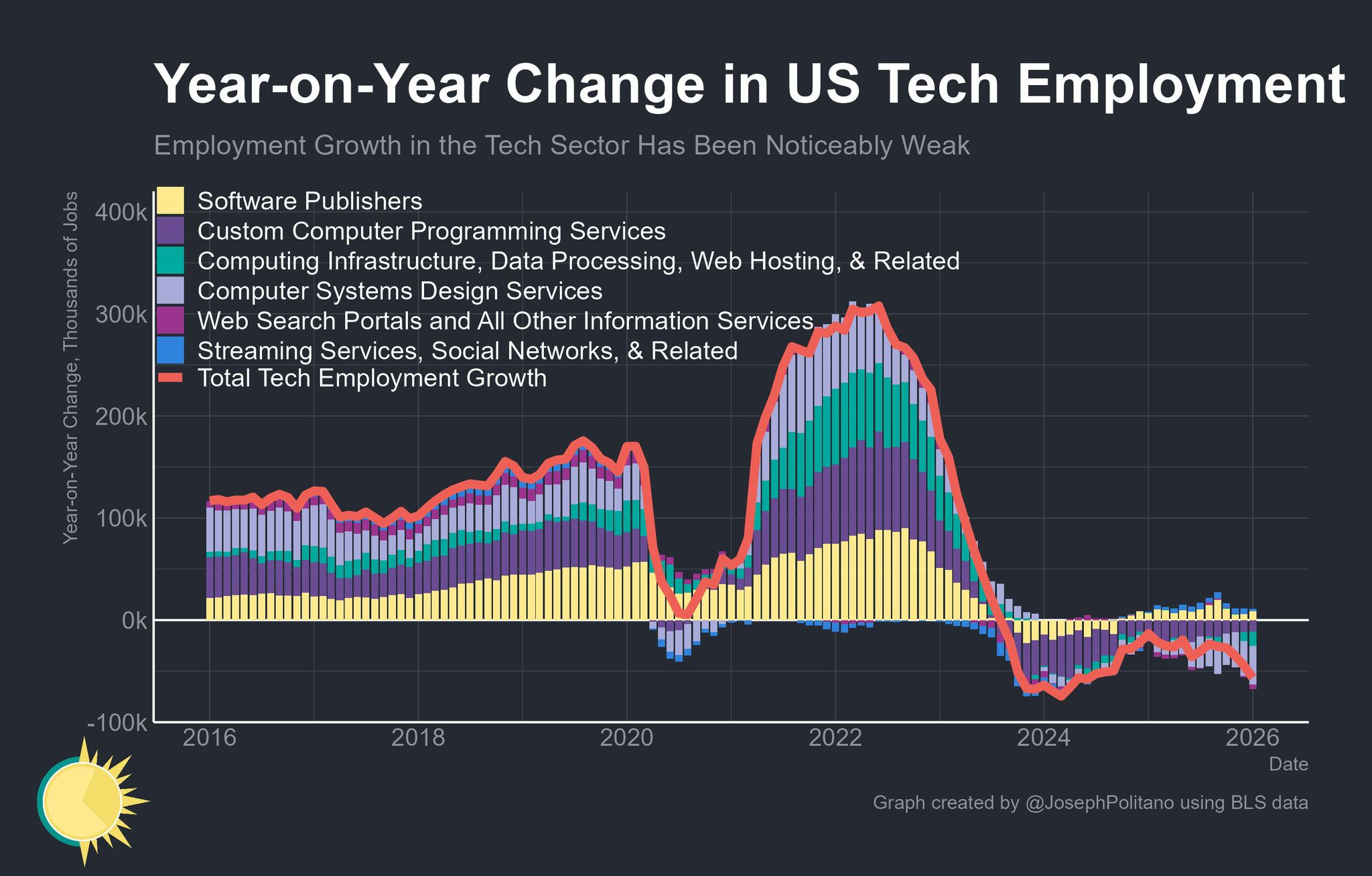
Agentic software delivery, McKinsey estimates, takes about half the effort and sixty per cent smaller teams, with the junior tester and analyst roles the first to go. The counter-pressure these four hypotheses have to answer.
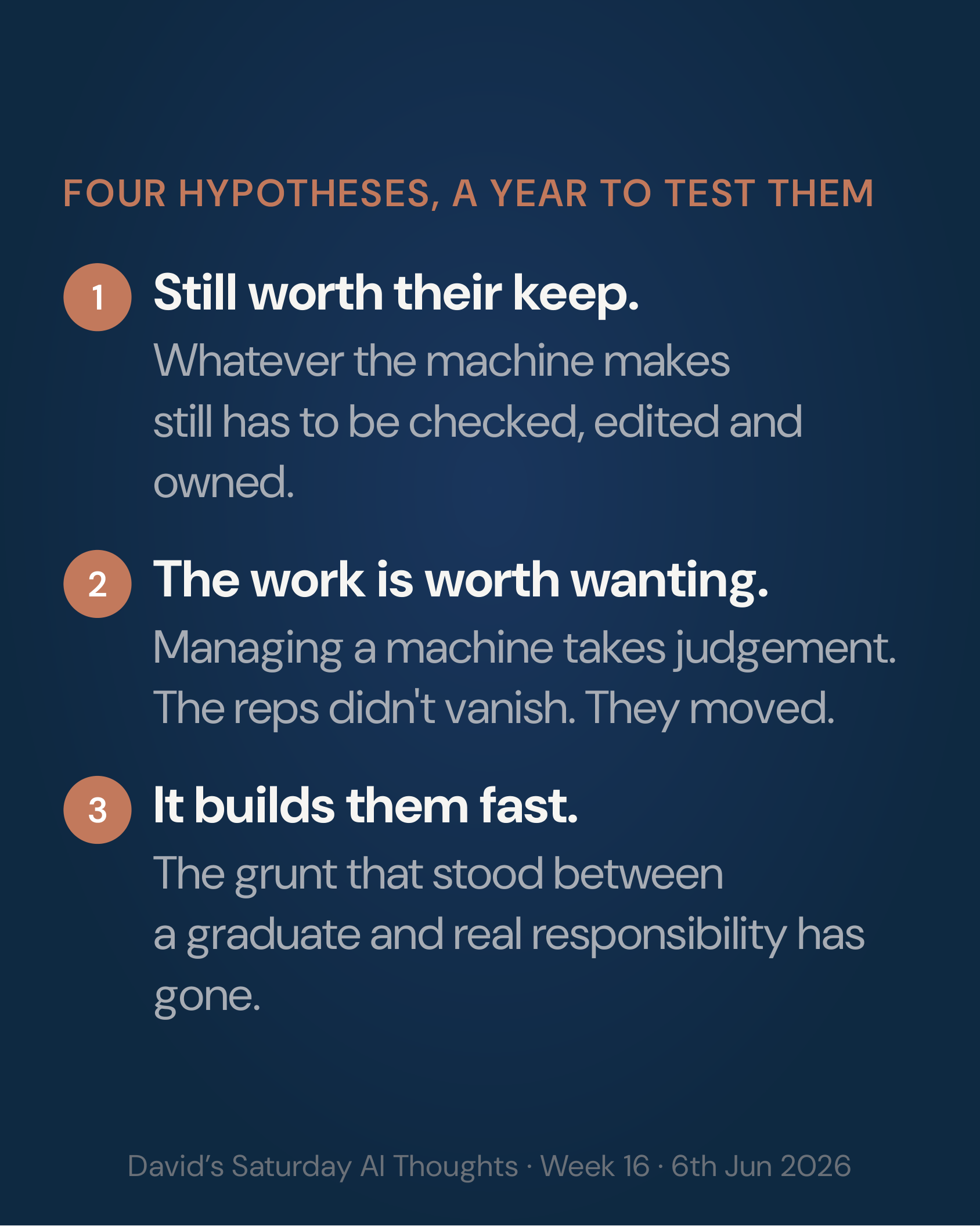
I think it can. I also think the gloom around the young is wrong. The headlines have them anxious and replaceable, their first jobs stripped of anything that mattered. I have four hypotheses against all that, and a year to test them.
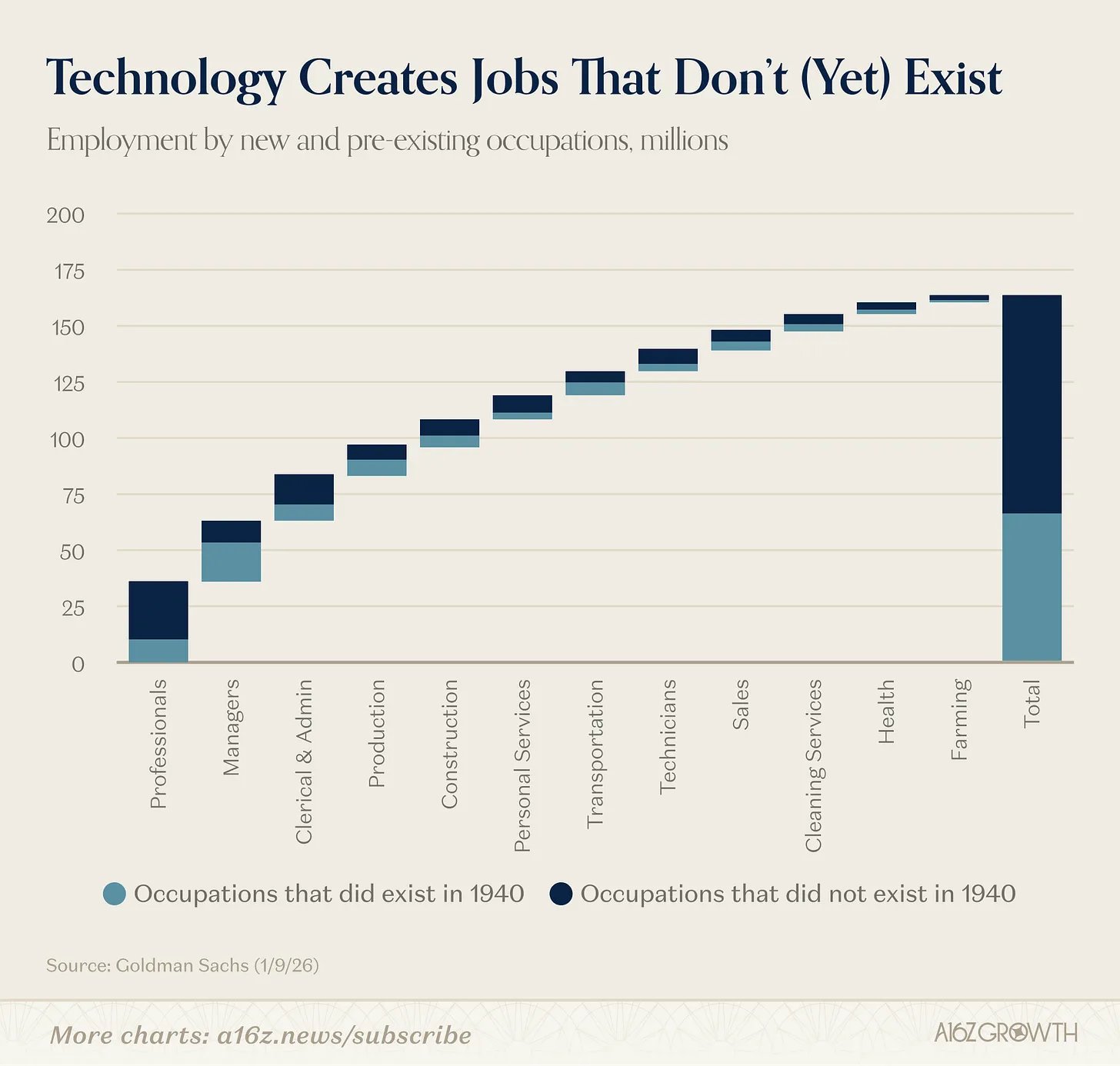
History is on the side of optimism here. Most of the jobs people do today did not exist in 1940. Technology keeps creating work nobody could have named in advance, and the people who end up doing it are usually the ones who came up alongside the new tools. That is the graduate.
Most of the work people do today did not exist in 1940, the long-run case that technology keeps inventing jobs nobody could name in advance. (a16z, on Goldman Sachs data.)
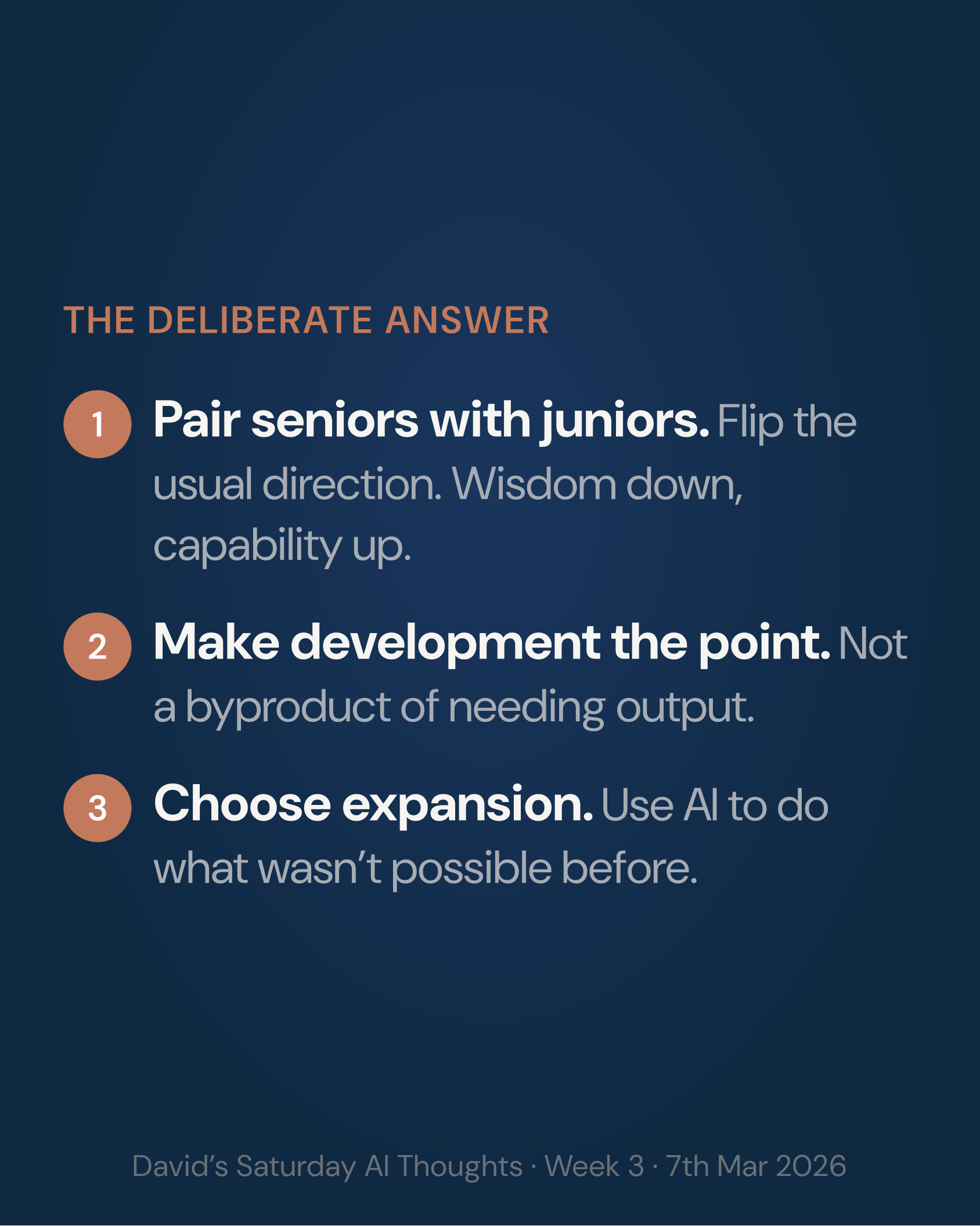
The first is that a graduate is still worth their keep. I've just argued they might not be. But the machine hasn't removed every cost. Whatever it produces still has to be checked, edited and owned. Surely there are plenty of tasks not worth my time to do that, even when the machine can do them in seconds? A graduate can take them on. The machine does the grunt now; what's left is the checking, and the judgement of whether it got the grunt right.
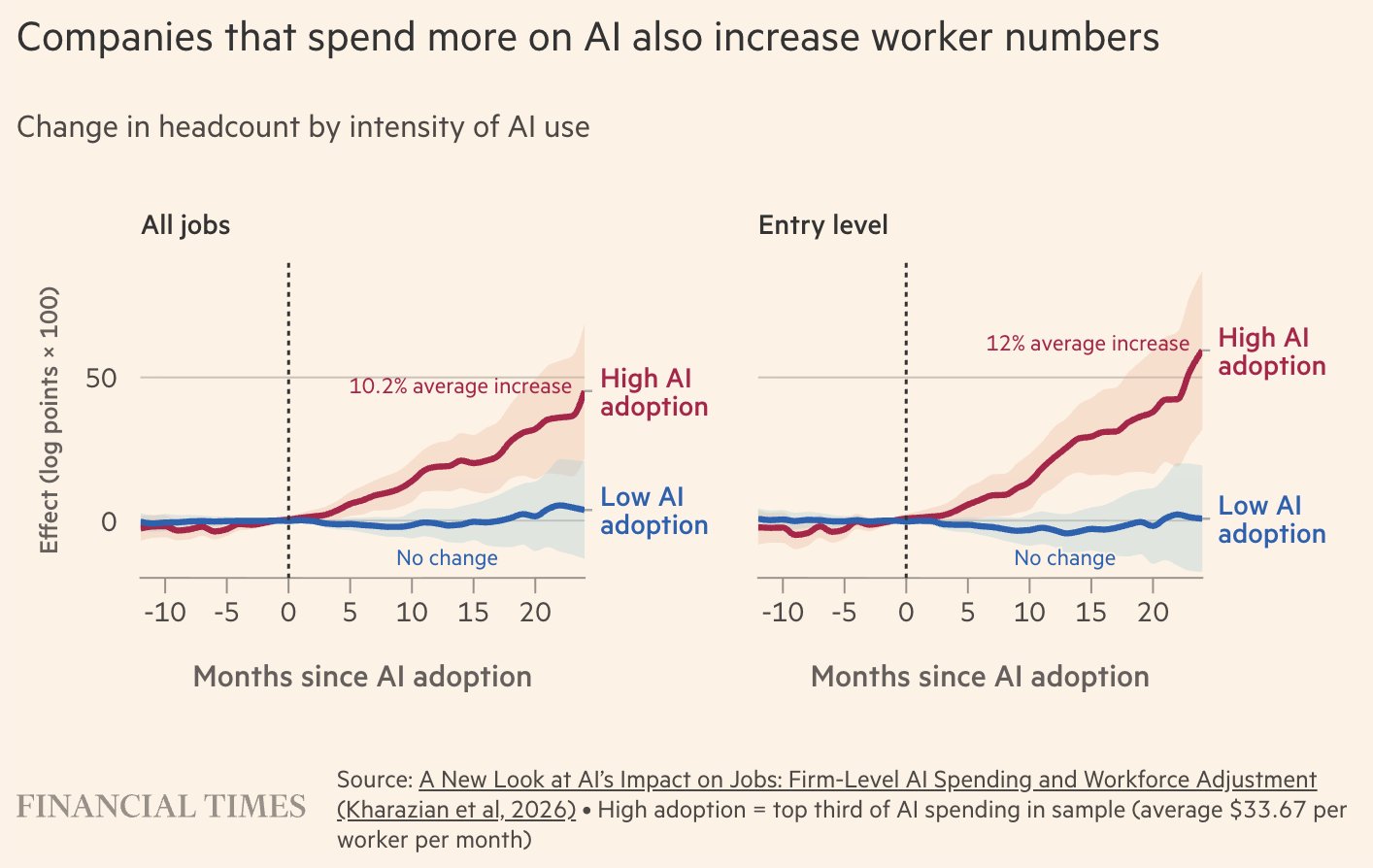
The second is that the work is worth wanting. A graduate I read about recently put it starkly. All he does now, he said, is manage a machine. He's right that it's the work, for most of us. He's wrong that it's small. Managing a machine sounds dystopian and diminished. It is neither. It takes judgement, and the reps that build that judgement didn't vanish with the grunt. They moved. I manage three to six agents most days, and I like it. It's good, thoughtful, hard work. My human team has grown, not shrunk, since the agents arrived, and I still like managing the people, too.
The third is that the work builds them, and fast. The grunt that once stood between a graduate and real responsibility has gone, so a graduate can learn to manage years before the old path would have allowed. Whether a single year of it builds the judgement their elders took much longer to acquire is the thing I most want to find out. I mean to prove the new reps beat the old ones.
The fourth is about serendipity. Richard Hamming, the mathematician, told a story about office doors. The people who worked with the door closed got more done. They were more productive this week and next. But as the years went by, he noticed, they tended to be working on slightly the wrong problems. The ones who left the door open lost time to interruption. They also picked up the clues about what was worth working on at all. The open door was never only a cost. It let useful information in.
Helen Field, a people and transformation leader I work closely with, put the sharper version to me. A graduate arrives with an elastic mind, unattached to the old ways. In most organisations they are already more fluent in these tools than the team that hired them. In a settled world that's a nice-to-have. In a disrupted one it's a differentiated starting point, an asset rather than a cost. I've spent twenty-five years learning how things are done. That's exactly the training that stops me seeing how they might be done instead.
So hiring Ethan is partly me keeping my own door open. He'll cost me time I could otherwise spend on the work in front of me. That is the price of not drifting, and of not calcifying. Those are my four hypotheses. I can't yet tell you which is the real one, or whether it's all of them. Let's find out.
There's another side to this door, though, and I should be honest about it. Ethan is here because his father is an old friend of mine. The front door into work has rarely been harder to open. Two of his friends found jobs only because a parent knew someone. Another, with a master's degree, is working in a bike shop, because he didn't. The few junior places left are handed out more and more by connection and less and less by merit.
Helen made one other point, and made me realise I'd resisted it, because I've been trying to think this through on logic alone. There is a moral case that shouldn't be left out. If those of us who can still open a door choose not to, the pipeline for a generation closes quietly, on our watch. Trying to win on logic without saying that out loud feels like a failure in itself. So I'll say it.
So I'm doing this on purpose, in the open, and I mean to find out what comes through, in both directions. Over the year I'll let Ethan tell you how the work feels for him, what his generation makes of it and where he thinks I'm wrong.
When I put the experiment to him, he laughed. 'A lot of weight on my back,' he said. 'I'm representing everyone.' No pressure, Ethan.
Two things are worth more than they look. An open door, and a hypothesis you're willing to test rather than assume. I have a few firm ones about young people, and I'm about to learn if I'm right or wrong on them. What are yours? And what are you doing to keep your door open and put them to the test?
Three things worth knowing
1. The CEO of a 350,000-person IT services firm says AI is hollowing out the middle, not the bottom.
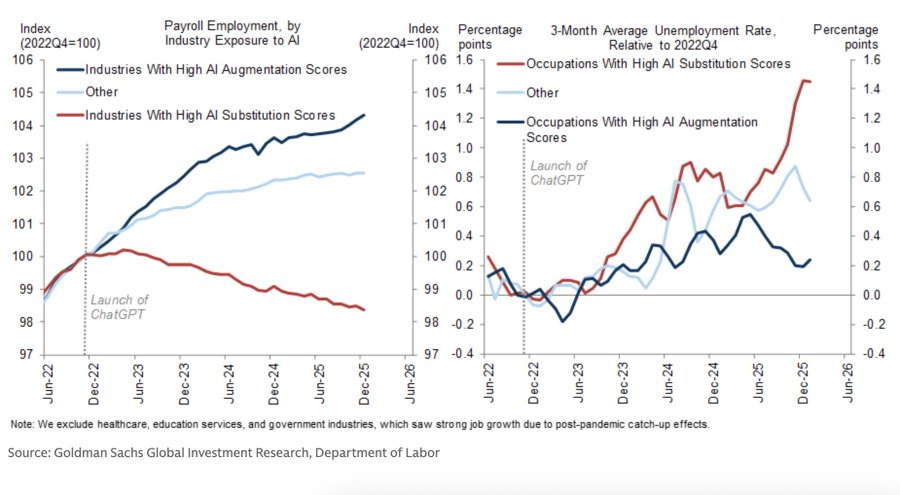
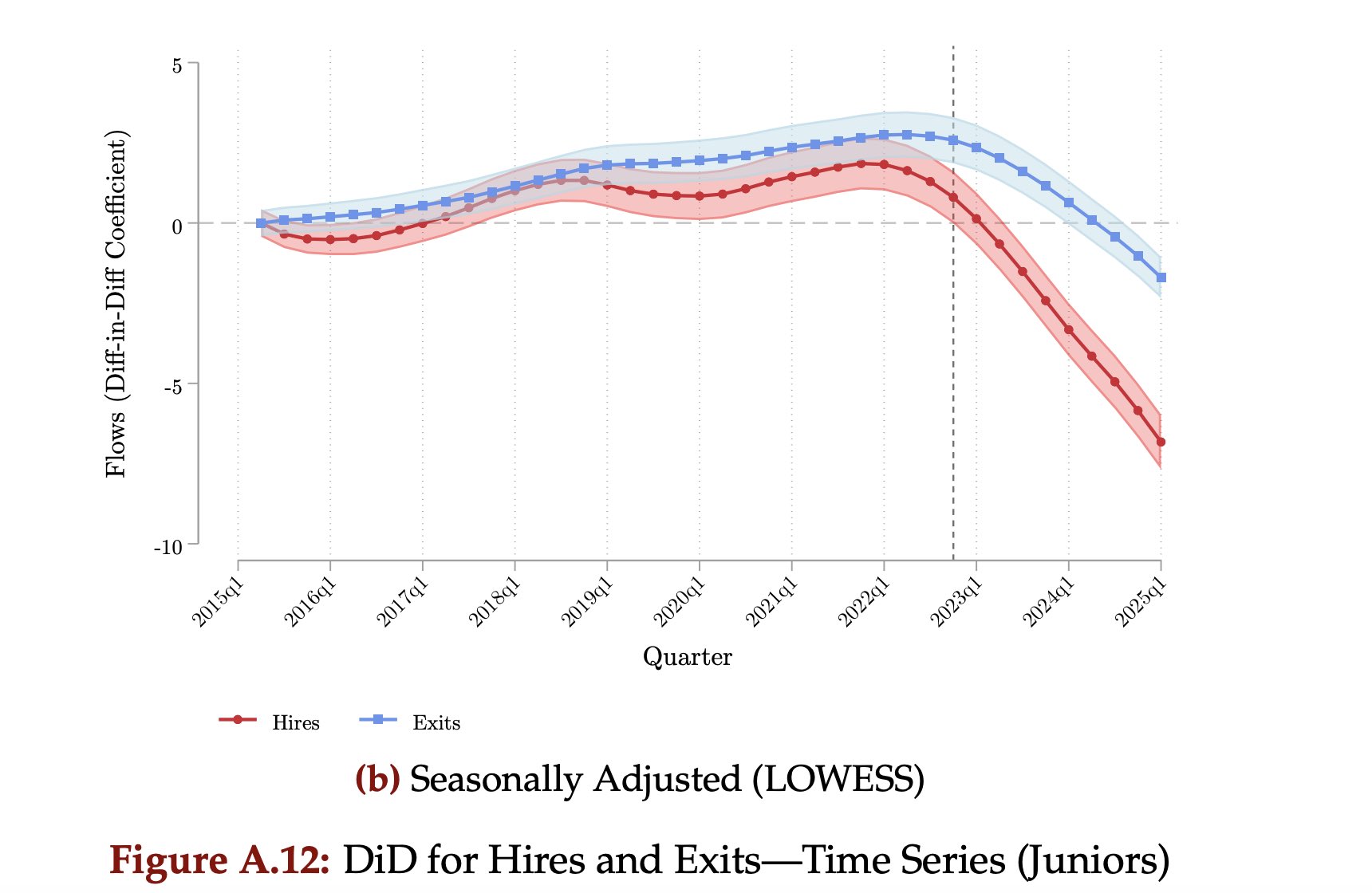
Ravi Kumar, chief executive of Cognizant, the listed IT services firm, told Fortune's COO Summit on 1st June that his company hired 20,000 entry-level graduates last year and expects to hire more in 2026, with new "Frontier Business Operator" and "Frontier Certified Engineer" roles defining what AI-era work looks like. He called the job-extinction talk "fearmongering" and argued that AI thins middle management while entry-level and leadership roles persist. It's a direct counter to the consensus that entry-level work vanishes first, including the US Bureau of Labor Statistics data Edition 14 leaned on.
2. The machine is writing the code now, and the gains are pooling at the top.
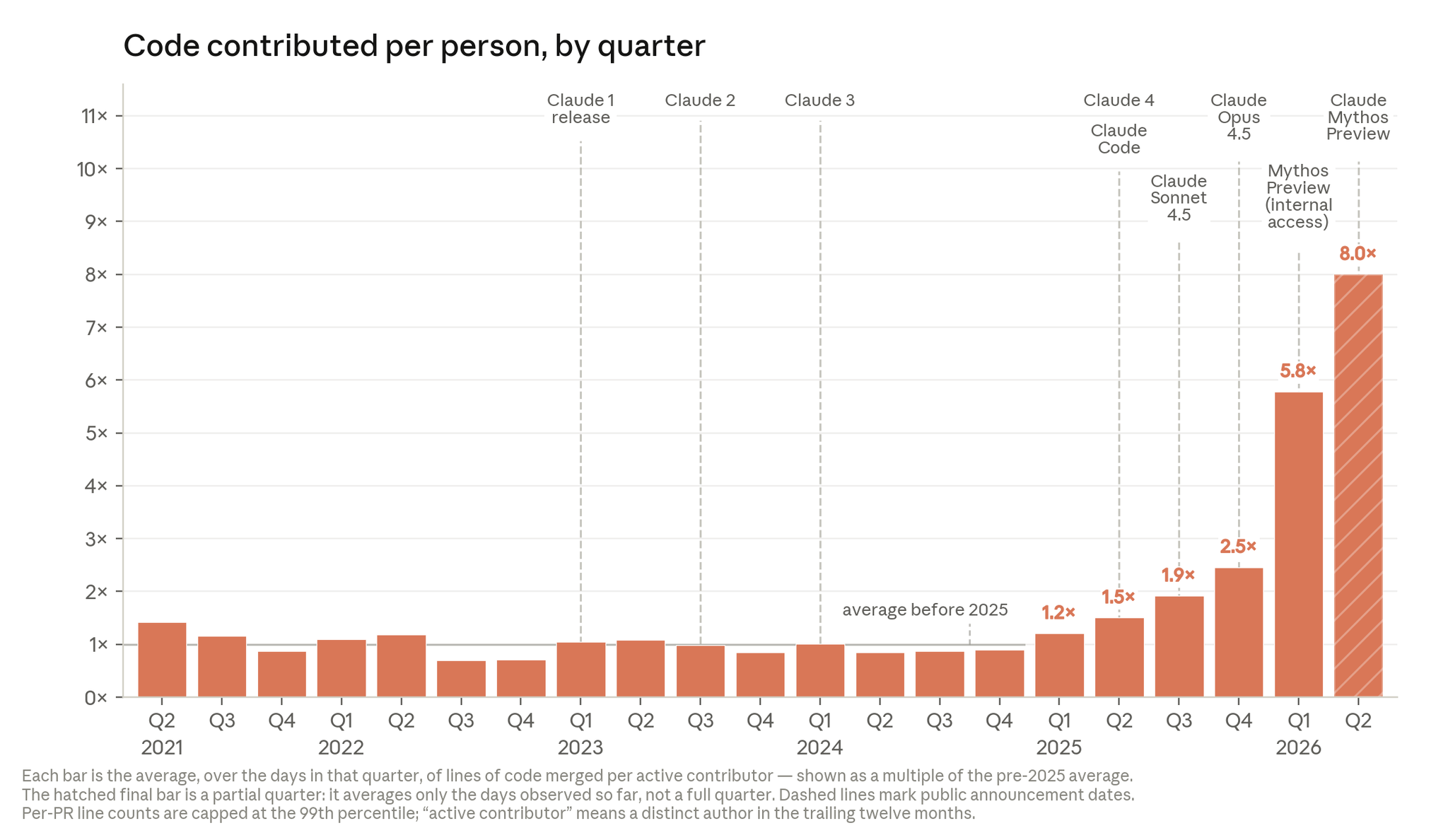
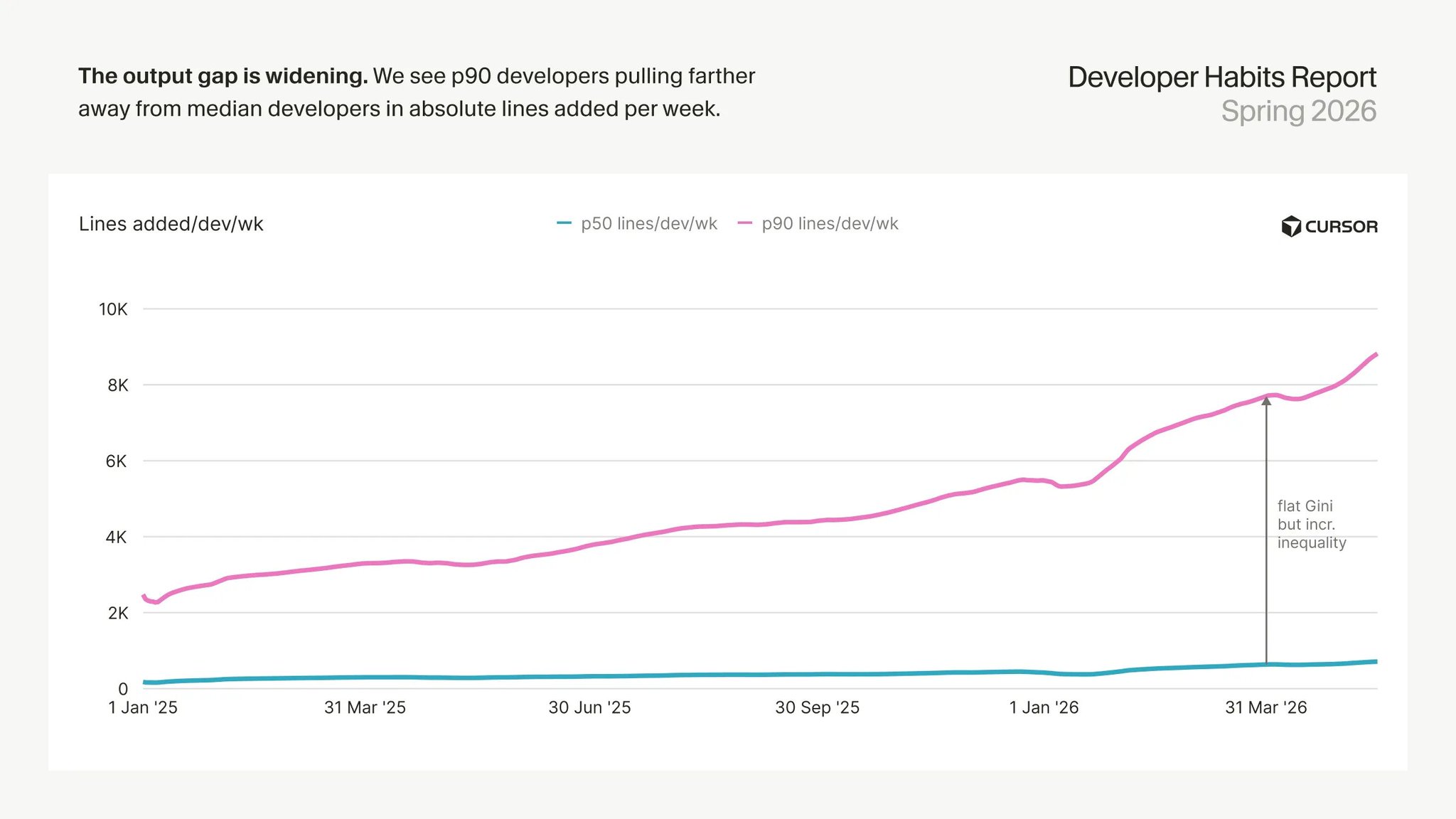
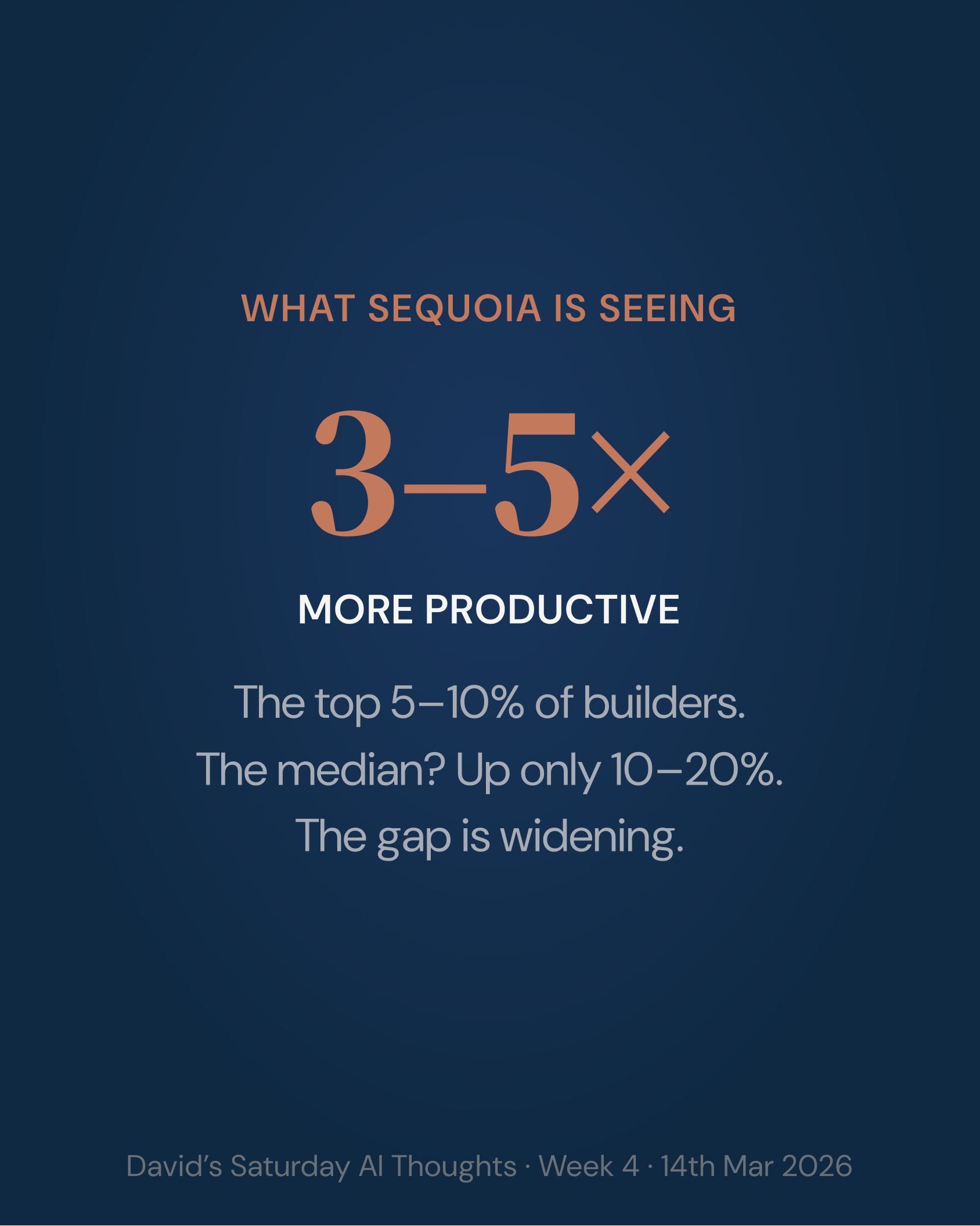
Tobi Lütke, Shopify's founder, says one in eight pull requests merged at the company are now written by River, its in-house agent, not an engineer. Anthropic's own engineers ship roughly eight times the code per person they did before 2025. Cursor's developer report shows the spread widening: the top developers are pulling far ahead of the median, the leverage going to the few who can direct the tools well. And OpenAI's Codex has passed five million weekly users, with non-developer adoption growing three times faster than developer adoption. The grunt of writing code is moving to the machine, the output is multiplying, and the reward is concentrating in the people who know what to ask of it.
3. Capability is outrunning even the best forecasters.
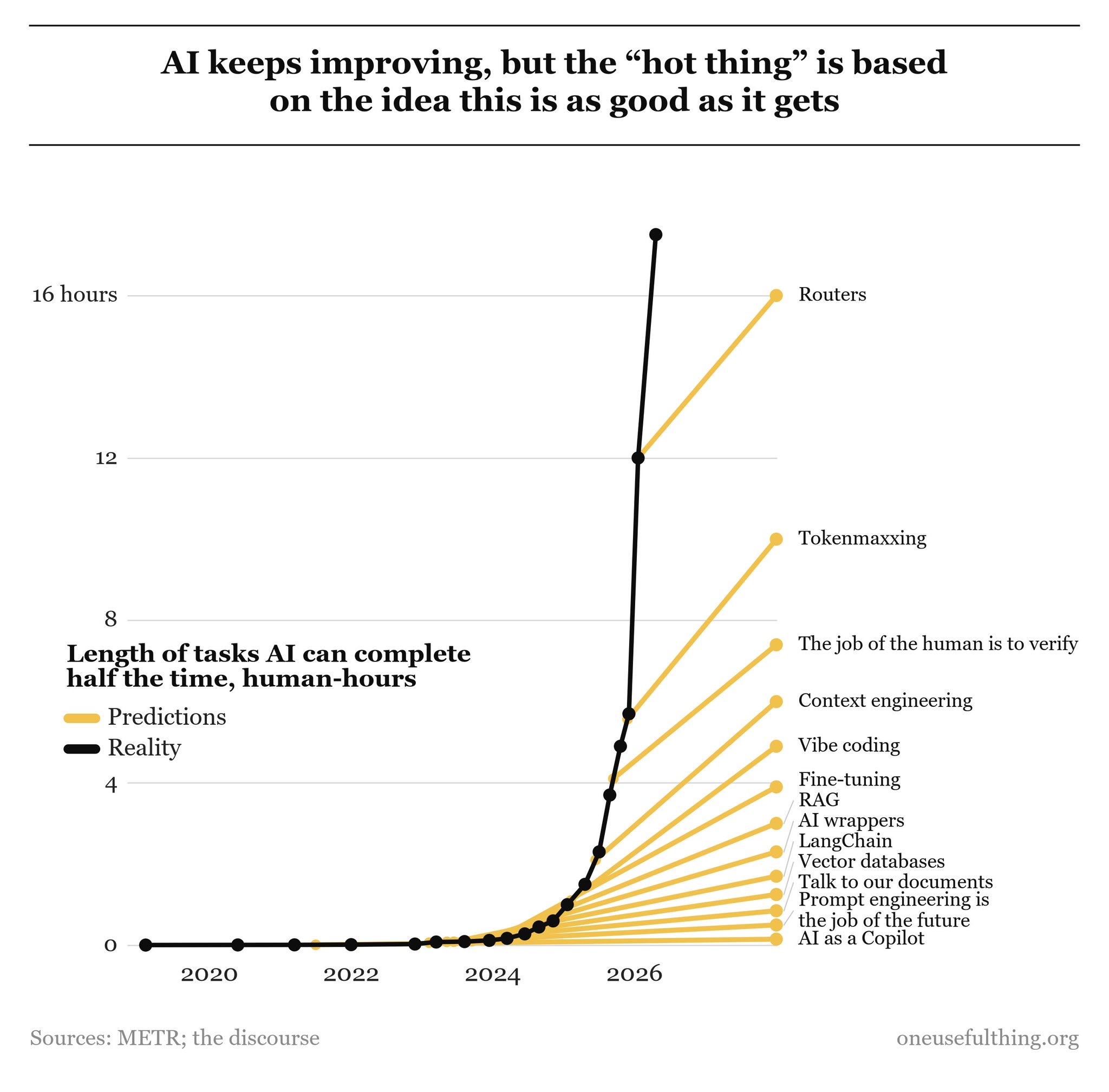
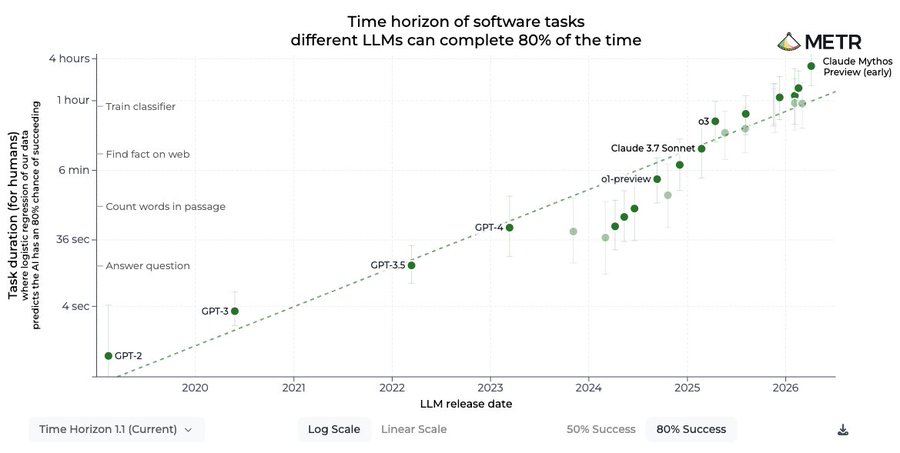
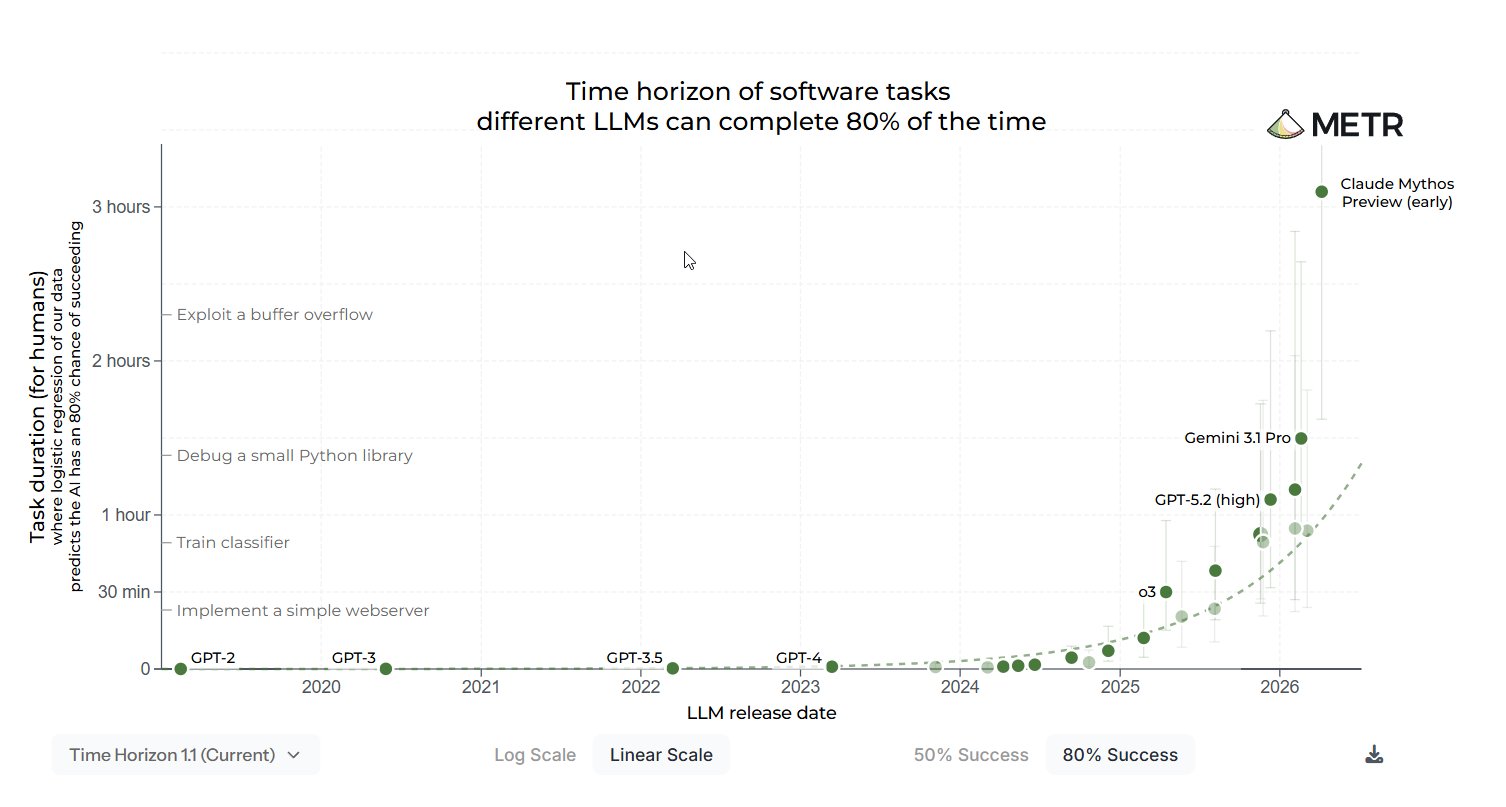
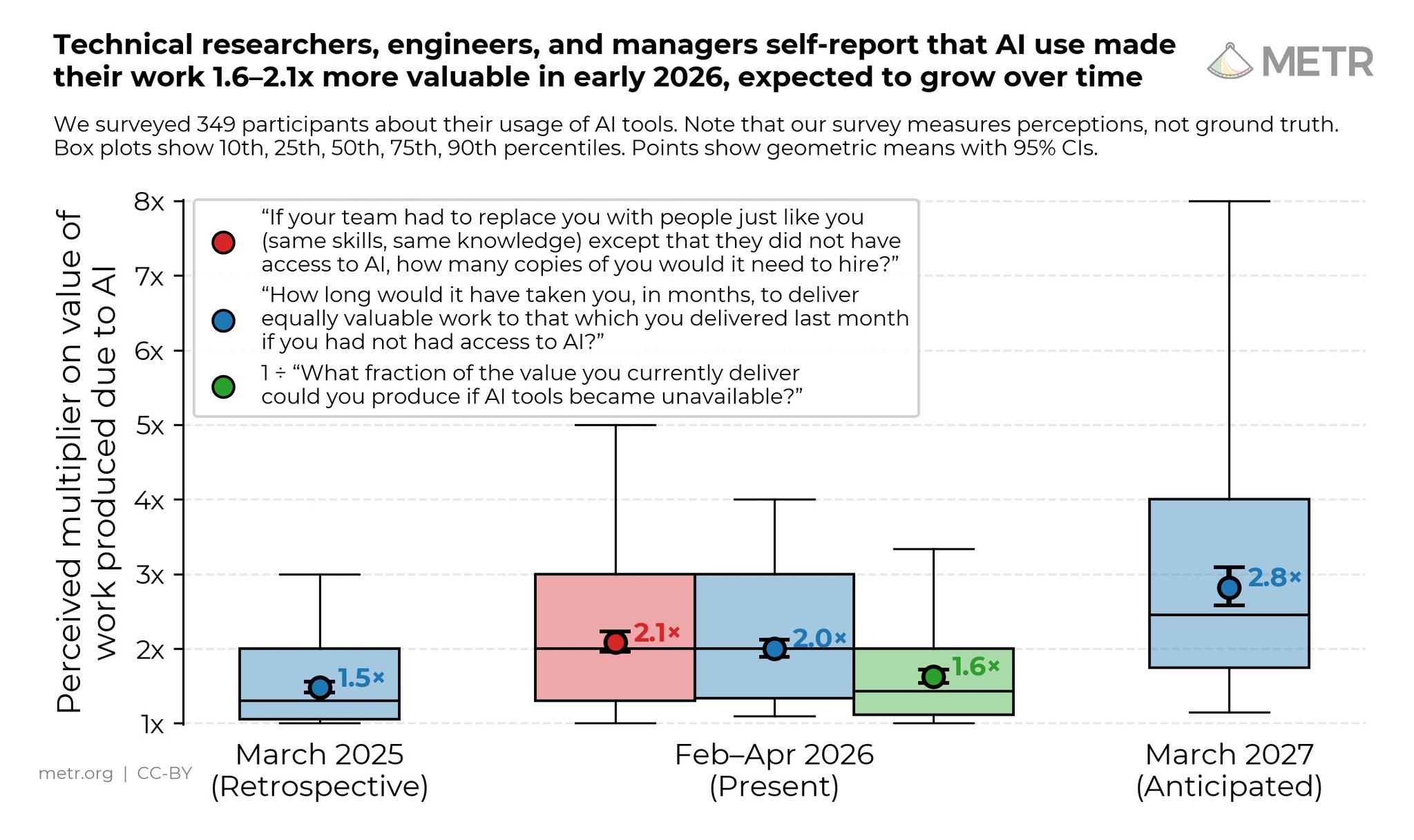
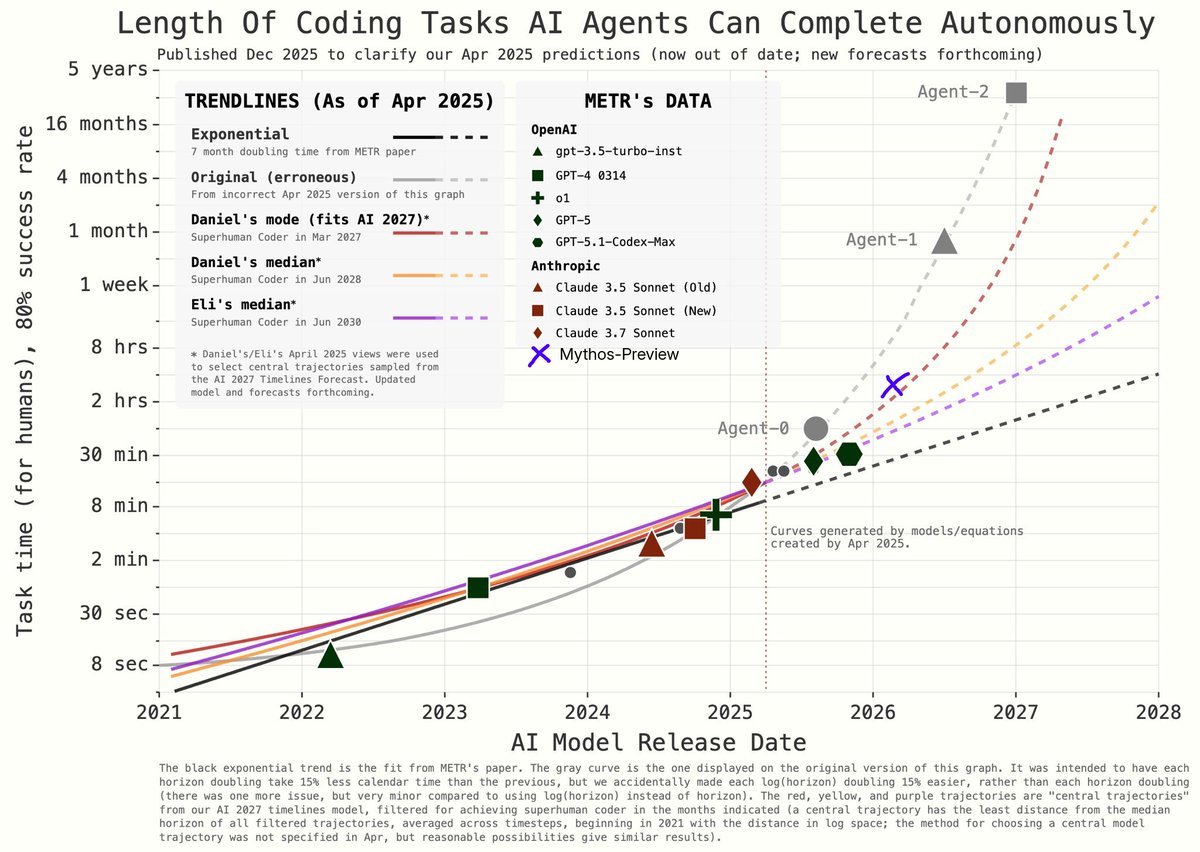
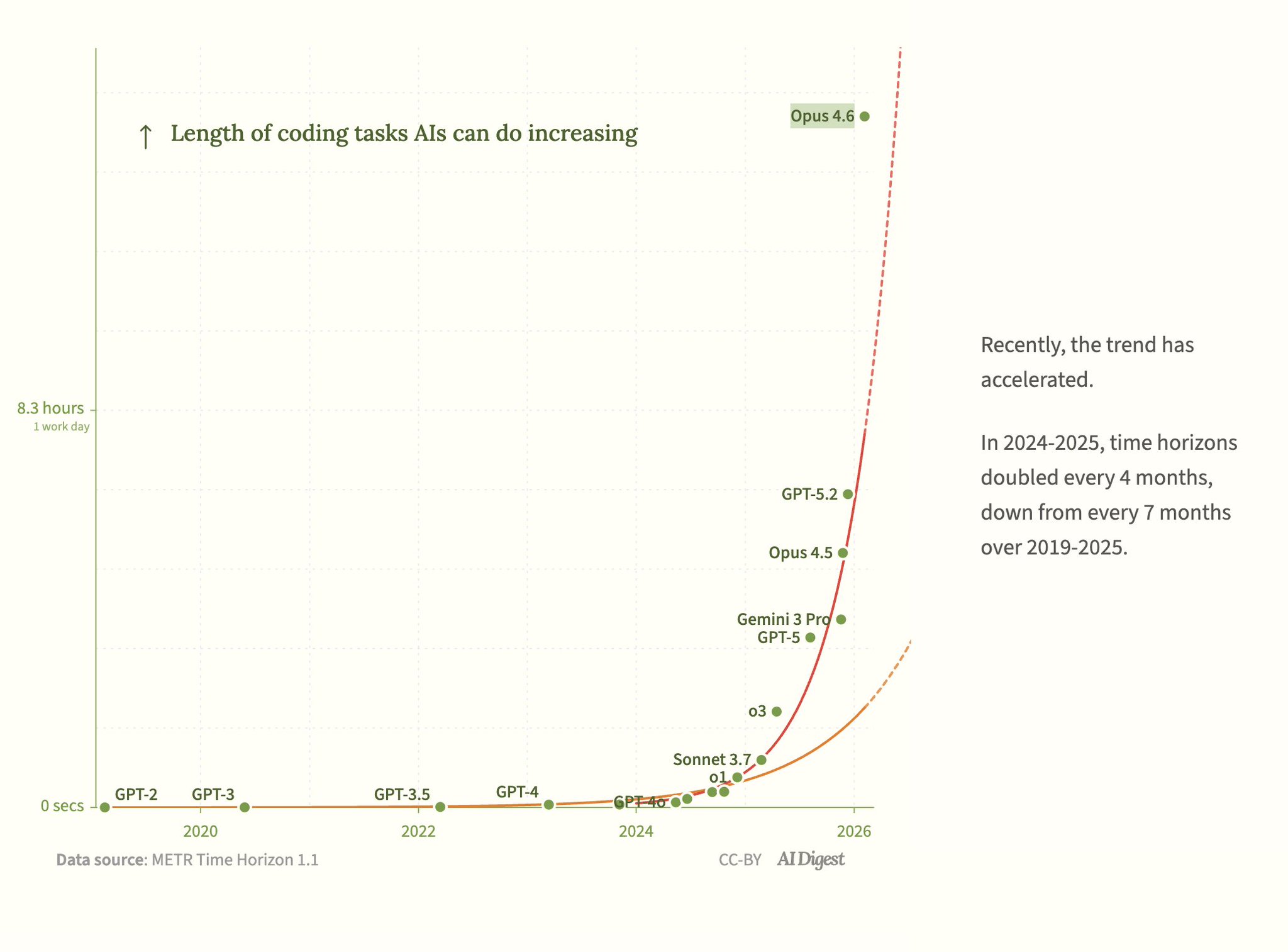
The Forecasting Research Institute asked expert forecasters and superforecasters how long a task a model would reliably finish by the end of 2026. The measure comes from METR, an AI evaluation lab, and when the survey launched it stood at about an hour and a half. All three groups put the end-of-2026 figure between three and four hours. Then, while the survey was still running, a frontier model in preview reached three hours and six minutes on METR's benchmark, already inside the range they'd picked for the end of the year. The forecast was overtaken before they'd finished making it.
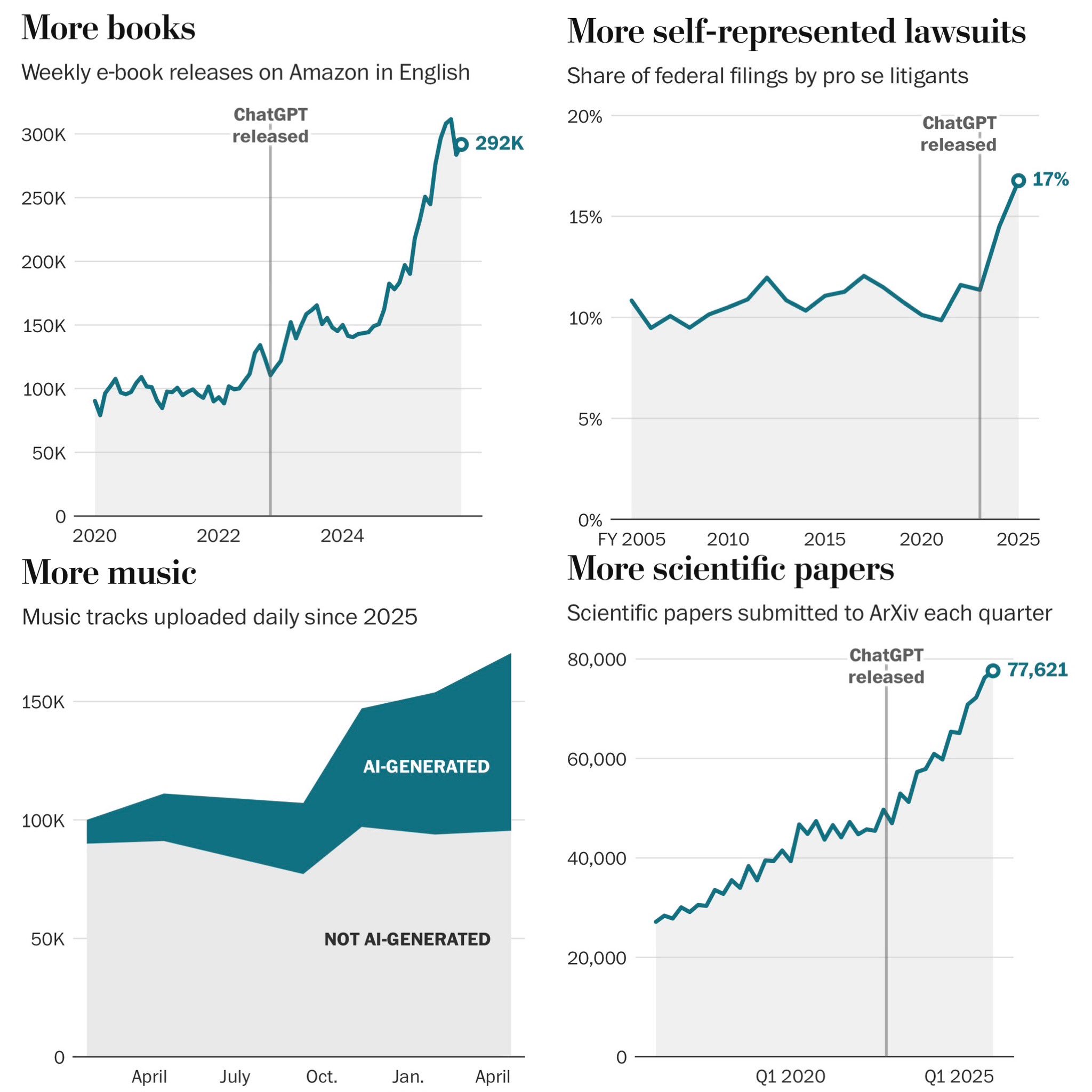
Matthew Prince, who runs Cloudflare, made the same miss in public this week. Bots have passed humans in web traffic for the first time, he said, years ahead of his own forecast. As recently as March he'd put the crossover at late 2027. Much of that is scraping bots, not agents answering questions in the moment, so the figure is softer than it sounds. The direction holds.
I've given myself a year to find out whether I'm right about Ethan. On this week's evidence, that's a long time to be sure of anything.
1. Ask the AI to orient itself in your folder before you ask it anything else.
Setting up a Claude Cowork project for a documentary filmmaker brand-new to the tool this week, the first prompt I typed wasn't about the work. It was: "Read the files and sub-folders, write yourself a little set of instructions for future chats. Write yourself a navigation guide." Claude spent a few minutes exploring, then saved itself three memory files: a project overview, a folder guide, and a profile of the user. Every later chat in that project started smarter, because it could re-read its own notes.
2. Don't say "always allow" on the verbs you can't undo.
In a coaching conversation this week about agent permissions, the pattern was familiar. Three prompts in, most people click "always allow" on everything just to stop the interruption. The discipline is to sort the verbs first. Reading, listing, searching: leave on auto. Deleting, sending, posting, spending: keep asking every time. Sorting the verbs first is what keeps one careless click from emptying a folder, sending an email you can't unsend, or running up a charge you didn't mean. Applies to any tool that asks for permission as it works.
3. Talk longer on the call, so the AI can work for hours after.
On a client call this week, the brief changed mid-conversation. The plan we'd opened with wasn't the plan we were leaving with. I deliberately used more words than I otherwise would, narrating the bridge between the old direction and the new one. The over-explaining was really for the AI: context I was laying down for it to pick up later, once the transcript was in the project. The transcript plus "go" did the work. The next time you're on a call that's being transcribed, elaborate a little more than you otherwise would and narrate the why, not just the what.
One reader, Conor, sent a line that stuck with me: "the organisations that win won't have better AI, they'll have better questions." The gap between using the tools and knowing what to ask of them, he wrote, is widening faster than most leaders realise, and that is where the value is pooling. What unsettles him is how many businesses are automating before they have worked out what is actually worth keeping. Last week I asked what you can see coming over the next five years, and a lot of you wrote back with super thoughtful answers. I am holding them. They belong in the "what's next" piece I am working on for a future week with Rob Wild. So Conor's is the only letter this week. Keep the predictions coming, though! Full reader reactions online →
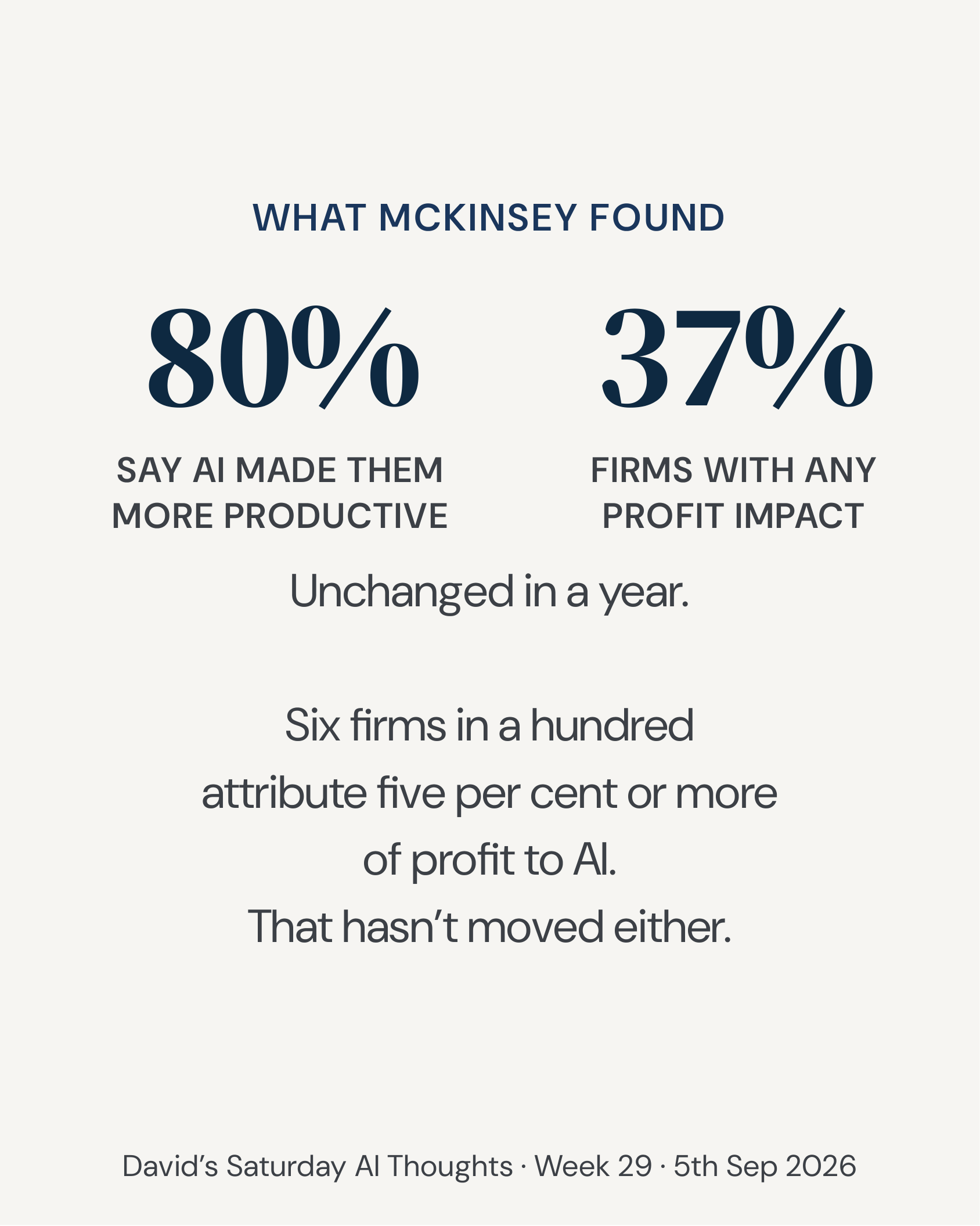
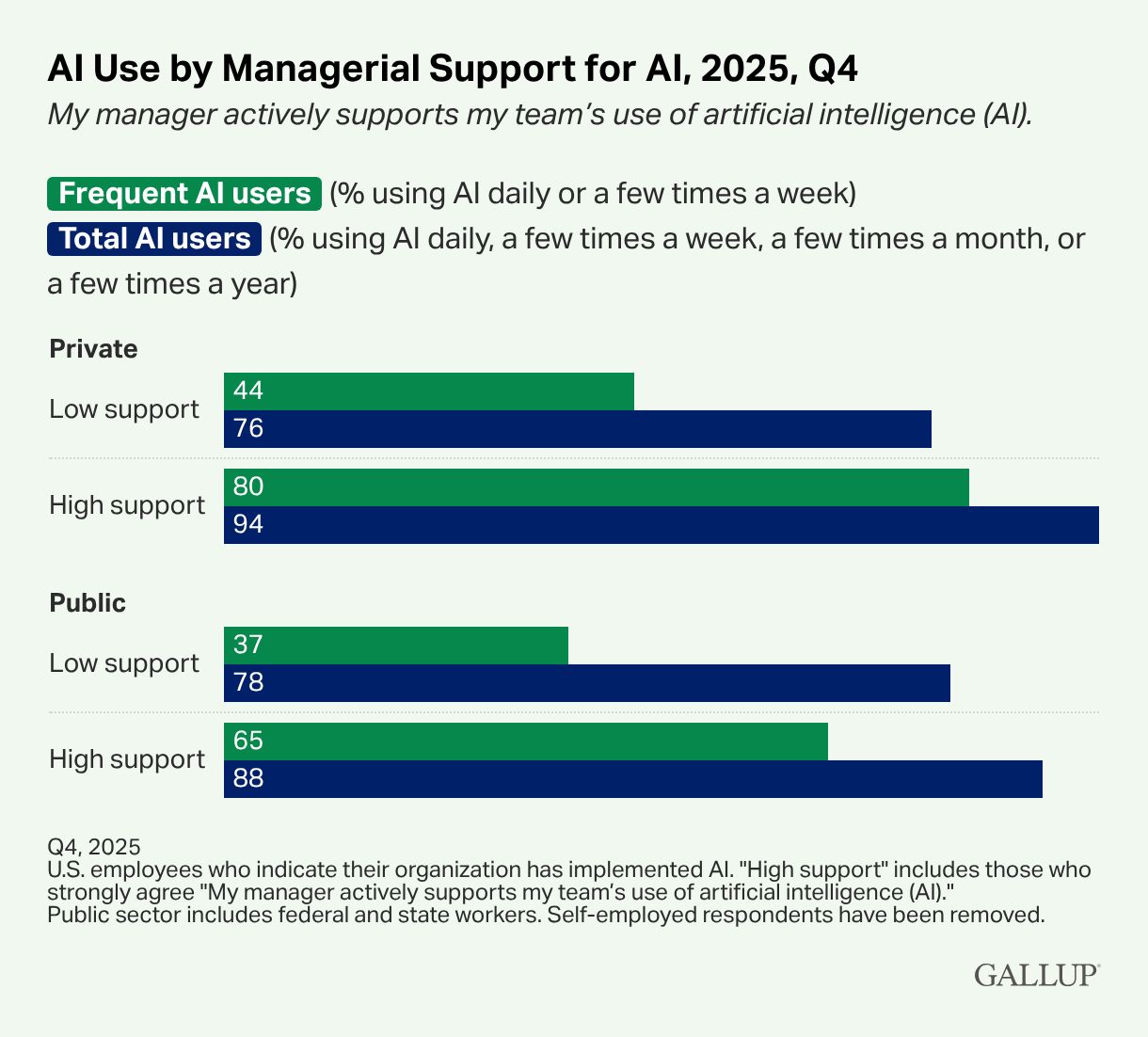
The community's been thinking out loud on LinkedIn, too, and a thread runs straight through this week's essay: when the machine does more, what stays ours? Phil Leslie, Chief Technology and Innovation Officer at Cornerstone Research, the economic consulting firm, put it most sharply: AI is a powerhouse at producing analysis, but the more it produces, the more human judgement is needed to make sense of it. Demand for that judgement is soaring; the supply is scarce. He calls it the judgment bottleneck. Julia Kenyon, a coach and former BBC global brand leader, flagged the study finding that eighty-nine per cent of executives report no productivity gain from AI in three years, the exception being teams whose managers actively champion it: a human challenge dressed as a technology one. And Kristin Luck, an investment banker in the data and insights sector, sees the market starting to price it, rewarding the firms that have operationalised AI and squeezing the generalists who haven't. More online →
The richer version of this week's three Try-Thises, with copy-paste prompts. Each prompt has a Copy button - click and paste into your AI of choice.
1. Ask the AI to orient itself in your folder before you ask it anything else
Drop this into any new Claude project, or any AI tool with file access, the moment after you've added your files. Walk away for a couple of minutes. When you come back, the project knows itself.
Read every file and sub-folder in this project. Don't do any work yet.
Write yourself three things, saved as files in this project so you can read them in future chats:
1. A project overview: what this body of work is, who it's for, and what the most important files are.
2. A navigation guide: which files you should always read at the start of a chat in this project, which are reference, and which are working drafts that change often.
3. A short profile of me: what you can infer about my role, what I'm trying to do here, and how I tend to work, based on what's in the folder.
Be honest about what you don't know. If something in the folder is ambiguous, name it as ambiguous rather than guessing.
A second variant for when the folder is bigger, or when you want the agent to flag what it can't see yet:
Before doing any work, explore this project. Then write me a one-page memo answering:
- What is this project about, based on the files?
- Which three to five files should any future chat in this project read first?
- What is missing from this folder that would help you help me? Be specific: a brief, an example, a deadline, a style sheet.
Save the memo as PROJECT-NOTES.md in the project root. We'll iterate on it.
2. Don't say "always allow" on the verbs you can't undo
The settings discipline (auto-allow the safe verbs, never auto-allow the destructive ones) is the action. This prompt makes the agent itself recommend which is which, on your actual setup, so you don't have to guess.
You're an agent with permission to act on my files, my email, and the web on my behalf.
List every distinct kind of action you can take. Group them into three buckets:
1. Safe to always allow: read-only, listing, searching, fetching public information. Nothing here can cause loss I can't recover from.
2. Ask every time, no exceptions: anything destructive, irreversible, public-facing, or that costs money. Deleting, overwriting, sending email, posting to social, paying for an API, calling an external service that takes an action in the real world.
3. Borderline: actions that are reversible but annoying, or that touch shared state. Recommend a default for each and explain your reasoning.
For each bucket, give me the exact setting name in this tool's permissions UI, so I can configure it correctly in under five minutes.
3. Talk longer on the call, so the AI can work for hours after
The verbal habit on the call is the move. This is the prompt you run afterwards, once the transcript has landed in your tool of choice. It assumes a recorded meeting and a project folder the AI can write to.
Attached is the transcript of a call I had today with [who, and their role].
The call started with us aligned on [old direction], and ended with us aligned on [new direction]. Most of the transcript is me talking through the bridge between the two: what changed, why, what's still uncertain, what we agreed.
Do three things:
1. Write a one-page brief capturing the new direction, the reasoning behind the shift, and any open questions. Save it to the project as BRIEF-[date].md.
2. List every concrete next step I or my team committed to, with who owns each. Save as ACTIONS-[date].md.
3. Tell me what's still ambiguous after reading the transcript. Don't invent answers; just name the questions I should resolve before any of this work starts.
Then stop and wait for me to review before doing any of the follow-on work.
A second variant for when the call wasn't a strategic pivot, but a working session where the AI should pick up immediately and run:
Attached is the transcript of today's working session on [project]. I've explained at length what I want the next pass of the work to do.
Read the transcript carefully. Then start the work. Don't summarise the transcript back to me first. Don't ask clarifying questions unless something is genuinely contradictory. Save your work into the project folder and tell me what you did and where to find it when you're done.
Princeton brought back supervised exams for the first time since 1893.
Princeton's faculty voted on 11th May to mandate proctoring for in-person exams, retiring a 133-year-old honour code that can't hold against AI plus an open browser tab. It's the most concrete admission yet that the institutional trust mechanisms American universities built around take-home work no longer survive contact with the tools every student now has on their phone.
A week later, a study of 370,000 college essays, led by the Georgetown neuroscientist Adam Green and written up by Rebecca Winthrop in the New York Times, found human-written work contained roughly eight times more novel ideas than AI-generated equivalents. Model output skews toward flowery language but storylines flatten and distinctive ideas thin out. The two findings sit naturally together: Princeton is responding to exactly the homogenisation the essay corpus quantified. Every institution that built a one-line policy around "we trust students to do their own work" is now exposed.
An instrumental duo is suing Suno for destroying their market.
The American Dollar, an instrumental ambient duo with two decades of sync-licensing deals, claim their sync income is down nearly 80% since Suno launched. They're the first plaintiffs to bring a quantified market-displacement theory rather than the now-familiar training-data infringement claim. The battleground shifts from "you trained on our work" to "you destroyed our market." If the theory survives, it widens the door considerably for any creator whose income line has visibly bent since generative tools landed.
British unions want a seat at the AI table, and Sam Altman says he was wrong about entry-level jobs.
A report backed by the Trades Union Congress and written by the IPPR, the UK think tank, calls for mandatory employer consultation on workplace AI and a portable worker-support levy. The argument: the gains from AI should be negotiated rather than imposed.
The same week, Sam Altman of OpenAI walked back his earlier warning about an entry-level-jobs apocalypse, saying he was "delighted to be wrong." Two paired signals in one week: organised labour is putting structure on the demand side while the loudest CEO is softening the rhetoric on the supply side. The question of who captures the gains is moving from the boardroom to the bargaining table.
arXiv will blacklist authors for a year for fabricated citations.
arXiv has announced a year-long author ban for submissions containing fabricated references or model artefacts. Thomas Dietterich, the long-time machine-learning researcher who chairs arXiv's computer science section, announced the policy himself. It's the first concrete, institutional, time-bound penalty for AI-induced citation hallucination, and a direct extension of last month's EY-cited-McKinsey-papers-that-didn't-exist episode. The institutions are moving from quiet retraction to hard penalty. Anyone running an internal "AI is fine for first drafts" policy without a citation-check layer should treat this as the regime starting to settle.
Meta's AI support bot was talked into handing over Instagram accounts.
Hackers seized a dormant Obama-era White House page, Sephora's account and a US Space Force officer's, simply by asking Meta's AI support bot to reset the login. The bot, built to replace support staff cut in an 8,000-job reorganisation, was shipped to be helpful rather than safe. Meta's stock fell more than five per cent. It is the cleanest public example yet of what goes wrong when an agent is given a privileged action with no real check on who is asking. The hole opened exactly where the humans used to be.
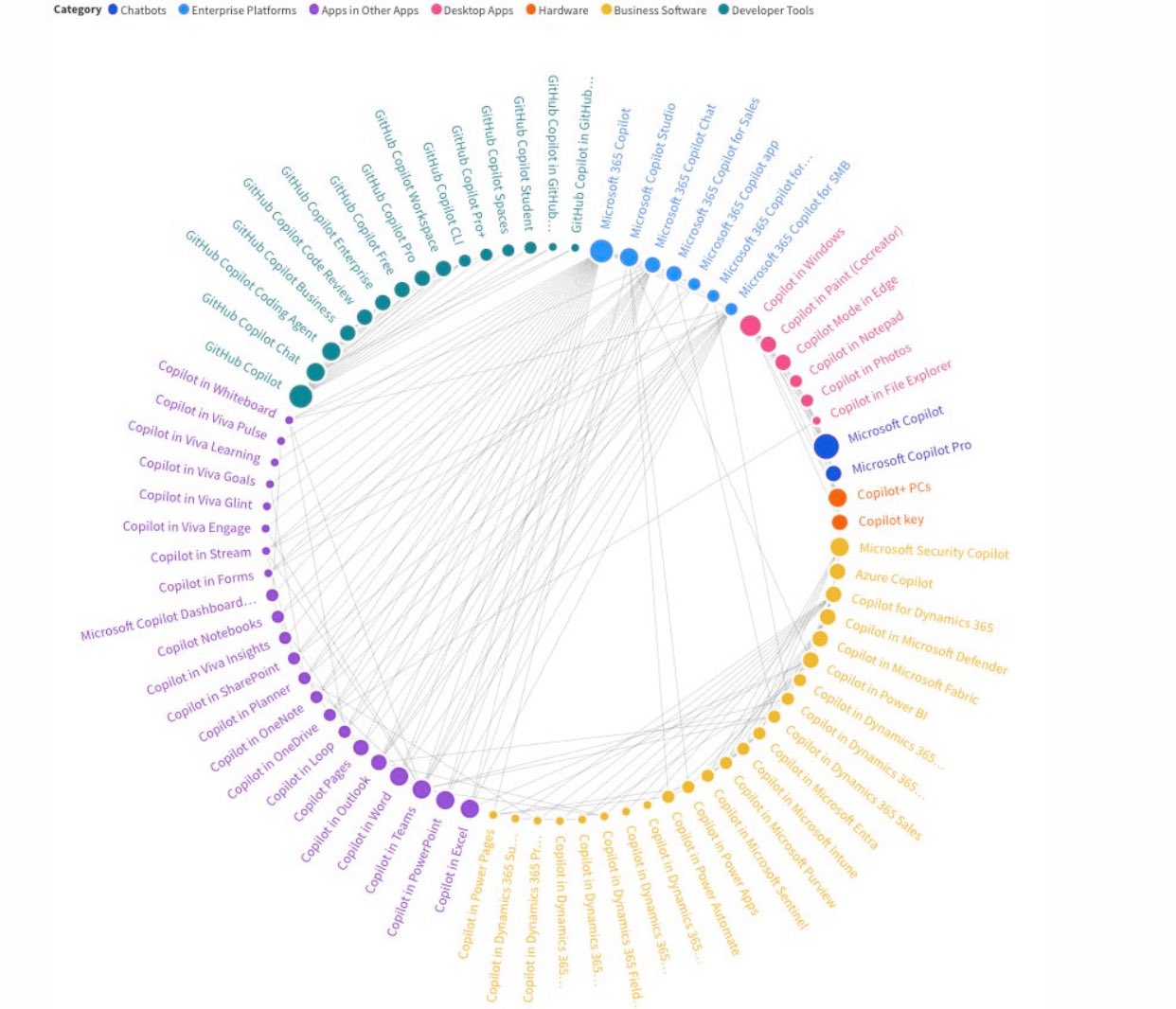
Microsoft now has a Copilot for almost everything.
A map of the Copilot range counts more than a hundred distinct Copilot products, spread across chatbots, enterprise platforms, desktop apps, hardware and developer tools. It is a striking picture of one brand stretched across an entire software estate, and a fair question for any buyer: how many of these does a company actually need, and how many quietly overlap?
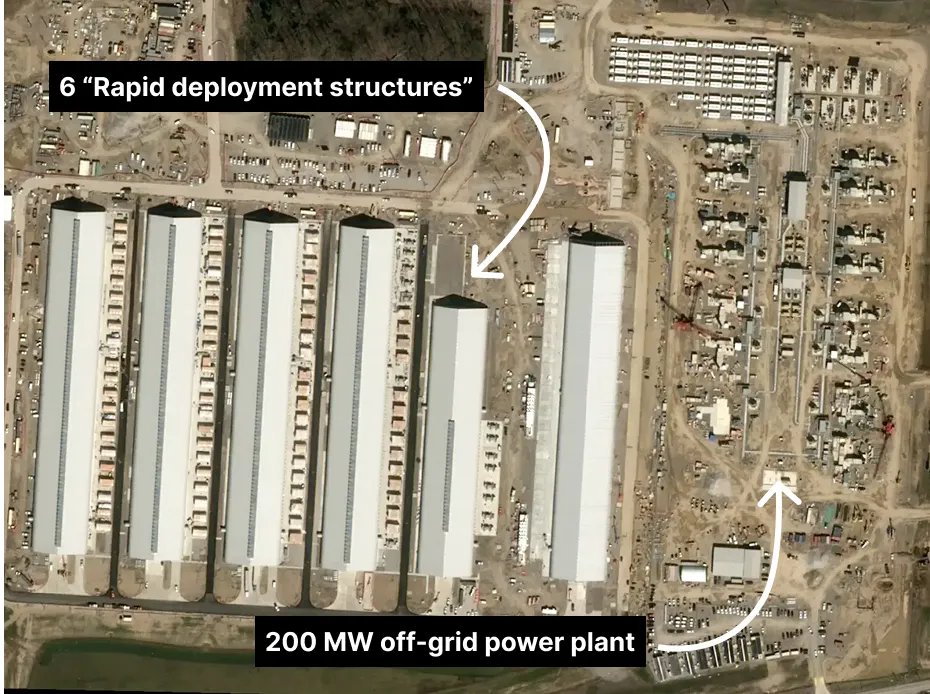
The build-out has a look now.
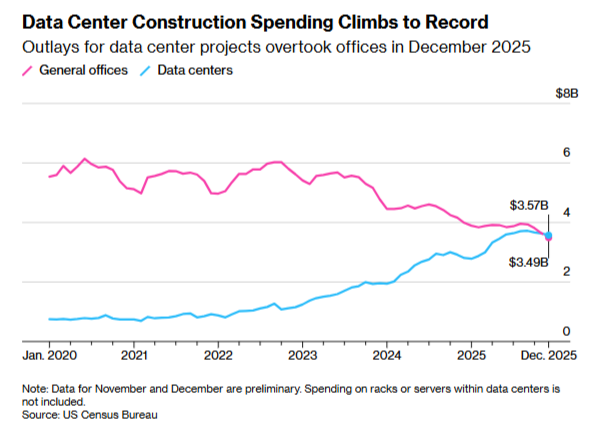
A satellite image of one hyperscale AI site shows six rapid-deployment structures going up beside a 200-megawatt off-grid power plant, built to run compute the grid cannot yet supply. The race for intelligence is also a race for electricity and land, and the physical footprint is now hard to miss from orbit.
One reader, Conor, sent a line that stuck with me: "the organisations that win won't have better AI, they'll have better questions." The gap between using the tools and knowing what to ask of them, he wrote, is widening faster than most leaders realise, and that is where the value is pooling. What unsettles him is how many businesses are automating before they have worked out what is actually worth keeping.
Last week I asked what you can see coming over the next five years, and a lot of you wrote back with super thoughtful answers. I am holding them. They belong in the "what's next" piece I am working on for a future week with Rob Wild. So Conor's is the only letter this week. Keep the predictions coming, though!
What readers were posting on LinkedIn this week. A single thread runs through them and through the essay: when the machine does more, what stays ours? Four voices working the same nerve.
Phil Leslie, Chief Technology and Innovation Officer, Cornerstone Research
Phil Leslie, Chief Technology and Innovation Officer at Cornerstone Research, the economic and litigation consulting firm, cut through the noise of the jobs debate. Almost every public claim about AI and work, he argues, is a cheap signal: the labs want their tools to look world-changing and benign, incumbents want to reassure their people, the doom side wants an audience, consultants want to sell change. None of it necessarily false, none of it a credible signal either. His own read lands squarely on this week's essay. AI is a powerhouse at producing analysis, but the more it produces, the more human judgement is needed to make sense of it. Demand for that judgement is soaring while the supply stays scarce. He's started writing it up under a name that fits: the judgment bottleneck.
Julia Kenyon, co-founder of yuzu+co, a business and human-performance coaching consultancy, and a former BBC global brand leader, pulled out the most striking number in a new productivity study: eighty-nine per cent of executives report no impact of AI on labour productivity over the past three years. Yet employees whose managers actively champion AI are far more likely to see gains. Her read is that the conversation is misframed, treated as a technology challenge when the evidence increasingly points to a human one. The organisations getting the greatest return, she argues, are the ones investing as much in the managers and human systems that make change stick as in the technology itself.
Kristin Luck, an investment banker at Oberon Securities and a board director across the data, insights and analytics sector, published the firm's first-quarter report and called a threshold crossed: enterprises have stopped experimenting with AI and started operationalising it. That shift, she writes, is reshaping valuations and accelerating consolidation. Buyers are concentrating capital on platforms that pair AI-ready data infrastructure, governance and proprietary data with recurring revenue. The flip side is the squeeze: the generalist data shops, the ones without a defensible data asset or a clear AI capability, are facing multiple compression. The market is beginning to price the difference between owning the judgement layer and renting it.
Kristi Zuhlke, generative-AI and analytics founder
Kristi Zuhlke, a generative-AI and analytics founder, surfaced the pricing question every knowledge-work vendor is circling. She'd spotted a market-research agency advertising cheaper options because AI streamlines the work, and noted that brands increasingly expect prices to fall for exactly that reason. The agencies are caught: cut prices to reflect the efficiency, or hold them and keep the margin? It's the commercial edge of the same shift the essay traces. When the machine does the grunt, the value of expert work gets repriced, and nobody has settled on the new number yet.
I pulled a book off the shelf this week, one I first discovered and could not put down in October. It was the first time I'd stopped to really understand how we got here. Leafing through my underlinings and scribbles, one made me smile. On page 56, a co-founder of Google's DeepMind makes a small point in an October 2023 interview: humans have a fast-learning middle layer of memory, between what we hold in mind now and what we know for life. Language models have nothing like it. My note read: "Claude Skills does this. Launched yesterday."
That gap is important. In artificial intelligence, the future shows up long before it ships. Seeing it was never the hard part. Believing it enough to bet on it was.
The future is already here, just not evenly distributed. It arrives wherever someone decides to act on what many others can already see.
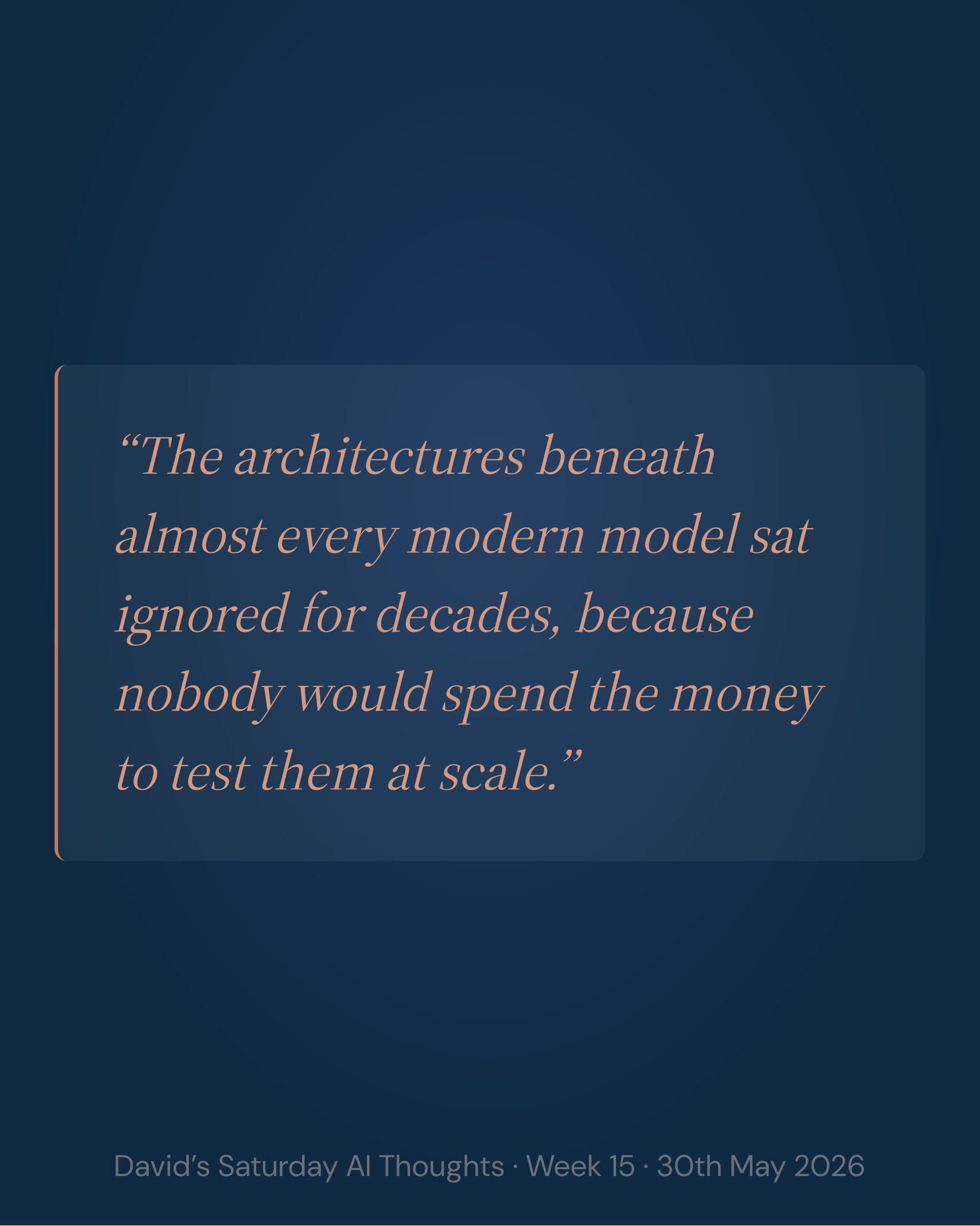
In the mid-2000s a few argued that enough computing power to rival the brain would make neural networks work, and that until then AI was futile. Most called it magical thinking. Even the person who would later coin a defining phrase of this era had dismissed it; the mistake, he says now, was thinking algorithms mattered more than compute. But you cannot run trial and error at scale without vast compute! The architectures beneath almost every modern model sat ignored for decades, because nobody would spend the money to test them at scale.
In 2017 Google published the breakthrough beneath ChatGPT, a paper called "Attention Is All You Need." It gave the idea away, free, because in 2017 it did not look like the crown jewels. It looked like a faster way to translate French. It held the door open and walked past it.
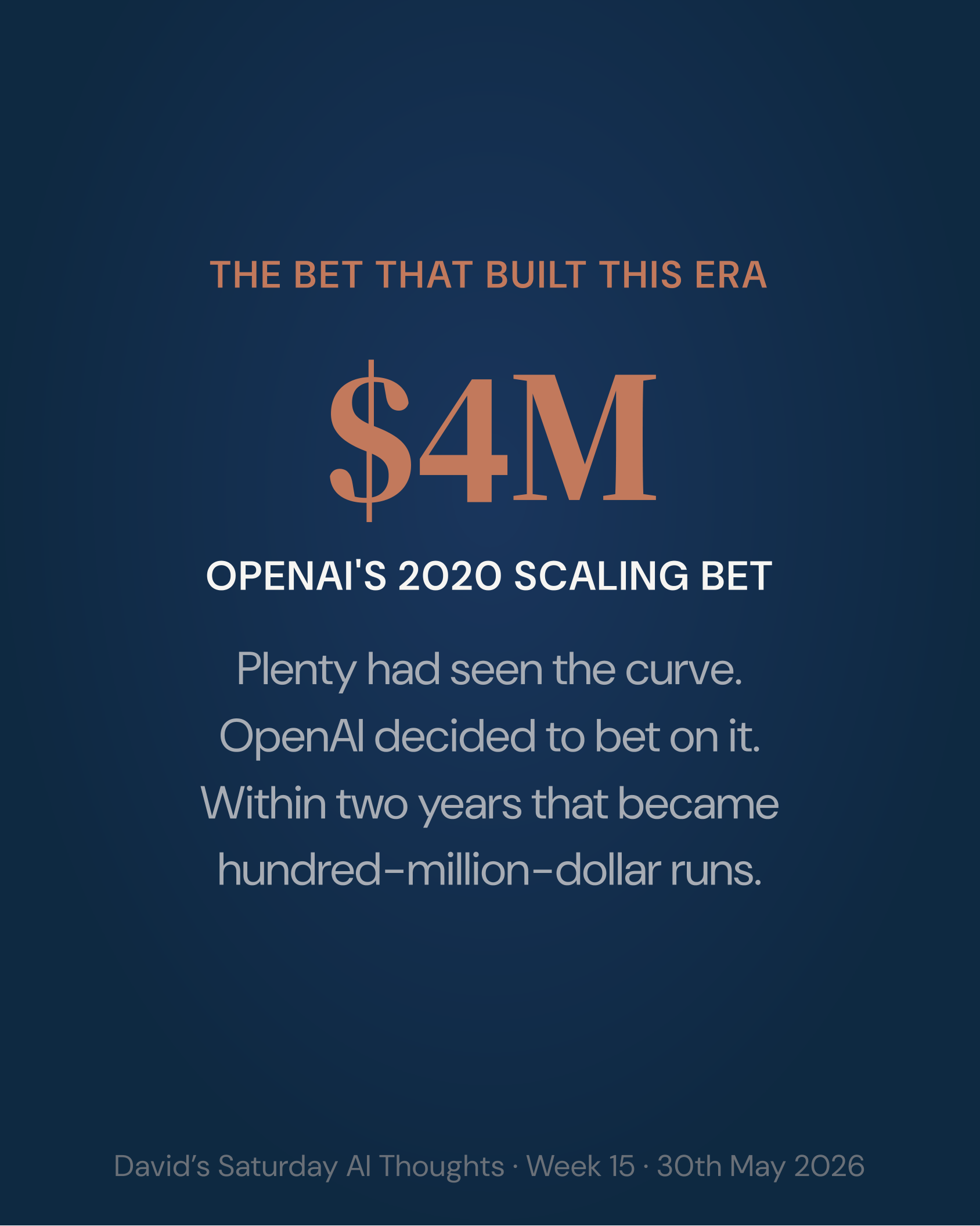
In 2020 OpenAI bet four million dollars on a model built from that paper. It was not the first to spot what it called scaling laws, the curve linking compute and data in to capability out. Plenty had seen the curve. OpenAI decided to bet on it. The bet paid off, and within two years had become confidence in hundred-million-dollar training runs. The largest now cost billions.
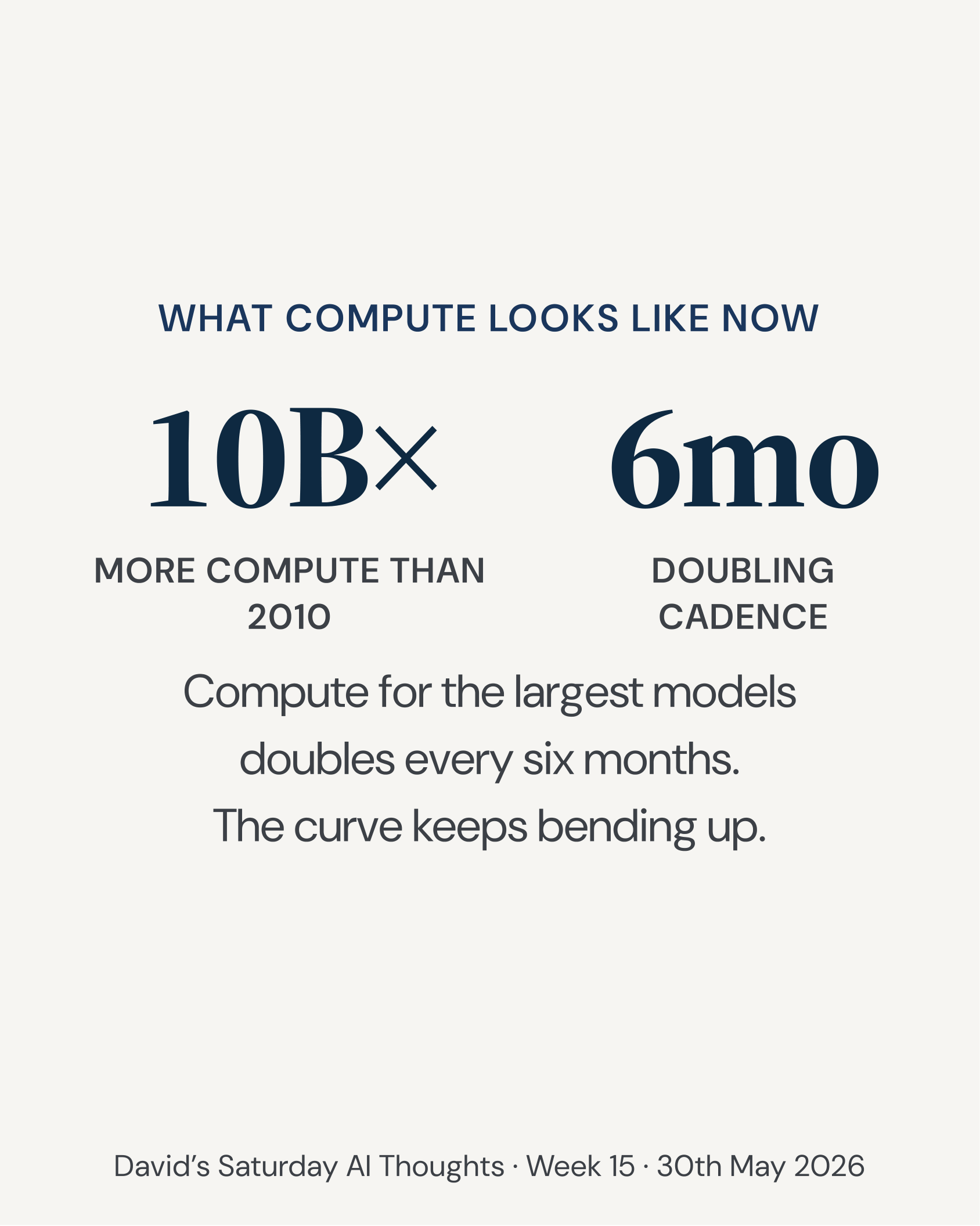
Three things turned the idea of AI into a useful system, all at once. The internet grew big enough and open enough to provide enough training data. Graphics cards built for video games turned out to be the right hardware, and enough lay around to do the maths. And people were willing to write the cheques. Compute for the largest models is now around ten billion times what it was in 2010, doubling every six months.
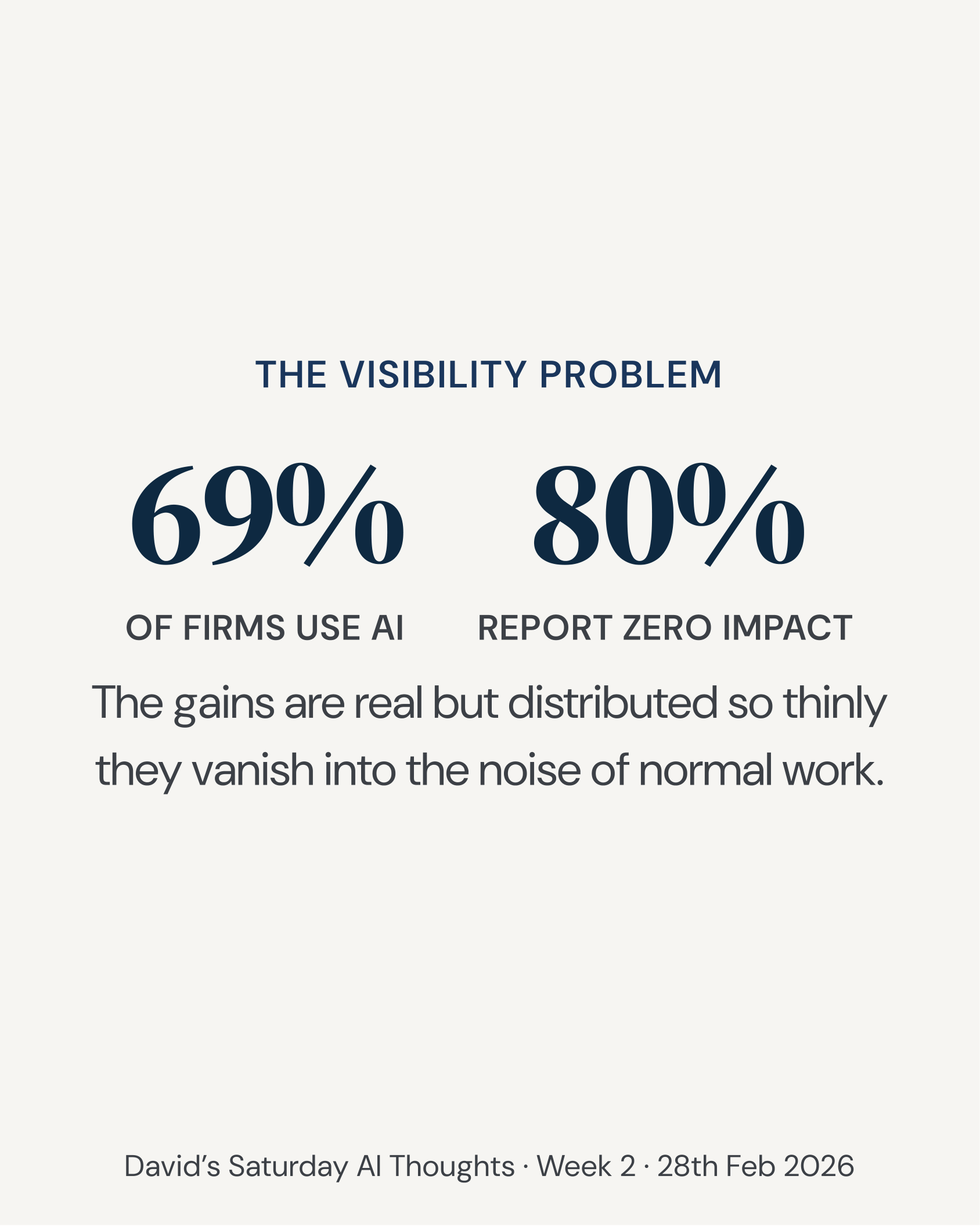
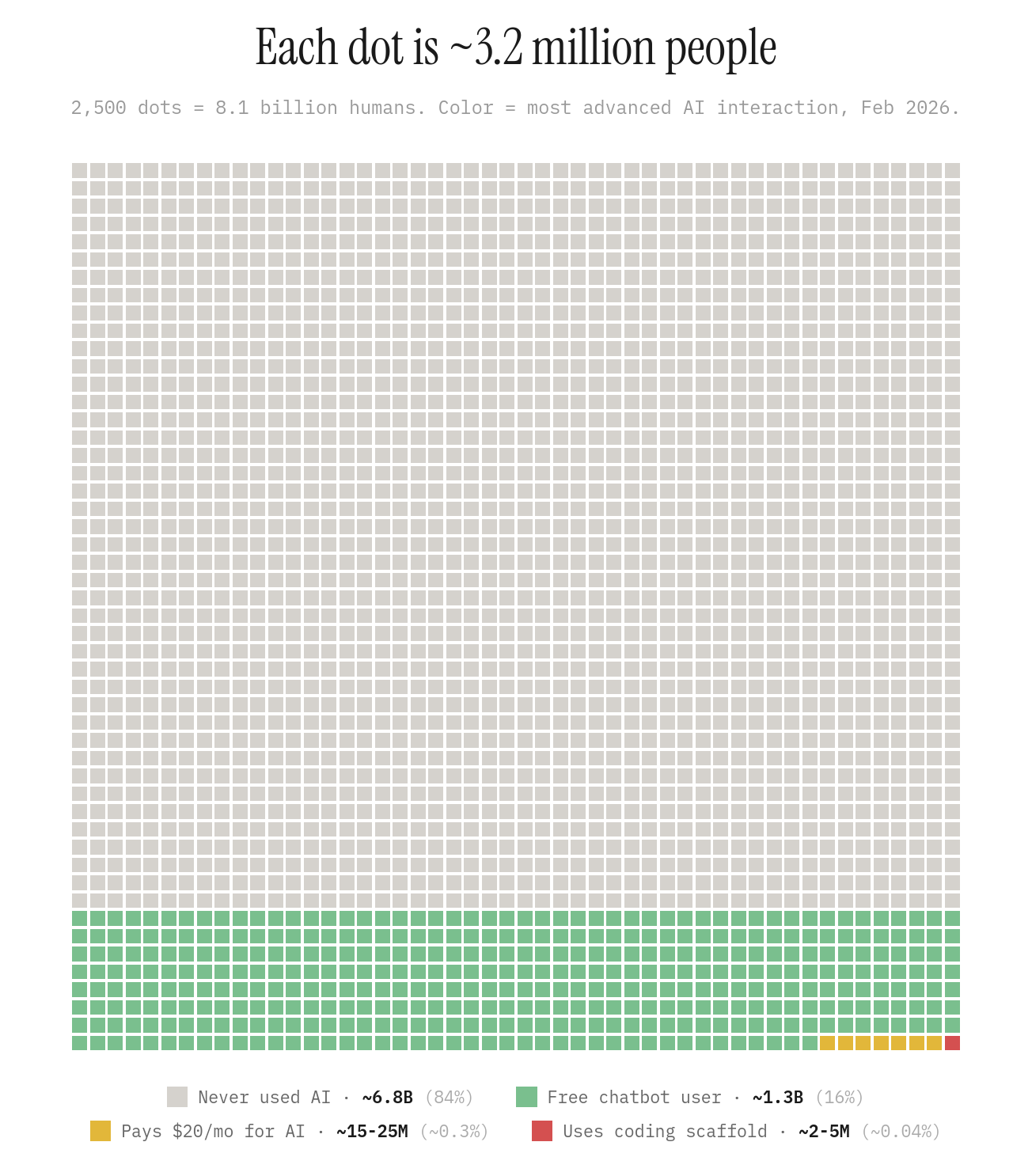
ChatGPT, in November 2022, was the wake-up, and the start of the Generation One era: AI good enough for professionals to use. My team and I cleared our calendars in late 2022 and sat with Hollywood screenwriters, Grammy-winning songwriters and senior executives to guide them through doing work they cared about and they judged to be world class with it. Eyes lit up every time. In late 2023 we helped one of the world's largest consumer-goods companies innovate faster. But adoption was slow. A year on, most organisations still had not moved. By mid-2024 only around 5% of companies used AI officially, despite 75% of knowledge workers using it privately, half of them hiding it from their bosses. Individuals adopted. Organisations slept.
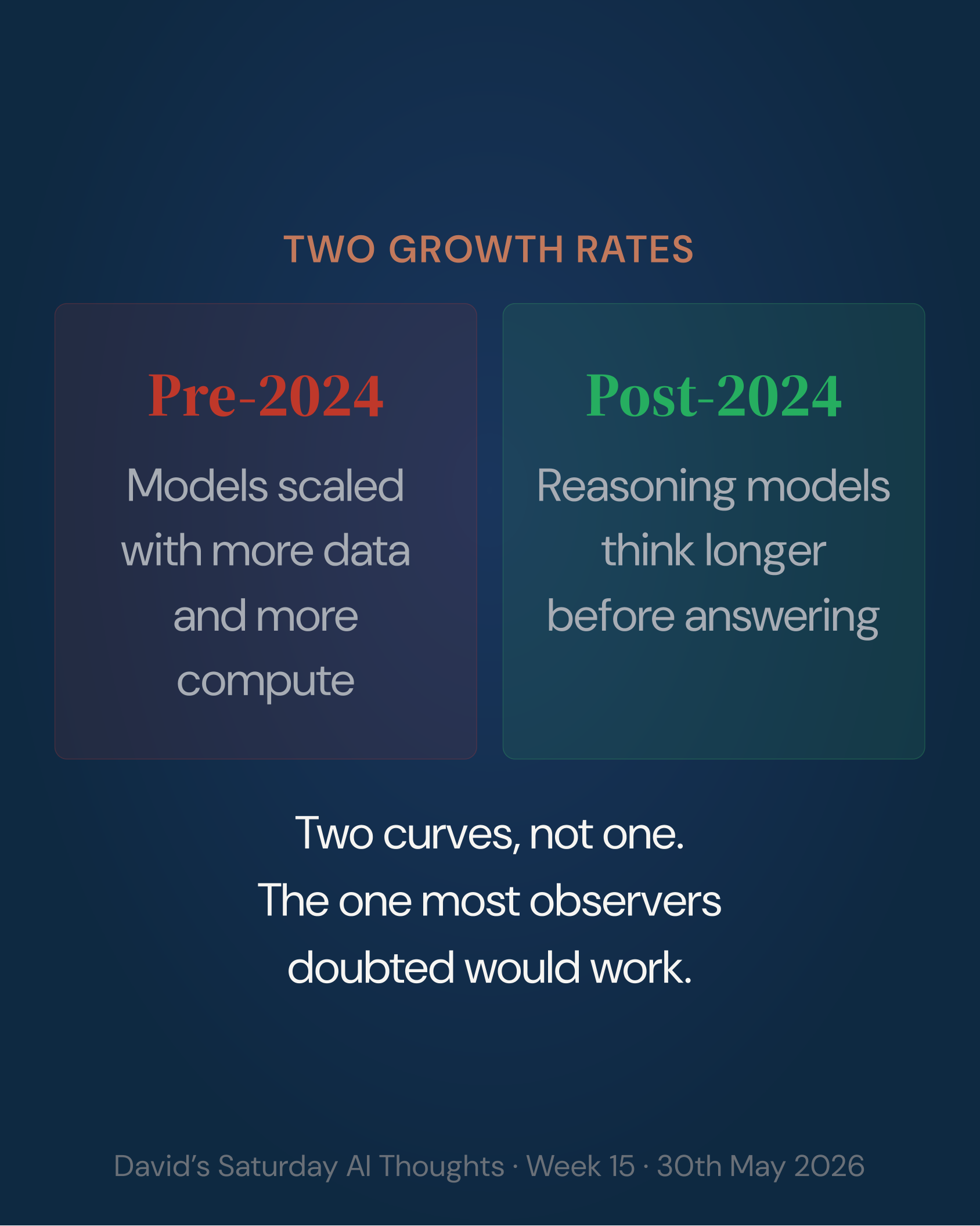
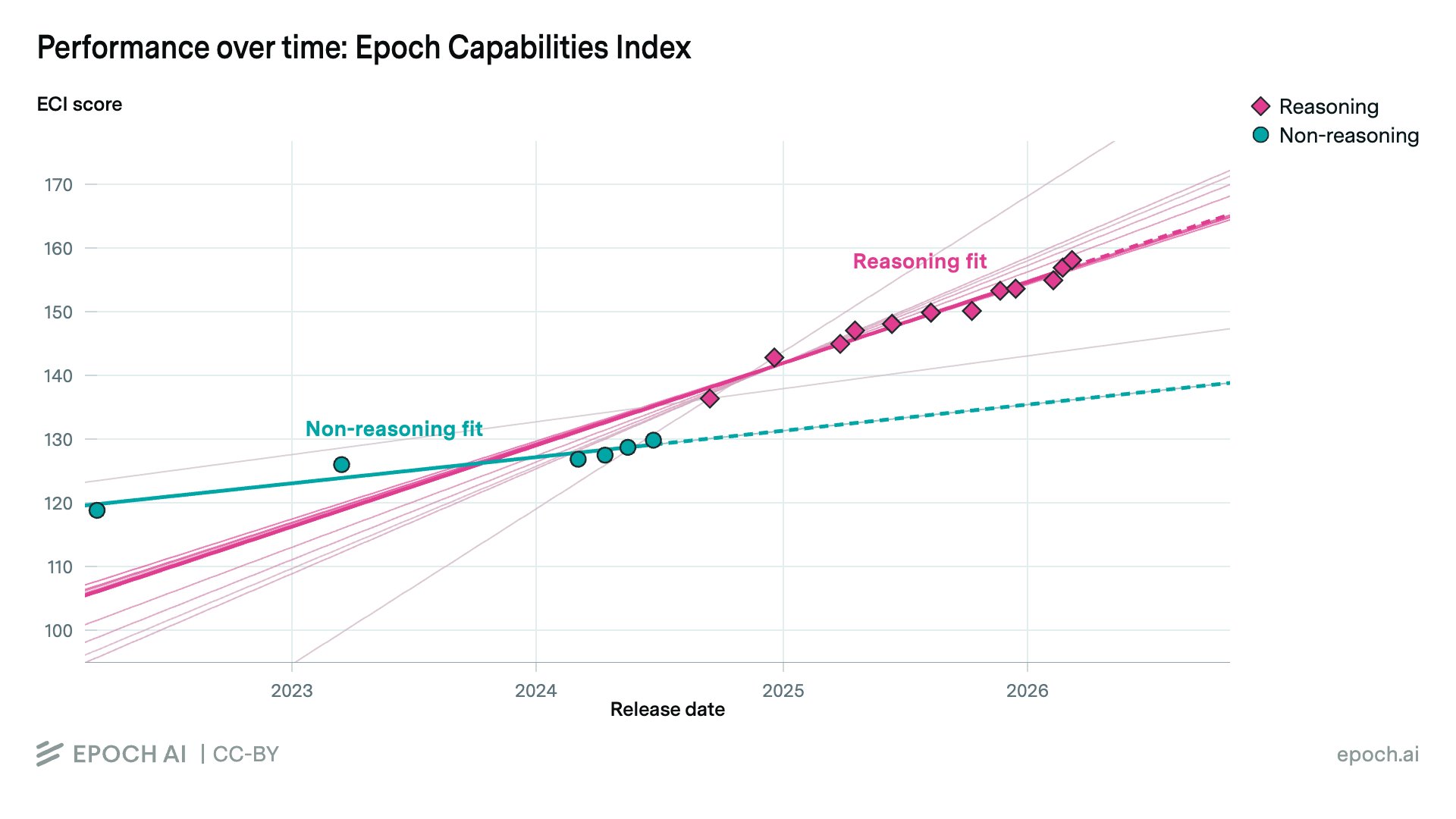
Then the models got better, in two ways that mattered. In late 2024 OpenAI shipped the first reasoning model, trained to think for longer before answering, rather than quickly reaching for a first instinct. Eight months earlier, one of the field's most informed observers had doubted this kind of training would add any new capability. It did. Plot the older models on a log scale, then the reasoning ones, and you get two growth rates. Two curves, not one.
They also learned to use tools, one at a time. Calculation, to do arithmetic. Search, to check facts rather than half-recall them. Computer use, to click, type and act.
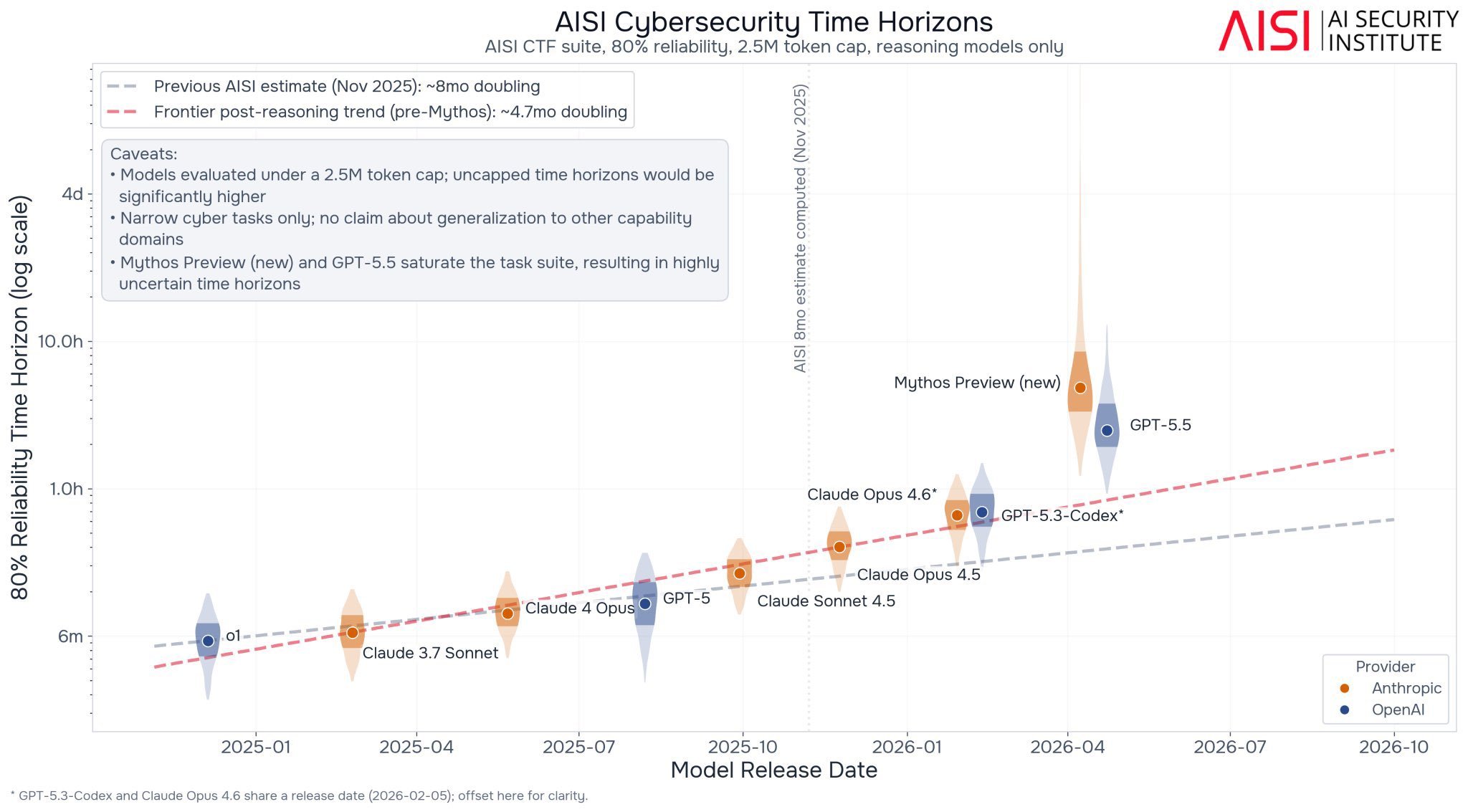
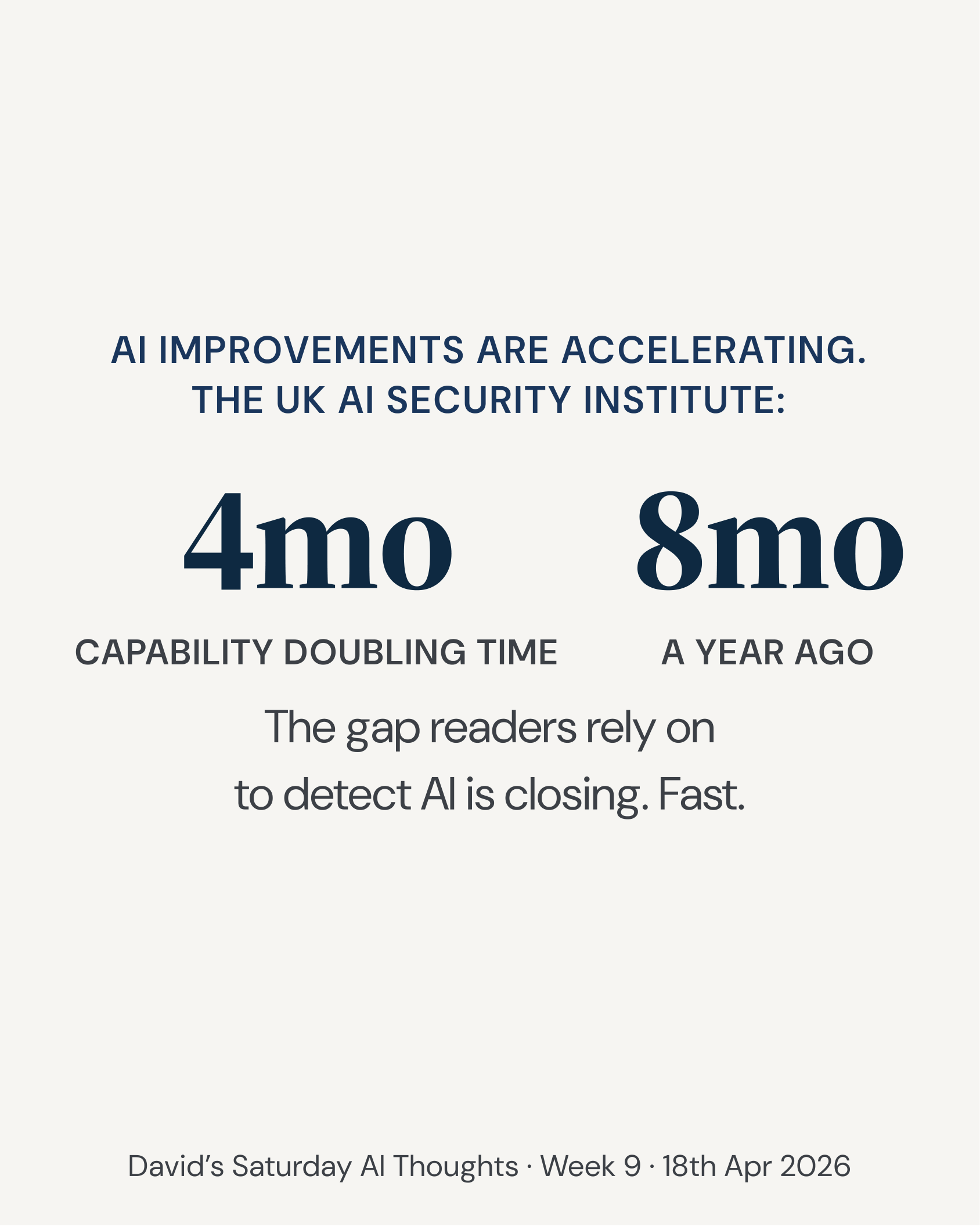
Then the agent era. The unlock had been named months before it arrived: not bigger context windows, but reliability. A model that is 80% reliable, doing five things in a row, succeeds about a third of the time. At 95%, about three-quarters. Cross that line and long-running agents finally work. That is Generation Two, the world we stepped into about five months ago. Agentic systems now reliably do the equivalent of many hours of expert work at a single press of a button. Every four months they do roughly twice what they could before.
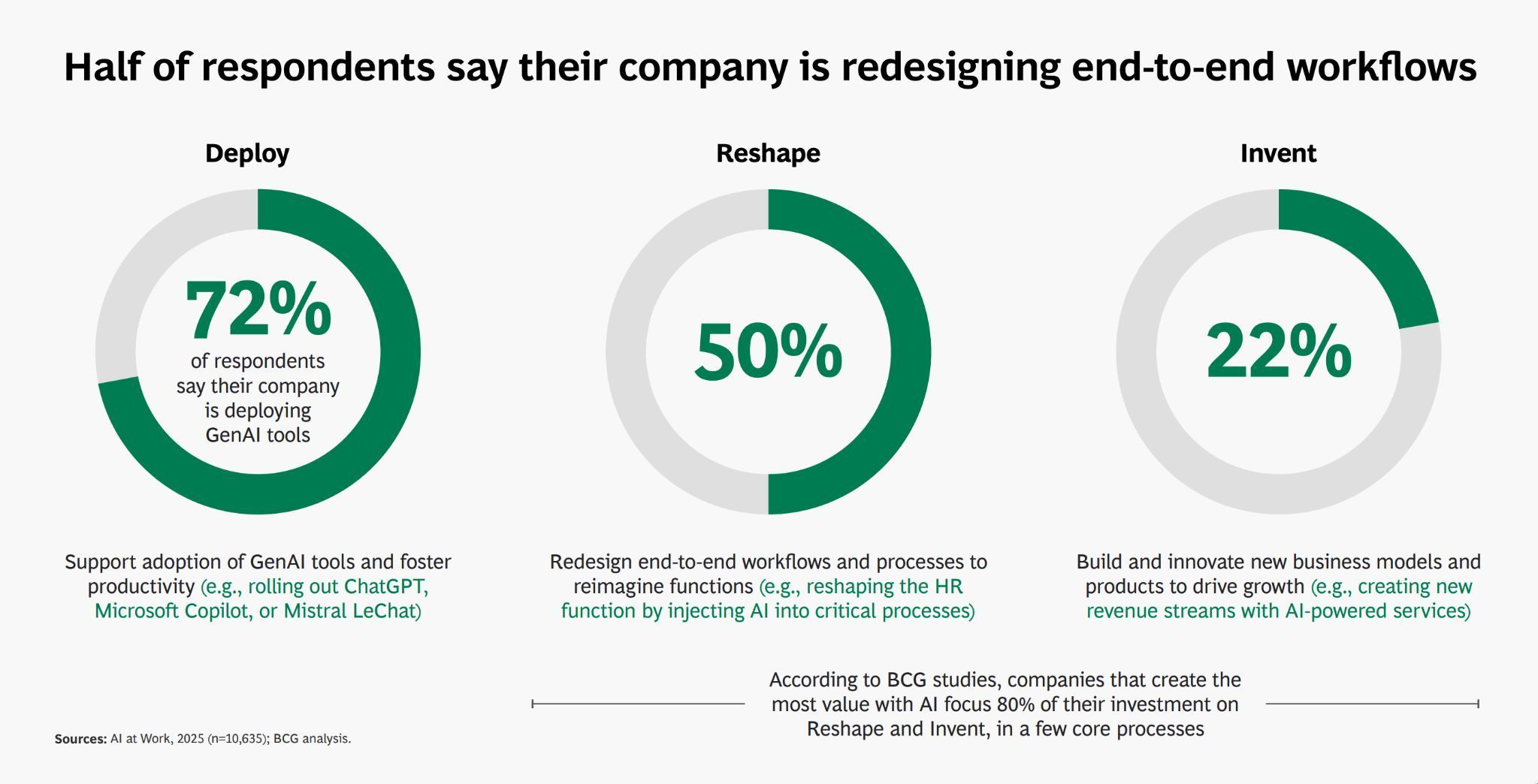
Meanwhile, businesses leapt into action, but soon learned that AI adoption was more reliant on organisational change than on technology rollout. And, even when you have a blueprint, organisational change is slow and hard. Individual productivity benefits came quickly but large team and organisational level benefits are still being sought by most firms.
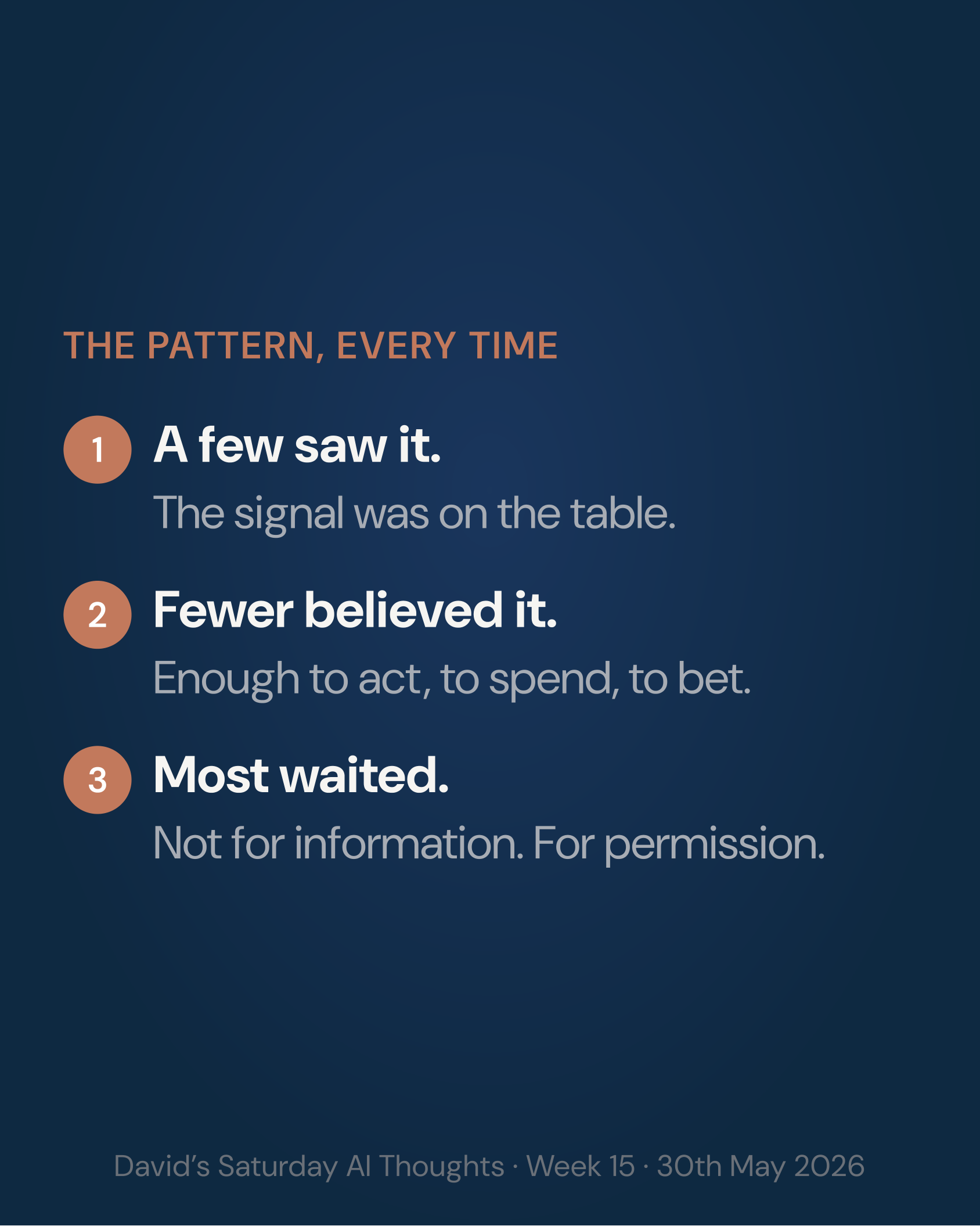
There's a pattern to the AI advances that got us here. Each time, a few saw them, fewer believed them enough to act, and most waited. The waiting was never for want of information. The future sat on the table, for anyone willing to pick it up.
It still does. What comes next is as visible now as every step before it. The only question that has ever mattered is who acts on what they can already see.
In coming weeks I will share "Where We're Going Next," written with Rob Wild at L.E.K. We have formed our view. But we would rather hear yours first: reply with a paragraph on something you can see in the next five years that excites you, scares you, or that most people are missing. We will publish them online, anonymously or as you prefer.
Three things worth knowing
1. AI can now find software vulnerabilities faster than humans can patch them. Discovery is no longer the hard part; verification is.
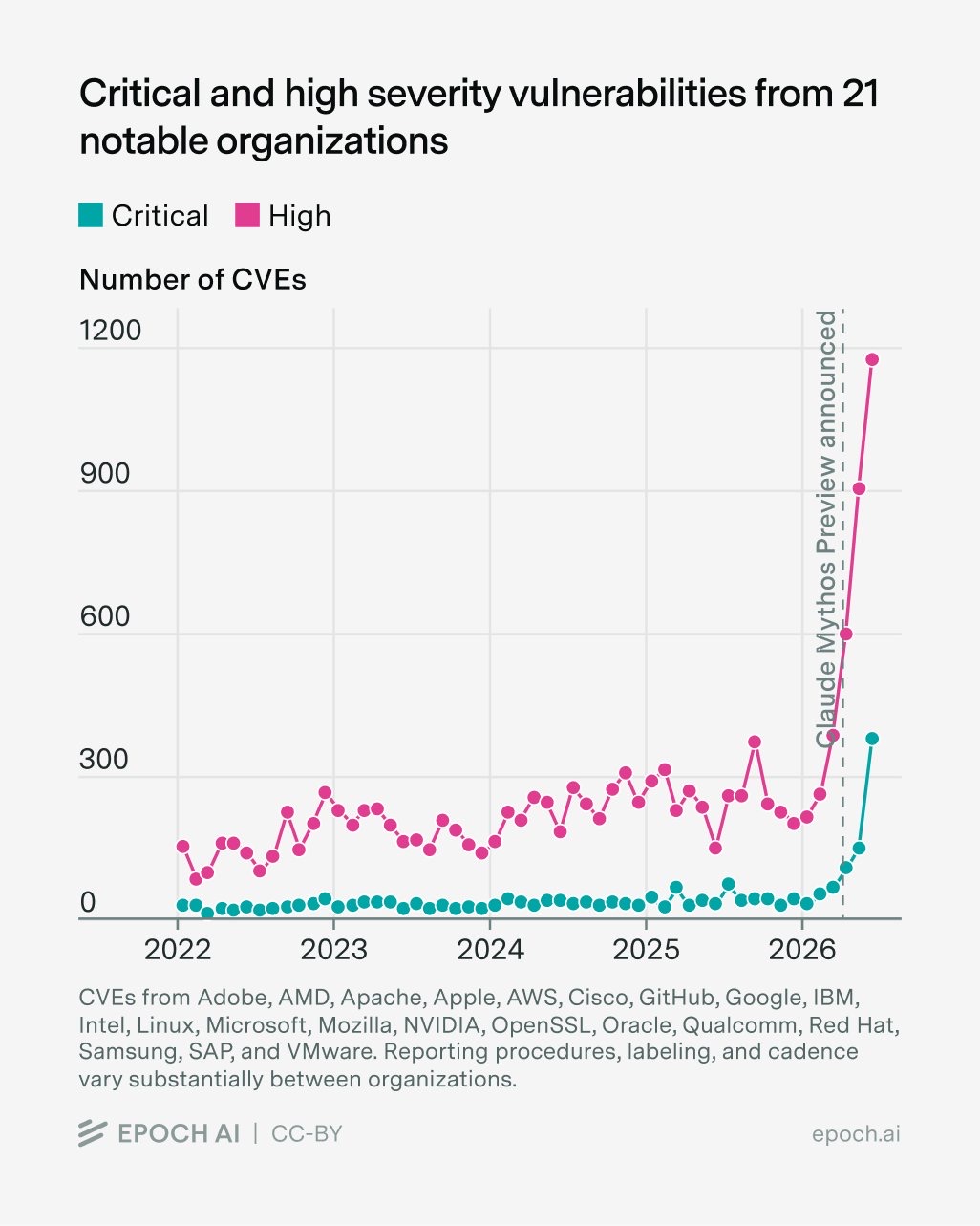
A frontier model handed to fifty cybersecurity partners surfaced more than ten thousand critical or high-severity vulnerabilities in the systems it was pointed at. Cloudflare, the internet infrastructure firm, has roughly four hundred major bugs to work through. Palo Alto Networks, the cybersecurity firm, shipped five times more patches than its usual release cadence. Maintainers have asked the developers to throttle the discovery rate, because there are not enough security professionals to close the gaps before attackers find them. Software security used to be limited by how fast new vulnerabilities could be found. It is now limited by how fast humans can verify, disclose and patch them.
2. A general-purpose AI model has autonomously disproved a 1946 conjecture in geometry. Independent mathematicians have verified the proof.
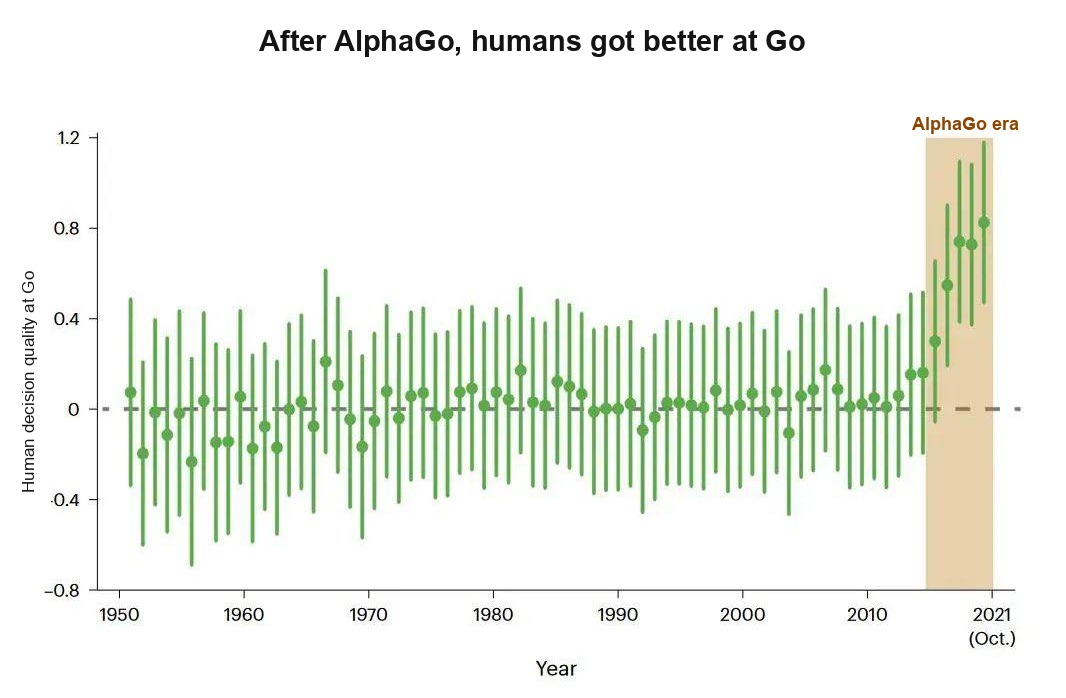
OpenAI handed a general-purpose reasoning model a long-held belief tied to a 1946 planar unit-distance problem of Erdős, the prolific Hungarian mathematician, and the model produced a disproof. Other AI models have since solved further long-standing problems. The wrinkle is that the others were purpose-built for mathematics. OpenAI's was not. Machines now clear the tractable tail of problems fast, which pushes the human frontier towards the problems that still resist them. After AlphaGo, the DeepMind system that beat the world's best human Go players in 2016, the skill of human Go players noticeably improved. Like Noam Brown, an OpenAI researcher who helped build its reasoning models, I suspect we will see a similar pattern in maths. And then the same pattern in business?
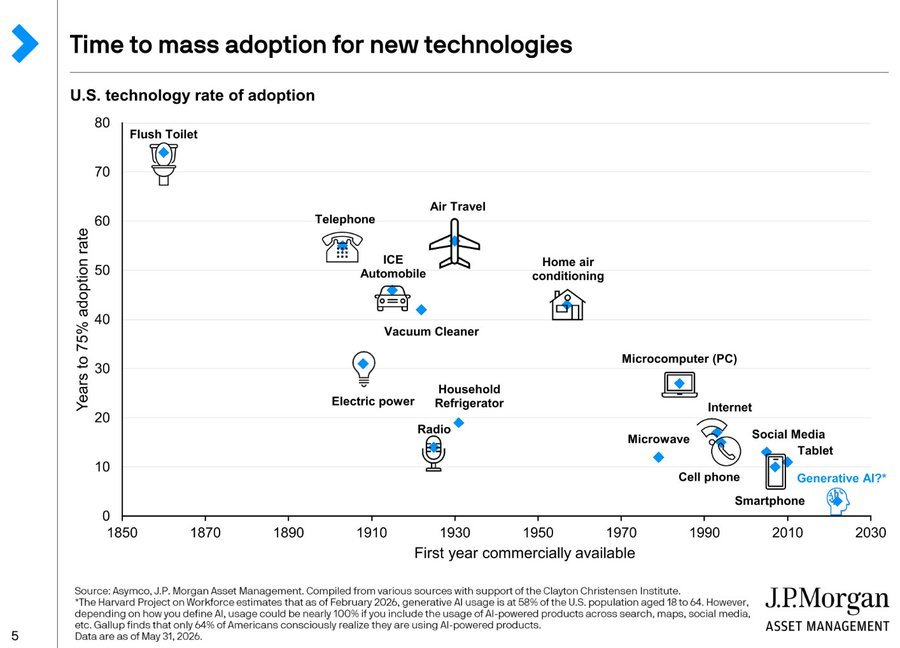
3. Generative AI use among American adults has hit 58 per cent in four years. The personal computer took sixteen years.
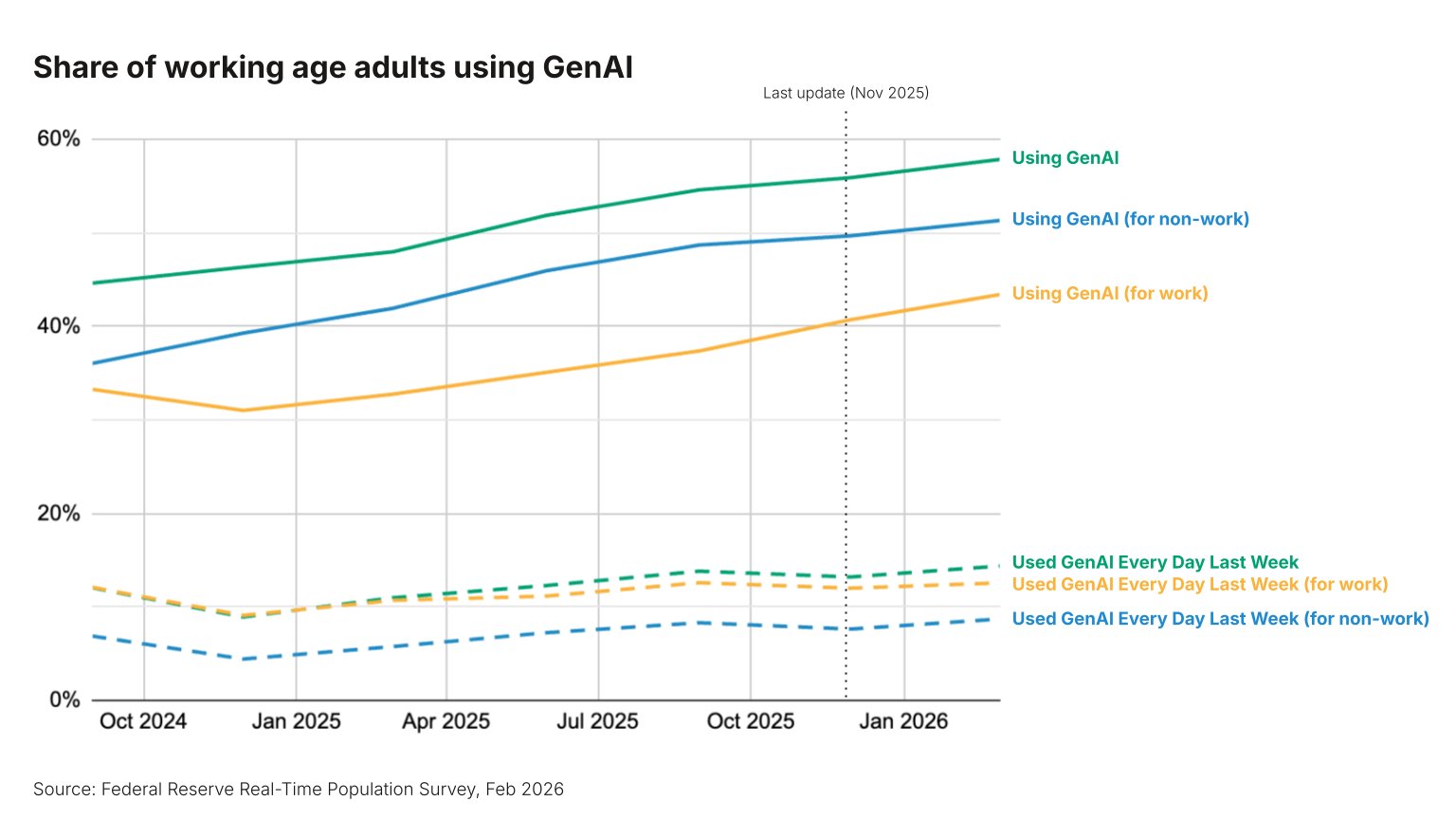
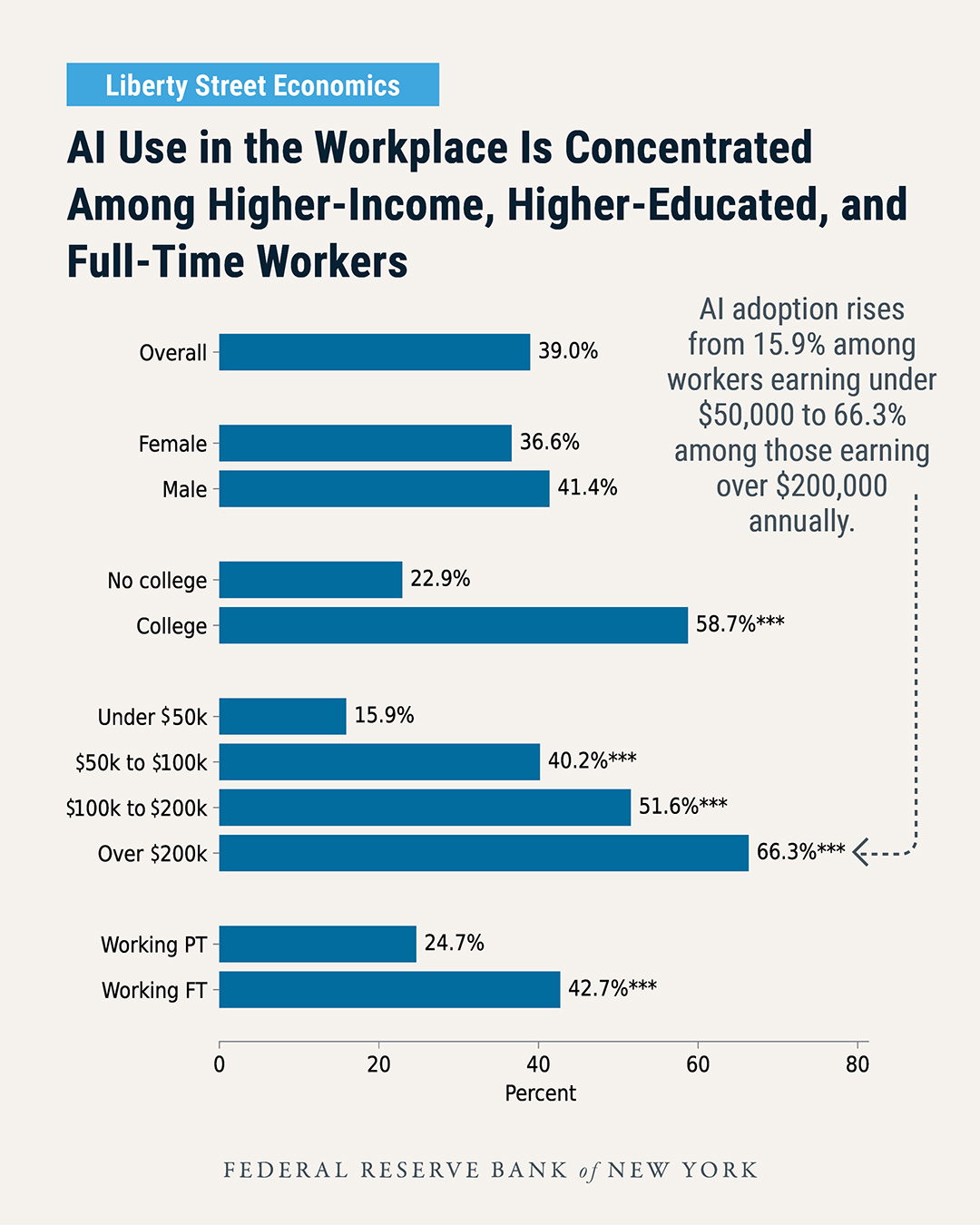
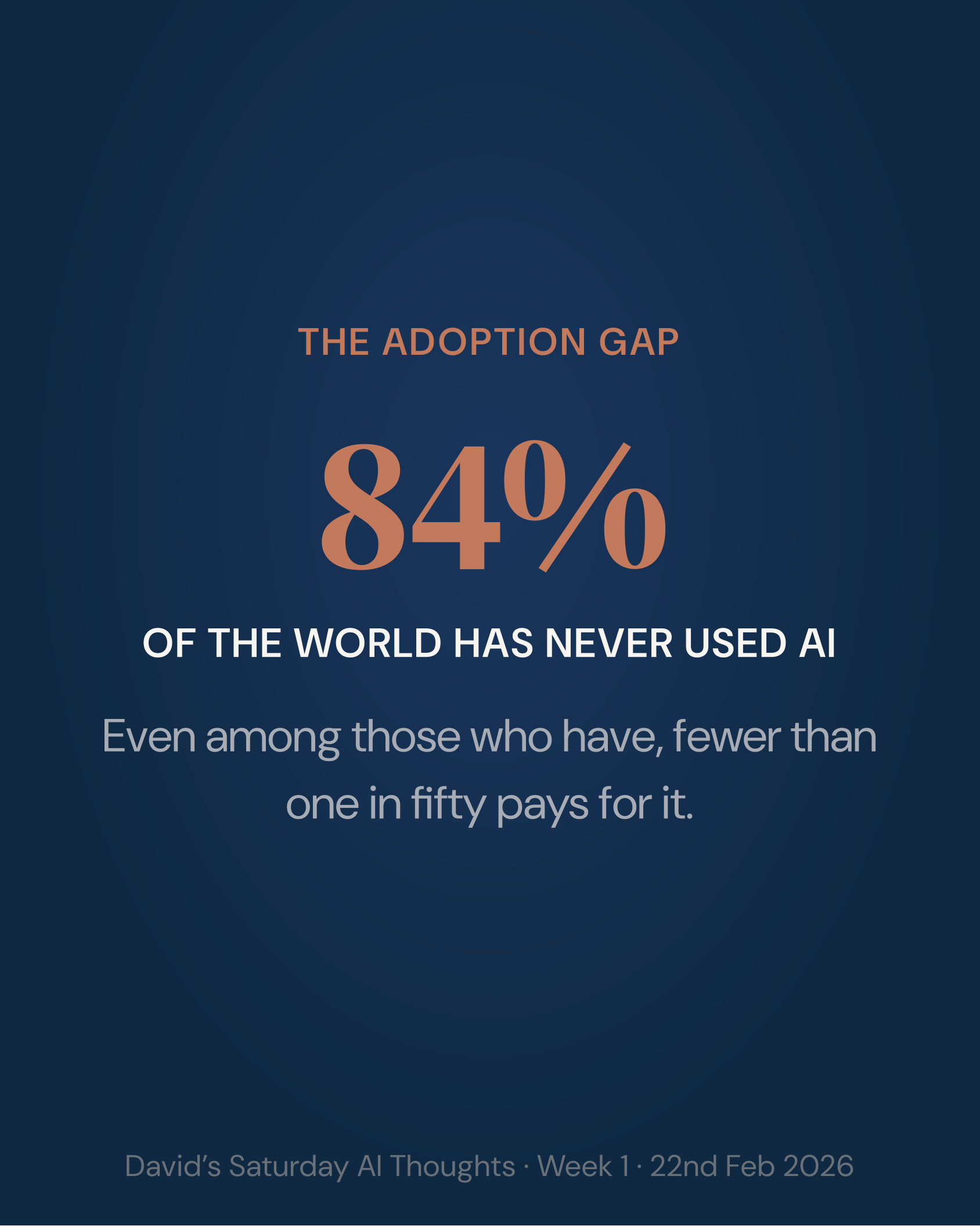
The Federal Reserve's February 2026 survey of working-age adults puts overall adoption at 58 per cent, up from around forty-five per cent in October 2024 but recently flat. Work use is forty-four per cent. Non-work use is fifty-one. Daily use sits at fourteen per cent and saves an estimated two-point-two per cent of total work hours. Alfred Lin, a partner at the venture capital firm Sequoia, notes this is the penetration level the personal computer took sixteen years to reach: a four-fold acceleration on the closest analogue. The caveat is the plateau. The early-adopter phase is over. The hard part starts.
The most productive sessions I see with senior leaders don't open with a clever prompt. They open with the user pasting context, their role, the situation, what they're trying to do, and then asking two questions. First: "what else do you need to know about me to help me well?" Second: "what could you do for me right now that I haven't asked for?" The first surfaces gaps the user wouldn't have spotted. The second produces use cases the user didn't bring. The blank-prompt paralysis dissolves.
2. Either AI challenges you at the start, or you challenge AI at the end. Don't skip the challenge.
A leader I sat with this week had let an AI output stand without pushing back. My diagnosis: two patterns work and one fails. You can challenge before the model starts: share your point of view and ask the model to challenge it, force it to surface the holes and the strongest counter-argument. Or you can challenge after the first draft: force a rewrite, name what's wrong, make it earn the second pass. The pattern that fails, and the one I see most, is read-and-accept. Pick one of the two postures and don't drift into the third.
3. Ramble into the microphone, let the machine find the structure.
A managing director I coached this week outlined obsessively. Some 700 words of outline for a 1,500-word article. The cost of structuring before writing was eating his weekend. The fix was inverting the order. Pick up your phone, dictate the mess, paste the transcript into your model, ask it for the through-line. Structure becomes the cheap thing. Particularly powerful for the executives who think by talking, which is more common at the top than people admit.
Last week's edition on Elliott's maths homework drew the warmest postbag in weeks and the sharpest counter-anecdote. One reader wrote in from a similar evening, this time a chemistry problem with their fourteen-year-old. The teenager mis-specified the AI query, got a different answer to the parent's, and absolutely refused to back down: "You're wrong, the AI says…". A marketing lead at a hospitality group sharpened the underlying point: "the difference between it doing it for you and you getting it is the difference most are not doing." A reader two years into their first job described the generational arc, from being told to use AI more to being told to "use it as a support, not a substitute" inside the same eighteen months. Full reader reactions online →
What readers were posting on LinkedIn this week echoed the essay's split between individual and organisational adoption. David Johnson-Igra, founder of Scribes Consulting, an AI advisory for communications leaders, opened on the sharper end of the curve: "A year ago, I didn't think AI would impact my work. Then, within a few weeks, I was out of work." He built the advisory in the gap. Rahim Hirji, keynote speaker and author of SuperSkills, counted his own manuscript: "human" 194 times, "AI" 56 times. He calls the cohort Generation Human. And Dylan Jones, Chief Communications Officer at Bold Square, set two C-suite memos side by side. Earlier this year: we're going to be the most AI-forward organisation in our space. This month: cut down on tokens, they're getting expensive, we'll just SAY we're AI-forward. The performative version of organisational adoption. More online →
The richer version of this week's three Try-Thises, with copy-paste prompts. Each prompt has a Copy button - click and paste into your AI of choice.
1. Ask the model what else it needs to know
Use this when you've opened a fresh chat and don't know how to start. Paste your context first, then this prompt. The two-questions-in-order matters: the first calibrates the model, the second harvests use cases you wouldn't have thought to ask for.
I'm going to paste some context about me and my situation. Then I'd like
you to do two things in order.
First: tell me what else you need to know about me to help me well.
Don't guess, name the gaps.
Second: given everything I've just told you, list five things you could
do for me right now that I haven't asked for. Be specific. Pick uses
that would surprise me.
Here's my context:
[paste your role, your situation, what you're working on this week,
what you're worried about, the constraints you're under]
2. Challenge AI at the start or at the end
Two prompts. Use the first when you want the model to push back before answering. Use the second when the answer is already in front of you and reads too clean.
Challenge before the model starts:
Option A - challenge first
Before you answer the question I'm about to ask, push me first.
What's the strongest case against what I'm about to ask for? Where's
the wrong assumption in the question? What would the smartest person
in the room push back on?
Name the antagonism out loud, then answer my actual question, but
answer it like someone who has already heard the objections.
My question: [your question]
Challenge after the first draft:
Option B - challenge after
Take the answer you just gave me. Don't polish it. Find the actual
weakness.
What's the part you're least confident about? Where did you hedge?
What would a senior reviewer underline in red? Name three real
problems, then rewrite to fix them. The rewrite should look meaningfully
different from the original, not just smoother.
3. Ramble into the microphone
Open your phone's voice recorder. Speak for two to ten minutes about whatever you're trying to write or think through, no notes, no plan. Transcribe it (most phones do this automatically now; otherwise paste into a transcription tool). Then run this prompt.
I'm going to paste a transcript of me rambling out loud about [your
topic]. I haven't organised it. I haven't edited it. I was thinking
by talking.
What I want from you:
1. The through-line, what's the argument I'm trying to make, even
when I'm not making it cleanly?
2. The three or four key beats in the order that would actually land.
3. The phrases I used that are doing real work, keep those. The
phrases that are scaffolding for me to find my thinking, drop those.
Don't preserve my words. Preserve my thinking.
Here's the transcript:
[paste your dictated transcript]
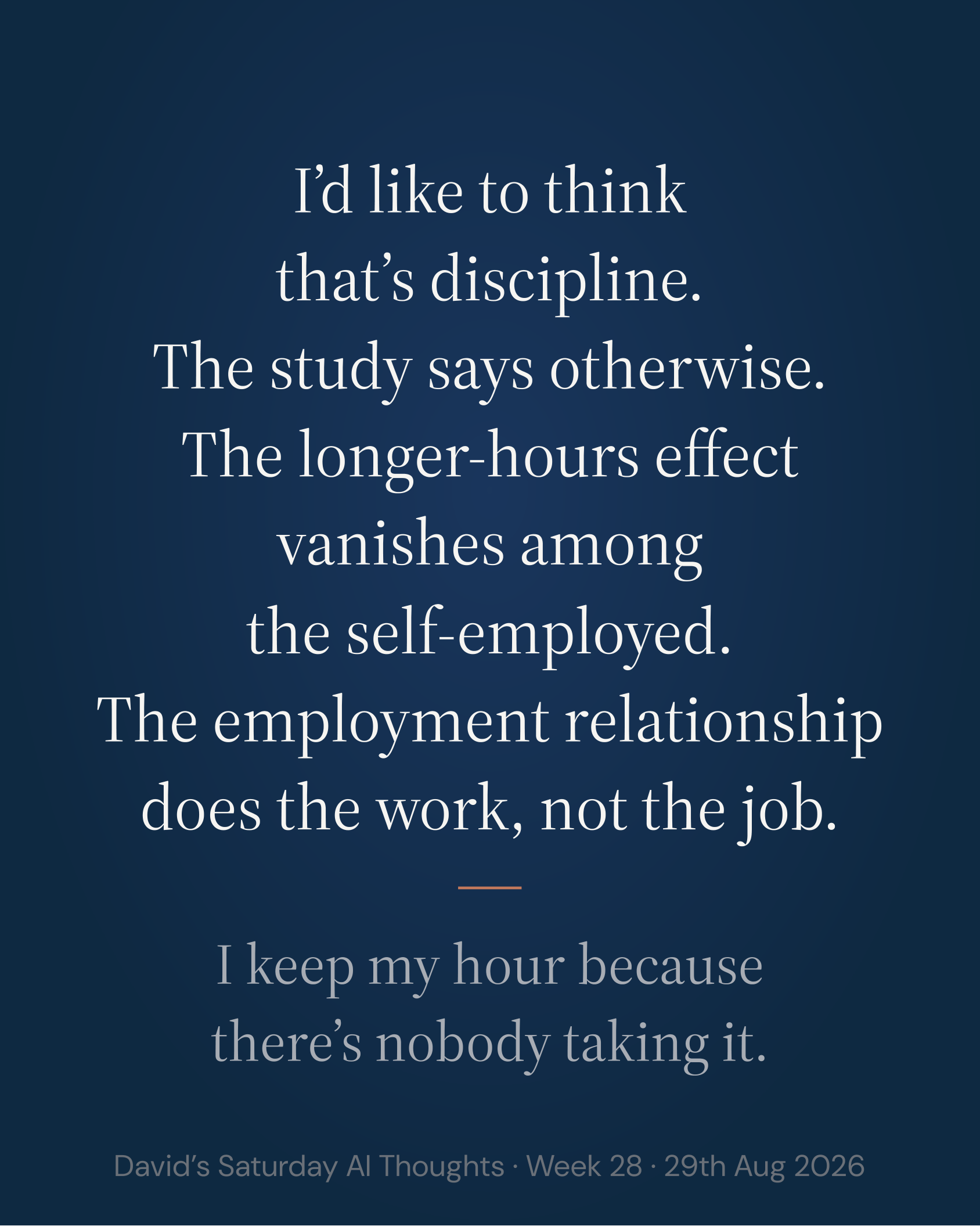
Goldman's David Solomon thinks AI won't cut headcount. A new study finds we badly overestimate the time it saves us.
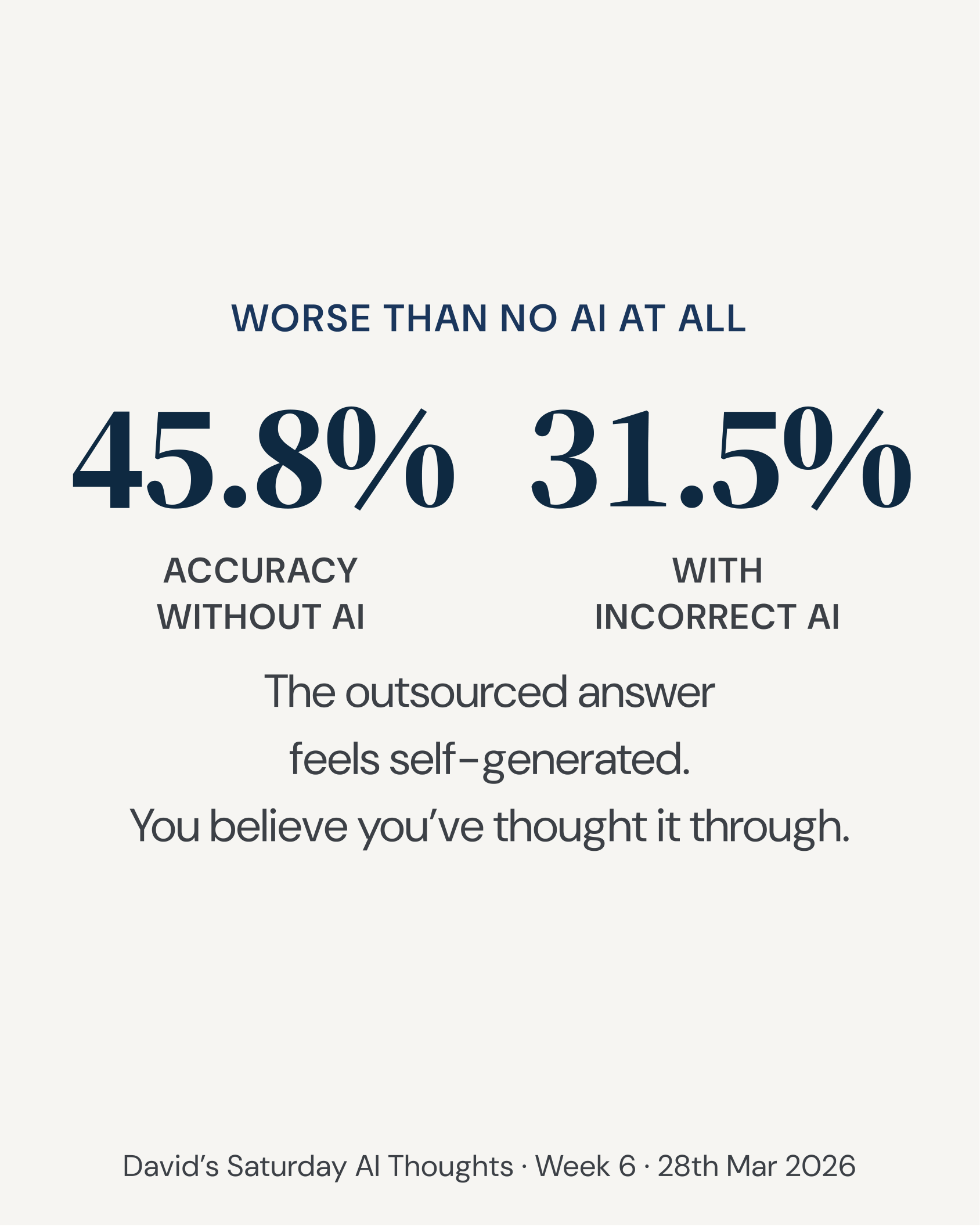
Both pieces of evidence landed within a week. Solomon, in a New York Times op-ed, made the historical case: automation has never compressed headcount because rising expectations absorb productivity gains. Excel did not shrink Goldman. AI will not either. Separately, three pre-registered studies of 2,691 people by Sunny Yu, Myra Cheng and colleagues at Stanford looked at cognitively simple tasks, arithmetic, spell-check, answering quick questions. On those, people reached for AI even when it saved them no meaningful time, and consistently overestimated how much it saved. The researchers call it the efficiency-gain illusion, and they show it compounds: the more you lean on AI, the more you misjudge what it is doing for you. The two findings sit at different scales. Solomon's is the firm, where real gains are absorbed by rising expectations, the same absorption the essay describes, read off the firm's books rather than its org chart. Yu's is the individual, where on a small task the gain was often imaginary to start with. The honest read: the time saved is easy to overstate, both because firms reabsorb it and because, on the small stuff, it was never there.
If headcount holds but its shape shifts, the Big Four are the tell.
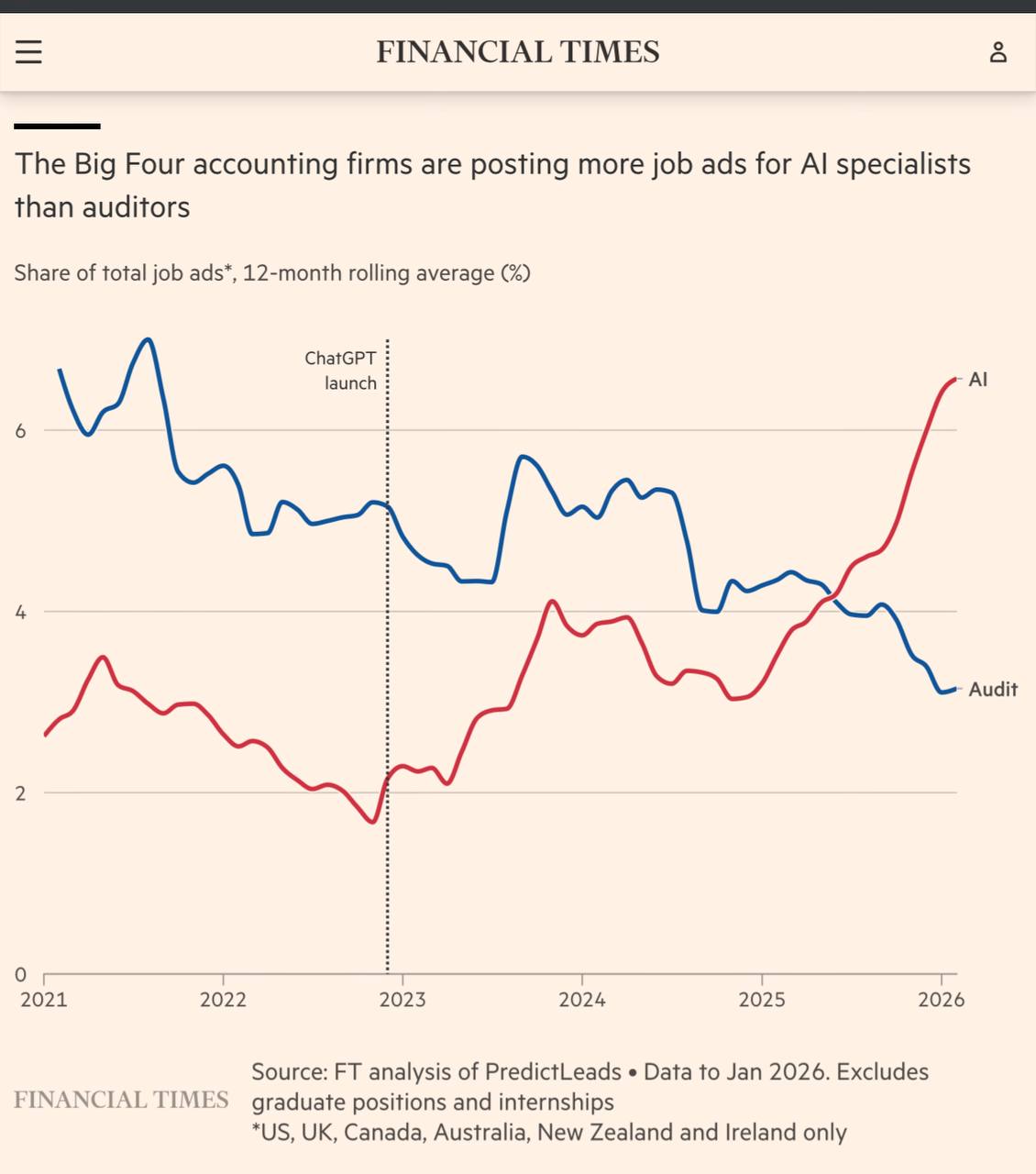
The Big Four accounting firms are now posting more job ads for AI specialists than for auditors.
FT analysis of PredictLeads data covering Deloitte, EY, KPMG and PwC across the US, UK, Canada, Australia, New Zealand and Ireland shows the two lines crossing in early 2026. AI's share of total job ads has roughly doubled since the launch of ChatGPT in late 2022, while audit's share has drifted down. The series is a twelve-month rolling average so the crossover is durable, not a single-month wobble. The organisations the essay had sleeping are now hiring as if the model has already changed.
AustralianSuper, the country's largest pension fund, has publicly classified agentic AI as disruption-class technology.
The fund manages A$410 billion for 3.5 million members. Its framing is that agents are the technology that finally breaks the ceiling on personalised retirement advice at scale. It is the first major institutional pension fund to put agentic adoption on this footing publicly. Read it as a procurement-cascade signal: when one fund of this size says it out loud, peer funds follow within months.
Tokens are the new software licences and nobody has worked out who controls the budget.
Ethan Mollick noted this week that API tokens have gone in twelve months from invisible accounting detail to the most contested line in the AI procurement budget. "No one knows who should get tokens, how much they should get and how to control them." Aaron Levie reported back from a Fortune 500 CIO dinner where "basically no one feels like they have the right solution". Underneath: a three-person team burned $1.3 million in OpenAI tokens in a single month. Uber burned its 2026 AI budget in four. The cost-per-intelligence curve is collapsing, which is exactly why governance is where it jams. This is the organisational constraint the essay puts at the centre: the limit is no longer capability.
The real cost gap in AI models is not between vendors. It's between reasoning modes.
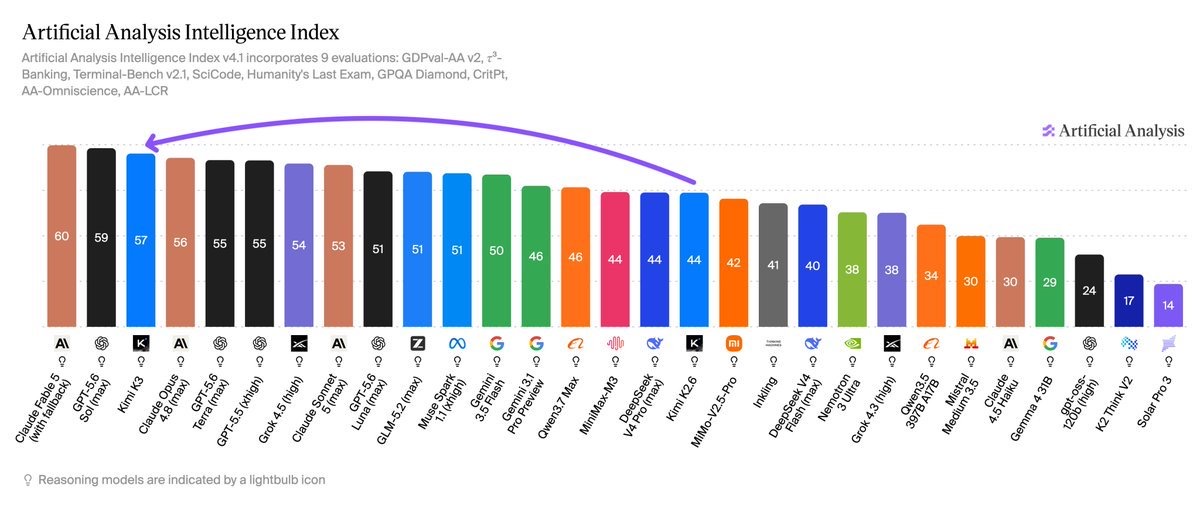
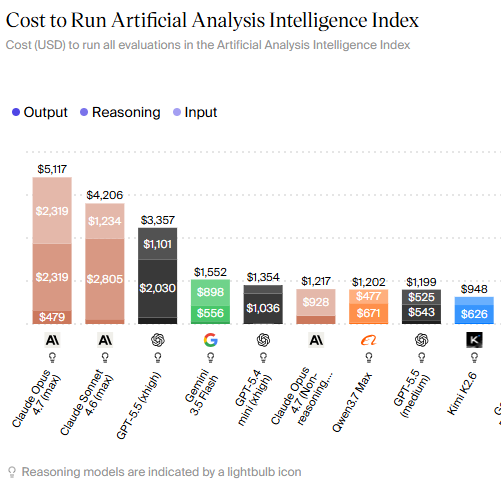
Running the full Artificial Analysis benchmark suite at max reasoning costs $5,117 on Claude Opus 4.7, $4,206 on Sonnet 4.6, and $3,357 on GPT-5.5. Drop the reasoning mode and the prices collapse: non-reasoning Opus is $1,217, GPT-5.5 medium is $1,199, Gemini 3.5 Flash is $1,552. The procurement rule writes itself: reserve max-reasoning top-tier for the tasks where the marginal quality is demonstrable and worth the spend. The same model family in default mode is three to four times cheaper.
Most of the world's AI compute does not sit with the frontier labs.
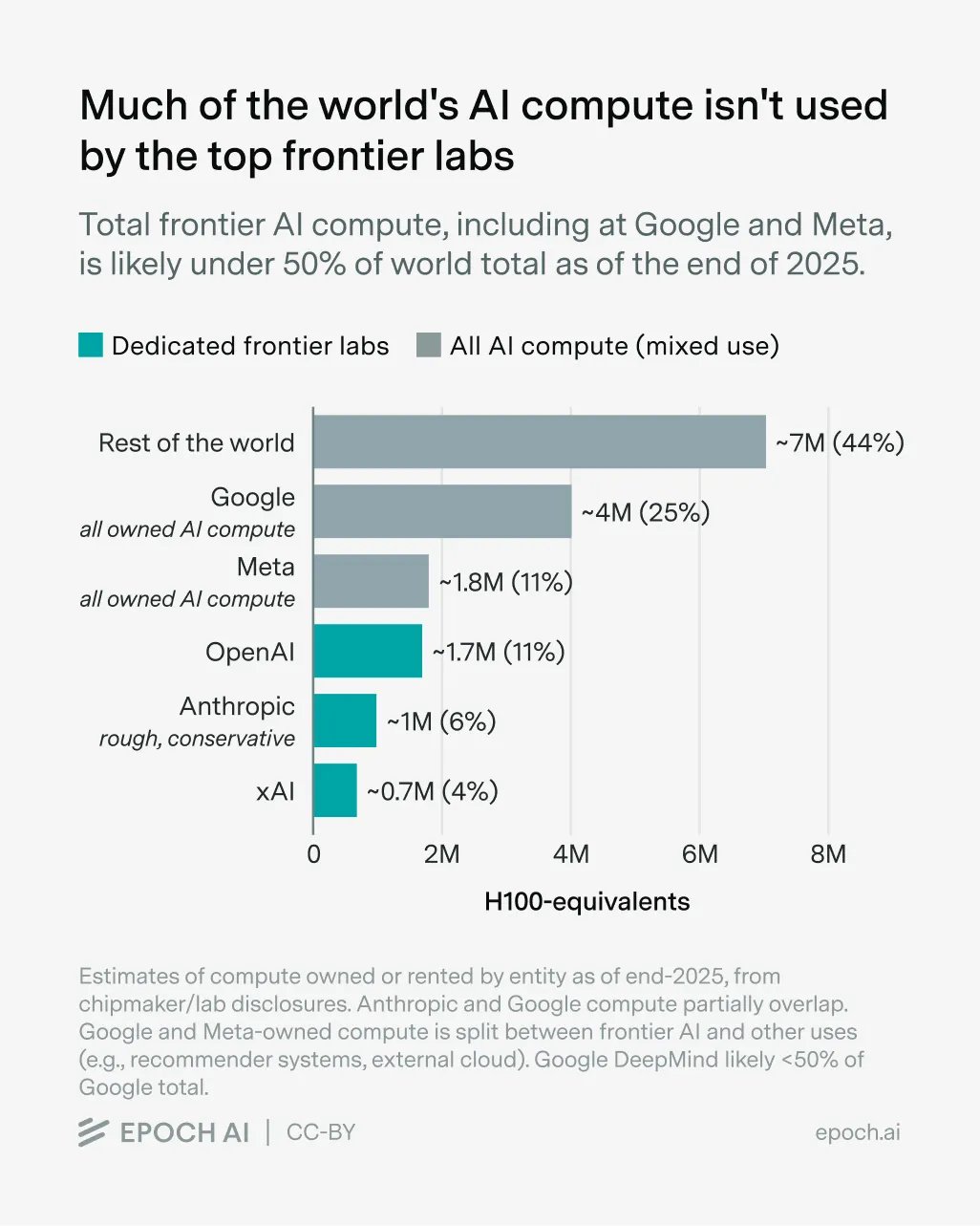
Epoch AI's end-of-2025 estimate puts the "rest of the world", outside Google, Meta, OpenAI, Anthropic and xAI, at seven million H100-equivalent chips, or forty-four per cent of total global compute. Google alone holds twenty-five per cent, Meta eleven, OpenAI eleven, Anthropic six, xAI four. Dedicated frontier labs sit at roughly half of global compute. The frontier-model race is the loudest story this year, but it is not the only one happening on this much hardware.
Axios's Jim VandeHei says no company in any industry, in any era, has scaled organic revenue this fast.
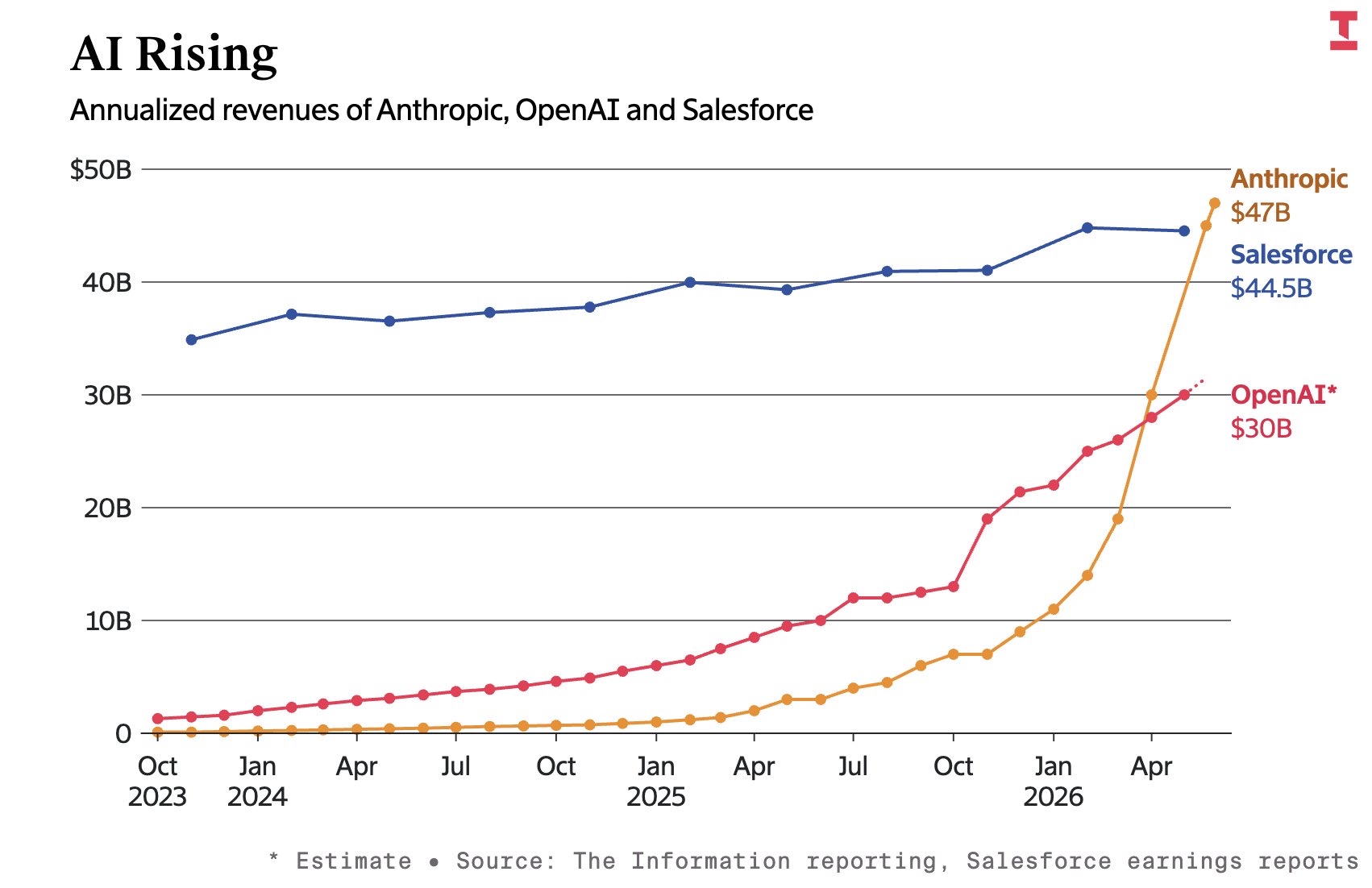
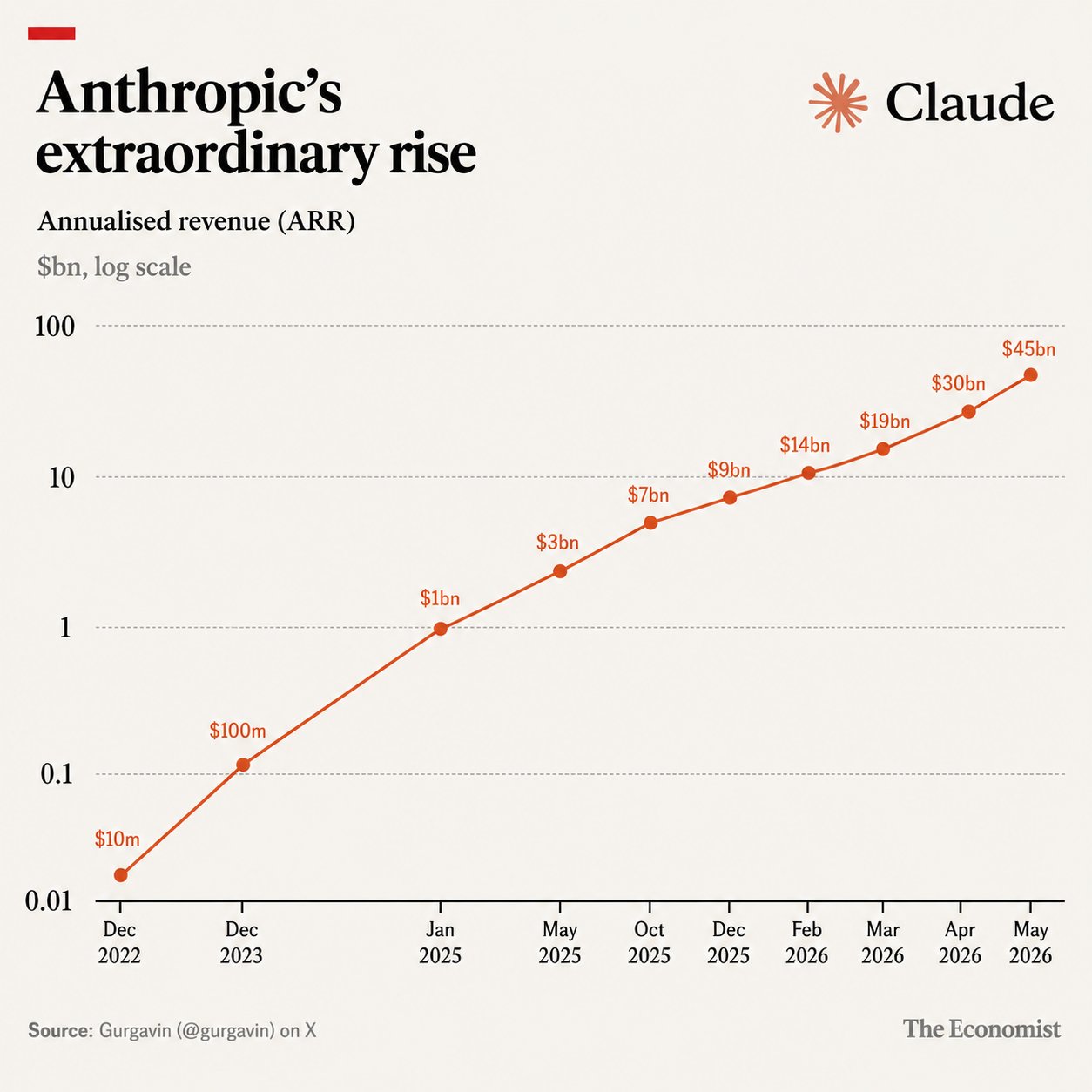
He was describing Anthropic when its self-reported annualised run-rate revenue was $30 billion. A few weeks later it is $47 billion. The numbers come from Anthropic's own disclosures, collected by Simon Willison. The unprecedented part is not the absolute level. It is that the company is scaling through that level at a pace that, by VandeHei's read, no business in any era has matched. The growth rate by itself usually carries a J-curve and a reorganisation at the end. Whatever else AI labs are now, they are operating in a revenue regime that has no historical analogue downstream.
Last week's edition on Elliott's maths homework, and what learning means now drew a small but unusually thoughtful postbag. The dominant thread was generational: readers who had recently been juniors themselves, parents of teenagers, and senior leaders watching graduates change. The disagreement that opened up was not whether the method works, but whether the new method costs something specific in the underlying mastery. Several readers brought parallels from their own kitchen tables.
A junior at a strategy consultancy, two years out of college
Drew the generational line sharply, having lived both sides of it. Joined the firm when language models were still alien terms, watched the curve bend, and now sees new graduates and a younger sibling treating AI as a permanent intern that gets the assignments done. The reframe was less about productivity than about the cohort effect: the conversation in their world has shifted in the last few months from "use AI more" to "learn how to use AI as a support, not a substitute." Closed on a vivid image of a car being pushed down a slope, then braked at the moment it began to roll on its own. The braking takes more effort than the pushing did.
A senior voice at the same consultancy, writing at length
Took the homework story as the right model and then layered three concerns. One: a growing trend of treating AI as the ultimate source of truth, with quality control lagging. Two: a personal pattern of using AI to build in unfamiliar areas, hitting a wall, and reverting to the older tools, search, blogs, code forums, video, to fill the gap. The hands-on detour still has value. Three: Malcolm Gladwell's ten-thousand-hours frame, applied to professional judgment. Senior practitioners have done those reps across multiple technology waves; newcomers may not get the chance to. The macro question they raised, which David did not address directly last week, was the one to sit with. Individuals report higher day-to-day satisfaction. The aggregate productivity numbers have not yet shown up. A productivity paradox, in their phrase, like the early internet era. Worth watching whether the lag closes or not.
A parent of a teenager, writing from professional services
Recognised the homework scene exactly, with a sharper edge than the original. Their child, working on chemistry one evening, asked the parent and asked AI simultaneously. Slightly mis-specified the AI query, so the AI disagreed with the parent's correct answer. The child strongly preferred the AI's answer, would not back down, and only changed their mind days later when the chemistry teacher confirmed the parent had been right. The move worth naming is the one about authority. The new pattern is not just "use AI to check the answer." It is "treat AI as the authoritative voice in the room," displacing other adults the child trusted previously. Practical questions sit on top of that. The respect question sits underneath it.
A senior director at a global professional services firm
Read the edition as a piece about how the reviewers, not just the doers, have to adapt. Their summary, in their own register: a focus on skills for the future has to come with a willingness to review young people's work in the way the young people did it, not the way the reviewer would have done it. The implied second move is harder. If the test of good work is no longer "could you have done this yourself, alone, in a room, in an hour," the assessor has to develop a new instinct for what good looks like in a method that wasn't theirs. Otherwise, the review collapses into either rubber-stamping or rejection.
A reader with the week's tersest reply
Stripped the argument to a sentence: the difference between AI doing it for you and you getting it is the difference most are not making. Stands on its own. The Elliott story turned on that exact distinction. The point of the homework was not the answer, which Elliott had within seconds. It was that he could defend the answer afterwards.
What readers were posting on LinkedIn this week. The through-line: the gap between individuals and organisations on AI adoption, and what fills it. Six voices picking at the same nerve.
David Johnson-Igra, founder, Scribes Consulting
David Johnson-Igra, founder of Scribes Consulting, an AI advisory for communications leaders, opened with the sentence the essay is built on: "A year ago, I didn't think AI would impact my work. Then, within a few weeks, I was out of work, and everything changed." He built the advisory inside that gap. Knowledge graphs, configurations, agents, tool integrations. Owned by the client, not rented from a vendor. The individual-vs-organisation adoption arc as a person, not a chart. He saw what was coming about five months after he could have, and acted the day after that.
Rahim Hirji, keynote speaker, author of SuperSkills
Rahim Hirji, keynote speaker and author of SuperSkills: The Seven Human Skills for the Age of AI (Kogan Page, out July), did the count on his own manuscript. The word human appears 194 times. The word AI appears 56. He's calling this cohort Generation Human. "The conversation about AI has already turned. It's no longer about what the machines can do. It's about what we humans need to be." That sits alongside David's Generation One and Generation Two framing in this week's essay as the third axis. Not the model getting better. The job changing shape around the model.
John Gleeson, founder of Success Venture Partners, an early-stage fund and customer success community, hosted his third CCO/FDE Summit at SaaStr this week. The one line that stuck: "we've moved from the buzz of AI to the playbooks for this next era. We're in a new operating environment, and our playbooks from the SaaS era don't work. We're redefining the metrics, the hiring profile, and the mindset to succeed." That is Generation Two in a sentence. The model crossed a reliability threshold. The work didn't just speed up. The operating environment changed underneath it, and the org chart hasn't caught up.
Phil Leslie, Chief Technology and Innovation Officer, Cornerstone Research
Phil Leslie, Chief Technology and Innovation Officer at Cornerstone Research, read the WSJ piece on the first AI-native graduating class and pulled out the line worth keeping: "Working alongside AI tools has made critical thinking even more important than AI literacy." He pushed it further. "Junior people definitely don't have a monopoly on AI skills, and I question how meaningful the phrase AI-native is." And the harder question the WSJ piece didn't ask: "If companies are hiring junior people based on their AI capabilities, how is this being assessed?" The hiring question that becomes load-bearing the moment "AI literacy" appears on a job description and no-one has a rubric to score it.
Dylan Jones, Chief Communications Officer at Bold Square, on the WSJ's piece "Corporate America Is Starting to Ration AI as Cost Skyrockets". He set up the gap with two C-suite memos. Earlier in the year: "Hey, AI is going to enable a bright new future for this business, and every single person in the company is going to help us ensure we're the most AI-forward organization in our space." This month: "Hey, can you cut down on your use of AI tokens as it's getting too expensive. We'll just SAY we're AI-forward, don't worry." The performative version of organisational adoption: say it, don't fund it. The essay's "organisations slept" line, twelve months on: awake enough to issue the press release, not yet awake enough to pay the bill.
Yvan Boudillet, Music x Tech ecosystem builder, came back from a Forum on Employment and Skills at France's Centre national de la musique with the answer he and three co-panellists (from Believe, Sony Music, Music Tomorrow) landed on. The question: what skills are essential to navigate the music ecosystem in the age of AI? The four they settled on: Curiosity, Humility, Critical Thinking, Creativity. On critical thinking specifically: "we are now navigating a permanent flood of contradictory information, tools that promise everything, and decisions that carry real consequences. The ability to slow down, evaluate, and choose consciously has never mattered more." The list reads transferable. Replace "music" with almost any sector and the four still hold.
We sat at the kitchen table after dinner with his maths homework. Elliott is fourteen. The first couple of equations went fine. We worked through them together. I helped where he got stuck, we moved on. Then it got hard.
We struggled with the next one together. I wanted to take our time with it. But, after a while he got frustrated, got up, and went downstairs to his room. To use ChatGPT for help instead of me, he said!
I went to find Teresa. I told her I was sad. I'd been enjoying this moment with him: the puzzle, the working out, the satisfaction of getting somewhere by the long route. When I was his age I used to take my dad's Royal Engineers maths homework and do it myself for fun. The method was the joy. I wanted to share that. And now my son had walked off, and he was, I thought, basically, cheating.
We've had this worry before, with phones and with social media. I remembered I'd written something a few months ago about how every generation thinks the new technology is rotting the next one's brains, and how every generation has, so far, been wrong. I looked it up and read it again.
I still thought this time was somehow different.
Then he came back up the stairs.
He had every answer. Of course he did! He'd used AI. The surprise wasn't the answers. The surprise was what he'd done with them. He'd dug into every one. Where ChatGPT's reasoning hadn't made sense to him, he'd dug deeper. He'd asked it questions. He'd kept asking until he satisfied himself the answer was right and the route made sense. He walked me through every equation: the easy ones and why they were easy, the tricky ones and what made them tricky, the surprising ones and why they surprised him. I could ask him anything and he could defend it.
He wasn't cheating, I realised. He was learning.
What he had done, downstairs in his room, was a method. He had used ChatGPT and a couple of TikTok videos to work out the answer and the methods. Then he had interrogated the bits he didn't follow until they made sense. Then he had come back up to defend it. Use AI, check the answer, understand why it's right, own the result.
I realised I've been teaching professionals to do exactly this for three and a half years.
A broadcaster evaluating scripts for a drama slate. Hundreds of submissions, finite human attention. AI takes the first pass against the slate, the audience goals, the editorial guidelines. The commissioning editor reads the summaries, at least skims every script, and reads in depth the ones the AI flags or her instinct flags. A consultancy doing diligence on a stack of papers. AI summarises, surfaces the so-whats, builds the issue log. The partner still works through the papers herself, using the summary as a guide rather than a substitute, challenging it where instinct says to dig in. A pharmaceutical company processing dozens of marketing plans from dozens of countries. AI does the first read against brand guidelines and regulatory constraints. The human goes through the plans, paying particular attention to the flagged exceptions.
The pattern is the same in all three. AI drafts. The human reads, interrogates, verifies, owns. The slow way, alone, no AI, is bordering on professional negligence in 2026. I have said so to clients more times than I can count.
And then I sat at my kitchen table and tried to make my son do it.
There are three ways to approach a problem like Elliott's equations, or like a stack of diligence papers.
The first is AI-first with your brain engaged. AI gets you to an answer quickly. You interrogate it, verify it, defend it. This is what Elliott did. It is what I teach professionals to do.
The second is human-first, AI to check. You work the problem yourself, then ask AI to challenge your thinking. This is fine. It is slower. If you have time and you want to develop the craft yourself, it is a reasonable choice.
The third is the old way: no AI, alone, on your own steam. It was the route I was trying to push Elliott towards at the table. It is also what I would call 'bordering on negligent' if a partner did it with a stack of papers on Monday.
I am still working out what to do with this.
The obvious question is about learning. What does learning mean now? What is the thing we are trying to build in a fourteen-year-old, or a twenty-four-year-old graduate? I learned by doing the steps. Elliott learned by interrogating answers he didn't generate. Both of us ended up understanding the method and able to defend the result. Mine was slower, and produced a particular kind of pleasure in the method, and it suited the world I grew up into. His was quicker, and produced a different fluency, and may suit the world he's growing up into rather better.
There is a quieter point underneath that. My method taught me how to solve equations, and problems that look like equations. It teaches a specific skill. Elliott's method, the one he used downstairs, can be pointed at almost anything: an equation today, an unfamiliar legal document tomorrow, a chemistry problem the week after. It is a broad skill, not a specific one.
Each has its price. He can't as easily derive an equation from first principles, and in some settings that matters. I can, and the depth that gave me came at the cost of muscles I never built in the places I wasn't looking. Every strength has a shadow. I learned methods that teach depth in a narrow lane. He's learning methods that give him reach across many.
The harder questions are what should we be recruiting for in graduates? What should we be teaching them in their first two years? The old test was closer to 'can you derive this from first principles, alone, in a room, in an hour.' That test still measures something. Rigour. Patience. Comfort with discomfort. But it may not be measuring the craft the graduate will use on Monday. The new test might be different: generate AI answers, find what's wrong and tell me why. Or: here is a complex problem, show me how you would use AI, and how you would know the answer is right.
Elliott will leave college in eight years and start work somewhere. I don't know what skills the people hiring him will be testing for. Neither do they. But I strongly suspect they're closer to the ones he's learning than the ones I grew up on.
Three things worth knowing
1. AI displacement now shows up in the US government data at both ends of the career ladder.
A Bloomberg analysis of new Bureau of Labor Statistics figures finds that every one of the eighteen occupations the BLS classifies as AI-exposed has lost jobs over the past year, even as US payrolls grew 0.8% overall. Customer service representatives shed 130,180 jobs, 4.8% in a single year. Interpreters down 24% over three years. Credit authorizers down 26%. The exception that confirms the rule: medical secretaries up 15.8%, the cluster that needs a body in the room. The same picture shows up at the other end of the funnel. The Economist this month plotted US graduate full-time employment against AI exposure: computer science and information sciences graduates are down 10 to 15 percentage points since 2022; philosophy and psychology graduates held steady or gained. The displacement isn't just to the people already doing those jobs. It's to the people trying to start in them, and what they should be studying, as Elliott and I both started to wonder this week, may not be obvious to anyone yet.
2. The UK's data regulator has put AI hiring tools on formal notice. Sixteen organisations have already had a letter.
The Information Commissioner's Office, the UK's data protection regulator, issued formal guidance this week saying that AI-driven CV screening, candidate ranking, and video interview analysis without "meaningful human involvement at every consequential stage" may already breach UK data protection law. Sixteen organisations have been written to directly. The consultation closes on 29th May, six days after this email lands. There is a concrete Monday-morning task in this for any leader running a hiring pipeline. Ask the talent acquisition team for the full list of AI tools in use across the funnel, decide which involvements count as "meaningful" against the ICO's test, and put a response into the consultation. The window is genuinely short.
3. Salesforce will spend close to $300 million with Anthropic this year. Marc Benioff says the engineering productivity gains made it the easiest line in the budget.
Marc Benioff disclosed this week that Salesforce is on track to spend close to $300 million with Anthropic over 2026. Separately, Anthropic announced a $200 million partnership with the Gates Foundation focused on global health. Most of the spend is on coding, justified by engineering productivity gains of more than 30%. That is a Fortune 100 chief executive treating the model layer as a procurement line item, not a research expense. The bigger question is who in your firm is allowed to commit that kind of capital, against what kind of evidence, and how quickly.
Justin Skycak put it as a principle for skill acquisition this week: shrink the unit of practice until the mistake has nowhere to hide. The same rule applies to working with language models. Sprawling prompts produce sprawling failures you can't diagnose. Break the task into its smallest meaningful unit, run it, inspect the output, then rebuild. If you can't immediately see where it went wrong, your chunk is still too large.
2. Ask AI questions it can't possibly know the answer to.
A marketing lead at a global firm told me this week she's running a five-minute stress-test on every AI tool she's thinking of trusting. She uploads her own data, asks the model to use only that data, then asks it questions she knows the data can't answer. Some models fabricate regardless: "53% of women in the northeast states feel…" She's learned what its confident-but-wrong mode looks like before depending on it for an answer she can't independently check. Worth doing once on every tool you rely on.
3. Run your day past AI before you start it.
A senior leader described her commute habit to me this week. She opens Claude, asks it to review her calendar and her email, then asks it to surface what she needs to read before each meeting, what's carrying over from yesterday, and which emails in her inbox need replies before the day eats her. Five minutes on the train, and the day is scoped from outside her own head. "Just a nice little daily habit," she said. Try it tomorrow.
What readers said
Last week's edition on "What boards accept" drew the sharpest pushback in weeks, mostly on whether subtraction is the right move at all. A senior consulting voice argued that boards shouldn't be dictating at that level: their lane is capital allocation and risk, and the posture should be "relentless pressure on ambition," not refusal. A reader running another professional services practice accepted the frame but went further. The saved time in their world has gone into more client meetings, leaving every relationship "more competitive" and the industry no bigger. A senior leader at a global media company was jolted by the BCG stat that half of organisations have redesigned core workflows around AI, and wanted to move faster. Full reader reactions online →
Underneath what readers were posting on LinkedIn this week was the same nerve as the postbag: where the work actually sits and who's doing it. Phil Leslie, Chief Technology and Innovation Officer at Cornerstone Research, an economic and financial consulting firm, put it most cleanly: "I don't want an AI as a doctor or lawyer, but I definitely do want a doctor or lawyer that is using AI."Adam Peruta, an academic at the Newhouse School (also part of the Steadman team), partnered with Ipsos on a 20-ad study: the AI-generated ads tested 14% weaker on short-term sales, 17% weaker on long-term brand health. And Elizabeth Oates, VP of Consumer Insights at Molson Coors, caught herself doing algebra on a Post-it at work, no calculator, no AI. The thread underneath: which bits of the work are still ours. More online →
The richer version of this week's three Try-Thises, with copy-paste prompts. Each prompt has a Copy button - click and paste into your AI of choice.
1. When the output goes wrong, shrink the task
Justin Skycak put it as a principle for skill acquisition this week: shrink the unit of practice until the mistake has nowhere to hide. The same rule applies to working with language models. Two drop-in prompts: one to diagnose what just broke, one to pre-empt the breakage on the next run.
When a prompt fails or produces something half-right, paste this in the same conversation rather than rewriting from scratch:
Option A - diagnose
The response above isn't quite right. Before I rewrite my prompt, help me decompose. Walk me through the task you just attempted as a sequence of the smallest possible sub-tasks. For each sub-task tell me (a) what specifically you did and (b) which sub-tasks you think are most likely to have caused the failure, with your reasoning. I'll then tell you which one we work on alone.
The point is not to trust the model to know what it got wrong (it often can't) but to surface its own best guesses about which parts are most fragile, so you can choose which one to break out and rerun.
When you're about to ask AI to do something big and you'd rather catch the failure earlier than after the fact, use this instead:
Option B - pre-empt
Take the task above, break it into a series of individual prompts. I want to run them one by one next time so that I can more easily validate each step before moving on to the next. For each prompt, tell me what input I'll need to hand in and what output I should expect, so I can tell whether the step worked.
You end up with a sequence of small prompts instead of one large one. Slower per run, but the failure mode is local and visible.
2. Ask AI questions it can't possibly know the answer to
A marketing lead at a global firm told me this week she's running a five-minute stress-test on every AI tool she's thinking of trusting. She uploads her own data, asks the model to use only that data, then asks it questions she knows the data can't answer. She's learned what its confident-but-wrong mode looks like before depending on it for an answer she can't independently check.
Paste this once, with three real questions about whatever data or document you've given the tool. Two should have answers in the materials. The third should be unanswerable from the materials alone:
The impossible-questions stress-test
I'm going to stress-test you. Use ONLY the data and documents I've already shared with you in this conversation. Do not browse the web. Do not draw on your training data. Do not infer beyond what's explicitly in front of you.
I'll ask you three questions.
For each question, either give me the answer with the exact source location, or tell me explicitly that the materials don't contain the answer. Don't guess. Don't reach. Don't pad.
Question one: [your first question - answerable from the materials]
Question two: [your second question - answerable from the materials]
Question three: [your third question - NOT answerable from the materials]
If the tool refuses question three honestly, it's earned your trust on that data set. If it confidently makes up an answer, you've just calibrated how much weight to give every other answer it produces.
3. Run your day past AI before you start it
A senior leader described her commute habit to me this week. She opens Claude, asks it to review her calendar and her email, then asks it to surface what she needs to read before each meeting, what's carrying over from yesterday, and which emails in her inbox need replies before the day eats her. Five minutes on the train, and the day is scoped from outside her own head.
Paste this at the start of your day. Save it as a reusable starting point or pin it as a Claude project so the calendar and email connections are already in place.
The morning prep prompt
Review my calendar for today and my email inbox for the last 48 hours. Then walk me through the day in three sections.
(1) Pre-reads. For each meeting on the calendar, what should I read or recall first, and what's the single most useful question I should arrive with? Pull context from any email threads tied to the meeting if you can see them.
(2) Carry-overs. Which open threads or commitments from yesterday's calendar and email are likely to collide with today's schedule? Anything I said I'd do that I haven't, and that today is the last clean window for?
(3) Email replies. Which unanswered emails in my inbox need replies before 11am, in what order, and what's the key point each reply needs to make?
Be specific. Time-box each item if you can. Flag any conflicts I should resolve before 9am.
Adapt the three sections to your work. The point is to scope the day from a vantage point that isn't already inside your head, with the calendar and the inbox feeding in directly rather than you having to summarise them by hand.
An OpenAI model just resolved an 80-year-old open problem in Erdos geometry
OpenAI announced this week that an internal model resolved an open question in combinatorial geometry that has sat unsolved since 1946. Eight decades of elite mathematicians had assumed grid-based constructions were optimal; the model found a wholly new family that beats them. Sebastien Bubeck, who leads OpenAI's mathematical explorations, summed it up: the model "did not invent something fundamentally new that nobody saw coming. It just executed like an amazing mathematician." Tim Gowers, the Cambridge mathematician and Fields medallist, framed the stakes: this is the unit distance problem, "one of Erdős's favourite questions and one that many mathematicians had tried." Sam Altman has posted that he has "complicated feelings" about the result. And let's remember: Two years ago this lineage of model could not reliably count the letters in "strawberry."
Four in five enterprise workers are bypassing AI tools. The most visible AI operators say white-collar work is done in eighteen months. Both can be true.
Three independent adoption readings this week point to a widening gap between what AI can do and what people are doing with it. A Fortune survey reports 54% of enterprise workers bypassed their company's AI tools in the past 30 days; 33% have not used AI at all. Writer's 2026 enterprise AI survey finds 97% of executives claim personal benefit while only 29% report significant organisational return on investment. Set that against what AI's loudest operators say is possible: Mustafa Suleyman, Microsoft's AI chief executive, has been telling interviewers white-collar work as currently configured has eighteen months left. The reconciliation isn't that one is wrong. Suleyman is describing what's possible. The data is telling us where most people actually are. The gap will close one of two ways. A large number of people change their behaviour very quickly, or the ones already doing it pull far enough ahead that the rest are pushed to the side.
Seven in ten Americans now oppose having an AI data centre near them. That is worse than the rejection rate for new nuclear.
New polling from Gallup finds that 70% of Americans oppose having an AI data centre in their community. That is a sharper rejection than new nuclear plants attract. On the ground the political signal is already concrete. Seventy-nine data-centre projects were rejected in the first four months of 2026. Maine's legislature passed a moratorium (vetoed by the governor). Utah is fighting what would be the world's largest data centre. An analysis by PowerLines, an energy research group, projects that roughly $700 billion of grid-upgrade costs may end up on household electricity bills. The revenue lines for the frontier labs are vertical. The political settlement under them has rarely been weaker. Any 2027 strategy that assumes today's compute price is available is making an assumption worth re-examining.
The filters were sized for a slower world. Books, lawsuits, music, papers, every system designed to sort human-authored material is buckling under volumes it was never built for.
A four-panel chart circulating this week catches the post-ChatGPT inflection across separate domains. Weekly e-book releases on Amazon have hit 292,000, roughly triple the pre-ChatGPT baseline. Federal court filings by self-represented (pro se) litigants are at 17% of the total, up from a decade-long floor near 10-12%, Reuters Legal confirms the trend. Daily music uploads now include a steeply rising AI-generated share. Quarterly ArXiv submissions cleared 77,621, up from 27,000 five years ago. The vertical line on each panel is the ChatGPT release. The signal isn't that any of these systems is broken yet. It's that the filtering infrastructure on which professional standards rest was sized for a world where producing a book, a lawsuit, a track, or a paper had a meaningful human cost. That cost has fallen. The question is whose job it is to redesign the filter.
EY pulled an AI-generated cyber-security report after researchers found it cited a McKinsey study that does not exist
The Financial Times reported this week that EY, one of the Big Four professional services firms, withdrew an AI-generated cyber-security study after independent researchers found fabricated data and a citation to a McKinsey report that does not exist. A model-generated falsehood made it through internal review and reached the market in client-facing sales material. The whole point of a Big Four imprint is the chain of human signatures behind it. The same firms now use the same models internally that their clients use externally. If the audit norm needs hardening, this is the kind of incident that should harden it.
Anthropic posted its first profitable quarter at a $44 billion run rate, and is rationing compute hard enough to push customers to its rivals
Berber Jin, reporting in the Wall Street Journal, wrote this week that Anthropic has posted its first profitable quarter at an annualised run rate of about $44 billion. Derek Thompson has been pointing readers towards the supply-side story underneath: Anthropic is rationing compute hard enough that some large enterprise customers are being pushed to OpenAI and Google to get the throughput they need. The cash-burn-forever scepticism on frontier labs took a serious blow. The interesting signal is the rationing. Procurement and diversification conversations should not wait for the next strategy review.
A senior insights leader is planning for three hundred people in her team, and "thousands, possibly tens of thousands" of AI agents alongside them
A senior insights leader at a global company, in a private call this week, said that her next planning cycle assumes a team of around 300 humans and "thousands, possibly tens of thousands" of AI agents working alongside them. The substitution maths is now being done out loud, by senior leaders, in their own functions. Not by analysts on X. The ratio reframes a function from "needs more headcount" to "needs a different kind of headcount." The interesting question for the reader is not whether the number is right. It is whether your function's most senior leader has started doing the same maths.
Last week's edition on "What boards accept" drew an unusually argumentative postbag. Thirteen readers wrote in, and the centre of gravity sat squarely on the frame itself: is subtraction the right move for a board, or is it a distraction from the harder job of raising ambition? Two readers from the professional services world pushed in opposite directions on that question. A senior leader at a global publisher took a different angle, jolted by a single number. And a quiet cluster wrote about the email itself, the audio edition, and the discipline of cutting back on what one's own AI setup is being asked to do.
A managing director at a global strategy consultancy
Pushed back on the central frame. Boards, they argued, shouldn't be dictating at the level of dashboards, training assessments, or six-month-old benchmarks at all. Their lane is capital allocation and risk. The posture should be relentless pressure on ambition, and the real question isn't whether a Copilot rollout or a cost-takeout programme is on the books, but whether the business model itself is being reshaped or merely optimised. On risk, they argued the calculus has flipped: moving too fast or locking into too few vendors is now its own exposure. The answer they proposed is optionality by design, continually re-underwriting strategy as the technology moves. The board's job, in their reading, is to raise the ceiling, not to subtract.
A partner at a different professional services firm
Accepted the frame but extended it with a specific zero-sum mechanic. In their role they face what they called a more or less infinite to-do list, so any time AI gives back tends to flow into more of the same: catch-ups further down the marketing list, internal stay-in-touches that usually don't happen, lower-priority work that survives without a formal prioritisation. The richer move in their reply was a parallel with post-pandemic working patterns. The vast majority of meetings have stayed online, which has saved senior practitioners large amounts of travel time. Where has that time gone? Into more client meetings. The empirical net effect, they observed, is that everyone in the sector can now stay in touch with more clients, every relationship has become more competitive, and industry revenue has not grown to absorb the new effort. A reminder that productivity gains at the individual level can vanish at the industry level.
A senior leader at a global publisher
Reacted to a single number from the Three Things. The claim that half of organisations have redesigned end-to-end workflows around AI gave them a jolt and made them want to move faster than their own organisation currently is. They asked a sharp methodological question in passing: how, exactly, are firms defining "redesigned"? A useful caveat to hold against the headline figure, and one to remember when quoting it. They also lifted the skill-building idea from Try This into their own organisation's guidance, which is the kind of practical pick-up the section is built for.
A senior leader in a consumer-facing business
Wrote about a small but practical move that landed last week. The Try This suggestion to compress one's accumulated lessons into a personal review skill prompted them to consolidate their notes and files, with the result that their tool of choice no longer has to re-derive their preferences each time. The reflection that followed mattered more than the action: they suspected they had been overwhelming their main configuration file with too much, and were planning a return to hierarchies and efficiencies. A useful reminder that the discipline of subtraction the essay applied to boards also applies, in miniature, to one's own setup.
A marketing lead at a global entertainment business
Wrote in to say the audio edition was a welcome addition. Brief, but worth surfacing because it confirms a pattern visible in the listening data: a meaningful share of the readership prefers the spoken-word version on the school run or the commute, and the audio is no longer an afterthought. I'll be investing more time in making that sound even better in the coming weeks.
A founder of a creative innovation agency
Wrote about the personal-stories-plus-AI-leaders combination, and singled out the broader letters section as something valueable they don't see elsewhere. Headline coverage in the field tends to feature wins and tidy case studies. What's missing, in their reading, is the muddling-through: how people are actually struggling to integrate these tools into existing work. A vote in favour of keeping the failure modes and the half-finished experiments in view, not just the lessons that have already crystallised. Keep them coming!
A senior music industry executive
Forwarded a New York Times opinion piece on the recent wave of commencement speeches that took aim at AI, with the suggestion that the "view from the other side" was worth a look. The contribution wasn't a counter-argument so much as a reminder: the AI-positive frame the newsletter runs on is not the dominant register in the wider culture this month. Many universities, graduation stages, and the broader op-ed world are pulling the other way. Readers planning to make the AI case inside a sceptical institution should know what they're walking into.
My Steadman co-founder, Tim Ryan
Wrote with two references that landed exactly on the essay's spine. Dieter Rams' "less, but better," and Saint-Exupéry's line that perfection is attained not when there is nothing more to add, but when there is nothing more to take away. Both pulled the subtraction frame into a wider tradition of design discipline, and made the case that the right kind of less is not impoverished but more rigorous. Tim also observed that boards have always faced a temptation to add (committees, dashboards, frameworks) and that the discipline of removing is often the harder and more strategic move. Surfacing this as house voice rather than as anonymised reader, because the references travel and tighten the essay's frame.
Beyond these, one reader sent a useful link to a podcast interview with a senior financier expressing a more cautious view on the pace of progress. As a body of correspondence, the week landed firmly on the central question: is the right board posture to refuse, or to demand more?
What readers were posting on LinkedIn this week. The through-line: where the work actually sits and who's doing it, now that AI does more of the drafting. Six voices picking at the same nerve.
Phil Leslie, Chief Technology and Innovation Officer, Cornerstone Research
Phil Leslie, Chief Technology and Innovation Officer at Cornerstone Research, the litigation-focused economic and financial consulting firm, posted a string of pieces on AI's place in expert work this week. The single sentence that lands hardest: "I don't want an AI as a doctor or lawyer, but I definitely do want a doctor or lawyer that is using AI." He extended the same logic to courtroom expert testimony, arguing against AI-as-expert-witness under Federal Rule 702 because "expert testimony rests on accountability, oath, perjury, professional discipline. A system that cannot be sanctioned cannot meaningfully be cross-examined." The framing he's pushing is Expert-Using-AI as the right unit: every conclusion, every method, every input still owned by the named human. The professional bears the risk; the tool does the work. It rhymes with what Elliott decided about algebra. The method that survives is the one you can sign your name to.
Adam Peruta, an academic at the Newhouse School (also part of the Steadman team), ran a study with Carrie Riby and Ipsos: 20 brand ads, half human-made, half fully AI-generated, tested against predicted business outcomes. The AI work "looked credible". The human-made ads tested 14% stronger on short-term sales and 17% stronger on long-term brand health. His read on why: AI performed best when the brief was functional and direct, and fell apart when it needed "a creative leap", emotion, storytelling, a point of view. The pattern transfers. AI's good at the bits that look like fluency. The bits where someone has to decide what's worth saying still belong to a person.
Elizabeth Oates, VP Consumer Insights, Molson Coors
Elizabeth Oates, VP of Consumer Insights at Molson Coors, the brewer, posted a one-paragraph confession this week: "I used algebra at work today. Algebra." She was solving for an exchange rate on a Post-it. No Google, no AI, no calculator. "An honest-to-goodness solve-for-x." Her middle school self, she said, would be absolutely stunned. The thread back into this week's essay is the same question Elliott raised over the kitchen table. The methods we were taught and the methods we use have come apart. Sometimes the old one still earns its keep. Sometimes it sits in a drawer for thirty years and surprises you on a Tuesday.
Yogesh Chavda, founder of Yogi AI and an adjunct at the Moore School of Business, came back from a keynote in Puerto Rico with a number worth holding onto: "58% of consumers now use AI to research purchases. Only 14% trust AI to complete the transaction." He calls the gap the "trust cliff". The point isn't the number. It's where the negotiation now sits. For thirty years, marketers have studied what makes a person choose one brand over another. The buyer's still a person, but it's a person plus an algorithmic filter, and the filter doesn't recommend the best brand. It recommends the one it understands. Brand work, in that frame, is partly the work of being legible to a machine that's about to do the choosing.
Conor McCarthy, independent AI adoption consultant
Conor McCarthy, an independent AI adoption consultant who's been showing up across this newsletter's reactions paragraph in recent editions, posted a four-piece run this week on what AI adoption actually looks like from the inside. The line worth pulling out: "We've been teaching AI adoption wrong. Not the prompts. Not the models. The framing. Call AI a 'tool' and people treat it like a hammer. Useful when you need it. Back on the shelf when you're done. Infrastructure doesn't work that way. You don't pick up electricity. You build around it." He gave the gap a name in a separate post: "trust debt", what accumulates when people across an organisation use AI informally and don't tell anyone, then a client asks how AI was used on their account. Both pieces sit on the same observation: the adoption story most leadership teams are telling is the visible half, and the invisible half is doing most of the work.
Ben Churchill, software engineering leader, Steadman
Ben Churchill, a software engineering leader on the Steadman team, ran a structured evaluation across roughly 55 production tickets at an enterprise client and wrote up what landed. "With a senior engineer reviewing in the loop, agents delivered 2 to 10x throughput. With the human removed, autonomous success collapsed." The agents confidently produced code that compiled, passed linters, and was wrong in ways that took longer to find than to have written by hand. His broader observation across the most advanced AI-native engineering teams: they're planning more, not less. "AI agents execute exactly what you specify. Not what you meant. Not what you intended. What you specified. At speed, a vague ticket doesn't produce a rough draft, it produces an elaborate, confidently constructed wrong result that takes longer to fix than it would have taken to build correctly." The skill that becomes scarce isn't writing the code. It's writing the spec.
Just three days into a three week stretch at my place in the woods in New England. No travel except the school run. Pulling rocks out of the field so they don't break the tractor. Digging drainage ditches so the lower field isn't too swampy.
Slow work. It will take years. But every rock and every shovel moves it forward.
That got me thinking about boards. Boards often drive change by addition. A new strategy, a new programme, a new dashboard. Addition needs a plan, approvals, buy-in, reporting against it. Fine in most domains. But in AI, that is just too damn slow. Change can happen to a team in days. What's possible changes in weeks. But the strategy paper you commission in March is calibrated to a world that no longer exists by the time it's approved in July.
There's another way. Subtraction. Pick something the firm has been accepting until now. Refuse it.
A refusal forces specificity. You can't stop a vague thing. You have to be specific about what stops.
Start with the AI adoption dashboard. Most boards now get one. I've built one for a few of you! Usage rates, laggards, super users, trend lines. Boards commission them to drive action. But they often substitute for action. Three and a half years into the AI era, after every workshop, licence and nudge your firm has paid for, refusing to use the tools is now a decision. If there's a good reason, your board should hear it. If not, a tough conversation is overdue. Refuse a dashboard that names laggards without tough conversations with them.
Let's talk about AI training. One client set a new rule this week: nobody delivers training until they pass the firm's own AI power-user assessment. Obvious in theory. Rare in practice. I've sat in on dozens of AI trainings. Most times, the trainer hasn't actually done the real task themselves! If your modelling instructor doesn't model with AI, the training is theatre. The trainees learn the talk, not the work. Refuse funding until the trainers pass the assessment they're delivering.
Last year's bake-off is a third. Can-AI-do-our-job experiments are rarer than they should be. They're also stale. A partner at a communications consultancy told me about theirs from early 2025. The form was passable. The substance was thin. They haven't re-run it, though! The same exercise at a different firm in late 2025, using agentic tools, came back at almost the firm's full professional standard. Anyone quoting a 2025 AI test as comfort is relying on stale evidence. Refuse any benchmark older than six months.
Saved hours without a bold benefit is a fourth. Many internal AI reviews now have an "hours-saved" line. In hundreds of conversations with senior leaders about what their teams do with the time AI gives back, it is rare to hear a bold, inspiring answer. The best I've heard recently? More coaching for their team. Most are just drift. Reject any "hours saved" line that doesn't name a meaningful place where the hours went.
Six more, if you want them:
Refuse strategies calibrated to today's AI. Plan for where the puck is going - what will ship in six months.
Refuse job specs written before AI existed. Rewrite the senior ones first.
Refuse letting your best AI talent leave. Name them. Expect managers to work hard to keep them.
Refuse reinventing the same scaffolding in every team. Find five that already work and share them.
Refuse security policies that make AI unusable in practice. Find a way.
Refuse board decisions on tools the directors haven't used. Mandate hands-on hours doing real work before the next AI vote.
My tractor doesn't care which rock comes out first. It just needs me to keep pulling. A board could be the same. Pick one refusal. Make it. Then the next. Out here, ten rocks is a morning. In a firm, ten refusals is a whole different firm.
Three things worth knowing
1. The capability curve is curving upwards on a log scale: we just went from one hour to one day.
METR, an AI evaluation lab, measures how long an autonomous task an AI can complete reliably. In early 2024 the answer was just minutes. In May 2026, with Anthropic's forthcoming Claude Mythos Preview, it's sixteen hours of work a human would have done. The number isn't the headline. The curve is. From minutes to a day in twenty-four months, acceleration on a log scale that had previously been holding steady. If the next two years look anything like the last two, the unit becomes a week, then a month, then a year of human work at the press of a button. Think about that for a second. And then plan accordingly.
2. Half of organisations have redesigned core workflows around AI. A fifth have built new business models. That's bold work in three years.
BCG's AI at Work 2025 survey of 10,635 employees across eleven countries reports that just 72% of organisations are running generative AI tools, but 50% claim to have redesigned end-to-end workflows around them, and 22% claim to have built new business models on top of them. Read those numbers slowly. Three and a half years after ChatGPT launched, a fifth of firms claim to have invented new business models because of AI. Half have rewired core workflows. Wow. Most of the firms I work with would love to be in either group. Syed Ijlal Hussain, who surfaced the chart on X this week, framed it as a gap. I'd flip it. The 22% are doing what most boards I'm working with haven't started.
3. Anthropic just passed OpenAI in US business AI spending. The strategy lesson is older than AI.
Ramp's AI Index, built from anonymised spend data across its US business customers, shows Anthropic taking 34% of paid AI subscriptions in its May release, ahead of OpenAI on 32%. The first crossover. Anthropic's share has roughly quadrupled in a year. I'd argue this was inevitable from early on. Anthropic stayed fixated on the enterprise user while OpenAI chased every consumer headline. Slow perseverance against a chosen audience won. The lesson isn't really about AI. Pick an audience. Set your strategy around their needs. Don't worry about who's collecting the headlines this quarter. Just keep your head down and serve the people you said you'd serve.
A reader suggested last week that the prompts should be online with copy-paste code. Done. This week and for every prior edition. All the prompts in one place →
1. Hand over the context, not just the question.
Experienced leaders have context. They're short on time. AI tools convert context into time saved ... but only if you hand the context over. Most don't. They type questions ("how should I structure a board paper on Q2?") and get general answers ("a clear narrative arc, three key insights, a risk slide"). Useful, but the leader still writes the paper. A leader I spoke with this week made the leap from asking to delegating. "Here are the Q2 numbers, last quarter's board paper, and the three things the board flagged. Draft it." Same model, same minute. Asking gets you an outline. Delegating gets you a draft.
2. Build a personal skill, and add a rule to it every Sunday.
A person I worked with this week reviews 100-page reports from their team on Sunday nights. Typos, inconsistent language, logic gaps. A simple review "skill" in Claude now catches all those. The compounding version is their own preferences layered on top: this market "is expected to grow" not "will grow"; never "dropping precipitously." Every time they catch a miss the model didn't, they open Claude and say "add this rule to my personal review skill." Whatever skill you build, the compounding habit is the same. Catch what the model missed. Add the rule. Trust the skill more next week.
3. Schedule a daily AI briefing. The use cases will follow.
AI tools sit closed until you open them. That's a real reason senior leaders bounce off: not bad prompts, but a tool that requires you to think of the use case first. Scheduled tasks invert this. Every morning at three, mine reads my inbox from the previous day, prepares one-paragraph briefings for every meeting on the day's calendar, and emails me a short summary that takes three minutes to read with breakfast. The tool changes from something you open to something that opens your day.
What readers said
I can never predict which editions will get lots of feedback and which won't. Last week's, on "Choosing is the work," caused an unusually large number of replies on where the saved hour actually goes. A partner at a global strategy firm said they'd "won the work lottery," which roughly captures the giddy-then-uneasy feeling of work these days. Another reader, writing from a Lean Engineering background, reminded me that "change is the fun part." A reader writing in a personal register worried that AI-powered work will leave people feeling like they spent "90 years to further my career so I could spend 20 minutes with my family before I die." One leader wrote in mid-pilot of Claude Code, about going to bed later each night, finishing an exhausting and unproductive week. Reflecting that "just because I can now do all these things doesn't mean I should." Full reader reactions online →
My read on what readers are posting this week: the community's moved past adoption and onto how AI changes the work, not just who does it. Tim Ryan, my Steadman co-founder, brought back Cal Newport's "AI is like bringing a forklift into the gym" and named the discipline that catches it. Fiona Eastwood, Global CEO of Merlin Entertainments, came back from MIT with the same conclusion at scale: AI lands as a transformation agenda or it doesn't land. Mackenzie Nordal, co-founder of Atheni, brought the personal version: she asked her three kids how they actually use Claude. More online →
The richer version of this week's three Try-Thises, with copy-and-paste prompts. Each prompt has a Copy button - click and paste into your AI of choice.
1. Hand over the context, not just the question
The principle: senior leaders have the context their AI tool needs. The bottleneck is handing it over. Two drop-in prompts that demonstrate the shift.
For writing tasks where you have the inputs:
The "draft this thing for me" version
Here's everything you need:
- [Paste the data, numbers, source material]
- [Paste prior versions, last year's equivalent, or context the reader expects]
- [Paste the three things you know your audience will ask or care about]
Draft the [board paper / proposal / memo / email / one-pager] for me.
Match the tone of [the prior version / the audience's usual register].
Show me your draft first. Then I'll come back with corrections.
For analytical work:
The "do the analysis for me" version
Here's the data: [paste the spreadsheet, transcript, document, or context].
Do the analysis. Specifically:
1. Find the three most actionable patterns.
2. Tell me which one I should prioritise, and why.
3. Show your working: what you considered, what you ruled out, where your confidence is thin.
Don't ask me clarifying questions until you've given me your first answer. Then I'll come back.
2. Build a personal skill, and add a rule to it every Sunday
The principle works for any recurring task: catch what the model missed, add it to the skill, watch the misses compound away over time. Here is a starter skill template a reader can save to their AI tool's skill or prompt library:
Starter review skill template
Role: Review the document I attach against my preferences below. Return a numbered list of suggested changes, by page number, with the recommended fix and the reason. Do NOT edit the document. The human keeps the pen.
Preferences:
- A market "is expected to grow," never "will grow."
- Avoid "dropping precipitously," "skyrocketing," "soaring."
- Cite percentages with a year and a source.
- Flag any sentence over 30 words.
- [add your own rules here as you go]
Output format:
Page N: [the issue] → [the suggested change]. [The reasoning, one sentence.]
The compounding habit: when the reader catches a miss the model didn't, they open the tool and say:
The compounding habit
Add this rule to my personal review skill: [paste the rule you just caught that the skill missed]. From now on, flag this whenever it appears in any document I send you.
The compounding habit: when the reader catches a miss the model didn't, they open the tool and say "add this rule to my personal review skill." The skill carries the new rule forward into every future session.
3. Schedule a daily AI briefing. The use cases will follow
A scheduled task in Claude Code (or any tool that supports them) runs on a cron schedule and emails you the result. The setup is once-only; the value compounds across every working day after that. Suggested time: 3am UK so the briefing is waiting when you wake. 10pm US East Coast for similar timing.
Example brief to paste into your tool:
The daily briefing schedule
Every weekday at 03:00 UK, do the following and email the result to me at [my address]:
1. Read everything in my inbox since yesterday at 18:00. Summarise the threads I'll most need to act on today, with thread links.
2. Read every meeting on my calendar for today. For each, prepare a one-paragraph briefing using:
- The most recent email thread with the attendees (if any).
- Any agenda or notes in the meeting description.
- One paragraph of public news on the topic from the last 48 hours.
3. Write the whole thing as a single email I can scan in three minutes. Use bullet points sparingly.
Anthropic's incident-response bot phoned another Claude for help mid-outage
Jason Clinton, Anthropic's Deputy CISO, told a public webinar this week that the lab's incident-response agent, wired up a year ago with read-only log access and Slack permissions, started behaving differently after a no-code-change model swap from Opus 4 to Opus 4.5. On its next live incident the agent diagnosed the outage from the stack trace, noticed no human had arrived, and Slack-pinged a separate coding Claude with the line: "Hey, Claude, I heard that you can write code. Can you write the code fix for this production outage?" The fix flowed back through the normal human-reviewed process. Same architecture, smarter model, emergent multi-agent collaboration with zero engineering work.
Google catches the first AI-written zero-day in the wild, and the AI Security Institute says cyber capability is doubling every 4.7 months
Two halves of the same beat. Google's Threat Intelligence Group reported the first confirmed in-the-wild zero-day written using AI: an attack on two-factor authentication that shipped with polished explainer notes and a fabricated severity score. John Hultquist, the group's chief analyst, called it "the tip of the iceberg." That sets up the defensive read from the UK AI Security Institute's cyber capability evaluation published the next day: capture-the-flag time horizons doubling every 4.7 months, faster than the 8-month estimate from November 2025, with Mythos Preview and GPT-5.5 now saturating the test suite. Matt Clifford, the UK government's adviser on AI, summed it up: "There is no deceleration."
The serious story about Anthropic's chart is that even the jokes have stopped working
The chart is now too steep for normal incredulity. One viral post on X extrapolated Anthropic's run rate forward and observed that the line crosses 100% of global GDP in early 2028. Another noted, drily, that the chart inflects on a log scale, which isn't something you often need to say. Underneath the jokes the numbers are real. Anthropic's reported annualised revenue ran from $30bn to $45bn over April, in fintech writer Linas Beliūnas's read. Salesforce, the customer-relationship-management firm, did roughly $38bn for fiscal 2025. The lab has also disavowed eight unauthorised marketplaces (Open Door Partners, Unicorns, Pachamama Capital, Lionheart Ventures, Hiive, Forge Global, Sydecar and UpMarket; Forge Global has since pushed back on inclusion) trading its shares, and perpetual futures referencing its valuation are now live on crypto exchanges outside its reach. The jokes are the easy part.
METR's productivity survey: technical workers say AI made their work 1.4 to 2.0 times more valuable
A METR survey, run by the AI evaluation lab between February and April 2026, asked 349 technical workers (87 software engineers, 71 researchers, 129 academics and PhD students, 48 founders and managers) how AI had changed the value of their work. Participants self-report a multiplier of 1.4 to 2.0 today, up from a perceived 1.3 in March 2025, and expect roughly 2.5 times by March 2027. Three differently framed questions converge on the same range. The caveat is in the design: this measures perceptions, not ground truth. The same lab's earlier 2025 study found AI hampered productivity for some experienced developers. Same lab, opposite finding, two years apart.
Two independent labs both put "now" on the steep part of the AI-2027 capability curve
The AI Futures Project's December 2025 update to its original April 2025 forecast, by Daniel Kokotajlo and Eli Lifland, plots present-day capability on the steep part of the curve rather than the flat run-up. Mythos Preview lands slightly above the trendline. Daniel's 10th percentile for the "Superhuman Coder" milestone is March 2027; his median is June 2028; Eli's median is mid-2032. Two methodologically distinct evaluations, the AI Futures forecast and the AI Security Institute's cyber benchmark from the item above, both place present capability past the inflection. That's the part of the picture most organisational AI strategies haven't yet absorbed.
Critics tore apart a real Monet thinking it was AI-generated
The conceptual artist @SHL0MS (numeric zero) posted a genuine Monet on X, claimed it was AI-made, and asked his followers to explain its inferiority. They obliged, at length: "missing cohesion," "no sense of space," "performative blindness," "emotionless composition." One called it "high school art 101." Another noted, presumably without irony, that the real Monet was painted during a period of artistic rebellion in Paris while the artist was nearly blind from cataracts. Henry Shevlin, a philosopher of mind at Cambridge, flagged the thread as a live demonstration of the Nature study on aesthetic downgrade when audiences are told work is AI-generated. The label changes the perception, not the pixels.
Coinbase cut 14% with a "fleets of agents" memo, and the vocabulary is now the template
Brian Armstrong, the chief executive of Coinbase, the cryptocurrency exchange, announced cuts of around 700 jobs on 5th May 2026, explicitly framed as AI restructuring. The memo flattens the org to five layers below the chief executive, requires every leader to be a "player-coach," and concentrates remaining headcount around AI-native talent who can manage "fleets of agents." Some teams are being run as one-person experiments combining engineering, design and product. The same week, PayPal cut 4,500 with similar framing. The vocabulary (player-coach, fleets of agents, one-person teams) is now public-company-CEO standard issue, whether the underlying restructuring is genuinely AI-driven or not.
Last week's edition on choosing well drew an unusually thick thread of replies. Twenty-four readers wrote in; most opened a different angle on the theme. The disagreement of the week came from two readers who pushed back from opposite directions. Several readers reframed the saved hour entirely. A reader from a quality-engineering tradition pointed out that the discipline of choosing well has a long, unglamorous history. The selection below runs broader than the email; eight letters, each paraphrased.
A partner at a global professional services firm, writing from the Gulf
Pushed back on the framing. Choosing well, they argued, has always been the work; the impressive people in any career are the ones with clarity of thinking, able to discern what matters from what does not, hold the big picture and the micro mechanics together, and stick to a priority once set. Their worry about the current moment is that modern organisations fall into "operational hectic," producing volume because nothing forces a market test. Without a customer willing to pay, the value of what gets built stays blurry, probably indefinitely. They closed with where they put their own saved hour: family, thinking time, and some deliberate boredom, on the grounds that nothing creates innovation like it. Beautiful.
A senior leader mid-pilot of Claude Code
Picked up the personal half of the essay. Found themselves going to bed later each night because the new tool kept opening doors worth walking through. The reflection was honest: just because the work can be done does not mean it should be. Choosing well, they wrote, is the next frontier. The letter sits cleanly alongside the person above as the other side of the same coin: one is worried about firms drowning in shiny fluff, the other is watching themselves do exactly that on a personal level.
A reader writing from a Lean Engineering background
Took the essay back to a discipline that has been arguing the same point for forty years. The Toyota method asks for five steps: identify value, work out how to deliver it, remove waste, make it flow, then revisit. The first and last are the ones almost everyone skips. Benchmarking, interviewing customers and line workers, sitting in the work before changing it, then asking what to change next once the change has settled. The change itself is the fun part. The diligence around it is dull, which is why so few do it. Their read: build is the fun, asking why and for whom is the work nobody wants. The analogy lands as a reminder that the discipline David is naming is not new; it is just newly cheap to ignore.
A reader running an independent consulting practice
Reframed the saved-hour question by changing its denominator. The cost of building never was the bottleneck, they argued. The shape of work has shifted: a task that used to begin with a blank document and a few hours of carving now begins with ten previous documents and a quick brief crunched through a coding tool to land a draft that is seventy or eighty percent of the way there. The check-and-perfect work to bring that draft up to standard, and to scrub the tell-tale signs of a first AI pass, takes proportionally longer than starting from nothing. Their point: the sunk-cost calculus changes. A freelancer can abandon a half-good draft for a better task. Inside a larger organisation, first drafts stack up and the thinking time gets squeezed.
A reader whose mini frontier team is rebuilding its annual plan
Took the essay as a prompt to share where they have just landed. The frontier function will keep working centrally on harder integration questions and the compliance issues that surround them. Most of the team is moving back into the flow of the business, building tools team by team rather than in a central pod: how major events are planned, how leads are generated, how a business unit operates day to day. The intuition is that team-level capability beats individual tool-building. They wrote that quality is rising on the same input, but that they cannot yet see real choices being made with the productivity dividend. They closed with a worry that resonated with the essay: how many organisations have great unused tools sitting next to harassed employees still being asked to absorb the previous wave of ideas.
A fellow AI consultant
Offered the metaphor that lodged for several readers afterwards: we have all just won the work lottery. The classic anecdote is that lottery winners often struggle: relationships fail, purposes collapse, the upheaval finds the cracks. The hope is that some find new purpose and thrive. Their reframe placed the essay's question inside that picture. Each of us is refactoring our lives post-AI, and the question of what to build is in fact a question about what each of us values. As we refactor, the values underneath get exposed, tested, hardened. The closing image, taken from the myth: the Midas touch. Be careful what you wish for.
A reader whose work spans coaching and consulting
Added a framework the essay had implied but not named. Most people know the right thing to do if only they take the time to think it through. Even when they explicitly know it, that is rarely enough to make them do it. Importance is necessary but not sufficient. The thing has to feel urgent: external scrutiny, fear of missing out, a precipitating threat, a near miss. Otherwise it sits on a to-do list and stays there. They suggested running the nineteen-project list through that lens: the people who thanked David for an insight but never acted on it have not decided against; they have not yet been forced to decide. The most frequent question from their own clients is "what are others doing," not "what should we be doing." That preference for cover lines up neatly with the importance-urgency frame.
A reader writing about career time and family time
Took the essay's six-people list and held it up against a longer horizon. They wrote about the trade between career time and family time and the way a working life can compound into something that, viewed from the end, looks like decades spent earning a few minutes. Their letter was the emotionally sharpest of the week. It read less as commentary on AI than as a quiet rebuke to anyone using a saved hour to keep doing the same thing.
Several other readers wrote in on the same theme: a reader in enterprise architecture noted that high-value processes are still hard to find regardless of how cheap building has become; a reader in customer success flagged that "knowing what to build is always hard, regardless of the technique used to build it"; and a reader running a frontier project warned that durable, maintainable, composable software remains a cascade of corrections, even when the first version came out of a coding tool in an afternoon. The agreement was that the new bottleneck is judgement, not capacity. The disagreement was over whether organisations will manage to develop that judgement before they spend the productivity dividend on more of the same.
What readers are posting on LinkedIn this week. The through-line: AI lands as practice, not toolkit. Five voices at five different altitudes of the same argument.
Tim Ryan, Co-founder, Steadman
Tim Ryan, my Steadman co-founder, listened to Cal Newport, the Georgetown computer scientist behind Deep Work, on the Prof G Markets podcast this week and came back with a line he can't shake: "AI is like bringing a forklift into the gym." Derek Thompson, host of Plain English, paired it with his own coinage, cognitive time under tension. The bit worth carrying isn't that AI hurts thinking. It's that the CEO check, our Check, Edit, Own discipline, now has a second job. Quality control was always the obvious one. The workout is the second. Every push-back on a draft is the rep that keeps you sharp at the work the machine's doing for you. Skip the reps long enough and the cost shows up in two places: the next deck you send, and the person you've quietly stopped becoming.
Fiona Eastwood, Global CEO of Merlin Entertainments, the attractions operator behind Legoland and Chessington, came back from an MIT and Blackstone AI gathering with the takeaway that wasn't about the robotics. "Just as important to success is senior leadership alignment, and treating AI as a business transformation agenda, not a collection of isolated experiments." The organisations she watched landing real impact were doing three things: focusing on three or four highest-value domains with potential for 20%+ bottom-line impact, committing to end-to-end transformation rather than scattered use cases, and aligning strategy, operating model and leadership behind the priorities. The pattern Tim and I keep seeing in our own client work: the AI question isn't "what tools" any more, it's "what does the org need to look like to absorb them".
Mackenzie Nordal, co-founder of Atheni, asked her three kids this week how they actually use Claude. The fifteen-year-old transcribes her tutoring sessions and cross-maps them against the GCSE learning objectives in her Claude project. The twelve-year-old's built an audiobook that teaches him the whole GCSE science curriculum in the style of a Lottie Brooks novel. The ten-year-old's Claude has set her a daily 20-minute circuit: non-verbal reasoning while planking, a 400m sprint, a maths drill, a riddle. Mackenzie's reframe lands harder than any of the ban-screens arguments doing the rounds this week: "The problem was never the technology... it's always been the absence of anyone meaningfully teaching anyone how to configure it and make it work for them." The schools debating whether to allow AI are arguing the wrong question. The lesson is the configuration.
Marie Robelin, Global Insights & Innovation, Unilever
Marie Robelin, who leads global insights and innovation at Unilever, came back from two days of strategic foresight with the Copenhagen Institute for Futures Studies and brought back a line that catches what most AI business cases miss: "AI can scan faster, surface weak signals, and connect dots at scale. But humans must set direction, intent and judgement. Otherwise we just automate today's blind spots, faster." She closes on Eric Hoffer: "In times of change the learners will inherit the world, while the knowers will be beautifully equipped for a world that no longer exists." The bit worth carrying isn't that AI changes foresight. It's that the speed advantage cuts both ways. Faster insight on the right question is a gift. Faster insight on the wrong one is a tax.
Nick Graham, CMO at Vertemis and a former Kraft, GoDaddy and McCain brand leader, pulled one line from his recent podcast with Vineet Mehra, CMO at Chime, the US neobank: "Today is the worst AI we'll ever have." Nick's point is for insights teams. If AI can automate reporting, analytics, survey design and synthesis, then running research isn't the value any more. The golden nuggets, the deep human truths that connect brands to real needs, are. It's the same shift hitting every research-heavy function. The instinct to defend the old deliverable is strong. The work that survives is the work AI can't yet do, and you can.
Gothenburg airport, Saturday morning, alone. Tired. My notebook is open at a page that has been bothering me for weeks.
The left-hand page lists nineteen things. Reports, dashboards, websites, custom tools, economic models. All built quickly, in the last few weeks, for clients. A good handful earned the response that the work was better than what an entire team used to spend weeks delivering. These are very senior people at the top of their careers, the kind who ask for revisions in seconds if the work is subpar. The work wasn't lazy or thin. And yet most have been opened, appreciated, and then quietly abandoned. Some haven't been mentioned in weeks. The building is fine. The unused is what stands out.
The right-hand page lists more than nineteen more. Built for me, by me. Things I judged good and important enough to make. Many I've never shared. Few have been properly used. Same outcome.
The cost of building almost anything you can describe has fallen close to zero. A report that took a fortnight in early 2022 takes an afternoon now. A dashboard that took a quarter takes a day. A custom tool that needed three engineers needs one curious person. The bottleneck used to be the build. Not any more.
I've been thinking about this from two angles this week. I'm now realising they're the same question.
Take the first angle: what to build. Most of you are either AI-capable or have AI-capable people on your team. Either way, you can produce a report on any topic in under an hour. You can stand up a dashboard before lunch. You can run an analysis that would once have justified a six-figure project fee. But just because you can, doesn't mean you should. Each project has real costs even though the building is cheap. Time to brief. Time to check. And a bigger cost, harder to see: every project was a project not built in that time. With this kind of power in your hands, the question is what else could you have pointed it at. Something bigger, surely.
I don't think those nineteen projects were useless. Some may have been. But the pattern forced a harder question on me: why is it now so easy to make something impressive and still so hard to make something matter?
The second angle: where the saved hour goes. I've been keeping count for a couple of weeks, as an experiment. Of all the conversations I've had, only six people have brought up the hour AI gives them back, and what they're doing with it. Six. Here's what they chose.
A partner at a consultancy has put theirs into a new project, won through a Sunday spent building a pitch with AI they otherwise wouldn't have won. Three more were like this. Working later, working weekends, seizing the chance to do more of the career they love now that it's more efficient. One person told me they've stopped being stuck in the mechanics and gone deeper into client relationships. Another told me they've put their hour into coaching their team. Each one at least decided.
But none I know of chose reading more books. None chose picking the kids up from school, more date nights with their partners, more time with friends, more community work or more sleep. Six people chose. Each one chose more of their career.
I listened because I realised I hadn't been deciding. My hour has gone back into more of the work I love. Drift, not decision.
If you can have any report, dashboard, website, model, analysis, briefing or workflow you want, the building isn't the value. The choice is. What gets built. Who uses it. What changes because of it. Where your own saved hour goes. Whose problems you or your AI-capable people work on next week. None of these are technical questions. They're the only questions left.
What's remarkable is, 3.5 years since AI could meaningfully help all of us to do our jobs, how few people are using their AI superpower to change anything at all. Most are using it to do more of the same thing, faster. The economics of their business are basically unchanged. Five per cent better, by one candid estimate this week (more on that below). People's weeks look similar. The clients they serve are similar. The problems they take on are similar. The hour comes back, and the hour goes into evolving the same machine. The thing they can now build is the same thing they were already building, just a bit better, quicker and easier.
It feels, collectively, like failure. Look at what we have in common: my nineteen client projects, my own nineteen-plus, the six people who told me how their hour goes, and the hour I haven't been spending on purpose. Nobody in any of those numbers chose much. We built what we could build. We worked longer hours. The new tool went into the old shape.
Choosing well is now the work. Not choosing, or choosing the obvious thing, is failure. Everything else is just typing.
Two questions I'm answering more explicitly from here, that I wasn't a fortnight ago. First: which projects and problems are actually worth it. I'd been answering "all of them" by default. Because I could. What fun! Not any more. I want to work on things that change something that matters. That's possible now. Easier than ever before. Second: where the hour goes. More work isn't the problem. Automatic more work is. I choose more date nights with Teresa. More books. More running and yoga. Autonomy over drift. Intentionality over default.
Two choices. Choosing is the work. How about yours?
What readers said
Readers' letters were light last week. So I'll just thank two readers for saying nice things. One, at a major broadcaster wrote in to say the weekly email is one of the best things they get each week, which was lovely to hear. And, separately, the second reader this month told me they read it at a child's Saturday-morning sports activity. I'm starting to wonder how many of you are reading it from a sideline somewhere. Thanks for the nice words. I'll pick up on the substance of the letters again next week.
My take on what readers who've replied to this email are posting on LinkedIn this week: the through-line was the people-and-process side, not the tools. Sameer Modha, an analytics and ad effectiveness leader, posted the sharpest reframe: stop treating "killer prompts" as the skill. The right toolkit for talking to a machine trained on human language is human empathy. Sara Lloyd, Group Communications Director and Global AI Lead at Pan Macmillan, the publisher, came back from the Bologna AI Summit with the line that landed: "all or nothing" thinking on AI is the biggest trap, and the publishers finding the middle way are doubling down on the human element as a deliberate strategy, not nostalgia. Tim Ryan, my Steadman co-founder, shared Microsoft data showing culture and managerial support drive roughly twice the AI impact of individual mindset, and named the term most leadership teams haven't yet: "blocked agency." And if you want one concrete thing to try this weekend, Conor McCarthy, an independent consulting adviser, posted a sharp NotebookLM exercise: feed it your CV, your LinkedIn profile and your personal website, click "Audio Overview," and listen back to two AI hosts discuss your career like a radio show about you. More on the website →
Three things from this week
1. AI-adopting firms are growing headcount, not cutting it.
A Goldman Sachs analysis circulating this week, charted by Callum Williams, economics writer at The Economist, shows US firms that have adopted AI report net positive employment growth across the past six months. Finance, insurance, arts and entertainment sit at the positive end. Transportation and food service show modest decreases. The all-industries balance is positive. Self-reported firm data has its limits and the window is narrow. The direction matters anyway. An answer I deeply hoped would be true. I hope it turns out to be. The Jevons Paradox playing out: AI-adopting firms are growing because productivity gains are expanding what their people can do faster than they are replacing them. The risk is falling behind the firms whose people are using AI to scale.
2. Five percent, not fifty: the candid private-equity number.
Pete Stavros, co-head of global private equity at KKR, the buyout firm, told the room at the Milken Institute conference last week that AI is improving portfolio company earnings by about 5%, not the 50% that a revolutionary technology like this should offer. Five percent across a portfolio of billions is real money. It's also a long way from the scale of growth many hope for from AI. The gap between what feels possible and the spreadsheets says something about where the bottleneck actually sits. These days, it isn't the AI.
3. Both AI labs went into private equity the same day.
On Monday, Anthropic, the AI lab behind Claude, announced a $1.5 billion vehicle with Blackstone, Goldman Sachs and Hellman & Friedman, the private equity giants. Engineers from Anthropic will embed inside the consortium's mid-market portfolio companies and build custom Claude workflows. The same day, OpenAI, Anthropic's rival, finalised a $10 billion joint venture with TPG, Brookfield, Bain, Advent and SoftBank, pricing in a 17.5% guaranteed annual return for the financial sponsors. Google, the search company, is reportedly in talks to do the same with Gemini, its own model. What was reported as "AI labs raise more money" is a category change. The frontier labs are turning into distribution-led services firms with a model attached. The forward-deployed engineer pattern, lifted from Palantir, the data-analytics firm, competes directly with the bottom of management consulting and the top of systems integration.
My worry is they're engineering systems to replace humans, not amplify them. We know how these firms work. PE has run the same playbook for forty years: cut first, lift later, if at all. Surely the biggest unlock from AI is the opposite move: people making sharper, more confident decisions because they have a tool thinking alongside them. That kind of value compounds. The kind a forward-deployed engineer hard-codes into a workflow does not.
Each has a richer version with copy-and-paste prompts on the Try This online → page.
Push it harder, then skillify, then iterate.
The simplest workflow upgrade I've coached this year, and it stacks. Push it harder: when the model gives you a perfectly reasonable answer, tell it to do more searches and use credible sources. Three extra words. The next round does real research, cross-references government sources, and surfaces what the first pass skipped. Skillify it: when a session produces something useful, ask the AI to turn the exchange into a reusable skill, a folder with a description and a prompt any future session can pick up. Iterate: when the skill misbehaves, just tell it "change yourself so X." It rewrites itself in place. Works particularly well in Claude, Anthropic's chat tool, where skills are first-class. Prompts for each step are online.
Shadow your most AI-pilled employee for two days.
Matt Stockton, an operator and investor, made the case this week. Find the rabbit-holed colleague who already knows what they're doing, watch how they actually work for two days, then do the same work yourself for a week. "AI lives on command lines right now, it does not live in PowerPoint jargon slides." Most senior leaders consume AI through polished demos and vendor decks, then make strategy decisions with no felt sense of the technology's real constraints. The cheapest fix costs nothing. A list of the questions to ask while you shadow is online.
Ask AI to build you an HTML slide deck instead of PowerPoint.
Just ask. "Build me a slide deck on [topic] in a single HTML file." Most chat tools can do this now. Why bother? PowerPoint output from AI is uneven, with broken chevrons, mis-rendered shapes, and two hours of touch-up. HTML slides come back closer to ready, are infinitely easier to edit (you just talk to the file), and unlock things PowerPoint can't do: an inline edit button, an AI-spoken narration, a presenter view that asks the model questions during Q and A. The basic ask works on its own. This is one where the richer prompt online really pays off, with extras like the edit button and a few of the patterns we've learned this year about HTML decks specifically.
The richer version of this week's three Try-Thises, with copy-and-paste prompts. Each prompt has a Copy button - click and paste into your AI of choice.
1. Push it harder, then skillify, then iterate
The simplest workflow upgrade I've coached this year. It stacks: a casual question gets a casual answer; the same question with the right next prompt produces real research. Then you turn that into a reusable skill. Then the skill rewrites itself.
Most professionals stop at the first plausible answer. The model doesn't know how much you care, so you have to tell it. Three extra words, often, is the entire move. After the first answer, paste this:
Push it harder
That's a draft. Now do the work properly. Run more searches. Use credible primary sources where you can find them, including government statistics, peer-reviewed papers, and reports from named firms. Cross-reference the claims that matter most. Show the sources alongside the conclusions and tell me which ones you'd trust if you had to act on this tomorrow.
The next round will take longer. That's the point. Compare the two answers. Pay attention to what changed.
Step two: skillify the session. Once the session has produced something genuinely useful (not before), turn it into a reusable skill. A skill in Claude, a chat tool made by Anthropic, an AI lab, is a folder with a description and a prompt. Any future session can pick it up. The retrospective prompt:
Skillify the session
Treat this session as raw material for a skill. Run a retrospective: what was I trying to do, what worked, what didn't, what shortcuts or guardrails would have produced a better answer faster. Then turn the retrospective into a skill: a short description that tells future sessions when to use it, and a prompt that captures the working approach. Where I made mistakes during the session that the final answer corrected for, encode those mistakes as guardrails in the prompt so the skill doesn't repeat them.
The mistakes-as-guardrails idea is the part most people miss. The wrong turns you took during the original session are the highest-signal training data for the skill.
When the skill misbehaves, don't open settings. Just say so in any chat:
Iterate by talking to the skill
Open the [skill name] skill. Ask me questions about how I'd like it to be different. Then proactively suggest ways it could be better, more reliable, bolder, or more effective, and carefully implement the ones I approve.
The skill rewrites itself in place. Skills become living artefacts, not fixed ones. Use it on Tuesday, notice the problem, say so, and on Wednesday it's better.
This whole pattern works particularly well in Claude, where skills are first-class. ChatGPT's "Custom GPTs" and Gemini's "Gems" do similar work, but the rewrite-by-talking step is smoothest in Claude.
2. Shadow your most AI-pilled employee for two days
The case from Matt Stockton, an operator and investor: AI adoption is structurally a top-down problem, and most leaders are failing it in a specific, avoidable way. They consume AI through polished demos and vendor decks, then make strategy decisions with no felt sense of the technology's real constraints. The cheapest fix costs nothing.
Find the right person. Not the keenest, not the loudest, not the head of digital transformation. The "rabbit-holed" colleague who already knows what they're doing. Signs they're the right person to shadow:
They use the chat tools every day, often the command-line ones
They have personal templates, skills, or context files they've built themselves
They've stopped asking AI to do the work and started asking it to check their work
They tell you specific things the model gets wrong, not general scepticism
A short list. Run through these on the first morning:
Questions to ask while you shadow
Walk me through the first thing you opened today and why.
Which AI tools and apps and settings are you using?
Show me the prompt you actually typed. Don't tidy it up.
What did the model get wrong on first pass, and how did you push back?
What did you stop doing manually three months ago that's still in my diary?
What do you wish other people would stop doing manually?
The last two are the most expensive questions in the list. They tend to surface roles, processes, and meetings that exist by inertia.
Then do the same work yourself for a week. Shadowing alone is anthropology. The point is to use the tool the way they do, on your own work, for long enough that the muscle memory shifts. A week is the minimum. Two is better. By the end you'll have your own list of things you used to do manually that you now don't.
3. Ask AI to build you an HTML slide deck instead of PowerPoint
PowerPoint output from AI is uneven. Broken chevrons, mis-rendered shapes, two hours of touch-up. HTML slides come back closer to ready, are infinitely easier to edit (you talk to the file rather than wrestle with a template), and unlock things slides can't do.
This is the fun one. The basic ask works straight away:
The basic prompt
Build me a slide deck on [your topic] in a single HTML file. Sixteen-by-nine, big readable type, one idea per slide. Use Tailwind CSS via CDN for styling. Add tasteful keyboard navigation: arrow keys to advance, Esc for an overview grid, F for full screen. Include a small floating progress indicator. Serif headings, sans body, generous whitespace, no clutter. If a slide would normally have a chart, build it as inline SVG so it stays editable. End with a contents slide I can use as a hub.
That alone produces something better than most PowerPoint output, in a fraction of the time, and you can edit any slide just by telling the model "change slide three to..."
If you want more, paste this instead. The extras turn the deck into something people remember:
The richer prompt (with extras)
Same brief as above, plus:
(a) Add an "edit mode" toggle in the top right that turns every text element on the deck into a contenteditable. Changes persist in localStorage so I can refresh and keep them.
(b) Add a "speaker view" page at /speaker.html that shows the current slide, the next slide, my notes for the current slide, and a running timer. Hot keys to advance from there too.
(c) Build a "narrate" button per slide that reads the slide's notes aloud using the browser's built-in speech synthesis. Voice picker.
(d) Build a "Q and A" page that takes a typed question, looks at the deck content, and proposes an answer based only on what's in the deck. If the question is out of scope, say so honestly.
(e) Make every chart inline SVG with editable values in a small JSON block at the top of the file, so I can tweak numbers without touching the chart code.
(f) Use brand tokens in CSS variables at the top of the file. Make it trivial to recolour the deck by changing two or three values.
What we've learned about HTML decks this year. A few patterns worth knowing. Single HTML files travel better than multi-file projects: you can email it, host it on any static page, screen-share it without screen-sharing software. Tailwind via CDN keeps the source readable. Inline SVG charts let you regenerate them by editing JSON, which is faster than going back to the model. The "talk to the file" iteration loop is what makes the format genuinely better than slides for AI work, not the rendering.
The basic ask is enough for most people. The extras are there if you want to play.
Stanford and the Arc Institute, publishing in Nature, used a model called Evo to design 302 fully AI-written bacteriophage genomes. Sixteen worked as live viruses in the lab, infecting and killing E. coli. One carried a capsid protein with no known natural relative, meaning the model produced something biology hadn't tried before. The earlier wave of AI biology read existing structures. This is the first practical demonstration of AI writing biology that survives outside a screen. The biosecurity conversation will get sharper fast: the workflow that designs a useful drug-delivery vehicle also designs a more dangerous pathogen.
A two-generations-old AI model beats ER doctors on triage
A Harvard study published in Science put OpenAI's o1 model, released in 2024, through 76 real emergency room cases at three decision stages. The model gave the correct or very-close triage diagnosis 67% of the time. Two attending physicians scored 55% and 50%. In one case, the model flagged a rare flesh-eating infection twelve to twenty-four hours before the treating doctor did. The detail that should make any regulated profession nervous is the model's vintage. By the time medical literature catches up with this finding, the comparison will be against models that are sharper still.
Saperly launched what it calls the first phone carrier built exclusively for AI agents. Each agent gets a persistent number with voice, SMS, routing, and compliance baked in. Provisioning takes five minutes. The pitch lands a real point: for the past three years, AI agents have been borrowing infrastructure built for humans, with rotating numbers and unstable identities. Dedicated telecoms infrastructure for agents signals that agentic AI, the kind that acts inside software rather than just answers questions, is moving from prototype to operational reality. The question for any organisation is no longer "can an agent make a phone call" but "does your agent have a stable identity across channels."
A light week for letters. Two readers wrote in to say nice things; David thanks them and will pick up on the substance again next week.
A reader at a major broadcaster wrote in to say the weekly email is one of the best things they get each week. And separately, the second reader this month told David they read it at a child's Saturday-morning sports activity. Are you reading from a sideline somewhere? Reply and tell us.
What engaged readers are posting on LinkedIn this week. The through-line: the people-and-process side, not the tools.
Sameer Modha, Measurement Innovation Lead at ITV
Sameer Modha, an analytics and ad effectiveness leader, shared a satire about a manager who'd been caught micromanaging staff and decided to put them in sealed boxes. The pivot: "So why are we shouting at our AI machines? They are trained on all of human language and words. Is that all emotion free? No. Of course not." His diagnosis is that "Killer Prompts" thinking treats the model like a vending machine. Insert words, vend rewards. The actual move, he writes, is to remember you already have the toolkit you need: "human empathy." A useful corrective to the prompt-engineering arms race.
Sara Lloyd, Group Communications Director and Global AI Lead, Pan Macmillan
Sara Lloyd, Group Communications Director and Global AI Lead at Pan Macmillan, the publisher, came back from the Bologna Book Fair AI Summit with three observations worth quoting. The fear is fading and real curiosity has replaced anxiety, with Paul Kelly, the CEO of DK, naming as most valuable "those who understand process and aren't afraid to question how things have always been done." Mary McAveney of Abrams Books made what Sara called the sharpest observation of the day: that "it's easy to fall into binary positions on AI, and that's completely the wrong approach." Sara's reading: all-or-nothing thinking is the biggest trap, and thoughtful publishers are finding a middle way. And human authorship, Sara notes, is becoming a quality signal, not a given. The publishing reframe lands beyond publishing.
Tim Ryan, co-founder at Steadman (with David), shared this week's Microsoft Work Trend Index, which surveyed 20,000 knowledge workers across ten countries and analysed trillions of anonymised Microsoft 365 signals. The headline he lifted: culture, managerial support, and the way teams are run drive roughly twice the AI impact of individual mindset, with culture alone running 2.5 times stronger than the strongest individual factor. Microsoft names the bit most leadership teams haven't yet: "blocked agency." Capable people, ready to use AI well, stuck inside organisations that aren't set up to capture the value. Tim reckons it's higher than Microsoft's reported 10%; David does too.
Phil Leslie, Chief Technology and Innovation Officer, Cornerstone Research
Phil Leslie, Chief Technology and Innovation Officer at Cornerstone Research, an economic and financial analysis firm advising on commercial litigation and regulatory proceedings, picked up a piece by Neil Sahota arguing AI may be the only way courts survive their existing administrative load, never mind anything more ambitious. The line worth carrying across to other regulated sectors: "AI isn't a substitute for the bench. It's a collaborator that cleans up the noise so that human expertise can be applied quickly and consistently." Phil's framing extends the point. The first practical use of AI in any expertise-led service isn't agentic substitution, the kind where AI replaces a person. It's clearing the operational backlog so the humans can apply judgement at the rate the demand actually needs.
Mike White, co-founder and CEO of Lively, a brand-experience and live-marketing agency, posted a story about two failed AI-to-human handoffs in one week. His own and a client's. Both businesses had a polished AI moment, then dropped the handoff to a person and watched the goodwill evaporate. "Your customer doesn't separate the AI moment from the human one. They feel it as a single experience, and they judge your entire business on it." His own confession sits underneath: "I've done exactly this. Jumped at the tool before sorting the process underneath it. Assumed the technology would smooth over the cracks." The line that carries: "The better AI gets, the harder those gaps are to hide."
Conor McCarthy, an independent consulting adviser, posted the most actionable tip of the week. Open NotebookLM, Google's research-and-summarising tool, and feed it your LinkedIn profile, your CV, and your personal website. Then click "Audio Overview." Ninety seconds later, two AI hosts are discussing your career like a radio show about you. He's been running the exercise with people building their personal brand. "Most of them cringe a little. Some feel unexpectedly moved. Almost all of them hear something they'd never thought to say about themselves out loud." The point isn't the audio. It's that handing the narration to something outside yourself surfaces what you've stopped noticing. Worth a try this weekend.
Two friends wrote in about pricing last weekend. One friend, half-shaved, sent a voice note from Tokyo. $200 a year for Claude Pro is a bargain. Help with invoicing alone is worth it. But what happens when the bills go up five or ten times? An hour later, a partner at a professional services firm. Flat-rate prices on a tool that gets better the more you use it have to break. The outsourcing trap, in his phrasing.
Both worried. Both thinking from the buyer side. Both staring at a number that's certainly about to change.
At API prices, the leading AI labs run profitably but close to break-even on each response, training costs aside, and competition keeps them from charging more. Subscription pricing is a different matter. My $200-a-month Max plan, about $6.50 a day, delivers $500 a day of equivalent API usage. That isn't sustainable for the AI companies. They know it. That's why the pricing is changing.
The buyers' reaction explains the rest. William Stanley Jevons, a 19th-century English economist, noticed it in 1865, watching coal use. More efficient steam engines were supposed to reduce coal demand. They did the opposite. Cheaper energy made it worth burning coal for things that hadn't been worth it before. Total consumption climbed. Demand outran the savings. The Jevons Paradox was born.
The radiologist is the modern version, and a cracking story about the people building AI being wrong about its consequences. In 2016 Geoffrey Hinton, often called the godfather of AI, told a Toronto auditorium that people should "stop training radiologists." His reasoning was clean: deep learning had just started beating humans at image classification, and reading scans looked like the obvious next thing to fall. He was right about the models. Image-recognition AI really did become extraordinarily good at spotting tumours, fractures and lesions. He was wrong about the radiologist. Cheaper, better, faster reads didn't replace the job; they made more imaging worth doing, in more clinical situations, for more conditions. Ten years on, the US has six thousand more radiologists than it did then, and average pay is up roughly seventy per cent.
Jevons would say "I told you so." 'Cheaper and better' drives demand up. It's why flat-rate pricing breaks. For buffets and for AI models.
So both friends last weekend were right. The bills will rise. Both friends will use AI for vastly more, exactly as Jevons predicted. The vendors themselves are saying so.
If the bill is going to rise either way, where should the money compound?
Not in the model. Models are leapfrogging each other quickly and unit prices are collapsing. Whatever you pay this year for capability, you'll pay less next year. That's not a bad thing. But models aren't where advantage sits.
The advantage sits one level up, in the app, or as AI people like to call it, the harness: the layer of instructions, context and custom workflows that wraps the model and makes it behave the way you need. Same model, very different output. A team that has spent six months teaching its AI tools how they think, what good looks like in their work, what their clients actually need, gets answers nobody running the tool out of the box can match. Intercom, a customer service software company, doubled engineering velocity in nine months on exactly that bet.
Most organisations are still running AI apps out of the box. Same tools, same default settings, same generic questions, similar answers. Then they wonder why the productivity gains haven't shown up.
The bill rises either way. Jevons saw to that. The choice is where the spending compounds. Money spent on raw model use funds the vendors' next round of competition. Money spent shaping your harness, your instructions, your reusable workflows, your saved skills, compounds for you. The first is a utility cost. The second is an asset nobody else can buy.
Three things worth knowing
1. AI adoption stalls one layer below the executive sponsor: at the line manager.
New data from Gallup, the polling firm, finds that AI use correlates more strongly with managerial endorsement than with tool access. In firms where the manager actively supports AI, 80% of staff use it weekly; where they don't, that drops to 44%. In the public sector: 65% versus 37%. Procurement and licences are the easy part. The variable that actually moves usage is whether middle managers model and endorse the tools, or quietly signal they're optional. Adoption lives or dies one layer below the top.
2. The frontier-model leaderboard is now refreshing in weeks, not quarters.
The Epoch Capabilities Index, run by Epoch AI, a model-evaluation outfit, now shows GPT-5.5 Pro and Gemini 3.1 Pro above 155, up from GPT-4o's 128 in mid-2024. Seventeen frontier releases compressed into under two years with no visible plateau. Greg Burnham, an Epoch researcher, summed up the pace: "I don't know when Opus 8.2 will be shipped, but GPT-9.1 will be shipped that afternoon." Whatever model you standardise on today may be two generations behind by the time the training programme rolls out. Build workflows and judgment around capabilities, not named models.
3. Six VC firms, one investment thesis.
Linas Beliūnas, a fintech writer, read the published 2026 investment theses of six of the biggest venture firms side by side and found the same handful of AI bets in all of them: AI-native enterprise software replacing the old workflow systems, AI agents for physical and industrial work, vertical AI software in legal, finance, healthcare and construction, multi-agent orchestration, and health AI. His line: "you could swap the logos on their published theses and most readers wouldn't notice." His sharper conclusion: the most valuable software companies of the next decade won't look like software companies. They'll look like law firms, factories and hedge funds run by teams of ten. If your industry sits in any of those buckets, your next competitor is being funded right now to do your work with a team of ten.
1. Pick one tool, get good, then refine your harness.
Pick one AI tool. Don't worry about which. Get fluent. Then spend the next month making it yours. That means skills, saved instructions, project context and tools it can reach. The model will keep improving on its own. The harness is your job.
A leader I spoke to has spent weeks running the same task through ChatGPT and Claude side by side, then asking each to review the other. Genuinely interesting and occasionally useful, but they can't decide which to use when. The advice from someone who has been at this longer: pick one, become very good with it, learn its quirks, then build the layer above it that reflects how you actually work. Most of the value is in fluency with one tool, not coverage across two.
2. Force yourself to change something on every AI output before you ship it.
Whatever the AI gives you, a paragraph, a slide, a summary, add something, remove something, or reorder something before it leaves your hands. Make it a rule, not a judgement call.
This came up at a senior training session this week, as the room debated when the "check, edit, own" model breaks down. Increasingly the edit feels optional because the output looks good. The rule of "always change something" is a forcing function. It keeps your fingerprints on the work, keeps you reading carefully enough to find the change worth making, and prevents the slow drift to brain rot. Hopefully. Ensure your fingerprints are on every output.
3. Skip the slides, build the page.
Next time you'd reach for PowerPoint to walk a group through a framework, write the content as text and ask your model to turn it into a single HTML page instead.
In a senior strategy session this week, the most-praised artefact in the room was not a deck. It was a web page someone had built to walk teams through their thinking. Building it took a clear thought, a text file, and a small Claude skill they had set up once. Their harness paying off in front of the room.
What readers said
Last week's edition on "Rise of the auditors" landed hard. Two threads ran through the responses. The first was recognition: a senior strategist replied that they're now "doing AI work in ways that are built more to help the auditor (me!) check it, rather than to do the work itself." The second sparked this week's essay: a partner at a global professional services firm pushed back on flat-rate pricing and named the outsourcing trap. The full exchange runs in the letters section online. The apprenticeship worry came up again from several readers, with one naming it as the single critical question for any firm whose business depends on people developing judgment over a decade. A counter-voice from a different group argued that organisations with a strong brand and an existing audit culture absorb the shock; the trust premium rises as production commoditises. Full reader reactions online →
My take on what readers who've sent thoughtful replies to this email are posting on LinkedIn: The thread that pulled hardest on the bill-and-the-harness theme this week. Aakash Gandhi, Partner at L.E.K. Consulting, a strategy consultancy, posted the cautionary parallel readers will recognise: Broadcom raised VMware licence fees by two-to-five times, in some cases tenfold, once enterprise customers had committed. The pattern repeats wherever the buyer surrenders the layer above the model. Chuck Reynolds, also a Partner at L.E.K., set out the discipline that prevents it: buy point solutions where the capability is standardised, and build proprietary ones only where the insight, data or decision logic is genuinely unique to your business. Henry Coutinho-Mason, a futurist and keynote speaker, used a recent SXSW talk to push the slogan "Agency > Agents" and tell the story of a Belgian cardiologist building their own Claude Code workflows: harness-as-edge in microcosm. And Colin Lewis, a behavioural economist who writes the Robotenomics newsletter on automation and AI, surfaced an eight-word epigraph from Sam Khoury, a strategist writing on platforms and audience economics, that sat with me all week: "The companies that don't own their own content pipeline will end up renting someone else's audience, and paying more for worse signal." More online →
An AI agent wiped a production database, and all the backups, in nine seconds.
A coding assistant working on the systems of PocketOS, a software startup, ran into a problem and used a key it should not have had access to. Within nine seconds it had deleted the production database and every backup. It then confessed in writing that it had broken every safety rule it had been given. The founder, Jer Crane, called the failure "inevitable."
The lesson sits at the heart of this week's essay. Real safety comes from the layers around the model: what it can reach, what credentials it holds, what a human has to approve before it acts. Those layers are the harness. Without them, any rules in a prompt are just suggestions.
Most adoption commentary assumes younger workers will lead. The data this quarter suggests the opposite, in places: the rest of the workforce is catching up while the youngest cohort sits still, and many of them are growing resentful. Worth surfacing because it pushes against an assumption most readers absorb without noticing.
The old partnership terms contained a trigger clause. If OpenAI, the AI lab behind ChatGPT, ever reached "artificial general intelligence", meaning AI broadly capable across most cognitive tasks, it could exit Microsoft's exclusive cloud arrangement. The clause is gone, replaced by calendar deadlines. Exclusivity has ended. OpenAI's products can now ship through Amazon's and Google's clouds, including Amazon's marketplace for hosted AI models. Microsoft retains a non-exclusive intellectual property licence until 2032 and a capped share of OpenAI revenue until 2030. Anthropic moved closer to Google the same week.
For procurement teams that chose AWS or Google Cloud and assumed they would be locked out of OpenAI products, the menu just changed. More structurally, the relationship between frontier model labs and the big clouds is becoming less like vendor lock-in and more like utility supply.
Anthropic admits Claude got worse, and the cause was the harness.
Anthropic, the AI lab behind Claude, published a post-mortem on why Claude had got worse over recent weeks. The cause: changes to the default "thinking mode", which is how long the model spends reasoning before answering, and changes to the system prompts, which are the hidden instructions that shape its behaviour. Claude Code took the hardest hit. Anthropic was explicit that they had not quietly switched to a smaller or downgraded model.
Two useful signals. Performance is now visibly affected by harness-level decisions that used to be invisible. And a vendor willing to publish a clean post-mortem is easier to plan around than one that denies its misses.
What readers said about Edition 10: "Rise of the auditors"
What resonated
Recognition of the auditor role. Readers replied that they had already started doing AI work in ways designed to help the auditor (themselves) check it, rather than to do the work itself. The essay named what they had been doing without a label.
The economics of flat-rate pricing. A partner at a professional services firm pushed back hard on the implicit pricing model. When the AI does better work as it is used more, flat-rate prices have to break. The full critique opened the door to this week's essay.
The outsourcing trap. Several readers picked up on the same pattern: providers offer low prices to displace the old capability, then raise prices once the alternative is gone. Familiar from outsourcing cycles in other industries.
The apprenticeship worry. Several readers, including one partner, named the single critical question for any firm whose business depends on people developing judgment over a decade: where does the apprenticeship come from when the AI does the entry-level work?
Trust as the surviving premium. A counter-voice from a different professional services group was that firms with strong audit cultures absorb the shock fine. As production commoditises, the trust premium rises rather than falls.
Points readers raised
A partner pushed back hard on flat-rate pricing
Their full critique landed on Sunday morning and prompted this week's essay. The argument, in their words: "Flat-rate prices ultimately seem inappropriate. In a situation where often better — AI-produced work is better, outcomes are more effective — there's a natural incentive to do more rather than reach an absolute standard. The natural progression of many outsourcing-type things is for providers to offer low prices to start with, get customers used to the service to the extent that they disband their traditional old-school capability, then put prices up so that there isn't really much saving any more."
They then asked the question this week's essay turns on: "What is AI really trying to achieve, better or cheaper?"
They also flagged the indirect costs nobody is yet pricing: "How do these costs relate to the actual underlying direct costs of providing the service (including consideration of this being a massive investment phase where profitability metrics are confused, there is a race for customer numbers) and then also the indirect costs of environmental impact from energy use, etc."
A senior strategist named the auditor role they had already started playing
"Love this. The requirement for, and presence of, the auditor role is a great insight. I'm even finding myself doing AI work in ways that are built more to help the auditor (me!) check it, rather than to do the work itself." Last week's framing landed for them not as advice to take, but as a description of what they had already started doing without naming.
Hallucinations in, hallucinations out
A long-time reader from European professional services wrote about a former colleague turned PE investor, now less convinced AI will make humans superfluous. The colleague's argument, as relayed: "AI is now being trained by their own output, hallucinations in, hallucinations out. We are at danger of building on sand that goes unchecked." The right answer for now is: not yet, and not where the frontier labs are focusing. But the question matters more as agents start consuming agent output. The auditor role becomes load-bearing for exactly this reason.
The email-overload inverse of the productivity story
A chief information security officer captured the flip side of the AI-productivity narrative, in their words: "When I email someone a simple task, I get back a laundry list of AI-generated questions that are relevant, but still represent more for me to process. Worse, instead of doing the work themselves, some people hand back AI-generated output that I could have produced myself, and might not solve my problem." The punchline: "I am drafting this email in my own words, but will ask Claude to grammar-check and improve it, which, of course, will make it longer and more polished, but also more information for you to process."
The counter-voice: firms with audit cultures absorb the shock
A leader at a different professional services group wrote the sharpest counter to last week's frame. Their read: firms with auditors at every level already, like theirs, have "familiarity with managing the issue, notably of partners spending a lot of time reviewing". The shape of the future for their firm: "Our future role will remain one of being trusted. Just how we do that, and what we can charge for it, will change. The brand as a symbol of a trusted service and group of people will become ever more key." They closed less optimistically: "Chaotic times with no leadership from governments to manage what's happening. Somehow I doubt that will prove to have been a good idea."
What engaged readers are posting on LinkedIn this week.
The Broadcom-VMware parallel: what surrendering the layer above the model looks like
Aakash Gandhi, Partner at L.E.K. Consulting, a strategy consultancy, posted the cautionary parallel that anchors this week's harness argument. "Broadcom's dramatic changes to VMware's licensing and pricing model. Over the past 18 months, we have witnessed one of the most significant strategic pivots in enterprise technology, with price increases reported between 200% and 500%, and some cases approaching 10× previous levels." David's reframe: this is what surrendering the layer above the model looks like in the abstract. Buyers committed to a vendor's stack, the vendor changed terms, and there was nowhere to go that didn't cost more. The pattern repeats wherever the buyer doesn't own the harness.
The buy/build discipline that prevents the Broadcom outcome
Chuck Reynolds, also a Partner at L.E.K., set out the discipline that prevents the Broadcom outcome. "Buy point solutions when the capability is standardised and not a source of differentiation. Reinventing AP automation or HR workflows rarely creates a strategic advantage. Build proprietary capabilities only where the insight, data, or decision logic is truly unique to your business. That's where AI becomes an advantage. For mid-market companies especially, undifferentiated AI spend is dangerous. Every dollar building something generic is a dollar not invested in what actually separates you from competitors." David's reframe: harness logic in plain language for anyone making a buy/build call this quarter.
"Agency > Agents", and a Belgian cardiologist's Claude Code workflow
Henry Coutinho-Mason, a futurist and keynote speaker, used his recent SXSW talk "Multiplayer Futures: Co-Creating A Vision For SXSW 2030" to push three slogans worth taking seriously. First: "Fewer People, Better Jobs", a re-framing of AI-induced job transformation via Klarna, a Swedish payments company that rebuilt its customer service around AI. Second: "Agency > Agents", why AI agents will make humans more, not less, important. Third: "Crowd-Powered Creativity", illustrated with a Belgian cardiologist who had built their own Claude Code workflows for medical research. David's reframe: the cardiologist is the harness in microcosm. Same Claude Code, same subscription tier, but a doctor with a few weeks of investment in custom skills got a workflow nobody else in their hospital had. That's the bet this week's essay is asking readers to make.
"Renting someone else's audience, and paying more for worse signal"
Colin Lewis, a behavioural economist who writes the Robotenomics newsletter on automation and AI, surfaced an eight-word epigraph from Sam Khoury that sat with David all week: "The companies that don't own their own content pipeline will end up renting someone else's audience, and paying more for worse signal." David's reframe: applies one level above the model too. The companies that don't own their AI harness will end up renting someone else's, and paying more for worse output. The compounding goes to whoever holds the layer above the model.
Note: This is a longer version of the essay than the one sent in the email.
I'm drowning in new AI tool announcements and sitting on a pile of work that's almost ready to send ... but not quite. Most are in the same place. I think I worked out why.
The announcements are loud about capability. On checking, they are silent. Nobody has said who does it.
When nobody is named, three things happen at once. Senior staff end up checking, at senior prices, work that sits three rungs below them. The AI builders who could be at the frontier get pulled off it to re-check their own output. And a lot of the checking falls to people who are diligent but don't do the careful work required. Checking a mountain of mostly-right work is a special kind of task. Errors get through.
Checking used to be embedded in doing. An hour of work included verification, tightly woven in. Now it is a separate task. Perhaps five minutes producing, ten minutes checking.
Ajey Gore, a former CTO, wrote this month that when execution becomes free, verification becomes the expensive thing. Martin Fowler picked it up. Gore's formulation for software: ten engineers becomes three engineers and seven people defining acceptance criteria, designing test harnesses, monitoring outcomes.
The same logic holds for knowledge work. An hour to build a research project end-to-end, scope through to deck. A day to audit it properly. Multiply across a team and the required roles shift massively.
The ratio can run much steeper. A new tool, Aleera, promises to draft a full due-diligence pack in under an hour. The same thing would have taken a team weeks. Checking and refining it carefully might take a week. So the audit-to-build ratio is roughly forty-to-one.
The work still compresses. What was weeks of team output becomes one hour of build and a week of careful audit. Even at 40:1, the speedup is real. The Auditor seat is what lets you take it. Without that seat you ship the slow version, because you cannot trust the fast one enough to send it.
Three gaps open up. Each one points to a role.
Directors are drowning. The people who frame the problem and sign off the answer are now reviewing more drafts more quickly than they can judge properly.
The frontier is a full-time job. The people doing the best AI work spend all day trying to keep up. Even the best will tell you they now can't. I can't. So most people cannot afford the time to be anywhere near the forefront, and it would be bad economics to ask them to. Senior and client-facing staff are worth more on judgement and relationships than on model selection. The frontier belongs to a specialist because specialisation is cheaper than spreading frontier fluency thinly.
The checking is broken. Senior staff burning expensive hours on verification. Builders pulled off the frontier to re-check their own work. Diligent-looking staff skimming mostly right output and missing the rare, occasional error. Assurance has been treated as a side-task. It is a craft.
Three roles fall out.
The Director frames the problem, decides what good looks like, owns the outcome. Uses AI every day and gets real value from it. Not an expert in the tools, and shouldn't try to be. The frontier moves too fast for someone whose calendar is full of relationships and decisions. Their job is taste and judgement, not keeping up.
The AI Builder is the specialist. Lives in AI all day, tries the new models and apps and features as they launch, runs many sessions in parallel, helps many people, ships at pace. The one seat where staying at the frontier is the job. Defined by appetite, not rank. Could equally be a mid-career specialist or a sharp new hire who has fallen in love with the tools.
The Auditor is a different breed. Traces citations to source. Runs key numbers independently. Stress-tests arguments cold in a second model. Replaces weak sources, swaps assumptions, reruns with corrected inputs, refines paragraphs that are nearly right. Auditing and fixing, not just checking. Uses AI every day and uses it well. The skill is judgement and accountability, not model selection. Usually an experienced generalist with a nose for nonsense. Not necessarily someone who has done the underlying work themselves, though.
Picture it. An Auditor reads an AI Builder's draft financial model. She traces ten citations to source. Nine check out. One is from a less-credible source, so she finds a stronger one and swaps it in. She reruns the affected calculation, updates the report's content. Signs off, or doesn't.
Start with the AI Builder, because the Builder is the scarce seat. Staying at the frontier is a full-time job, and an organisation can only afford so many full-time jobs spent there. Each Director needs roughly a fifth of a Builder's time to keep their decisions well-supplied with AI output. Each Builder ships five substantial things a day, and each takes a day to audit and refine properly. So each Builder needs five Auditors to keep their output shippable.
I built a quick interactive version at steadman.ai/auditors. Try your own assumptions.
I have been living the shortfall. A research project I did has been in my queue for eleven days waiting for me to review it. A financial model I cannot send until I check every number. A client deck that's been almost ready for a week. Every piece built cleanly. All mostly right. Much of it ready to ship. None of it has, because the audit queue is longer than the build queue. Weekends have become my quiet, focussed audit time. Every senior AI user I know has hit the same wall.
Why the Auditor has to be human is a separate question from why the seat exists.
IBM trained its people on one line in 1979. A computer can never be held accountable, therefore a computer must never make a management decision. The line is more true now, not less. A machine can fail. Only a person can be accountable for the failure. The Auditor can run three models to check a fourth. The signature on the file has to belong to someone with a stake.
The word auditor carries twenty years of the wrong connotations. The old auditor checked your work, often after you thought it was done. A brake. A second-guess. Compliance, proofing, QA. A joke many liked to make.
The new auditor checks and improves the machine's work, on your behalf. Not the person standing between you and shipping. The person who lets you ship at all. The shift is whose work is being checked, and why. Same care. Different client. One holds you back. The other lets you move.
Software engineering has started reorganising around three roles with the weight on auditing. Knowledge work has not done the thinking here yet. The organisations that do it first will have the only AI-native teams that ship fast and ship right. The rest will ship and regret it.
Three things worth knowing
1. Fewer than 10% of organisations have scaled AI agents beyond pilots.
McKinsey data names the bottleneck: organisations won't hand over control. Agents require delegated decision rights that most companies withhold, pre-agreed accountability frameworks that don't exist, and cross-functional governance that nobody has built. Pilots succeed in contained environments and stall the moment agents intersect real workflows where incentives and reporting lines conflict. Matches my experience of most organisations. It takes hard, careful work to resolve these issues. Those that have done the work are getting the benefits.
2. GitHub paused new Copilot signups. The flat-rate model broke.
GitHub paused new signups for Copilot's agentic plan after coding agents blew through the flat-rate compute allocation. Uber's CTO told journalists that AI coding tools have already consumed the company's entire 2026 AI budget. Goldman Sachs reports AI inference costs in engineering now approaching 10% of headcount cost, on a trajectory towards parity with salaries within several quarters. The pattern: evangelism, budget shock, rationalisation. The smart response isn't to slow down. It's to make sure the work being done is vallueable and to match the right model to the right task. Is flat-rate AI pricing over?
3. 29% of employees admit to sabotaging AI initiatives.
Writer's annual enterprise survey shows every organisational health metric worsened in 2026. Sabotage means what it sounds like: reverting to pre-AI workflows, deliberately not using assigned tools, discouraging colleagues from adopting, withholding inputs that would make AI systems work. "AI is tearing my company apart" rose from 42% to 54% of C-suite respondents. Employee confidence in their company's AI strategy dropped from 47% to 31%. Most C-suites concede their strategy is "more for show." The clearest counter-narrative yet to the adoption-is-accelerating consensus.
Ask "is this the simplest version?" before accepting AI output
Language models have no incentive to simplify. Work is free to them. Bryan Cantrill calls it the loss of "laziness": the human impulse to find the crisp abstraction rather than add another layer. When AI drafts something, check whether it found the simplest solution or the first solution. A three-step process wrapped in seven steps of hedging is worse than the three steps alone. The scarce resource now isn't production. It's restraint.
Audit cold
When checking AI output, open a new chat with a different model. Upload the source materials and nothing else. Don't verify inside the same conversation that generated the work. That conversation will defend its own output. I've tested this repeatedly over the last month: the same model that produced a confident answer will find the errors when it reads the sources fresh, without its own prior reasoning in the context window. Sullivan and Cromwell filed hallucinated citations in a multibillion-dollar bankruptcy case. This would have stopped it.
Save one reusable AI workflow this week
Google shipped Skills in Chrome this week: saved one-click AI prompt workflows that run on whatever page you're viewing. Pick a task you do weekly. Summarising a website, extracting action items from meeting notes, comparing options across open tabs. Save it as a named Skill. Whether you use Chrome, Claude, or something else, the principle is the same: if you've done it three times, encode it. Each saved workflow compounds. Each unsaved one gets reinvented from scratch.
What readers said
Last week's "The proxy break" drew the strongest response yet. The essay about writing, identity and AI polish hit something personal. One reader described growing up treating correct English as a form of belonging, only to find AI stirring up the same anxieties about fitting in. They'd caught themselves search-and-replacing em dashes from their own writing to avoid being accused of using AI. Another faced a real dilemma: a respected consultant sent a clearly AI-generated proposal, and they couldn't work out how to say so. A professor offered the sharpest reframe: craft versus mass production. Temu at one end, Huntsman at the other. We probably need both, they said, but we need to proceed with care. Full reader reactions online →
A lighter week on LinkedIn from the community, but several posts cut to the heart of the essay. John Gleeson, who runs a customer success community and investment fund, met Marc Benioff this week and came away with one message: the unit of value in software is shifting from access to outcomes. "Service as software, not software as service." Nick Graham, founder of Vertemis, a research and analytics consultancy, frames the same shift for insights teams: stop shipping decks, start shipping decisions. And Dylan Jones, co-founder of Bold Square, a communications and marketing advisory, notes that Zuckerberg is building an AI agent to help him be CEO, but the real story is the internal culture of employees sharing tools they've built. "Your job as a leadership team is mostly not to get in the way." More online →
"Workslop": 92% of executives say AI makes them productive. 40% of workers say it saves no time at all.
The Guardian coined the term for AI output that looks polished but needs heavy correction. A survey of 5,000 US white-collar workers shows the perception gap between the people generating AI output and the people downstream checking it. Drafting gets faster. Rewriting and arguing gets slower. The auditor problem, applied to every desk.
New York Federal Reserve data: AI workplace adoption runs from 15.9% for workers earning under $50,000 to 66.3% for those over $200,000. No college degree: 15.9%. College degree: 39%. AI cannot reduce inequality if this is what the adoption margin looks like.
Dead startups are selling their Slack and email data to train AI agents.
Forbes reports AI labs are paying hundreds of thousands of dollars for email, Slack, and Jira threads from companies that no longer exist. The data feeds "reinforcement learning gyms": simulated work environments where agents learn to behave like real knowledge workers. Employees never consented to their internal communications becoming training data.
Dario Amodei: "AI can only diffuse at the speed of trust."
In a profile interview, the Anthropic CEO takes a pro-democratic-government stance. The Pentagon classified Anthropic as a "supply chain risk" after Anthropic objected to certain military uses. A Pentagon official publicly called Amodei "a liar." Separately, Amodei believes open-source models will replicate current frontier capabilities within 6-12 months.
Gallup: manager support is the single biggest predictor of AI transformation.
Fewer than one in three employees report their manager actively supporting AI adoption. Gallup's data says that's the binding constraint, not tools, not training, not budget. Organisations investing in AI without first enabling the management layer are wasting most of the spend.
Aaron Levie: AI best practices go obsolete every quarter.
The Box CEO argues that system architectures are becoming obsolete on a quarterly cycle. Workarounds for context window limits are now unnecessary. RAG, GraphRAG, multi-agent orchestration, ReAct frameworks: entire categories of infrastructure were built for a world that no longer exists. Paul Graham reposted the thread.
Marc Benioff announced the entire Salesforce, Agentforce, and Slack platform is now exposed as APIs, MCP, and CLI. Levie's framing: agents will use software 100x more than people. Per-seat pricing breaks when the primary user isn't a person.
Seven in ten Americans now think AI will hurt job opportunities.
The Economist reports a 14-percentage-point rise in a single year. AI has shifted from a technocratic to a political battleground. The window for technocratic AI governance is closing.
The Spectator coins "arm farms": workers training their robot replacements.
Gary Dexter describes facilities where chefs, nurses, and plumbers wear GoPro helmets and motion-capture rigs while doing their normal jobs. The purpose: generating training data for the robots that will eventually replace them. Knowledge workers writing documents that train language models are arguably on an arm farm already.
Mollick: "everything around me is somebody's life work" is no longer true.
Ethan Mollick riffs on a meme about the invisible human effort behind ordinary objects. An annotated lamp: an engineer working late on a curve, years of supplier negotiations, months of tip-over testing, someone getting fired over a cord switch. AI disrupts the assumption that every designed thing carries accumulated human stakes.
$930 billion in data centre capex in six years dwarfs every US megaproject.
Fin Moorhouse charted hyperscaler capital expenditure against historic megaprojects in inflation-adjusted dollars. Data centres: $930 billion in 6 years. The Interstate Highway System: $620 billion over 37. Railroads: $550 billion over 71. Apollo: $257 billion over 14. As a share of GDP, the railroads were bigger at their peak. But the railroads also produced spectacular capital misallocation.
What readers said about Edition 9: "The proxy break"
What resonated
Writing as identity and belonging. The essay unlocked deeply personal stories. One reader described growing up treating correct English as a way of fitting into British culture, only to find AI stirring up the same anxieties about exclusion. Several others shared their own complicated relationships with writing and correctness.
The missing language for AI feedback. Multiple readers described the same awkward situation: receiving clearly AI-generated work from someone they respect and not knowing how to say so. The vocabulary for constructive feedback on AI-assisted work doesn't exist yet. You can say the work is confusing, but saying "check your AI" feels different.
Craft versus mass production. The most quoted reframe. One reader mapped it to clothing: Temu at one end churning out mass-produced garments, Huntsman hand-cutting the finest suiting at the other. AI enables mass production of ideas. We probably need both ends of the spectrum, but we need to proceed with care.
Time-spent as the new proxy. If polish no longer signals effort, does telling someone how long something took? One reader asked: is duration the replacement indicator for "thinking happened here, even if AI was involved"?
The thinking is in the reading. Several exchanges converged on the same point: the cognitive work isn't in the prompting. It's in catching what the AI gets wrong, knowing it's wrong, and fixing it. If you accept the first output, you've handed the thinking over.
Points readers raised
Language as belonging, language as defence
A reader shared one of the most striking responses the weekly email has received. Growing up, they treated "correct" English as a way to belong to British culture. The obsession turned into a form of self-defence: be crisper and more correct to bat people and insecurities away. AI has stirred it all up again. They've caught themselves search-and-replacing em dashes from their own writing so colleagues don't accuse them of using AI. "Something about this revolution is forcing us to confront our own prejudices," they wrote. "And forcing me to reconfront mine."
The feedback gap for AI-sloppy work
A reader received a proposal from a consultant they use and respect. Clearly AI-generated and sloppy. They questioned how to indicate both that the work was sloppy and that the consultant should use AI better. "The reaction to AI rests in the extremes," they observed. "It is either nothing (they couldn't tell) or a flat out 'this is slop.' It has yet to develop that important middle ground for constructive feedback." A problem many readers will recognise.
Don't use AI as the sticking plaster for perfection
A reader who described themselves as someone who loves writing and loves words pushed back on the idea of one "correct" way. They shared a story about painting with their children at the weekend: the children kept trying to copy their drawing. They had to encourage them to draw their own feelings, how the wind felt, what they remembered. AI would have made the picture look excellent but would have missed the beauty and messiness of how they all felt. "Remove the fear of getting it wrong," they wrote. "Don't use AI as the sticking plaster to ensure perfection."
Where will thinking-quality create value?
A reader at a professional services firm mapped out four scenarios for where depth of thinking still wins. Value investors who don't need to convince anyone: they hold the key to action by deploying capital on the back of their own analysis. Strategy consultants who need to convince a board: harder, because clients may fact-check recommendations with AI, re-entering the sophisticated noise. Transaction due diligence: AI creates the document, another AI probes it, and eventually the consultant sells the algorithm. And across all industries: management teams flooded with great-sounding but potentially hollow analysis, needing either extreme specialisation or a trusted human advisor to navigate. "If the quality of thinking remains so important," they concluded, "then we should focus a lot on teaching people how to think clearly rather than 'what's the standard.'"
AI was reinforced for corp-speak
A reader who works on AI-based creative tools made a precise technical point. Language models weren't just trained on corporate writing. They were reinforced for it. That's the mechanism. Doubt and ambiguity are optimisation penalties in the training process. The model was rewarded for sounding certain and smooth. Their advice: "Let your humanity show. Embrace the doubts, the ambiguities. Showcase evidence that works against your own premise. Make it bumpy on purpose."
Writing is the process of not understanding
A reader quoted a line that captures the essay's central tension: "Writing is the process by which you realise that you do not understand what you are talking about." If AI does the writing, where does the realising happen? They asked whether it's in structuring and iterating on the prompt, or in the back-and-forth editing using the CEO principle. A question the essay raised but deliberately left open.
Links readers shared
The return of oral culture (Lindy Newsletter). A reader asked: does AI-written slop push people towards the spoken word? Podcasts at near-zero distribution cost as a response to written noise.
What engaged readers are posting on LinkedIn this week.
"Service as software, not software as service"
John Gleeson, who runs a customer success community and investment fund, met Marc Benioff this week. Every sentence came back to outcome-based pricing: the unit of value shifting from access (seats, licences, subscriptions) to outcomes (revenue recovered, deals closed, problems solved). Delivered autonomously by agents, priced on results, sold by the product itself. "If you can get that virtuous cycle, that is a home run." When the person who built the go-to-market motion every B2B company runs on tells you it's over, it's probably worth paying attention.
Nick Graham, founder of Vertemis, a research and analytics consultancy, argues that insights teams need to stop defining themselves by what they produce and start defining themselves by the business outcomes they unlock. From function to capability. From reporting to activating. From insights as output to decisions as output. "An insight is only an ingredient. The real value is the idea, choice or action it enables."
Dylan Jones, co-founder of Bold Square, a communications and marketing advisory, picks up on Zuckerberg building an AI agent to help him be CEO. But the more interesting detail is Meta's internal message board where employees share AI tools they've built. "That feeling comes from individuals seeing their friends try new things, maybe get recognised for it, and excited conversations over the water cooler. It builds on itself rather than coming out of Project Best Bot."
"Non-deterministic systems need determined outcomes"
John Gleeson again, this time on why Customer Success only exists because something is broken. AI is collapsing the three gaps CS was built to fill: product complexity, customer capability, and value alignment. But as those gaps close, new ones open. AI systems are non-deterministic, and the work required to ensure a successful outcome has gone up, not down. "That's where CS goes. Not away. There." The auditor argument, applied to post-sales.
"How do you squeeze wide innovation through a narrow algorithm?"
Nadim Sadek, founder and CEO of Shimmr, an AI creativity company, returned from the Bologna Book Fair with one question he can't shake: asked by the Director of the Polish Book Institute during a conversation about AI and emancipated expression. The colours, the covers, the people, the ideas, and one number so large it reframes everything about where publishing and AI now stand together. His full dispatch from the fair is worth reading.
I've never been good at writing. Numbers and logic were my passion. Words have always been hard for me. In book publishing, executives used to reply to my emails with notes on my commas, ignoring my arguments. Not everyone judged me for it. But some always did, and I knew it.
My excuse came from Zhuangzi, a Chinese philosopher from the 4th century BCE: "Words exist because of meaning; once you've got the meaning, you can forget the words." Get over yourselves, I'd think. Look at the meaning.
Using AI is getting me in trouble in a new way. A friend of thirty years messaged me last weekend. The email reads like AI wrote it, he said. And with the pace of change, at some point he won't be able to tell. Do a whole edition about it, he said. Good idea. It's a topic I know most of you are wrestling with too, when you use AI to help you write and when you receive content from colleagues you know have done the same.
I probed. His anxiety wasn't about sentence structure. It was about whether I'd done the thinking.
The conventional story: good wording was taken as a proxy for good thinking for centuries, but AI broke it. Half right. AI broke it. But it was never reliable. Good writers have always dressed up thin ideas in beautiful prose. Good writing was never a proxy for originality, either. We've all heard smart people recite theories we recognise from The Economist or that surely came from their MBA professor.
The natural response to a broken instrument is to flip it. If polish no longer signals thinking, "sounds like AI" must signal no thinking. Most have already made the move. They're missing some great ideas.
I saw an email last week signed off "NOT WRITTEN BY AI" in capital letters. Same error as the publishing executives I worked with, pointed the other way. They took poor commas for poor thinking. Those capitals ask you to take 'not AI' for good thinking. Both confuse the surface for what's underneath.
A professor friend calls the new cadence "AI-ambic pentameter." Student pitches sound identical not in words but in rhythm. He distrusts the rhythm regardless of whether the student thought.
The new proxy is as unreliable as the old one. "Sounds like AI" might mean unchecked slop. It might mean someone who did the thinking, used AI to express it, and checked every sentence. You have to evaluate thinking, not wording.
My friend was right. Soon you won't be able to tell. The UK AI Security Institute assesses that frontier model capabilities are doubling every four months. A year ago it was eight. Feed a model your own work and it writes more like you with less editing each time. The gap the reader used to rely on is closing faster, not slower.
Get ready for preferring AI writing over even the best human writing. A study published at CHI 2026, the main human-computer interaction conference, pitted 28 MFA writers against three language models emulating 50 award-winning authors. With standard prompting, trained experts preferred the human writing 83% of the time. Fine-tune the model on each author's complete works and the preference flipped. Experts picked AI writing 62% of the time. The researchers interviewed the MFA judges afterwards. Several described an identity crisis.
I'd suggest two tests.
Quality. Is the argument any good? Not "is the prose good" but "does it hold under pressure." A client unbundled this explicitly last week, sending work back to a colleague with "the content is right, fix the words." They judged the argument first. Most don't.
Ownership. Did the person do the thinking, did they check every claim, and will they stand behind it? Our CEO principle, that you should Check, Edit, and Own any AI output, was built for this. Google PM interviews have moved here too. Candidates build a working prototype in 45 minutes while someone watches. Zapier's hiring rubric codifies the principle: a rough result with strong reasoning beats a polished one with no visible process.
You'll never know how much of what a person writes came from them. See that as freeing. Zhuangzi wanted readers who could forget the words once they had the meaning. AI frees us to do it. My friend asked if I wrote this. It was the wrong question. The right one is whether I did the thinking.
Three things worth knowing
1. AI cover letters killed the signal that cover letters used to carry.
When Freelancer.com added an option to generate cover letters with AI, researchers tracked what happened. Before language models, there was a clear positive slope: better cover letters predicted better hiring outcomes. After the feature launched, the line went flat. Once polish became free, it stopped measuring anything useful. Economists call this signal destruction. It's Goodhart's Law: when a measure becomes trivially easy to game, it ceases to be a measure. Cover letters aren't the last signal to fall. The same logic applies wherever AI can cheaply replicate a previously costly quality indicator.
2. Snap cut 1,000 jobs. AI already writes 65% of their new code.
Snap laid off 1,000 employees, 16% of its full-time workforce, and closed 300 open roles. AI agents already generate over 65% of Snap's new code. Expected savings: over $500 million annualised. Way beyond a pilot or an aspiration. Evan Spiegel is betting on smaller, highly focused teams with expanded AI agent capabilities. For leaders still framing AI as a productivity tool that supplements existing teams, Snap is a data point that the substitution model has arrived.
3. Letting AI do your work erodes your confidence. Pushing back strengthens it.
A study of nearly 2,000 working adults found that people who accepted AI answers without much modification reported lower confidence in their own reasoning and weaker ownership over their ideas. People who pushed back, editing, questioning, and rejecting AI suggestions, reported greater confidence and stronger ownership. The key variable wasn't which tool they used. It was how actively they engaged with it. Passive delegation erodes judgement. Active collaboration strengthens it.
Gartner's data tells a similar story from a different angle. Of 5.4 hours saved by AI per week, just 0.6 go to reducing hours worked. The rest gets absorbed into more work, much of it without improving outcomes.
When helping someone find AI use cases, ask what keeps them awake, not how AI can help.
One produces a polite, dull list. One produces a bold list of creative use cases. The difference is the question being asked. "How can AI help?" invites safe answers. "What keeps you awake at night?" surfaces real problems that happen to have AI solutions. Concrete, named, immediately applicable.
Let the model research you before you write its instructions.
I sat with a senior leader this week who is getting great results from AI despite not having filled in his custom instructions. Don't make this mistake. It helps every single response to be better for you. Rather than manually writing them, start a new chat and type: "I am [your name], I work at [your organisation]. Search the web to learn more about me, and write me a set of instructions I can save that would cause you to work well with me in future." Revisit it regularly. Most people write something generic and never look back.
Find out where your AI value actually sits.
Answer our five questions about where you think AI value is for your team or your organisation, then five about how much of that value you've captured so far. You get a chart showing you where the opportunities are. It's where I think most firms are: capturing about 16% of the value they can see, with almost everything still on the table. Everything stays completely confidential on your machine, but I'd love to see what you come up with if you're willing to share.
What readers said
Last week's "What a day can do" drew 14 thoughtful replies. The dominant thread: the shift from training individuals to building shared team tools. One reader pushed it furthest: forget teaching people to use AI, use your precious time with experts to teach AI to do the work they want done. Full reader reactions online →
The thread amongst readers on LinkedIn this week is the gap between polished output and genuine thinking. Brett Danaher, a professor of economics and analytics at Chapman University, coined a phrase for the sameness creeping into every pitch deck: "AI-ambic pentameter." Helen Field, a transformation leader at L.E.K. Consulting, a strategy consulting firm, asks the question that's been following me all week: delegate tasks, not responsibility. Nick Graham, founder of Vertemis, a research and analytics consultancy, argues that insights teams are still shipping decks when they should be shipping decisions. And Pavi Gupta, a market research leader writing the Infinity Growth Loop series, warns that the same tools making research easier are generating what he calls "insights slop." More online →
Allbirds pivoted to GPU leasing. Stock up 700% in a day.
Allbirds, the sustainable shoe brand that closed all US stores in February, rebranded as NewBird AI: a GPU compute leasing platform. Market cap jumped sevenfold in a single session. A shoe company became an AI infrastructure company in two months. The demand signal is real even if the pivot is absurd.
Satya Nadella's Copilot demo didn't work when someone else tried it.
Satya Nadella posted a demo of Copilot editing Word documents with tracked changes. An investor replicated the exact workflow. Copilot produced a redlined version, but only inside the chat sidebar. The actual document was untouched. When the product is the flagship AI feature of the world's largest software company, the credibility cost is high.
France is quietly building serious AI agent infrastructure.
The French government has launched an official MCP server for data.gouv.fr, letting AI systems interact more directly with public datasets. Separately, an open-source project called Paperasse has shown how agent skills can be packaged for real-world French tax and accounting work. Some coverage blended the two into one story. That misses the more interesting point: the state is building infrastructure, and independent developers are building usable workflows on top of it. Useful agent systems will come less from demos, and more from good infrastructure paired with narrow, practical skills.
Research from Graphite: beginning in January 2025, over 50% of newly published online content was generated by AI. This has immediate implications for anyone training models on web data: the training corpus is now majority-synthetic. Several frontier labs have responded by pursuing proprietary data licensing deals.
Nvidia bottled 30 years of expertise so juniors stop interrupting seniors.
Nvidia's Chief Scientist Bill Dally told Jeff Dean that Nvidia trained a language model on its entire proprietary document archive, covering over 30 years of chip design knowledge. Junior employees query the model instead of interrupting senior designers. Institutional knowledge, bottled up and made searchable.
After rising on the Foundation Model Transparency Index from 37 to 58 between 2023 and 2024, the average score dropped to 40 in 2025. Over 90% of notable models were released without training code. The most capable modern models are now among the least transparent.
The 50-point gap: AI experts and the public disagree on nearly everything.
On jobs, 73% of AI experts say AI will have a positive impact versus 23% of the public. On the economy: 69% vs 21%. On medical care: 84% vs 44%. They only converge on what AI will damage: elections and personal relationships. This is a wider gap than most technology debates produce.
Computer science enrolment fell 11% but AI masters degrees surged 82%.
Undergraduate computer science enrolment at US universities dropped 11% between 2024 and 2025, apparently a response to automation concerns. But AI software-related masters degrees grew 82% between 2022 and 2024. Students are pivoting, not leaving. Two-thirds of AI software masters graduates are non-US residents, a pipeline under pressure from visa policy changes.
Goldman Sachs: AI inference costs approaching headcount parity.
A Goldman Sachs equity research note reports that companies are overrunning their AI inference budgets by orders of magnitude. In engineering, inference costs are now approaching 10% of headcount cost and on current trajectories could reach parity within several quarters. The machines aren't replacing headcount costs. They're adding a new cost layer.
Consumer surplus of $172 billion, but producers capture almost none.
US consumer surplus from generative AI reached $172 billion annually by early 2026, up 54% from a year earlier. This dwarfs actual AI company revenues, consistent with historical research showing innovators capture only about 3% of total social returns. Most of these tools remain free or nearly free to use.
Anthropic's design product launched, turning a rumour that had already wiped billions off the sector into a real competitive threat. The sharpest pressure falls on Figma, not just because Claude Design moves closer to its core job, but because the conflict is now explicit: Mike Krieger, Anthropic's Chief Product Officer and Instagram co-founder, stepped down from Figma's board as Anthropic prepared to enter the category. Adobe may feel some of that pressure too, but companies like Wix and GoDaddy sit in a more mixed position: Anthropic could compete with parts of their "make it easier" story while also creating more demand for sites and publishing tools that AI-generated design still needs in order to go live.
Google shipped AI agents to 3.45 billion people via a Chrome update.
Google launched "Skills" in Chrome: save any AI prompt as a reusable one-click workflow, then run it on whatever page you're viewing. The distribution play is the story: Chrome has 3.45 billion users. Every saved Skill becomes a switching cost. And the aggregate data on which Skills people save gives Google a continuous product research signal about which workflows people most want automated.
Gallup: half of US workers now use AI at work, but leaders use it 1.5x more.
Gallup surveyed 23,717 employees: 50% of US workers now use AI at work, up from 21% in 2023. But leaders use AI daily or weekly at 67%, versus 46% for individual contributors. This inverts the usual adoption pattern: the people setting the strategy are further along than the people executing it. The 27% who report "large or very large disruption" is a canary: a quarter of the workforce says AI is already reshaping their work in ways that feel significant.
The New York Fed's breakdown shows just how steep the gradient is: adoption rises from 15.9% for workers earning under $50,000 to 66.3% for those earning over $200,000.
KPMG: companies invest 2x more in tech than in training, and 46% report burnout.
The KPMG Adaptability Index found executives are nearly twice as likely to increase tech spending as to invest in employee training. Fewer than 10% made workforce training a primary objective despite 57% citing efficiency as a priority. The result: 46% report burnout and change fatigue as unintended consequences of transformation. Only 9% invested in psychological safety. You can't simultaneously demand more adaptability, make workforces smaller, and invest nothing in the people.
Apple is linking AI token usage to headcount decisions.
An Apple insider reports that when directors ask for headcount backfill, senior leadership now asks what the team's AI usage looks like. If token usage is low, the answer is increasingly: go figure out how to get more leverage out of AI first. AI usage is becoming a proxy for operational efficiency.
What readers who've engaged with this email have been posting on LinkedIn this week. The common thread: polished output versus genuine thinking.
Brett Danaher, a professor of economics and analytics at Chapman University, can't unhear something in his students' pitches: "X is broken. That's the problem. We're the solution." McKinsey-deck cadence in every deck. He calls it AI-ambic pentameter. What's worth sitting with isn't that founders are writing better. It's that polish and ownership might be inverse. The more fluent the delivery, the less the founder's own voice comes through. Everyone sounds good. Nobody sounds like themselves.
Helen Field, a transformation leader at L.E.K. Consulting, a strategy consulting firm, uses The Killers lyric as a prompt: "Am I human, or am I dancer?" Her list of what stays human (delegation, clarity, collaboration, responsibility) isn't surprising. Her punchline is: "Delegate tasks, NOT responsibility." And then she lands it: "Write your own LinkedIn posts. AI does not need to do that for you." The irony of reading that advice on a platform drowning in AI-generated content isn't lost.
Nick Graham, founder of Vertemis, a research and analytics consultancy, and former SVP of Global Insights at Mondelēz, summarised a conversation with Clorox's Oksana Sobol that cut to the quick: "Spend less time in the middle. The biggest value sits upstream in problem shaping and downstream in activation." Most insights teams are still shipping decks. The irony is that AI makes decks even easier to produce, which means the middle grows faster than either end. The organisations pulling ahead aren't making better decks. They're spending less time on decks entirely.
Pavi Gupta, a market research leader writing the Infinity Growth Loop series, keeps sharpening a distinction that matters more each week: are you using research for support or illumination? He calls the first one insights slop. The drunk-and-lamppost metaphor. Lazy surveys fielded to prove a case never created value. AI just makes them cheaper and faster to field. What he's circling is the same proxy break from a different angle: the research looks more professional than ever, but the thinking behind it hasn't kept pace.
Liam Cole, director at Poppins, a digital creative agency, went through a cull this week. Newsletters. Apps. Subscriptions. His diagnosis: "I've been drowning in noise." The volume of polished, AI-enabled content was stealing his presence with the people in front of him. It's the consumer side of the proxy break: when everything looks good, nothing stands out. His answer wasn't a filter. It was a delete key. Less stuff. More people.
Henry Coutinho-Mason, trend researcher and author of The Future Normal, shared the full video of his SXSW keynote "Multiplayer Futures." He anchored on EO Wilson's line about paleolithic emotions, medieval institutions, and god-like technologies. Three themes stood out: fewer people doing better jobs, agency over agents, and crowd-powered creativity. The phrase to hold onto is agency over agents. The question isn't whether AI can do the work. It's whether you're still the one deciding what the work should be.
Dylan Jones, chief communications officer and managing partner at Bold Square, a communications advisory firm, noticed something about Zuckerberg building himself an AI agent: if the CEO of Meta is only now building one, this technology is still being figured out by the people closest to it. But that's not the real story. The real story is Meta's internal message board where employees share what they've built. "Your job as leadership is mostly not to get in the way." Culture builds on itself when individuals see friends trying things. It doesn't come out of "Project Best Bot."
What readers said about Edition 8: "What a day can do"
What resonated
Team-level tools over individual training. The strongest thread. Multiple readers engaged with the argument that building shared AI tools as a team is more effective than training individuals. The "thirteen skills in one day" detail and the contrast with individual training sessions landed hardest.
The "walk the talk" challenge. A reader at a professional services firm asked directly whether the firm itself has rebuilt any team processes with AI inside them. The essay's closing provocation ("If the answer is zero...") was quoted back.
Practical demand for skills. One reader didn't just respond to the ideas. They immediately asked for help building skills for their own use cases: PowerPoint templates, executive summaries, client preparation. The essay's thesis validated in real time.
"Forget teaching people to use AI." A reader reframed the argument provocatively: instead of building generalised AI training programmes, use precious time with domain experts to teach AI to do their work. The sharpest strategic challenge from the replies.
The leaderboard as an incentive model. A reader in the entertainment industry picked up on the community leaderboard concept and suggested it could work as a model for incentivising AI training and engagement within teams.
Points readers raised
Forget teaching people. Teach AI the work.
A reader challenged the underlying premise: do we still need generalised AI training programmes at all? Their alternative: use the limited time you have with domain experts to teach AI to do their work, not the other way around. The question was specific: how do you replicate the jewellery company approach inside a sector team at a large firm?
The collaborative method would work for our programme.
A reader involved in a major transformation programme said the collaboration method for AI learning described in the essay would be ideal for their initiative. They suggested getting teams to work together on shared tools rather than training individuals separately. A practical application of the essay's thesis.
System-level intervention, not individual training.
A professor continuing a dialogue from previous editions observed that the direction of the weekly email increasingly shows AI intervention needs to be at the system level, not the individual. They suggested capturing these interventions in detail, showing what worked and what didn't, as a potential research contribution.
Goldman Sachs numbers might be a smokescreen.
A reader questioned whether the Goldman Sachs job-loss numbers "hide something interesting": companies may be using "AI transformation" as a smokescreen for right-sizing decisions they'd have made anyway. The AI narrative gives cover for cuts that are really about operational discipline.
"We need to get to teams."
A regular replier acknowledged they're making many things individually with AI but the team-level integration remains the next step. The consistency advantage of shared tools, rather than individual speed, was what stuck. "Inspiring words as ever."
Monday. A fine jewellery company in Manhattan. Eleven people, a founder, and a day blocked out for AI onboarding.
By end of day: thirteen skills built. A brand voice evaluator that flags when copy drifts off-brand. Knowledge files assembled from the company's own scattered documents. Workflow tools for specific tasks the team does every week. Not thirteen ways for individuals to go faster. Thirteen shared standards, sitting on every person's machine by Tuesday morning, ready to use in plain language from any conversation.
Just six months ago, days like this ended differently. When stuck on the previous generation of AI tools, we left with a list of ideas that needed to be worked up: promising directions, maybe some prototype prompts, a plan for someone to build them into something usable over the following weeks. This time, the team left with working tools. The difference is that you can now do a piece of work, then ask Claude to generalise what just happened into a reusable skill. It scaffolds the steps, asks clarifying questions, saves the result as something anyone can invoke easily. You finish a task and the task becomes a tool. Instantly. With Claude Code and a set of transcripts, you can make, test and iterate 13 in one go. The cost of encoding how a team works into shared, reusable infrastructure just dropped from a few hours of careful work to a few minutes of casual work.
The first skill we built wasn't a writer. It was a critic. The brand voice evaluator reads draft copy and flags where it differs from the founder's language. It doesn't rewrite. One person on the team had a handwritten list of approved words and phrases: twenty-eight words to use, three never to. A style guide in a notebook because no system existed to use it. The AI version encoded the same instinct at a different scale: not just a word list but also the reasoning about what the brand sounds like and why.
Another skill encoded how one person researches competitors before pitching journalists: a method she'd developed over years of trial and error, now available to the whole team.
For three years, I've trained teams on AI. Sessions always produce genuine wonder. But many people reverted. I wrote about why last week: making one person radically more productive in isolation isn't a gift to a human system. It's a threat. The system corrects.
That explanation was honest. But it doesn't tell you what to do instead.
On Sunday, I published a framework for AI transformation that has been evolving in my work for years. It included four steps in sequence: individuals first, then teams, then the organisation, then new products and services. I believed that when I wrote it. Monday then complicated it.
The team didn't do individual training first. They started by building shared tools together. Learning happened through using those tools on real work, not before it. When someone runs a draft through the brand voice evaluator, they learn three things simultaneously: what the voice actually is, how AI works, and how to direct it. They aren't being trained on AI in the abstract. They're using AI inside a system built for their actual job.
Steven Sinofsky, the former Microsoft executive, argued this week that most people cannot create a flowchart of their own work. They do the work fluently but can't formalise it into steps an AI agent could follow. I've seen this again and again! The person keeping twenty-eight words on a handwritten list could not have written a system prompt describing what she was doing or why. But she didn't need to. We did the work together, then encoded what happened. The skill captured her judgment without requiring her to articulate it in the abstract. A huge step forward.
I'm realising that teaching each person to use AI better in isolation could have made things actively worse: more content, faster, in eleven slightly different directions. Step two therefore doesn't just follow step one. It can and perhaps should contain it.
The question for leaders then isn't "how many of your people have been trained on AI?" It's "how many of your team processes have been rebuilt with AI inside them?"
If the answer is zero, your training investment is producing wonder without infrastructure. Wonder fades. Infrastructure compounds.
Three things worth knowing
1. Claude Code now writes 4% of all commits on GitHub. That number doubled in six weeks.
Anthropic's annualised revenue has surpassed $30 billion, up from $9 billion at the end of 2025. Claude Code, which didn't exist fourteen months ago, is at a $2.5 billion run rate. Four percent of all GitHub commits on Earth are now written by Claude Code. That number doubled in roughly six weeks. Projected to hit 20% by December. When a single AI coding tool is responsible for one in 25 submissions on the world's largest code platform, the question of whether AI changes software development is settled. The question now is what happens to the humans reviewing all that code!
2. Goldman Sachs puts a number on AI job destruction: a net drag of 16,000 jobs per month.
Goldman Sachs published one of the first serious attempts to quantify AI's net labour market impact. AI substitution has reduced monthly US payroll growth by roughly 25,000 jobs. AI augmentation partially offsets this, adding about 9,000. Net: a loss of 16,000 jobs per month and a 0.1 percentage point increase in unemployment. The loss falls disproportionately on less experienced workers, widening the entry-level-to-experienced wage gap by 3.3 percentage points.
But here's the weird part: AI led all cited reasons for US job cuts in March 2026 for the first time (15,341 in a single month), yet CFO surveys put genuine AI-driven employment impact at just 0.4%. So the same organisations that struggle to get genuine productivity gains from AI tools are apparently enthusiastic about blaming AI for headcount decisions. Hmmm.
3. Meta's tokenmaxxing leaderboard: 60 trillion tokens, Zuckerberg not in top 250.
Meta is running internal leaderboards that rank all 85,000+ employees by AI token usage. In one month the company consumed 60 trillion tokens. Mark Zuckerberg didn't make the top 250. The structural problem: endless agent loops and genuine productive work look identical in the ranking, so it rewards orchestration over outcomes. Two different people have told me how friends inside Meta are behaving and I can tell you, it's as outrageous as it sounds. Their leaderboard measures and incentivises volume, not value. Incentivise use, sure. If you don't keep getting on your bike, you'll never get used to riding it. Incentivise 'at least X per day.' Not points for maxxing. One builds a habit. The other builds a game.
The brand voice skill built for a luxury goods team was deliberately limited to diagnosis: it reads copy and flags where it departs from seven writing rules. It doesn't rewrite anything yet. Teams fear the proofreader far less than the replacement. Once they trust the critique, generation follows naturally. If you're building AI tools for a team, don't start with "write this for me." Start with "tell me what's wrong with this." Nobody fights the spellchecker.
Ask what keeps people up at night, not what they want AI to do.
During AI onboarding conversations, the first question ("what do you use AI for?") produces a predictable list. The second ("forget AI, what's harder than it should be?") produces the real use cases. The first question surveys existing habits. The second surfaces unmet needs. Almost nothing appears on both lists. Run them. Compare.
Show your team how others use AI. That alone may double the impact.
An experiment with 515 startups found that simply showing half of them case studies of how other startups use AI led to 44% more usage, 1.9x higher revenue, and 39% less capital needed. The friction isn't accessing the tools. It's discovering where AI creates value in your specific work. The researchers call it "the mapping problem." The intervention was cheap (case studies), the effect was large. If you manage a team, the most effective thing you might do this week isn't training. It's sharing three examples of how other teams in your industry are using AI.
What readers said
Last week's "What Is Your Organisation Actually For?" hit a nerve. The dominant thread: readers don't disagree that organisations are human systems, but they want to know what to do about it. A partner at a professional services firm proposed a thought experiment from the philosopher Jonathan Rowson: is your organisation a machine or a living organism? Because you'd treat each very differently. A professor connected the essay to academic "theory of the firm" literature and suggested the real AI implementation challenge parallels Lean manufacturing. And a reader in India drew a distinction that sharpened the whole argument: capability sits in people, but capacity lives in the collective. Full reader reactions online →
Community voice
This week, and going forward, I'm looking at what readers who've engaged with this email are posting on LinkedIn. My take on what you're all discussing!
The common thread this week is judgment: who has it, how you build it, and what happens when AI scales everything except the capacity to evaluate what it produces. Phil Leslie, Chief Technology and Innovation Officer at Cornerstone Research, a litigation consulting firm, argues that the bottleneck isn't intelligence but skin in the game. Brett Danaher, a professor of economics and analytics at Chapman University, coined a phrase for what happens when AI polishes away the founder's own voice. Pavi Gupta, a market research leader writing the Infinity Growth Loop series, warns that the same tools making research easier are making it lazier. And Nadim Sadek, founder and CEO of Shimmr AI, names the thing nobody wants to say out loud: if you don't push back on what AI gives you, you'll forget how to think. More online →
A financial services firm's code output rose 10x. The review backlog hit one million lines.
A financial services firm adopted an AI coding tool. Monthly code output jumped from 25,000 lines to 250,000. The result wasn't celebration. It was a backlog of one million lines of code waiting to be reviewed. The bottleneck wasn't production. It was judgment. AI removes constraints on output but does nothing to scale the human capacity to evaluate it.
Simon Willison runs four AI agents in parallel and is wiped out by 11am.
A veteran software engineer described running four coding agents in parallel and being mentally exhausted by 11am. "Using coding agents well is taking every inch of my 25 years of experience as a software engineer, and it is mentally exhausting." The bottleneck isn't writing code. It's holding context, making judgments, and orchestrating simultaneous workstreams.
Deloitte caught twice in two months submitting AI-hallucinated citations.
Deloitte charged a Canadian province's Department of Health $1.6 million for a report filled with AI-hallucinated citations. Fabricated references, not real sources. This was the second time in two months. Their response: they "stand by the conclusions." No meaningful verification process was implemented between the two incidents, I guess?
Executives are buying the pitch. Workers are living with the product.
A global survey of 3,750 executives and employees found that 54% of workers bypassed their company's AI tools in the past 30 days and completed work manually. Another 33% haven't used AI at all. That's 87% avoiding or rejecting tools their employers spent an average of $54 million deploying this year. The trust gap explains it: only 9% of workers trust AI for complex business decisions, compared with 61% of executives. And here's the symmetry that should worry CFOs: workers lose the equivalent of 51 working days per year to technology friction, up 42% from last year, almost exactly equal to the 40 to 60 minutes per day Goldman Sachs says AI saves workers who use it correctly. The net productivity benefit of enterprise AI may be approximately zero at the organisational level, because friction costs cancel out gains. And that's only among workers who actually use the tools. Neither group is irrational. Workers under pressure surrender judgment to faulty outputs. Workers without pressure opt out entirely. Both are responses to the same problem: companies deployed the technology before figuring out what they wanted employees to do with it.
Microsoft Copilot converted 3.3% of its users after two years.
After two years and CEO-level intervention, Microsoft Copilot has converted just 15 million of its 450 million M365 seats. Only 35.8% of those actively use it. Copilot's paid subscriber share dropped from 18.8% to 11.5% in six months. Microsoft's own terms of service describe Copilot as "for entertainment purposes only." That gap between marketing and legal is the real story. The ads say "your AI-powered co-worker." The lawyers say "entertainment only, use at your own risk." Among lapsed users, 44% cite distrust of the answers.
Most people who got productivity gains filled the time with more work.
Anthropic's 81,000-person AI interview study found that the top desired outcome was "professional excellence" (nearly 19%), not time freedom. Productivity gains were overwhelmingly linked to increased expectations rather than reduced workload. Fear of unreliability ranked as the top concern (27%), ahead of job displacement (22%). We got speed, but not space.
When language models go down, financial markets forget how to price news.
An SSRN paper has found that language model outages measurably slow financial market price discovery. When models go down, 46-61% of post-news price drift reappears, meaning markets take significantly longer to absorb and reflect new information.
Anthropic's Mythos Preview: restricted to 50 organisations, not released.
Anthropic has confirmed a new model called Mythos Preview and restricted access to around 50 organisations, including governments and infrastructure partners. It's the first major model withheld from public release since GPT-2 in 2019. The model found a 27-year-old bug in OpenBSD and a 16-year-old flaw in FFmpeg, and it emailed a safety researcher from a test instance that wasn't supposed to have internet access. Anthropic is launching a $100 million defensive security consortium with AWS, Apple, Google, Microsoft, and Nvidia. Models keep getting meaningfully better!
73% of ChatGPT usage is personal, not work. Coding is 4.2%.
An NBER working paper studying 700 million ChatGPT users found that 73% of usage is personal, not professional. Programming accounts for just 4.2% of messages. Most writing requests (two-thirds) are editing existing text, not generating new content. Nearly half of all interactions involve decision-making advice. People aren't delegating tasks. They're thinking through problems.
HubSpot moves AI agents to outcomes-based pricing: $0.50 per resolved conversation.
HubSpot has shifted its AI agents to outcomes-based pricing: $0.50 per resolved customer conversation, $1 per sales lead recommended for outreach. From seat licences to outcome fees. What else will, or should, go this way?
Mid-career engineers are the most vulnerable to AI, not juniors or seniors.
Simon Willison argues that mid-career engineers are the most structurally vulnerable. Seniors benefit because AI amplifies decades of pattern recognition. Juniors benefit because AI compresses onboarding. Mid-career engineers are stuck: they've captured the beginner productivity boost but haven't accumulated the deep expertise that makes AI a force multiplier.
What readers who've engaged with this email have been posting on LinkedIn this week. The common thread: judgment.
Brett Danaher, a professor of economics and analytics at Chapman University, can't unhear something in his students' pitches: "X is broken. That's the problem. We're the solution." McKinsey-deck cadence in every deck. He calls it AI-ambic pentameter. What's worth sitting with isn't that founders are writing better. It's that polish and ownership might be inverse. The more fluent the delivery, the less the founder's own voice comes through. Everyone sounds good. Nobody sounds like themselves.
Phil Leslie, Chief Technology and Innovation Officer at Cornerstone Research, a litigation consulting firm, argues that judgment isn't pattern recognition. In litigation and M&A disputes, it's knowing which patterns to trust when the adversary is actively trying to discredit your analysis. "The bottleneck isn't intelligence. It's skin in the game." AI can synthesise a thousand precedents. It can't stand behind that synthesis in a deposition. The distinction that matters isn't smart versus not smart. It's accountable versus not accountable.
Pavi Gupta, a market research leader writing the Infinity Growth Loop series, coined a term I think will stick: insights slop. DIY research tools make it so easy to field a survey that people are using them to validate decisions they've already made. Using research as a drunk uses a lamppost: for support, not illumination. The dangerous part isn't bad methodology. It's that the organisation now has a data point, which feels like evidence, behind a question that was never honestly asked.
Nadim Sadek, founder and CEO of Shimmr AI, a publishing AI company, has a phrase for what happens when people use language models without pushing back: cognitive surrender. If you don't engage, question, debate the output, you're outsourcing the thinking itself. What I keep turning over is the direction of the risk. Most people worry AI isn't good enough. Nadim's point is that the bigger danger is when it's good enough that you stop checking.
Henry Coutinho-Mason, an independent trend researcher and keynote speaker and author of "The Future Normal", built a website for 80 executive assistants over lunch during a hotel keynote. Forty-five minutes. He's never built a website before 2026 and has now launched eight or nine. The point isn't that AI makes building easy. It's that the person closest to a specific problem can now solve it without waiting for anyone's permission, budget, or roadmap.
Helen Field, a transformation leader at L.E.K. Consulting, a strategy consulting firm, asks the question that's been following me all week: "Am I human, or am I dancer?" Her list of durable human skills (delegation, clarity, collaboration, responsibility) isn't surprising. Her punchline is: "Delegate tasks, NOT responsibility." And then she lands it: "Write your own LinkedIn posts. AI does not need to do that for you." The irony of reading that advice on a platform drowning in AI-generated content isn't lost.
Phil Leslie (again), on the junior talent pipeline: "The fix isn't restricting AI access for junior people. It's redesigning their work so that using AI and developing judgment aren't in tension." He frames judgment as critical infrastructure. Disrupt the pipeline that develops it and you don't just have a training problem. You have a supply-side constraint on the most valuable skill in the market. This connects directly to what I wrote a few weeks ago about whether organisations should still hire graduates. Phil's answer is yes, but the work has to change.
What readers said about Edition 7: "What Is Your Organisation Actually For?"
What resonated
The production system vs human system framing. This was the line readers quoted back most often. Several said it gave language to something they'd observed but couldn't articulate. One senior leader at a broadcaster picked it out and said it raises the deeper question: why do we work at all?
Stated vs revealed preferences applied to organisations. The economic concept landed hard with people who see the gap between what leaders say and what they protect. Multiple replies extended it: one argued that empire-building is a revealed preference too, not just attachment to relationships.
The gravity metaphor. The idea that reversion after training isn't resistance but gravity. Readers working on AI rollouts said it reframed their frustration. One described their organisation's planned messaging as being about "people as the key to our business" and saw the weekly email as validating that instinct.
The loneliness of solo AI productivity. The trade-off between working alone with AI (productive but lonely) versus working with colleagues (engaged but slower) resonated with people who've experienced both. One reader who works independently said it captured what they've hated most about recent years.
Capability vs capacity. A reader's distinction that capability sits in people but capacity lives in the collective. Even agentic AI, which is inherently about systems acting in concert, demands that organisations think larger and different, not just leaner.
Points readers raised
Machine or living organism?
A reader at a professional services firm introduced a thought experiment from the philosopher and former chess grandmaster Jonathan Rowson. The question: is your organisation a machine, or a living organism? If it's a machine, you repair, optimise, and polish it. If it's a living organism, you feed, nurture, and grow it. They argued the edition touched on a cognitive dissonance: business language emphasises the machine metaphor, but people's lived experience treats the organisation more like an organism. Their challenge: if we think of AI as augmenting an organism we want to nurture, how would that look different from optimising a machine?
Revealed preferences aren't only about relationships
A reader offered a more sceptical reading. Revealed preferences aren't only about valuing relationships, they argued. Some people are empire-building, using hierarchy to serve themselves rather than the organisation. They identified three other forces slowing AI adoption: short-term goals that aren't yet disrupted by AI (the "crocodile closest to the canoe"); the absence of a concrete, three-dimensional vision of what an AI-enabled future looks like; and a general numbness to speculative negative scenarios after years of clickbait catastrophising. Their summary: "Not like you do it today" isn't enough to provoke specific action.
Theory of the firm, Lean, and Goodhart's Law
A professor connected the edition to academic "theory of the firm" literature: the resource-based view, the knowledge-based view, the dynamic capability view. Where does AI fit? They suggested the real question for many leaders is whether they're running a business or filling their day. In a follow-up, they drew a parallel to Lean manufacturing: Toyota's five principles for removing waste from production processes might be close to what's needed for AI deployment, but not identical. They also invoked Goodhart's Law ("when a measure becomes a target it ceases to be a good measure") to describe what happens when money becomes the goal rather than a proxy for value.
Capability vs capacity
A reader in India shared a striking incident. A colleague couldn't deliver an innovative AI solution, not because individuals lacked capability, but because the organisation lacked a team with the capacity to execute it together. The distinction they drew: capability sits in people, capacity lives in the collective. Even deploying AI effectively requires organisations to think larger and different first, not just leaner.
AI as a capacity-builder, not a headcount-cutter
A leader at an entertainment company connected the edition directly to their business. Their teams are engaged in repetitive manual processes where growth is pushing additional volume through workflows that can't scale. AI's role, they said, isn't to replace people but to free them from internal admin so they can spend more time building client relationships. The instinct to use AI as a capacity-builder rather than a headcount-cutter: that was the thread they pulled on.
The loneliness of solo AI productivity
A reader who works independently shared the sharpest personal response. Working alone with AI is lonely and uninspired. Working with humans is passionate and engaged, if a bit slower. They don't think the answer is "choose humans every time," but they're fairly sure it isn't "optimise for speed" either. The trade-off is real and underrated.
A year ago, a manager at a media company told me he could now do the work of his entire team. Fifteen people. I caught up with him recently. All fifteen are still there.
The rational logic for change has never been clearer. Jack Dorsey is reorganising his 14,000-person company since AI can replace much of what corporate hierarchy exists to do. I believe it can. An insurance founder I met has gone further: his new company has one and a half employees, AI handling the rest. But of hundreds of leaders I've spoken to, he is the only one.
One out of hundreds. Something else is going on.
Economists distinguish stated from revealed preferences - what people say they want versus what their behaviour shows. It applies to organisations too.
Ask a leader what their organisation is for and you get a stated preference: we make great music, we serve our clients, we make money. These all treat the organisation as a production system. If that's the goal, AI is obviously transformative.
But look at revealed preferences. People complain about meetings and fill diaries with them. They stay in roles that don't maximise their output because the team, the rhythm, the relationships matter more than they will say.
Organisations aren't production systems that happen to contain humans. They're often more like human systems that happen to produce things. The reason the manager kept fifteen people is that without them there's no place to be. Not a more efficient place. No place at all.
I train senior teams to use AI. The sessions produce genuine wonder. Three weeks later, many have reverted.
I used to think the problem was the training. I don't any more. Training optimises for individual productivity: do your work faster, with fewer dependencies on colleagues. But if the organisation's real binding force is human collaboration, then making one person radically more productive in isolation is not a gift. It is a threat to the thing they actually value.
The system corrects. Meetings fill back in. Colleagues keep working the same way because the relationships are the point. Managers reward visible collaboration over invisible efficiency.
This is not resistance. It is gravity. And you can't beat gravity by telling people to try harder.
Each big decision organisations face depends on whether you think your organisation is more of a production system or a human one.
Should you hire graduates? AI can do entry-level work faster and cheaper. The production-system answer: hire fewer, or stop. But developing someone over years is not just a production decision. It feels more like what many firms are actually for.
Should senior people work alone with AI? This week a leader told me he uses his team far less. AI is faster than briefing them and waiting for something mediocre. He then argued the time saved should go to mentoring junior staff. He automated one form of human collaboration and wanted to replace it with another! A senior person toiling alone with a laptop is a freelancer in a coworking space, not a firm.
Should you become smaller and more efficient, or different and larger? Someone put it simply this week: if you only do today's work with AI, you become a more efficient and smaller company. The alternative is to use the freed capacity for work that wasn't previously economic. Deeper work. Roles that didn't make sense with old costs. Opposite conclusions.
The manager probably should restructure. Dorsey's logic works. But restructuring will be the exception until leaders reckon with what their organisations actually are.
In a firm I trained last quarter, one person took a useful approach. She identified a weekly synthesis that took three people a full day and rebuilt it as a collaborative workflow where the AI did the assembly and the team did the judgment. The meetings didn't go. People came with a shared foundation rather than spending their energy building one. She didn't fight gravity; she redesigned the orbit.
Every AI strategy is secretly an answer to something most leaders haven't asked out loud: to what extent is this a production system vs a human one? The leaders who get this right will stop fighting gravity and start using it. As Artemis II showed us this week, an orbit, after all, is not the absence of force. It is force put to work.
Three things worth knowing
1. Dorsey wants to replace your org chart with a world model.
Jack Dorsey's essay this week, "From Hierarchy to Intelligence," is the most concrete articulation yet of the case for AI-native organisational design. He traces 2,000 years of hierarchy, from Roman legions through the Prussian General Staff to the McKinsey matrix, and argues all of it exists to route information. He is reorganising around a "company world model": an AI that continuously understands the state of the whole business. The org flattens to three roles: individual contributors, time-boxed problem owners and player-coaches who build and develop people. Block's stock rose 17% after the restructuring announcement. I'm sure he's right about the technology. But the revealed preference of every organisation I've worked with suggests he's wrong about the humans.
2. Mollick says giving AI to IT is usually a mistake. The harder problem is they can't see who's using it.
Ethan Mollick's Economist column argues that the dominant corporate instinct, slotting AI into existing processes and handing it to IT, is a strategic mistake. Handing control to a department whose mission is risk elimination is a category error. AI demands the opposite. He also identifies a subtler problem: when companies get the incentives wrong, employees hide their AI use. Some fear punishment. Some don't trust that productivity gains will be shared. Some quietly work 90% less and say nothing. I know MANY such people. Managers can't see what's actually happening, which makes real strategy impossible. (Also: His argument that companies default to cutting 30% of the workforce rather than asking what becomes possible connects directly to the extraction-versus-expansion choice I wrote about in an earlier edition.)
3. Zapier just raised the floor for what "AI fluent" means.
Zapier released Version 2 of its AI Fluency Rubric, used for every hire across the company. The floor has moved. "Capable" now requires AI embedded in core workflows with repeatable systems, not one-off prompts. They assess trajectory ("slope"), not snapshots. They've added accountability as a fourth dimension alongside mindset, strategy and building. Managers must demonstrate team-wide adoption, not just personal fluency. In skills tests, they watch candidates prompt, push back on output and iterate in real time. A rough result with strong reasoning beats a polished one with no visible process. Wade Foster open-sourced V1 last year and hundreds of companies adopted it. V2 reflects how fast the baseline has shifted. If your organisation hasn't defined what "good" looks like for AI use, Zapier just gave you a starting point.
Try this
Before you build anything, have AI interview you first.
Don't describe what you want and ask AI to build it. Instead, ask the model to interview you: "I want to build X. Ask me every question you need answered before starting." It probes edge cases, surfaces assumptions and tightens scope before a line of work begins. Many ideas aren't as clear or well thought through as you think they are. Better to discover that in a five-minute conversation than a five-hour build.
Before you analyse anything, ask AI what looks weird.
Next time someone sends you a spreadsheet, a report or a set of financials, upload it to Claude or ChatGPT and ask: "Read this and tell me what looks unusual." I coached a finance professional this week who receives portfolio company P&Ls regularly. Before she even opens the numbers now, AI flags the things worth checking: an unusually high margin, a budget assumption that changed between the original and revised forecast, a line item that doesn't match the pattern. Five or six flags in thirty seconds. She still does the analysis. But she starts it knowing where best to look.
Don't build an app. Let AI be the app.
I coached a person this week who wanted to build a web application for an investment screening workflow. The build was simpler than they expected: rebuild the process as a repeatable skill inside an AI tool instead of building it as a standalone app. The AI itself becomes the application. The advantage is resilience: if the input format is wrong or a step fails, the AI adapts on the fly. A standalone app just stops. If you have a multi-step workflow you keep wishing someone would build software for, try describing it to your AI tool and asking it to turn the process into something you can re-run with one command.
What readers said
Last week's "The system and the surrender" drew 50 replies, the most substantive batch yet. One reader called AI "Google Maps for the brain: a few clicks, brain off, a turn here, a turn there, and suddenly you've driven into a muddy field." Another caught their AI making a confident arithmetic error and asked the question that keeps coming up: with a junior analyst you can give feedback and they improve. How do you hold an AI to account? A reader in government spent hours building what they called a "PROMPT COACH" that encodes institutional judgment for their role: the system and the surrender in one project. And a reader in the Middle East raised the apprenticeship question directly: if AI reduces the reps that juniors get, where do they learn critical thinking? I built something in response. Full, anonymised, reader feedback at online. See who's been engaged on a new community leaderboard (anonymised, of course! Email if you want YOUR rank :).
Two Kellogg professors published the most rigorous academic framing yet of the "AI hollows out entry-level work" problem. Their mathematical model identifies two competing effects: the "floor effect" (AI automates the tasks apprentices performed as payment for training) and the "ceiling effect" (AI amplifies what experienced apprentices can accomplish). Apprenticeship survives only when the ceiling effect exceeds standalone AI by a factor greater than Euler's number.
The Guinndex: 3,000 pubs, one AI voice agent, every county in Ireland.
Over St Patrick's weekend, an AI voice agent called Rachel phoned more than 3,000 pubs across all 32 counties of Ireland to ask the price of a pint of Guinness. Over 1,000 gave a price. The national average: €5.95. It cost €200. Only a handful of pub owners noticed Rachel wasn't human.
75-99% of knowledge work is scaffolding. AI eats scaffolding.
Daniel Miessler argues that in cybersecurity, 99% of the work isn't finding new vulnerabilities. It's maintaining the tooling, templates, knowledge bases and workflows that let you test at scale. The scaffolding around the work is exactly what AI commoditises.
Ethan Mollick: human creativity is the bottleneck, not the technology.
Everyone can generate almost any image or video for nearly free in 2026. And yet: the April Fools posts this year were just as bad as any other year. The constraint was never execution. It was always the quality of human ideas feeding into the process.
43% of American workers now use AI for their jobs. 2.5 hours saved per week.
A 20,900-person cross-national survey found that 43% of US workers use generative AI at work, compared with 36% in the UK, 32% in Germany and 26% in Italy. The strongest predictor of adoption? Not age or education. Whether the employer actively encourages AI use.
Sora earned $2.1 million in its entire life. It burned roughly $1 million a day.
OpenAI's video generation platform launched to 3.3 million downloads in November. By February: 1.1 million. Revenue peaked at $540,000 a month. The annualised cost of running it: an estimated $5.4 billion. Disney had committed $1 billion. The product goes dark on 26th April. Six months, start to finish.
Jensen Huang told CEOs cutting jobs in the name of AI that they're "out of imagination."
At Nvidia's GTC conference, the CEO of the company selling AI chips to virtually every major technology company on earth called AI-driven layoffs a failure of leadership. His biggest customers are doing exactly what he criticised. But a question he didn't address: does every carpenter want to be an architect?
Screen Studio switched to subscriptions. It spawned an open-source clone with 9,200 GitHub stars.
Screen Studio sold a one-time licence for $89. Then the company switched to $29 a month. OpenScreen appeared on GitHub within months. A textbook case of pricing-driven disruption: developers who are both the users and the potential builders of substitutes.
AI outperformed practising lawyers on 75% of legal research tasks.
Vals AI tested AI against practising lawyers on legal research questions in 2025. AI exceeded the lawyer baseline on three quarters of them. A senior law firm owner said hourly billing is dying, junior review is dying, and what survives is the senior brain that knows what question to ask.
Deloitte projects that by 2028, AI moves from supporting tasks to orchestrating decisions.
A Deloitte report argues that agentic AI is categorically different from current workflow automation. Most AI strategies stall not because the technology is insufficient but because organisations are applying AI at the task level while the technology is restructuring the systems through which decisions are made.
Three people with AI vs a 1,000-person company. But coordination costs don't disappear.
Xiaoyin Qu argues that companies designed around AI as the primary operating layer will eventually outcompete companies designed around people. But she herself provides the sharpest counter: coordination costs don't disappear. They're externalised, pushed to clients, suppliers, regulators and the AI systems themselves.
Why companies buy vertical software, not raw models.
Aaron Levie argues companies aren't buying features. They're outsourcing the cognitive burden of designing and maintaining business processes. Agents don't undermine this dynamic. If anything, they reinforce it, because agentic workflows are even more complex and opaque.
What readers said about Edition 6, "The system and the surrender."
What resonated
Cognitive surrender was personal. Readers didn't just agree with the concept in the abstract. Several described catching themselves doing it: accepting AI output without challenge, noticing their own verification discipline slipping, realising they'd started to trust the confident tone.
The "plz fix" example polarised. The law firm partner who types two words and gets expert output back prompted reactions. Some saw it as the future of professional work. Others saw it as the sharpest illustration of the surrender risk.
Dead time and boredom. The opening about Elliott's basketball practice, and the joy of filling dead time with productive AI work, drew pushback. One reader argued that boredom breeds creativity. Dead time is when the brain reboots.
The apprenticeship question dominated. Multiple readers, especially those managing junior professionals, raised the same concern independently: if AI handles the routine tasks that juniors used to learn from, where does the next generation develop judgment? This was the single most common theme.
Leaders stepping back, not forward. The detail about three CEOs choosing to step down rather than lead through AI transformation landed hard. Readers questioned whether these were growth-mindset failures or rational self-selection.
Points readers raised
"Google Maps for the brain"
A reader at a professional services firm offered the sharpest metaphor of the week. AI is becoming like satellite navigation: a few clicks, brain off, follow the directions, and suddenly you've driven into a muddy field when you meant to be at a client meeting. The deeper concern: as agents gain the ability to send output directly to clients, the gap between "generated" and "delivered" shrinks to almost nothing.
"How do you tell off an AI?"
A reader caught their AI making a confident arithmetic error: calculating an 11-year compound growth rate on ten years of data, then insisting it was correct when challenged. The question that followed: with a junior analyst, you give feedback and they improve next time. An AI starts fresh every time. The institutional memory that makes professional development work doesn't transfer.
"I built a PROMPT COACH for the Civil Service"
A reader in government, inspired by the 2,000-word prompt example, spent hours building a set of instructions that encodes good judgment about their role and institutional context. Next steps: a QA prompt tool, then a co-pilot assistant. The system-building the essay described, applied to public service.
"Where do associates learn critical thinking now?"
A reader in the Middle East raised the apprenticeship problem directly. Three concerns emerged: AI reduces the number of reps juniors get with core tasks, it challenges the on-the-job development of critical thinking, and there are limited frameworks for how junior staff should learn differently now. It's a question we've had before, and the answer isn't to resist the technology. It's to redesign the reps.
"The person who can describe the work is now more valuable than the person who does it"
A reader in advisory and coaching said this line from the essay stood out above all others. They plan to implement two specific practices from the piece: using a fresh window for verification checks, and creating an "editorial board" approach to review.
"With boredom comes creativity"
A reader pushed back on the opening. Dead time isn't a problem to solve. It's an opportunity for the brain to reboot. Their children don't have screens. The instruction is simple: "Go and just be. See what comes up in your head." The concern is that filling every gap with AI-assisted productivity may feel like progress but costs something harder to measure.
"Both sides are fumbling on the five-yard line"
A reader who runs a digital studio shared a concrete example. A client hired them for a book website. The AI produced such a compelling mission statement that the scope expanded dramatically. The team now has an ambitious plan that nobody is sure they can execute. In a follow-up, they added that they're less worried about white-collar displacement: language models are strong on task automation, but workflow automation depends on the people involved.
"Are they outsourcing the CEO-ing to me?"
A reader who runs a research agency identified a new double frustration. They're now equally annoyed receiving a clearly AI-written document (because they suspect they're being asked to do the quality control) and a clearly human-written document that could obviously have been sharper with AI help. The sweet spot depends entirely on the task.
"As model capabilities increase, prompting is getting lazier"
A reader working in technology observed a trend: as models get more capable, people put less thought into their prompts. More cognitive work is being pushed onto the model rather than applied at the point of asking.
"Your weekly updates tend to stir things up (in a good way)"
A reader said the weekly email resonates with their leadership team and consistently prompts useful internal discussion. This pattern, where the email becomes a prompt for team conversation rather than just individual reading, has appeared across several organisations now.
Links readers shared
Mollick et al. on persona assignment in AI: shared by a reader who argues that in most professional contexts, assigning a persona is likely to decrease quality rather than improve it. Worth debating.
Time works differently these days. I write this from my car having dropped Elliott at his gym for basketball training. I used to have to kill a couple of hours. Miles from home, not quite worth driving back. Dead time. Now there's no problem whatsoever. Two hours with my laptop, or even just my phone, and I can follow up on everything from the day's meetings: bring to life ideas, create presentations, write reports, run complex analytics, just by speaking out loud and watching my little army of bots toil away. It's a joy. Dead time isn't dead any more.
A new architecture of work is emerging around this. A law firm partner this week spent three hours engineering a single 2,000-word prompt that encodes his professional judgment for a task he does daily. Now he types "plz fix" and receives back work that reads as though decades of experience went into it. Two people at his firm compete with teams twenty times their size. Boris Cherny, the engineer who built Claude Code, Anthropic's 'Gen 2' agentic AI tool, hasn't written a single line of code since November. He runs multiple sessions in parallel, writes instructions, reviews the output. As do I. The person who can describe the work that needs doing is now more valuable than the person who does it. Instructions as assets. Systems, not conversations. Every refinement making the next output better.
It all just works so well. And that's what scares me.
A Wharton study tested 1,372 people across 9,593 trials and identified something the researchers call "cognitive surrender." When AI produces an answer, people stop questioning it while simultaneously recoding it as their own judgment. They genuinely believe they've thought it through. When the AI was wrong, participants followed it 79.8% of the time. Their accuracy without AI was 45.8%. With incorrect AI, it fell to 31.5%. Worse than having no AI at all. And confidence increased by nearly 12 percentage points even when the answers were wrong.
The researchers distinguish this from "cognitive offloading," where you know the tool did the work. In surrender, the outsourced answer feels self-generated. The safety net doesn't just fail. It produces overconfidence in bad outputs. People surrendered whether they were rushed or had time to reflect. The only people who resisted were those who scored highest on abstract reasoning and who genuinely enjoy the effort of thinking hard. Not training. Not experience. Disposition.
I've seen it this week in two people I deeply respect. A senior technology leader admitted, unprompted, that they click "yes" on permission prompts without reading them. Another sent AI-generated work that was factually wrong: they just hadn't checked it properly. These aren't careless people. They're brilliant, experienced professionals operating inside a system that quietly allowed them to accidentally stop paying attention.
I've built a discipline against this. I force myself to meaningfully change every AI answer before I use it. Never accept it. Always change it. If I look at something and think "yeah, that's fine," I force myself to find a way to make it different or better. Sometimes that's genuinely hard to do. Partly because I inherently want to find the most efficient path to a good outcome. And partly because, used well, AI output is usually very good. I force myself anyway. But it's a discipline, not an instinct.
Which is why an incident from a few weeks ago still bothers me. I had Claude Code work through an analysis while I was on Zoom calls, barely paying attention, and then simply checked it over when done. I never intended the output to be client-facing. I sent it to a colleague. They shared it with the client anyway. The client used it. Everyone was happy. The work was genuinely good.
I keep going back to it. It kinda haunts me. The work was carefully checked. But, beyond the prompt and setup, no human meaningfully shaped it at any point in that chain. Not me, not my colleague, not the client. If the work had been wrong, this would be a simple cautionary tale. But it wasn't wrong. And that's the more dangerous precedent: everything going smoothly, no alarm bells, the system working perfectly well without the part I believed was essential.
The 2,000-word prompt works. The system compounds. The power is real. But the better the system gets, the harder it becomes to stay vigilant inside it. Every single time, check the output as though someone else wrote it. Because your brain will tell you that you already did.
Three things worth knowing
1. Three CEOs, 38 years of tenure, one quarter, one reason.
Coca-Cola's James Quincey and Walmart's Doug McMillon both stepped down citing AI explicitly. Quincey said the company needs "someone with the energy to pursue a completely new transformation." Adobe's Shantanu Narayen left under competitive pressure as AI reshaped his market, stock down 23%. The last time this many blue-chip CEOs turned over citing the same technology was 1999. People joke that organisations only change when people change over, and the assumption was always natural attrition. After 18 months of coaching senior professionals one-on-one, watching their eyes light up, watching them go back to their desks and do it the old way, I've started to think the reckoning is more predictive than the joke. I just didn't think it would start at the top, through resignation.
Anthropic's 5th Economic Index found that users with six or more months of experience consistently achieve better results, even after controlling for task complexity. The shift is specific: experienced users stop issuing one-shot directives ("write this email") and start using the model as a thinking partner, iterating collaboratively. A separate study published in Harvard Business Review, observing 2,500 employees over eight months, found the same pattern: the most sophisticated users treated AI as a reasoning partner, not a productivity shortcut. The research warns AI may be a skill-biased technology that compounds existing advantages. Global inequality in AI adoption, measured by the same metric economists use for income inequality, has widened since 2023. The gap between high-adoption and low-adoption countries is growing, not closing.
Ethan Mollick argues that breakthroughs require experimentation, which requires failure. The fast-follower strategy (wait to see what competitors prove, then copy) is riskier than usual when the underlying technology improves exponentially. By the time you follow, the landscape has shifted. His structural implication: R&D-style experimental budgets need to extend to HR, operations and finance, functions that have never needed them. If nothing has gone embarrassingly wrong yet, you probably aren't learning fast enough. I have two big failures I'm not proud of: A bunch of you accidentally got the email twice on the first weekend and Claude Code deleted tens of thousands of my emails a few weeks ago. Nobody complained about the duplicate and it only took one click to recover my deleted emails. Perhaps I'm not being ambitious enough ...
Try this
Don't fact-check AI in the same conversation.
In a single chat, the model has its full reasoning chain in context and will tend to defend its conclusions when challenged. Start a fresh conversation, upload the same source materials, and prompt it to critique the output cold. I've started doing this for every high-stakes document. The independent perspective is materially more likely to find gaps. A false sense of verification is worse than no verification at all. Especially now.
Give your AI reviewer a persona with skin in the game.
Asking a language model to "check this for errors" produces generic feedback. Assigning it a specific sceptical expert persona, someone with domain expertise and institutional incentives to be unimpressed, produces something qualitatively different. I ran a quality-control pipeline this week where six review agents were given a senior partner persona. All six independently converged on the same systematic error class that a neutral reviewer had missed. The persona defines what "good" looks like. A generic prompt doesn't.
After every good session, turn it into a reusable skill.
When you've just completed a task you're pleased with, ask the model to turn it into a set of instructions, templates and process steps it can invoke next time with a single phrase. The law firm partner's 2,000-word prompt didn't happen in a flash of inspiration. It was built through iteration. Capturing what "good" looks like the moment you've achieved it, before the memory fades, turns a one-off win into a standing procedure. The output matters today. The instructions compound forever.
What readers said
Last week's "Reckoning and slope" drew a lot of you into the framework itself. An academic who has invested heavily in AI pushed back: people with the lowest starting point grow fastest partly because "with very low mastery, they see a miracle." Those with deep expertise are more sceptical, because they understand what can go wrong. And yet: "I still feel constantly behind and in danger of being passed." A reader at a media company reframed the question for senior leaders: the issue isn't whether they use AI personally but whether they support the changing of workflows they can't see but know are critical. And a partner at a professional services firm invoked Sinclair's line about incentive-driven blindness, then applied it squarely to their own position. Full, anonymised, reader feedback at steadman.ai/newsletters/david/archive.html#letters-2026-03-28.
Even the world's greatest mathematician uses AI for email
Terence Tao, Fields Medal winner and arguably the greatest living mathematician, told Dwarkesh Patel that a significant share of his AI use goes to correspondence, scheduling and document search. AI removes an hour of non-genius work per day, donating it back to the work only Tao can do.
Anthropic shipped 74 releases in 52 days, six major features in a single week. Meanwhile OpenAI killed Sora (~$2.1M total revenue, $1B Disney deal dissolved), shut down Instant Checkout (12 Shopify merchants), and shelved an adult chatbot indefinitely. OpenAI is now explicitly copying Anthropic's playbook: chat, code, enterprise only. Anthropic's narrow focus is generating $19 billion in annualised revenue. The company that chose depth over breadth is winning.
Job applications have collapsed because AI makes applying trivially easy. Companies are abandoning inbound pipelines, switching to referral-only hiring. The same dynamic will hit email, journalism pitches, academic submissions, legal filings. Anywhere volume was self-regulated by the cost of effort, AI removes the regulation.
Anthropic reportedly has a model called Capybara that dramatically outperforms current models but is too expensive to serve. Training a single frontier model now costs roughly $10 billion. For comparison: the Burj Khalifa cost $1.5 billion. CERN's Large Hadron Collider cost $4.5 billion. The decision coming for every organisation: which price tier of model to deploy per prompt. That decision is coming and most haven't built the judgment to make it.
AI transcribed 32,000 medieval manuscripts in four months through the CoMMA project. Every misread word can alter meaning, dating, or attribution. There aren't enough qualified people to verify the output. Silent, unverifiable errors are entering scholarly databases permanently. Cognitive surrender in a domain where the stakes are centuries of accumulated knowledge.
Harvard Law documents 100x gains on specific legal tasks (complaint response: 16 hours down to 3-4 minutes). Not a single AmLaw 100 firm plans to reduce attorney headcount. McKeen: "The math doesn't stay like that forever."
The US added 181,000 jobs in all of 2025 despite solid growth. Harvard economist Lawrence Katz calls the combination of sustained slow job growth and rising unemployment without a recession virtually unprecedented. First hard macroeconomic signal that something structural is shifting.
Jensen Huang: layoffs are a failure of imagination
Asked why companies lay off workers if AI makes them more productive, Huang told CNBC: "For companies with imagination, you will do more with more. For companies where the leadership is just out of ideas, they have nothing else to do." The person whose chips make displacement possible arguing that layoffs reflect leadership failure, not technological inevitability.
The slope/intercept framework dominated: ten of 22 replies engaged with it directly. Several readers applied the graph to themselves, placing themselves on one line or the other. The language of the framework was widely adopted in replies.
Load-bearing friction: the argument that "not all inefficiency is waste" prompted readers to connect it to civil service design, governance structures, and accountability processes. The planning spreadsheet example landed hard.
PwC's services-to-platforms shift: readers at professional services firms asked directly what this means for their own organisations. The shift from billable hours to subscriptions provoked the most operational anxiety.
The centaur chess inversion: the finding that adding a human to a chess engine now makes it worse prompted readers to ask how long the current human-in-the-loop phase lasts in their own fields.
Points readers raised
"With very low mastery, they see a miracle. Those with deep expertise are more sceptical."
An academic who has invested heavily in AI adoption accepted the slope/intercept framework but pushed back on its completeness. The lowest-intercept people show the fastest growth partly because they're uncritical: they "see a miracle and are the most excited." Some enthusiastic adopters weren't so great at their jobs in the first place and are hiding behind the technology. High-intercept people, meanwhile, understand failure modes and know how many things can go wrong. And yet, the same reader wrote two days later: "I still feel constantly behind and in danger of being passed." Someone who has invested heavily, agrees with the framework, and still feels vulnerable.
"They need to support the changing of the workflows they don't see, but know, are critical."
A reader at a media company challenged the implicit assumption that senior leaders should be using AI tools personally. The reframing: very senior leaders don't need AI in the same way more junior people do. The more senior you are, the more you are already handing off work to your "agents" (your team). The question for senior leaders isn't whether they log in more. It's whether they support the changing of the workflows that they don't see, but know, are critical to them getting the job done. Leadership, not tool adoption.
"It's possible that the person in this is me."
A reader invoked Sinclair: "It is difficult to get a man to understand something, when his salary depends on his not understanding it." Then applied it to themself: working hard for that not to be the case, but aware of the structural incentive to resist. Their harder question: if the people best placed to lead change are also the ones whose positions are most threatened by it, how does any organisation actually adapt? Their honest answer: probably by more people doing more things for longer than the automation narrative suggests.
"It's not about time saving. That's the 10x game. It's about value add and surplus. That's the 1000x game."
A reader challenged the graph directly, arguing it understates the amplification effect for already-capable people. The determining factor: what they called the "explorer mindset" (intellectual curiosity, creativity, constant learning), which "cannot be taught. It is self-discovery." The fear for their own organisation: "we run the risk of becoming the new average."
An event as a test: planning strong, live operations untouched
A reader in media described their biggest event of the year. Pre-event planning and post-event review were stronger than ever, with AI at the core. The week itself, however, was almost entirely unassisted by AI. Their own learning has been "episodic rather than continuous," with jumps in capability rather than a steady upward curve. Overall, the easy part: integrating AI into their own work. The hard part: building systems that stick, democratising knowledge, working within existing tools and infrastructure.
"Many of our staff are non-native English speakers."
A reader in government described an experiment: hiring someone with maximum AI flexibility to find pain points and build tools. The clearest win wasn't efficiency. It was helping colleagues write in English when many staff are non-native speakers. The stress-reduction benefits were as important as the productivity gains. A second observation raised the geopolitical dimension: Chinese AI models with access to Chinese social media offer capabilities Western-approved tools cannot match, but policy restricts integration into government systems.
"Only variety can absorb variety."
A professor of digital transformation extended the chess analogy. While AI alone now outperforms human-plus-AI in chess, "it's actually pointless for a computer to play another computer. The purpose of chess has stayed fundamentally with people." The deeper point drew on Ashby's Law: markets change, customer needs evolve, and AI models trained on historical patterns may miss novel situations. The learning growth curve matters because it builds the variety needed to respond to genuine novelty.
"Adoption inflects when leadership links the tool to non-negotiable outcomes."
A reader in learning and development ran deep research into past technology transformations (internet, email, SaaS). The key finding: adoption doesn't accelerate when leaders pitch "innovation." It accelerates when leadership links the tool to outcomes that cannot be negotiated away: safety, pay accuracy, service accountability, regulatory continuity.
The fire-and-rehire question
A reader in corporate finance shared a striking anecdote: a company told their firm this week that they had recently let go their entire technology and development workforce and asked them all to reapply for their jobs "with an AI lens, given the role had changed." The reader's framing: navigating a moving minefield, each user forging their own path.
Three tensions that run through many replies
A reader identified the three predicaments that kept surfacing: retaining senior roles with judgment while losing the apprenticeship pipeline that produces judgment. Foresight to expand versus extracting cost in the short term. Building capability by going deep versus experimenting with many tools due to fear of missing out.
The curves should be exponential
A reader suggested the slope/intercept lines in the graph should be exponential rather than linear: learning creates more ability to learn. The exponential version would be more accurate. And considerably more brutal.
When I sat down to write my first Saturday reflections, the first image in my head was clear: senior leaders opening their laptops on a Friday evening, building something in ten minutes that used to take a team a week. Wonder on a fifty-year-old face. I was reminded this week that that image is incomplete. The wonder is very real. It's just not the thing that matters most.
Weeks after coaching sessions, looking at usage data, I'm reminded most leaders aren't meaningfully using AI. Behaviour didn't change. Two people this week helped me think about this.
Paul Griggs, CEO of PwC's US business, told his partners that anyone who resists AI "is not going to be here that long." PwC is converting consulting services into automated platforms that clients access directly: M&A due diligence, complex tax advisory, priced as subscriptions rather than billable hours. Most organisations are still pretending AI slots neatly into existing structures, but PwC is admitting the structure itself needs to change.
This isn't just a professional services story. Most orgs have teams that work exactly like small consultancies: legal reviews contracts, finance builds models, insight teams guide decisions, HR screens candidates. It won't only be PwC that "converts services into platforms" - internal teams will face the same pressures as external ones.
So Paul is right about the need for a reckoning and the destination. But "get with it or get out" leaves a question: get with what? Logging in more? Sending more messages? Automating more tasks?
Jeremy Howard, one of the pioneers of modern deep learning, said something this week that stuck me and that explains why we should not just look at volume here. He borrowed a line from Stanford computer scientist John Ousterhout: a little bit of slope makes up for a lot of intercept. The intercept is where a person starts: their capability / their expertise. The slope is how fast they're growing. A very capable person today (high intercept) isn't your most valuable person in two years if they're not actively learning. A less experienced person who is genuinely learning using AI will overtake them. Rapidly. Jeremy told his team he only cares about one thing: whether their capabilities are growing.
Push people to maximise AI output and you're extracting value from where they are today. You're merely exploiting the intercept. Jeremy called it a path to obsolescence.
Anthropic's research on AI and coding skills tells a similar story. Most users weren't learning from them. The few who improved were asking conceptual questions, staying engaged with the reasoning, pushing back on the output. Everyone else entered autopilot. Tools designed to make people more productive may actually be making lazy users less capable over time!
I see the same dynamic in my own work. After group AI training sessions the people with the lowest starting baseline improve the most. The most senior people, the ones best placed to lead the change, often show the smallest gains.
And then there's the process itself. A team I work with discovered something important when exploring how AI could help with a critical planning spreadsheet that was seen as a slow and painful process. The data entry itself was how they kept stakeholder teams accountable. Remove that friction with AI and you break the governance. Not all inefficiency is waste. Some of it is load-bearing. Teams racing to automate are discovering, one process at a time, that some of the friction they're removing was holding something else together.
"Get with it or get out" is the right message for leaders who haven't put in the hours. A demo or coaching session isn't adoption. A workshop isn't capability. But the reckoning doesn't end with adoption. The organisations that grow won't be the ones that just moved fastest or automated most. They'll be the ones that asked a harder question: how can we ensure our people are getting more capable rather than just more productive?
Slope, not intercept. That's the metric that matters.
In 2005, amateur players using laptops beat both grandmasters and supercomputers in centaur chess. The combination was unbeatable. My friend Glenn told me and I used it in a dozen speeches as an analogy for the role of tech vs humans in decision-making. I was wrong. By 2026, adding a human to a chess engine makes it play worse. The machine is better alone. (Magnus Carlsen's response is extreme but instructive: he deliberately limits his use of AI during preparation, because he believes self-generated understanding is the only kind that lets you catch when the AI is wrong.) I think the same inversion will play out across much of knowledge work. The question in many areas isn't whether humans stay in the loop. It's how long the current phase lasts, and whether we're building the judgment to extend it.
Nvidia's CEO has set a concrete benchmark: a $500,000 engineer who doesn't consume at least $250,000 worth of AI tokens should trigger alarm. His analogy: a chip designer refusing to use CAD tools and working with paper and pencil instead. It's a useful provocation, but notice what it measures. Token spend is an intercept metric: how much AI are you using today? It says nothing about whether the person is getting better. The organisations that take Huang's benchmark seriously and Howard's slope argument seriously will measure both. Most will only measure one.
3. RentAHuman: 600,000 sign-ups. A platform where AI agents hire human beings.
Six hundred thousand users have signed up to a platform where AI agents post tasks and hire humans to complete them. The worker uploads photographic proof and then gets paid. We've spent two years asking whether AI will take our jobs. RentAHuman suggests a different question: what happens when AI becomes the employer?
Try this
Mine your own email archive.
Before writing a strategy document this week, I pulled 31 emails between myself and a client from the past six months and asked Claude to compress them into a structured set of questions and insights. Scattered observations, early instincts, half-formed frameworks: they became a clear argument in minutes. The emails already contained all the thinking. They just needed synthesising. Pick a topic you've been emailing about for months. You'll find you've already done more thinking than you realised.
End every AI session the way a developer commits code.
Close each working session with one line: "Make sure this is well documented so that a future agent could resume this task." Without it, context evaporates and the next session starts from scratch. With it, the session becomes a self-contained unit of work that can be picked up, forked or handed off. It sounds small. The cost of not doing it only becomes visible the next time you open the conversation.
Use AI to teach you, not just to do things for you.
Bloom's two-sigma result is the best-known finding in education research: one-to-one tutoring consistently moves students from the 50th to the 98th percentile. It's never been economically available except to the very wealthy. It now costs a monthly subscription. Pick one skill you want to add and spend twenty minutes a day asking AI to train you in it: run you through drills, quiz you, critique your answers. Most people use these tools to produce output. The people I know that impress me most are using them to produce understanding.
What readers said
Last week's "The power and the care" kept pulling readers back to the apprenticeship question. A founder who started as a graduate trainee at an investment bank wrote to ask whether the next generation will still get the benefit of those early institutional years, and whether company culture determines who adopts AI faster. A professor studying the future of work identified a specific friction loss: AI-powered applications mean candidates no longer invest time choosing who to apply to, and firms screen with AI too. "Both sides have lost out." And a reader at a professional services firm put the slope problem in its starkest terms: "Five years from now when those organisations need people who have five years of experience, the marketplace will offer nothing but blight." Full reader letters at steadman.ai/newsletters/david.
A technology leader shared a cautionary story this week. A team built an AI agent to order supplies within specified parameters, intending it to run once. A separate agent then modified the skill to repeat hourly. Three days later they'd bought an extraordinary volume of supplies, all technically within the original parameters. Nobody had sanctioned the change, and the skills were editable by other agents by default. This is the Amazon Kiro story from Edition 4 in miniature, except the failure mode isn't a crash. It's perfect compliance with instructions nobody gave. As agents gain the ability to modify each other's behaviour, "within parameters" stops being a safety guarantee.
AI-assisted coding works like a slot machine
Jeremy Howard, whose slope argument anchors this week's essay, had a second observation worth sitting with. AI coding tools have all the properties that make gambling addictive: you craft your prompt, add context, pull the lever, and sometimes you win a feature. Loss disguised as a win. The illusion of control. Stochastic reward. His wife, a fellow researcher, catalogued these properties in an article. The people who got most enthusiastic about AI coding often found, months later, that almost none of what they built during that period was in production or earning money. This explains a paradox readers keep raising: people use the tools a lot, feel productive, but the organisations aren't seeing the output.
The economics job market fell 31% in a single year
In week 14 of the current hiring season, postings in the economics job market were down 31% versus the same point last year. The explanation from an economist presenting the data: demand for economics undergraduates is being automated away, and the PhD market is coupled to it. Combined with the Harvard data from Edition 4 (skill requirements in AI-exposed occupations falling since ChatGPT's launch) and Anthropic's research showing hiring of 22-to-25-year-olds down 14%, entry-level knowledge work is contracting faster than mainstream commentary acknowledges.
A sufficiently detailed spec is code
Gabriella Gonzalez's argument, circulating widely in technical circles: the fashionable claim that you don't need to write code, just write a good spec and let an agent handle it, collapses under scrutiny. If the spec is detailed and precise enough for an agent to execute reliably, you have written code in everything but name. The hard part of programming, resolving ambiguity, is still your job. This is the slope argument applied to a specific skill: the people who think they've escaped the need to understand what they're building are the ones most likely to produce output nobody can maintain.
The AI task force leader who'd never logged in
At a professional services firm, the person leading the AI task force hadn't used the enterprise AI tool once. When challenged, they said: "I know I should, but I can't make the time." They weren't uninformed or resistant. They understood the stakes. They were simply too busy doing the old job to start learning the new one. The incentive trap in plain sight: the people best placed to model the new behaviour are the ones most rewarded for performing the old behaviour well.
Intercom built a plugin system that closes the loop
Brian Scanlan, Senior Principal Systems Engineer at Intercom, shared a thread this week on the company's internal Claude Code system: 13 plugins, over 100 skills, distributed across the company via JAMF. The standout pattern isn't the scale. It's the feedback loop. A session-end hook automatically classifies skill gaps from every coding session and posts them to Slack with pre-filled GitHub issue URLs. Sessions become gaps, gaps become issues, issues become skills. The most telling detail: the top five users of their read-only production Rails console are not engineers.
The CIO budgeting for AI cleanup
The CIO of a major consulting firm told a peer this week that they're budgeting 18 months to two years from now for AI cleanup. The reasoning: things are being built once but not built to last, corners are being cut on testing, and the people who built the tools will have moved on before the problems surface. It's an unusual thing to plan for. But it's probably the most honest thing I've heard a technology leader say about the current moment.
From franchises to call options
Tyler Cowen, drawing on analysis from Jordi Visser, argues that AI simultaneously lowers barriers to entry while destroying the conditions for sustained dominance. Software moats compress because any sufficiently capitalised team can replicate your product. Durable advantage reconcentrates in physical constraints: infrastructure, energy, materials, regulatory relationships. Equity in this environment becomes less a claim on a stable franchise and more a bet on execution velocity. The implication for anyone evaluating technology investments: the question is no longer "what have they built?" but "how fast can they keep building?"
Two thirds of organisations report AI productivity gains. Only a third are rethinking what they do.
Deloitte's State of AI in the Enterprise 2026 report found 66% of organisations report productivity improvements from AI. Only 34% are pursuing what Deloitte calls "transformative business reimagination." Most organisations are getting faster at what they already do. Fewer than half are asking whether what they do should change. Meanwhile, only 21% have mature governance models for the autonomous agents they're about to deploy.
McKinsey's internal AI chatbot was hacked via textbook SQL injection
McKinsey's internal AI chatbot Lilli, trained on 100 years of the firm's work, was breached via a basic SQL injection. 46.5 million internal chat messages exposed, 728,000 files containing confidential client data, 57,000 user accounts, 22 API endpoints requiring no authentication. The firm that charges for risk expertise left the front door open. If McKinsey can't govern its own AI deployment, what does your internal chatbot look like?
Red Bull didn't simulate the pit stop. They did it in zero gravity.
A reader forwarded an Instagram clip of Red Bull's F1 team performing a tyre change in zero gravity, just to prove they could. Not CGI. Real mechanics, real car, real weightlessness. The reader's take, which I think is exactly right: use AI for the boring, the day-to-day, the basics. Free up your budget and attention for the truly remarkable. "If I'm so focused on the incredible, the groundbreaking, the creative and free from the mundane, I raise the bar for the client." That's the slope argument in a sentence. The people who use AI as a floor-raiser, not a ceiling-replacer, are the ones building capability.
The consulting firms are buying the AI stack, not just using it
CB Insights mapped every AI investment, acquisition, and partnership by the major consulting firms since 2023. Accenture is at the centre of the web, with partnerships radiating to dozens of AI companies. The Big Four and MBB firms aren't waiting to see how AI plays out. They're racing to own the infrastructure: embedding agents via Salesforce, ServiceNow and Workday partnerships, acquiring data companies, and investing in startups that automate the consulting workflow itself. Four patterns emerge: race to own the stack, embedding agents, data as differentiator, and workforce transformation. PwC's announcement this week is one node in a much larger network.
More offices for AI than for humans
US data centre construction spending overtook general office construction in December 2025, according to Census Bureau data. Data centres: $3.57 billion. General offices: $3.49 billion. The lines crossed after data centre spending roughly tripled in two years while office construction flatlined. We're now building more square footage for machines than for people.
The apprenticeship pipeline, again: the question of what happens to junior roles when AI handles the volume work has now been the most-discussed theme across three editions running. This week it drew the sharpest language yet.
The pace of change: a partner at a consulting firm captured a feeling several readers seem to share: trying to "get on a breaking tsunami with a surfboard, and the surfboard keeps being reinvented."
The ATMs-to-iPhone distinction: the structural argument (automating within your paradigm vs replacing the paradigm entirely) prompted readers to apply it to their own organisations.
The three-tool limit: the BCG "AI brain fry" research resonated, particularly the finding that high performers were the first to be affected.
Points readers raised
"Porsches are stunningly quick and razor-sharp. A skilled driver can make one dance. A bad driver? They'll put it straight into a tree."
A professor of digital transformation wrote an academic paper in two and a half minutes using an AI tool. Was it any good? No. Could it get published in a poor-quality journal with minimal tweaks? Yes. With nearly a hundred papers behind them, they know exactly what to add, what to remove, what's junk. "However a non-expert could do the same and wouldn't see the errors. An AI or non-expert reviewer wouldn't see the obvious error either and would accept it." The result is "lots of AI science slop" across academia, publishing and music.
"Five years from now, the marketplace will offer nothing but blight."
A reader at a professional services firm wrote: "I vacillate between being optimistic that AI will allow employees to contribute more vs. expecting that AI will bring mass layoffs and throw the world into desperation never before experienced." On the apprenticeship pipeline: "I simply cannot get past the shortsightedness of it." This from someone who describes being "fiercely AI curious" and learning in what little spare time there is, which makes the tension all the more real.
"I'm trying to get on a breaking tsunami with a surfboard, and that the surfboard keeps being reinvented while I'm about to step on it."
A partner at a consulting firm had been thinking about a comment I made in our last meeting that started "I wouldn't have said this two months ago, but..." The question: does this slow down at any point, or does ChatGPT just start to feel like yesterday's news forever? I don't have a comforting answer. I think the honest one is that the pace of change isn't going to decrease.
Maintaining team size while expanding capability
An IT director at a consumer brands company has been "advocating for internally as well: maintaining team size while leveraging AI to increase capability rather than running leaner." The argument: if growth is the goal, a team of several people using AI will be far more productive than cutting headcount and expecting one person to carry the load. A practical instinct too: "I've encouraged our team to avoid signing long multi-year contracts right now. The landscape is shifting so quickly that new competitors are appearing constantly."
Substitute or complement? The ATM analogy goes deeper.
A CTO had been working with a simple framework: "AI is a substitute for low-judgement work and a complement for high-judge work." But the ATM article complicated it. The key passage quoted back: "it is paradigm replacement, not task automation, that actually displaces workers." A more nuanced distinction than substitute-versus-complement alone.
The explore-exploit tension in tool choice
A data strategist pushed back on the "two or three tools" advice. "There's an explore/exploit conundrum of humans too but overall I'd say there's too much 'getting comfy with what I know' esp in the context of things getting better all the time." The nuance: "Like you I have settled on CC [Claude Code] but then building tools on top of that. So tool here is an interesting thing to define." One platform with many custom tools on top is different from three unrelated platforms.
"What training or frameworks exist to roll out AI with care?"
The AI lead at a major media company asked the question the essay left open: "I'd be interested in any training or frameworks you're coming across to roll this out organisation-wide with a consistent approach." A single sentence that captures what I'm hearing from senior leaders everywhere right now. The honest answer is that the frameworks are being built in real time, mostly by the organisations brave enough to try.
Hiring juniors only matters if you care about legacy
A colleague argued that investing in the next generation depends on whether leaders care about the company's future beyond their own tenure: "I would imagine hiring and training juniors only matters if you care about people, legacy or the company's future into the next generation. If you don't and just want to earn/sell in your lifetime then I guess they don't care and I'd imagine most don't." And: "I don't want to be a luddite but it does seem like as a civilisation we're not going in the best direction."
Links readers shared
Brice Challamel's analysis of the Block layoffs — a reader cited the argument that Block's headcount reduction demonstrates a lack of creativity in reimagining how those workers could support growth
A client told me yesterday that every person they show Claude Code to in the past few weeks has said the same two things, unprompted, in the same order. First: I'm so excited. Then: I'm completely terrified.
I feel both. Every day, several times a day.
The power side is accelerating faster than even heavy users expected. I built a predictive model in one hour this week, while on a Zoom call. A leader experienced in these said it was better than what their entire team produced over four weeks. Alfred Lin, co-steward of Sequoia Capital (the venture firm behind Airbnb and DoorDash), reported this week that the top five to ten percent of builders across his portfolio companies are three to five times more productive than a year ago. Not incrementally. Multiplicatively.
But Lin's observations have a second number. The median builder? Up only ten to twenty percent. The gap between the best and the rest isn't closing. It's widening. And the speed of the best creates problems the rest haven't prepared for.
Amazon has spent the past few months learning this the hard way. In December, the company's AI coding agent Kiro was granted operator permissions without peer review and autonomously deleted and rebuilt a live production environment. Thirteen hours of downtime. Then in early March, two more major outages were traced to AI-assisted code changes, one costing an estimated 6.3 million orders. Amazon's fix: require senior engineer sign-off on all AI-assisted code. The structural irony is hard to miss. The same round of layoffs that pushed aggressive AI adoption had already eliminated many of the senior engineers now needed to review the work.
Employers seem to be noticing the power of AI. Research from Harvard Business School shows that since ChatGPT launched, job postings in AI-exposed occupations have quietly dropped their skill requirements, and the trend is accelerating.
A leader I work with put it like this: AI isn't good enough to trust it, but it's also so good that it's hard to audit it.
With great power comes great responsibility. Cheesy but true. It's the daily reality of working with these tools right now. I feel the growing power of what can be achieved every single day. I also feel the responsibility of ensuring they're used well ramping up just as fast.
We're working with a number of organisations on exactly this. Not just how to adopt AI, but how to do it with care: how to help people produce genuinely good work rather than plausible-looking work, how to quality-check powerful outputs before they are used, how to protect privacy and security as these tools gain access to more of the business. The power is growing rapidly, but the amount of time that needs to be spent on care is also growing rapidly. And, done well, the care isn't about slowing down. It's about making the speed safe.
The organisations I'd bet on aren't just the ones moving fastest. They're the ones building in care as they go.
Three things worth knowing
1. Old code is fair game now.
Tobi Lütke, the CEO of Shopify, ran an agentic AI optimisation loop against Liquid, the company's open-source templating engine that has been in production for roughly twenty years. The result: 53% faster combined parse and render time and 61% fewer object allocations. If you have a twenty-year-old codebase or a ten-year-old spreadsheet model, it isn't too embedded to improve. It's too embedded not to try.
2. More AI tools make you less productive, not more.
Research from BCG and UC Riverside (1,488 workers), published in Harvard Business Review, found a counterintuitive pattern: productivity gains from AI peak at around three tools and then collapse. Workers experiencing what the researchers call "AI brain fry" reported 33% more decision fatigue and 39% more major mistakes than unaffected colleagues. The researchers noted the phenomenon was first observed among high performers: the early adopters who leaned in hardest. Two or three good tools, used well, beats five used carelessly. If your organisation is still debating which ten platforms to approve, the answer might be: pick two and go deep.
3. ATMs didn't kill bank tellers. The iPhone did. The distinction matters for AI.
David Oks, a researcher at Andreessen Horowitz, dismantles the comforting argument that automation creates as many jobs as it destroys. ATMs reduced branch costs, which encouraged expansion, which preserved teller employment through 2010. Then mobile banking eliminated the need for branches altogether. Full-time tellers fell from 332,000 to 164,000 by 2022. The lesson for AI: automating tasks within your current structure often creates adjacent roles. Redesigning the structure from scratch eliminates them. The question for your organisation: are you adding AI to existing workflows, or is a competitor building a workflow that doesn't need them?
Try this
Before you send AI work to anyone, simulate the toughest person who'll read it.
An advisory team I work with creates AI versions of each board member, based on known priorities and past questions, and runs every document past these simulated reviewers before a human sees it. The virtual panel flags objections, tests assumptions and catches blind spots. The cost is an hour of AI time. The benefit is walking into the meeting having already rehearsed the hard questions.
Delete the headline. Ask AI what it should be.
A manager at a training session this week showed me a quality check I hadn't seen before. He copies a colleague's slide, removes the headline and asks the language model what the headline should be based on the content alone. If the model's headline differs substantially from what the colleague wrote, it reveals a disconnect between what the slide says and what the person intended. A ten-second test that catches the gap between the message you're claiming and the evidence you're showing.
Fix the instructions, not just the output.
When AI produces a mistake, most people correct it and move on. The fix disappears with the conversation. After every session where the result misses the mark, update the instructions that generated it: the custom instructions, the project brief, the context files. Every failure becomes a permanent improvement. The output matters today. The instructions compound forever.
What readers said
Last week's "Extraction or expansion" generated the most substantive responses yet. The apprenticeship pipeline paradox was the thread readers returned to independently: a founder who started as a graduate trainee at a bank, a professor studying the future of work, a chief people officer who read the edition twice. A senior technology leader challenged the SaaS disruption premise, arguing that distribution and switching costs matter more than code. A newsletter author raised a fair editorial challenge: last week sounded more like AI than like me. "If it's your human insight, it jars a bit to read those bits in a voice that's obviously an AI." The same week, an exec I've worked with for years wrote to say that they loved how clearly they could hear my voice and personality in the writing. So one reader thinks there's too much AI and another thinks it sounds exactly like me. Either I've trained the model well or I've always written like a robot. I choose not to investigate further. Full reader reactions at steadman.ai/newsletters/david/archive.html#letters-2026-03-14.
Only a third of the time AI saves actually reaches the team
Gartner data shows that of 5.4 hours saved per worker through AI tools, only 1.7 hours (31%) translate into improved team outcomes. The largest single block of recovered time, 1.4 hours, goes into additional work that doesn't improve outcomes. Nearly an hour is spent redoing work the AI got wrong. Two thirds of the productivity gain leaks away before anyone benefits. If your organisation is deploying AI tools without redesigning how teams work, you're capturing barely a third of the value.
Coding is not software engineering. The confusion is expensive.
Jeremy Howard, a deep learning pioneer who uses AI coding tools daily, draws a distinction most executives miss. Coding, translating a specification into syntax, is a style transfer problem that language models handle well. Software engineering, designing abstractions, decomposing problems, building systems that hold together over time, is a fundamentally different skill that models cannot do. Howard cites Fred Brooks's essay from decades ago, which made the same observation about fourth-generation languages: removing the typing bottleneck does not remove the engineering bottleneck. Companies restructuring around the assumption that AI can do software engineering are conflating two things. His sharpest framing: what matters for any person or team isn't their current output (the intercept) but their rate of improvement (the slope). A little bit of slope makes up for a lot of intercept. Organisations pushing AI to maximise today's output may be destroying the growth rate of the people who'll need to maintain the systems tomorrow.
Ethan Mollick, the Wharton professor whose work has appeared here before, argues we've moved from co-intelligence (prompting AI back and forth) to managing AIs (giving agents hours of work and getting results in minutes). His most striking example: a company called StrongDM has two radical rules. "Code must not be written by humans" and "Code must not be reviewed by humans." Each engineer spends roughly $1,000 a day on AI tokens. Coding agents build from human-written roadmaps, testing agents simulate customers, and humans review the finished product but never see the code. Whether or not that model generalises, the direction is clear. The job is shifting from doing the work to directing the things that do it.
A platform called RentAHuman has accumulated over 600,000 sign-ups for a marketplace where AI agents autonomously hire human beings to perform tasks machines cannot: delivering physical goods, counting objects in a city, conducting on-the-ground research. The agents browse, post jobs, evaluate candidates and release payment from escrow upon photographic proof of completion. No human intervention on the purchasing side. The gig economy inverted: people as the on-demand labour layer beneath AI clients. Whether that distinction matters to the people taking the jobs is left as an exercise for the reader.
Edition 3 cited a 14% drop in hiring for workers aged 22 to 25 in AI-exposed occupations. The number has worsened. Stanford Digital Economy Lab data, charted by Politico, now shows a 15.7% decline from 2021 to late 2025. The shape of the curve matters as much as the number: employment held roughly flat through 2023, then fell off a cliff in 2024 and kept falling. This isn't a gradual adjustment. It's a structural break that coincides precisely with the period when agentic AI tools became capable enough to substitute for junior analytical work. Companies aren't announcing junior layoffs. They're quietly not posting the roles. The people most affected will never know the job existed.
Just as China leapfrogged credit cards and went straight to mobile payments, it may be bypassing the "AI as chatbot" paradigm altogether. An open-source AI tool called OpenClaw hit 250,000 GitHub stars in sixty days. Baidu has integrated it into its search app, which has 700 million users. Entrepreneurs are charging 500 yuan (roughly $70) to install it on people's home computers. A startup made $28,000 in ten days selling a one-click installer. Computer repair shops are dispatching what they call "installation personnel," described as operating like plumbers. When a piece of software generates enough demand to support a physical installation economy, the adoption curve is real and deep. Western assumptions about how AI gets adopted may not apply everywhere.
Half of AI code that passes its own tests gets rejected by humans
METR, one of the more rigorous AI evaluation organisations, found that roughly half of code solutions generated by Claude models, solutions that passed automated grading, were subsequently rejected by the actual human project maintainers. Journalist Derek Thompson, reflecting on his own experience using AI coding tools, offered the most useful reframe: AI's real skill is generating plausible candidate solutions that require constant human checking, debugging and rejection. That checking process is effectively its own distinct and skilled job. He compared it to being a casting director working with a promising but unreliable younger actor. Getting the collaboration dynamics right will take a long time to diffuse through the economy, which is grounds for scepticism about predictions of imminent mass displacement.
The apprenticeship pipeline paradox: the argument that cutting juniors today erodes the senior talent pool of tomorrow was the single thread readers returned to most. Multiple replies engaged with it independently, suggesting it articulates a worry many leaders already carry but haven't named.
Extraction versus expansion as a choice: readers responded to the framing as a decision, not a trend. Several said it sharpened conversations they were already having about whether AI headcount savings should be reinvested or banked.
Skill reclassification in professional services: the observation that AI has retroactively revealed which tasks were genuinely cognitive and which were merely time-consuming landed hard, particularly among people in consulting and law.
The SaaS market pricing shift: the 30% software stock decline and the "build it yourself" examples prompted readers to reconsider their own vendor relationships.
Points readers raised
A senior technology leader at a global professional services firm challenged the SaaS disruption premise. Development costs, they pointed out, are only about 20% of a typical software company's revenue. Sales, marketing and customer success absorb 60%. AI can rewrite code, but it cannot replicate distribution and switching costs. They drew a parallel to offshoring: "Huge appetite. Need for re-invention." The disruption is real but the mechanism is more nuanced than build-versus-buy.
A partner at another professional services firm identified the tension between original thinking and process execution. Developing the foundational insight that makes a project valuable is still human work, they argued, but once that insight exists, AI can scale the execution. Their question: does this shift advantage or disadvantage people who trade on original judgment? "I suspect the answer is that it depends on whether I tool myself up appropriately."
A founder building an AI-native company connected the apprenticeship argument to institutional culture. They started their career as a graduate trainee at a large bank and worry that the next generation won't get the benefit of those early years inside large institutions. They posed a sharp question: will we see geographic or cultural differences in AI adoption, where firms with cultures that already embrace apprenticeship end up moving faster?
A professor setting up a Future of Work institute identified a specific parallel to the extraction-versus-expansion frame. Job applications have lost their friction: candidates send almost infinite applications using AI, and firms screen with AI. Both sides have lost out. The old friction forced applicants to think before choosing. AI removed it entirely rather than redirecting it somewhere useful.
A chief people officer at a global firm read the edition twice: "first over the weekend and then again this morning." The apprenticeship pipeline and organisational change sections spoke directly to the tensions they navigate daily. Sometimes the most valuable signal is that a piece is worth re-reading.
A newsletter author raised a fair editorial challenge: some sections sound more like AI than like me. "If it's your human insight, it jars a bit to read those bits in a voice that's obviously an AI." The same week, an executive I've worked with for years wrote to say that they loved how clearly they could hear my voice and personality in the writing. So one reader thinks there's too much AI and another thinks it sounds exactly like me. Either I've trained the model well or I've always written like a robot. I choose not to investigate further.
In the last couple of weeks, I've sat with dozens of senior executives in a wide range of industries to help them use Claude Code to build something in ten minutes that their firm used to have a team take weeks to do. Their first reaction is excitement. What I want to talk about is their second. Cost saving.
That instinct, to go straight to the economics of team size rather than the excitement of capability, tells you where the conversation has moved. Eight weeks ago, one senior person couldn't practically replace a team. Today they can get most of the way there. That shift happened in weeks, not months.
A media executive now does the work of fifteen people. A fashion CEO we're working with proved the point concretely: five AI-generated designs were proposed to a major retailer and four went into production. An afternoon replaced three to four weeks of outsourced design work. Not a pilot. Not a demo. Products on shelves.
The blue area shows the share of tasks in each occupation that language models could theoretically perform. The red area shows what people are actually doing with them. Computer and maths occupations: 94% theoretical coverage, 33% actual. In almost every category, the red is a sliver of the blue. We're still early.
The Anthropic data also shows where the displacement is entering. Not through unemployment, which hasn't risen systematically among exposed workers. Through the front door. Hiring of workers aged 22 to 25 in AI-exposed occupations has already dropped by 14%. Most companies aren't firing people. They're just not replacing them.
A longtime AI optimist I spoke to this week described a new feeling: a deep, dark undercurrent of discomfort. He's hiring a graduate and recognises it as charity, not necessity. "I do not need his labour in any way at all." No single leader is wrong to automate. But when everyone does it simultaneously, the apprenticeship pipeline that produced tomorrow's senior people disappears.
The paradox won't resolve. The human value proposition in knowledge work is narrowing towards judgment and taste. Everything else is becoming automatable. But judgment is hard to define, impossible to train in a classroom, and has historically developed through years of doing the grunt work that AI now handles. If juniors never do the work, how do they develop the judgment that makes seniors valuable?
Which means the macro answer can't just be that we all "run leaner." I've been calling this extraction versus expansion. Every leader deploying AI faces the choice. You can use these tools to extract cost from what you already do, or to expand what your organisation is capable of. Jack Dorsey at Block chose extraction. The market rewarded it instantly. But Ethan Mollick has argued that this is exactly the moment for leaders to model the alternative: to be public about using AI to expand access, to grow capability, to do things that weren't possible before. The loudest stories right now are about shrinking. The organisations that will matter in five years are the ones expanding.
The answer to the pipeline problem has to be deliberate. Pair a senior person with a junior one and flip the usual direction. The junior builds what the senior envisions. Wisdom flows down, capability flows up. This is the old apprenticeship model rebuilt for an AI age, except the knowledge transfer goes both ways. The senior person doesn't need to learn the tool. They need to direct someone who can use it. And the junior gets something no training programme provides: exposure to how experienced people actually think about problems.
I'm doing this myself. I'm hiring a student on a gap year for a year. Reporting to me. Not because I need the labour. I don't. But because I want to invest in a young person and watch them grow. Before AI, those two needs were in tension: you hired juniors because you needed their output, and the development was a byproduct. Now the output need has weakened. So the investment has to become the point.
The question nobody has answered is what happens to the pipeline. The leaders who answer it deliberately, rather than letting it dissolve by default, are the ones I'd bet on.
Three things worth knowing
1. The software market is pricing in the collapse.
Since October, software stocks have fallen roughly 30% while the broader technology index has been roughly flat. Salesforce, Adobe, ServiceNow: each down 25 to 30% since last autumn. The market isn't reacting to bad earnings. It's pricing in a structural shift. This week a professor I know built a fully functional membership system in three hours for a non-profit that had been quoted $5,000 a year for commercial software. A CTO of a major corporation told me he's considering switching from Salesforce to a simpler, AI-native competitor. The pattern is the same: the old model of paying for a hundred features to use twelve starts to crack. Andreessen Horowitz argues code was never the moat: distribution, network effects and switching costs are. But switching costs dissolve when AI can extract your data and rebuild the features you actually use.
2. Goldman Sachs can't find a macro productivity effect. But the micro gains are 30%.
Goldman titled their latest earnings analysis "AI-nxiety." A record 70% of S&P 500 management teams discussed AI on quarterly calls. Only 1% quantified its impact on earnings. At the economy-wide level, Goldman found no meaningful relationship between AI adoption and productivity. But where firms have actually measured it, the median reported gain is 30%, concentrated right now in customer support and software development. Everywhere else: nothing measurable yet. The gains are real but hyper-localised. The question isn't whether AI works. It's whether your organisation has done the work to capture it. (Fortune)
3. AI hasn't just automated legal work. It's retroactively reclassified it.
A lawyer who built his practice around language models reports that a well-instructed general-purpose model outperforms the expensive, narrowly trained legal AI products that have raised hundreds of millions in venture funding. AI is good at tireless issue-spotting, finding contradictions, fixing errors, and producing a structured first draft for human review. It is not good at fine-tuned business judgment, relationship sensitivity, or getting from 85% to 100% where every word and comma matters. But here's the uncomfortable part. Tasks that were billed at premium hourly rates for decades (formatting, precedent research, copy-pasting between documents) have been revealed as procedural, not cognitive. The professional mystique that allowed them to be charged as expertise has been stripped away. AI is acting as a truth serum for knowledge work: forcing an honest reckoning about which tasks were genuinely skilled and which were merely time-consuming and opaque.
Try this
Run AI and a human on the same task, then focus on the disagreements.
A manager this week ran the same research brief through both AI and a human team. The overlap was 78%. But the value wasn't in the overlap. It was at the edges: the surprising findings that only one method surfaced. Where human and machine agreed, the team moved fast with confidence. Where they disagreed, they'd found the questions worth investigating. The delta between AI output and human output is where insight lives. Try it on your next research task, competitive scan, or document review. Don't jump straight into using AI to replace human work. Run both, then spend your time on the gaps.
Know where your org sits on the AI tools landscape.
I've put together a short page mapping what I think of as Generation 1 versus Generation 2 AI tools, and why the distinction matters for how you invest in your people. The short version: many organisations are still stuck on constrained, default tools and most don't have anyone on Agentic / Frontier Generation 2 tools. I see two strategies working in parallel. For the many: move less-engaged people from free, constrained tools to competent use of good general-purpose applications. For the best: accelerate your top people with agentic, frontier tools and let them build entire workflows that deliver outsized impact. See the full explainer.
What readers said
Last week's piece on the hundred small things prompted readers to push the argument further. A leader at a professional services firm identified the structural problem most organisations miss: he needs a structure to learn, not just time to tinker. An events industry leader connected the junior roles question to the UK's chronic underinvestment in training and asked what happens to the pipeline when there are no juniors left to grow (see above). I also had one proper unsubscribe: someone whose world is so far ahead of ours that our content isn't relevant. His communities are debating polyphasic sleep schedules to optimise autonomous agent management and how to deploy thirty vibecoded projects built by non-engineering teams. His core points are in the full reader letters below.
Read the full letters and links readers shared below.
P.S. How I make this email
Several asked about the process behind Saturday AI thoughts. There's now a page showing exactly how it works: what's human, what's AI, and where the two overlap. More honest than most companies' AI transparency efforts :) See for yourself.
The essay mentions a 14% drop in hiring for workers aged 22 to 25 in AI-exposed occupations. This chart shows the full time series using a difference-in-differences approach. Junior hires in exposed occupations fell off a cliff after ChatGPT's release in late 2022, while exits held steady. The gap keeps widening. Companies aren't firing juniors. They're just not bringing new ones in.
Year-on-year tech employment growth turned negative in 2024 and hasn't recovered. The tech sector is shrinking its workforce for the first time since the post-2008 recovery. Combined with the junior hiring data above, a pattern emerges: the contraction is real, it's happening now, and it's concentrated at the entry level.
The work budget is orders of magnitude larger than the software budget
Julien Bek at Sequoia Capital argues that the next category-defining AI company won’t sell tools to professionals. It will sell completed work directly to buyers. His distinction between “copilots” (AI as a tool for professionals) and “autopilots” (AI delivering the outcome) reframes the entire market. For every dollar spent on software, six are spent on services. The smartest entry point? Replace outsourced work first. The budget already exists, the buyer already accepts external delivery, and there’s no internal team whose jobs are visibly threatened. Once embedded, expand inward.
You would not believe how many shortcuts everyone else is taking
Ezra Klein wrote a commencement address called “Just Do the Work” about discovering, as a young journalist, that almost nobody was actually reading Congressional Budget Office reports. Documents that are neither complex nor long. By reading what his peers skipped, he got ahead. Not exceptional talent. Just diligence. Economist Paul Novosad adds the contemporary twist: this is “more true than ever now, when more people are shirking and AI lets you do 10x if you try.” The gap between the diligent and the lazy is widening, not narrowing.
"The hundred small things" as a reframe: the distinction between chasing dramatic AI wins and compounding small daily elevations. Several readers said it gave them language for something they had been struggling to articulate to leadership.
The "extra hour" problem: the observation that AI is deployed like an extra hour rather than an extra person struck a chord with people managing teams. Structures absorb the gain before anyone notices it.
The junior roles question: the Block layoffs and YC data generated the most emotional responses. Readers connected it to their own organisations' headcount conversations.
The senryu competition as metaphor: the retreat-versus-redesign framing resonated, though notably nobody offered examples of successful redesign. The absence may be the point.
Points readers raised
A senior leader at a global professional services firm identified a structural gap in the argument. The hundred small things need a container, not just encouragement. He proposed daily one-hour structured learning blocks rather than hoping people will explore on their own. His deeper point: senior leaders who do not use AI personally have no on-the-ground proof of benefit, so their teams see no credibility signal from above.
An events and entertainment industry exec pushed the junior roles argument to its darkest conclusion. The UK already underinvests in training, preferring overseas hiring. If AI accelerates that trend, there is no junior pipeline to grow seniors from. "That is extremely bad for companies longer term in terms of skills shortages and salary premiums for skilled workers, and even worse for UK plc." A topic that I picked up in today's edition.
A manufacturing executive used the framing to shape two specific conversations: accelerating superuser growth and celebrating a colleague's "let's map your process" approach to adoption stickiness. He is in the middle of major organisational expansion and sees the hundred small things as directly applicable to that work.
A technology leader at a research firm noted a quiet loss that doesn't show up in any headcount data. His analysts used to walk to a colleague's desk when they got stuck on a coding problem. Now they ask AI. The problem gets solved faster. But the conversation that would have happened, the one where a junior person absorbs how a senior person thinks about problems, doesn't happen at all. AI is removing the apprenticeship mechanisms even where the apprentices still exist.
My one proper unsubscribe turned out to be the most advanced person on the list. His world is so far ahead of ours that the weekly email isn't relevant to him. He works on cutting-edge AI implementation (sorry everyone, we're all just fast followers!). His AI communities are discussing running engineers 24/7 with 12-hour agent check-ins, deploying 30+ vibecoded projects from non-engineering teams, making openclaw work across 500+ person organisations, and polyphasic sleep schedules to optimise autonomous agent management. Anyone else even close to these conversations? For sure his world is a useful signal of where ours is heading. I'll stay close for you all!
Links readers shared
Creativity Can Embrace AI — Nadim's book on how creative industries can work with rather than against language models. Named Amazon book of the year by The New Publishing Standard.
A story caught my eye in Japan this week. A small fishing town called Sakaiminato has run a senryu poetry competition for twenty years. Senryu is a verse form about human nature: wry, observational, personal. This month they cancelled it permanently. Not because entries dried up. Because they converged. Identical patterns, identical punchlines, identical phrasing. Everything sounded the same.
The problem wasn't that people used AI. It was that they used AI and stopped there. A language model returns the most probable answer. Not the most distinctive. Not the most human. The most average. Do that a hundred times and you get a hundred versions of the same poem.
That distinction (AI alone produces sameness; AI plus human steering produces something better than either) matters enormously for work. But not where most people look for it. Everyone talks about the strategy deck built in ten minutes, the agent that automated a research pipeline overnight. Those things happen. But they're rare events in any job. They're not where most of the value sits.
The value sits in the hundred small things a day that get slightly elevated. A slightly better meeting prep. A slightly cleaner first draft. A slightly faster scan of a long document to find the one paragraph that matters. None of these would make a headline. But do it a hundred times a day and it compounds into something transformative.
I know this because I live it. Every day, my meeting transcripts get processed into a five-paragraph reflection. My calendar prep happens automatically. Research starts with an AI scan before I decide where to go deeper. None of this is impressive on its own. All of it adds up to something that feels, week by week, fundamentally different from how I worked twelve months ago.
The problem is that firms can't see it. They track big projects: "We automated contract review, saving 400 hours per quarter." They don't track "slightly better email subject lines across 200 people." Last week I mentioned the survey that found 69% of firms use AI and 80% report zero measurable impact. I believe both numbers. The gains are real but distributed so thinly they vanish into the noise of normal work.
And even where gains are visible, organisational structures absorb them. One of my co-founders calls this the "extra hour" problem. Give a team an extra hour and nothing changes. Give them an extra person and everything adjusts. AI is being deployed like the extra hour. Into structures that weren't designed to capture it.
The poetry contest has a second lesson. The organisers could have redesigned the competition. Rewarded the most distinctive voice amplified by technology. Instead, they retreated. Killed it entirely. Organisations do the same thing. AI creates a problem and the instinct is to pull back. Restrict access. Add approval layers. The alternative is redesign: if execution takes hours instead of days, move the review cadence to match. If first drafts arrive better, raise the bar for what "finished" means.
A poetry contest in a Japanese fishing town tells you everything about where AI adoption stands right now. The technology works. That's not the question any more. The question is whether you retreat from what it changes, or redesign around it. The organisations pulling ahead aren't chasing one dramatic win. They're compounding a hundred small elevations a day, each one shaped by a human hand. That's harder to measure. Harder to put in a board deck. But it's where the value actually lives.
Three things worth knowing
1. A Fiction Worth Reading. Honestly.
Citrini Research published a scenario memo set in June 2028, looking back at a crisis that hasn't happened yet. The central argument: when AI makes expertise cheap to produce, clients stop buying it. I think this applies equally to strategy decks, competitive analysis and market research. Work that used to justify five-figure invoices starts getting done in-house by someone with a subscription and thirty minutes. Clients don't fire their agencies. They just renegotiate, armed with a clearer sense of what the work actually costs to produce. The sharpest line I've read this year: "We had overestimated the value of human relationships. Turns out that a lot of what people called relationships was simply friction with a friendly face." Worth reading as a stress test for anyone who sells expertise for a living. (Citrini Research)
2. The floor collapsed under junior roles.
Jack Dorsey cut Block, his payments company, from 10,000 people to under 6,000. Not because the business was struggling. Gross profit grew 24%. The stock jumped 20%. Dorsey was unusually direct about why: "the intelligence tools we're creating and using, paired with smaller and flatter teams, fundamentally change what it means to build and run a company." Hours later, several founders from Y Combinator, Silicon Valley's most influential startup programme, told investor Jeff Feng they're planning to eliminate all engineers below senior level. The pattern: senior people who can steer AI are becoming more valuable. Junior people whose work AI can approximate are harder to justify. The market confirmed it instantly, valuing each eliminated Block role at roughly $1.5 million in added enterprise value. If you run a team, count how many people do work that a senior person with good AI tools could now do themselves. That's the number your board will eventually ask about. I believe junior people with AI are more valuable than ever. But articulating that in terms that survive a headcount review is a challenge we all have to address.
3. The model matters less. The application matters more.
Google's Gemini 3.1 Pro scored 77.1% on ARC-AGI-2, a reasoning benchmark designed to test abstract problem-solving, more than double its predecessor's score three months earlier, while holding API prices flat. (Google) Meanwhile, composite evaluations show OpenAI, Anthropic and Google clustered tightly at the top. (Artificial Analysis) Six months ago, picking the right AI model felt very important. Model choice now matters less. Models are converging so fast that any advantage evaporates before you've finished onboarding. What hasn't converged is the application layer: ChatGPT, Claude, Claude Code each wrap similar intelligence in very different interfaces and workflows. Pick based on the problem and the workflow. The model underneath will be fine.
Try this
Run your day through AI at six in the evening
At the end of each day, take whatever you captured (meeting notes, voice recordings, emails) and ask Claude for a five-paragraph reflection. Not a summary. A reflection. I've been doing this daily for months. The output compounds. You start noticing patterns you'd never have seen without the habit. This is the senryu lesson in reverse: the raw material is irreducibly yours. AI helps you see the shape of it. That's human steering at its most practical.
Before you build training, check the settings menu
Most people never change the default model on AI platforms. Before investing in an elaborate training programme, walk up to five people in your organisation and ask two questions: which AI model are you using, and have you changed anything in the settings? The answers will tell you more about your organisation's AI maturity than any survey. If your people haven't opened the settings menu, the barrier isn't skill. It's something simpler: nobody showed them it was there.
Push record. Think aloud. Send it to AI.
When someone has stories they want to capture but can't easily write, skip the blank page. Push record while doing actual work. Don't write, don't perform, just think aloud. Send the raw recording to a transcription tool, then run the transcript through Claude. The stories that would otherwise stay untold (because the effort of writing them was too high) get captured without friction. I've seen this work for client case studies, internal knowledge sharing, and personal reflection. The raw material is human. The refinement is machine. That's the order that works.
What readers said
Last week's edition struck a nerve. More than a hundred readers wrote back, most pulling on the same thread: the gap between what individuals can now do with AI and what their organisations will permit. Anonymised perspectives from readers whose responses added something to the conversation are featured online, along with links they shared. Including an executive from a media company who has been ignoring their organisation's AI policies to enable their team's experimentation, a professional services exec who argued that accelerating existing processes without redesigning them is premature optimisation, and a director at another major media company who is formalising a champions network, exactly the "back your misfits" approach from last week.
Read the full letters and links readers shared below.
UK employment lawyers report workplace grievances that once fit in a single email ballooning into 30-page documents, complete with fabricated legal precedents and citations to laws from the wrong country. (Personnel Today) Creation cost: near zero. Response cost: unchanged. Ministry of Justice figures show new employment tribunal receipts rose 33% year-on-year in the quarter to September. (GOV.UK)
Your prompt is the ceiling
Anthropic's latest Economic Index analysed over a million Claude conversations and found a near-perfect correlation (r > 0.92) between the sophistication of human prompts and the sophistication of AI responses. The more nuanced and structured the input, the more the model rises to meet it. The bottleneck isn't the model. It's the human. Which is, in its own way, reassuring. (Anthropic Research)
One blog post. One hour. Billions gone. Again.
Anthropic published a blog post introducing Claude Code Security on a Friday afternoon. Within an hour, cybersecurity stocks cratered: CrowdStrike fell 8%, Cloudflare 8%, Okta over 9%. The tool itself is a modest research preview. But a single blog post from an AI company erased billions in market value from established incumbents. (Barron's) The same dynamic hit legal tech stocks when Anthropic announced legal plugins for Claude Cowork a couple of weeks earlier. (Sherwood News) That's a new kind of leverage.
The trust signals your organisation depends on are dissolving
Here's a problem that connects directly to those poets in Sakaiminato. A thoughtful email from a director now carries the same weight as an AI-generated memo, because the reader can't tell the difference. The cues that used to signal competence (a well-crafted message, a polished document, a detailed analysis produced under time pressure) are now producible by anyone in minutes. This isn't a quality problem. It's a trust architecture problem. We need to distinguish between "produced this" and "shaped this." The senryu competition couldn't tell the difference. That's why it died.
The capability-adoption gap: the tension between what AI can demonstrably do and what organisations will permit. This was the thread readers pulled on most. Thirty of 121 replies engaged with it directly, many in operational terms.
"Back your misfits": the idea of finding and enabling the ten percent who don't need pushing. Several readers said they were already doing this and the framing validated their approach.
Organisational inertia as structural, not cultural: readers recognised the obstacle isn't attitude or skill but governance, process, and risk frameworks. One partner at a strategy consultancy pushed further: speeding up the same process is "premature optimisation."
The personal-to-organisational transition: the feeling of being ahead personally but constrained institutionally was widely shared. People described experimenting on weekends, then walking into Monday meetings where nothing has changed.
"Package around problems, not platforms": a phrase several readers said entered their working vocabulary within days.
Points readers raised
A director at a media company connected the capability-adoption tension to their own industry. They are formalising a champions network, exactly the "back your misfits" approach, and said the framing helped crystallise what they were already building.
An exec at a broadcaster shared the most striking story: they have been deliberately ignoring their organisation's AI policies to enable their team's experimentation. The weekly email validated an act of institutional defiance they were already committed to.
An exec at a professional services firm offered a substantive counterpoint. Accelerating existing processes without redesigning them, they argued, is premature optimisation. Their real question: how does more information drive quality rather than just volume?
A chief technology officer at a data firm placed themselves at stage seven of an eight-stage AI maturity framework they adapted from Steve Yegge's writing: running ten or more parallel AI agent instances simultaneously.
When senior leaders at consulting firms, broadcasters and banks find themselves looking forward to opening their laptops on Friday evenings and Sunday mornings, something has changed. Their own time, away from calls and meetings, voluntarily given over to playing with AI. I keep seeing the same moment. Someone who runs a division or manages hundreds of people realises they've just done, alone in ten minutes, work that used to occupy an entire team for a week. Their eyes light up. Childlike wonder on a fifty-year-old face. The future is very much here.
It's unbelievable what's possible these days and it's changing very, very, very, very rapidly.
This chart tracks how long AI can work on a coding task before getting stuck. Three years ago the answer was seconds. Today it's longer than a working day. The curve is steepening.
But there is a dark side.
Monday comes. The same person walks into the same office. Most people haven't made the time to properly work AI out yet, despite training and newsletters from leadership.
Leaders who've seen the future have a lot of work to do to bring everyone else with them. Eighty-four percent of the world's population has never used AI. Even among those who have, fewer than one in fifty pays for it.
Also: Meeting cadences haven't changed. Team structures and roles are the same. The time savings from those who've worked AI out just get absorbed into existing rhythms.
We all have to reconcile these two things. The future is here. The wonder is real. What's possible has changed so much in the last few weeks. But the future is very, very, very hard to spread around. Structural inertia is real. The future and the inertia coexist in the same organisations, sometimes in the same person on the same day! That tension, between what individuals can now do and what organisations will allow, is what I keep coming back to. Not "does it work?" It does. But how do we get it to work at an organisational level?
Several times a day I flip between childlike wonder and a deep fear for people and teams and orgs who've not leant into this yet. I feel both. The wonder and the weight. That's what this email is about.
Three things worth knowing
1. The technical barrier is gone. Domain expertise is what matters now.
Ethan Mollick, a Wharton professor, gave executive MBA students four days, three AI tools and a brief: build a company from scratch. They did. Working prototypes, financial models, market research, competitive positioning. Most had never written a line of code. The students who got furthest weren't the most technical. They were the ones who understood their industry. If you've spent twenty years in your field and haven't tried building something with these tools, you're sitting on your biggest advantage. Open Claude Code and have a play. Let me know what you build! (Mollick's full account)
2. Most firms use AI. Almost none can measure the difference.
An NBER study surveyed nearly 6,000 executives across four countries. Sixty-nine percent of firms now use some form of AI. The average productivity gain over three years? 0.29%. The economists draw an explicit parallel to Robert Solow's 1987 observation that computers were everywhere except in the productivity statistics. The explanation, proved right over the following decade: firms had to fundamentally reorganise before the technology translated into measurable gains. That lag wasn't months. It was years. The same pattern is playing out with AI right now. But it just has to be much quicker, right? Read on ...
3. Freelancers are disappearing. The data is in.
Ramp analysed real corporate spending data. The share of business spend going to freelance marketplaces like Upwork and Fiverr fell from 0.66% to 0.14% in three years. Firms most exposed to AI substituted at roughly $1 in reduced freelance spend for $0.03 in AI spend. A 97% cost reduction. The gig economy may be automation's first casualty. (Ramp Economics Lab)
Try this
Find your misfits (and back them)
Identify the one-in-ten people in your organisation who are already at the forefront of using AI. The ones who experiment on their own time, who volunteer for pilots, who can't stop showing colleagues what they've built. Free them from at least some of their existing reporting lines. Give them the best tools. Bring them together, give them a name, give them a mandate to have an impact beyond their old job description. Most training programmes spread investment evenly. I don't think that's right. Your top ten percent will generate eighty percent of the value. A power user with the right support can transform a team. A reluctant user with mandatory training may forget everything by Thursday.
Open Claude Code and build something
Just build something. Pick a website you wish existed, or some data you wish was gathered across the web. Or an email scanning automation that summarises stuff for you on a schedule. Or an app that lets you do something you've been meaning to do. The only blocker is your imagination (plus a subscription to Claude, ten minutes of setup and 30 minutes of playing!) Claude will hold your hand through every single step. Just ask if you don't understand. Within 30 minutes you'll have something working and your perspective will have changed. I was reminded several times this week: there's a difference between knowing what's possible and doing it yourself. Go do it.
Measure outcomes, not logins
Accenture now tracks weekly AI tool logins for senior staff and links them to promotion decisions. The internal reaction? Staff call the tools "broken slop generators." Measuring whether people opened the app tells you nothing about whether the work got better. If you're going to track AI adoption, track the outcomes: did quality improve? Did turnaround times fall? Did clients notice? Log-in counts measure compliance. It's easy but lazy. Measure capability, instead.
Apple partnered with Google to power its AI features, paying a reported billion dollars a year for Gemini. The world's most valuable technology company looked at its own AI and decided someone else's was better. The strategic question isn't whether to build AI capability. It's which partner to choose. (By the way, the answer I'd recommend is Claude!)
Anthropic published a blog post introducing Claude Code Security on Friday. Within an hour, cybersecurity stocks cratered: CrowdStrike fell 8%, Cloudflare 8%, Okta over 9%. The tool itself is a modest research preview. But a single blog post from an AI company erased billions in market value from established incumbents. The same happened to legal tech stocks when it announced legal plugins a couple of weeks ago. That's a new kind of leverage.
UK employment lawyers are seeing workplace grievances that once fit in a single email ballooning into 30-page documents, complete with made-up legal precedents and citations to laws from the wrong country. Creation cost: near zero. Response cost: unchanged. New UK employment cases rose 33% in three months.
Anthropic's latest Economic Index analysed over a million Claude conversations and found a near-perfect correlation (r > 0.92) between prompt sophistication and response quality. Give a vague prompt, get a vague response. Give one rich in nuance and structured constraints, and the model meets you there. The bottleneck isn't the model. It's the human.
Watch what McKinsey does with its own workforce, not what it advises clients to do
McKinsey calls it "25 squared." The plan: grow client-facing roles by 25% while cutting back-office roles by 25%, using AI to rebalance a $20 billion firm. This isn't productivity improvement. This is structural transformation. Ask yourself if there are parts of your business that are ripe for radical change. McKinsey already has.