Futures and Fears: The Full Record
Around twenty readers wrote down what they can see coming over the next five years. More wrote in this week with the fears that keep them up at night. And on Wednesday afternoon, a panel of practitioners spent an hour on what happens when AI remembers, perceives and acts on its own.
Saturday’s essay distils all of it (read the essay: Futures and fears). This page keeps the detail.
I. What readers see coming
The 30th May edition, “How We Got Here”, closed by asking readers what they can already see coming. Around twenty replied, from consulting partners and bank executives to publishers, founders, investors and people early in their careers. Their answers cluster into eight themes.
The costs and the benefits land on different people. The sharpest challenge in the postbag: the question that matters is who bears the cost of others acting, “as who drives the future of AI and who it most affects are not the same.” Inside firms, the same worry in miniature: those already fluent will spend more and pull further ahead.
Judgement: what erodes, and where the next generation’s comes from. (the longer history of this argument) The single biggest cluster. The risk sits in the boring middle of work, handed over because the machine’s version is more thorough on first pass. “The line moves, but nobody moved it. We just never stopped to ask.” And if junior work disappears, where does senior judgement come from? The proposed answer: deliberate, structured apprenticeship in judgement, not cheap execution.
The tools are changing the users. Readers report their own behaviour shifting. One senior partner’s spouse has noticed them speaking to humans with the excessive context-setting they use on the models, and is reportedly not amused. The deeper question: how do people change as they spend their days marshalling an army of AI workers?
First flush, then long burn. The most hopeful arc: today’s can’t-put-it-down excitement settles into something steadier, and humanity gets deliberately added back in, the way music re-humanised after the first synthesiser wave. The durable category is human-and-machine craft.
Better questions beat better AI. “The organisations that win won’t have better AI - they’ll have better questions.” Most businesses are automating before deciding what is worth keeping.
The economics of the firm get rewired. Cheaper work should expand demand, but senior capacity becomes the constraint and margins are genuinely uncertain. AI-lean firms carry no slack. Training budgets are already too low for what is coming.
New public goods, and whether anyone can steer. One reader argues governments must treat AI-enabled cyber threats the way they once treated policing and defence: a small bank cannot defend itself against sophisticated criminals, and deposit insurance “won’t cut it”. Another quotes the Financial Times commentator Martin Wolf on pausing the whole thing, then asks what collective mechanism could possibly do it.
A missing human layer in the stack. A cluster of founders and an investor, all building in this space and flagged as such, converge on one prediction: models reason and agents execute, but no layer of the stack yet represents the person, their judgement, taste and values. They bet the next infrastructure battle is over a portable, user-owned identity and memory layer.
II. The five-year visions
A chief executive at a media company sees transformational disruption through three compounding lenses. Economic: job disruption so far is minuscule relative to the technology’s potential, and those at most immediate risk are least placed to transition. Societal: the future is already visible in graduates entering one of the worst job markets in decades, people with little agency who did everything society asked of them. Political: most politicians appear unwilling or unable to comprehend the scale of what is coming, and in the absence of real solutions people turn to answers of seductive simplicity. Then the other half: at a personal level the technology is enormously exciting. “I can’t reconcile the two sides of this email and I’ve given up trying.”
A leader at an insight firm fears a tipping point when AI is good enough for most people to do most things, and “the real creep towards widespread interconnected slop begins”. The real loss is not bad output but “the slow loss of the judgement you only build by doing the hard version yourself.”
A senior partner in professional services asks how humans themselves change, in behaviours, values, even morality, as they spend their days directing AI workers. Courtesy or command?
A co-founder of a strategic advisory offers the synthesiser analogy: everything went synthetic, then humanity was added back in because the work felt cold without it. The first flush of love settles into the long burn, “the coals that sustain growth, that sustain warmth, that run all the way through the night.”
A founder of an AI advisory practice stakes one thesis: the winning organisations will know what to ask. What unsettles them is the order of operations in the wild: automation first, definition of what matters never.
A senior executive at a global bank makes one structural move: cyber becomes a public good, because the existing regulatory perimeter was designed for a different generation of risk.
III. The fears that arrived this week
Last Saturday’s edition asked readers for their big fears. The postbag is still open; these are the threads so far, anonymised as always.
The closing window. An investor describes the present as a brief window of arbitrage: half the working population has not understood what is available, and those who use it well look like superheroes. The fear is what follows: a perfect senior-adviser avatar built from experience and transcripts, achievable with technology that already exists. In a couple of years, they reckon, it is done.
Limitless agency. The same investor’s deeper worry: society is bearable because resources and agency are limited. We let things go because pursuing them is too much hassle. AI has limitless resources and limitless agency, and it never sleeps; they see it setting us up for a far more conflictual society. The tax authority could already audit every taxpayer every year. And the worry is generational: those closest to retirement have least to fear, and those just leaving university have most.
Switch and bait. A reader who built their life around one company’s free services watched the quality quietly fall away once they were locked in, and fears the same arc for AI: “you will come to rely on it and then they also switch and bait.” The same reader has stopped reading anything that sounds machine-written: “If you couldn’t be F* to write it, I can’t be F* to read it.”
The hollowed middle. A strategic adviser fears for middle managers and the mid-career: “they are the story spreaders and the keepers of the culture of organisations, and they are the ones who hands-on manage the younger generation.”
The diamond economy. A reader in the nonprofit world asks whether the pyramid-shaped economy becomes a diamond, and what happens to careers, apprenticeship and meaning if it does. Their nightmare: “work outputs get so commodified that we all end up in the gig economy, and none of us get any of the benefits that labor movements of the past have worked so hard for.”
Sedation. “My greatest fear is that more and more of us will be sedated by a constant stream of personalised, AI-generated content, optimised not to inform, educate or inspire but simply to keep them consuming... and that they / we will never fulfil their potential as human beings.”
Who owns your archive? Two readers arrive at the same inversion from different directions. One sketches a person licensing their own work archive and receiving equity in their own distributed instance: “they’re not leaving the firm; they’re becoming portable infrastructure... now they own a piece of the thing that replaced them.” The other asks the prior question: “Who owns our digital footprint when we work for a company?”
The ventriloquist’s dummy. One reader watched junior colleagues give outstanding presentations, eyes down on machine-prepared scripts, and wondered what happens in the unpredictable conversation afterwards. Their endgame image: a real-time earpiece good enough “to make us ventriloquist dummies”, until excellence has to be celebrated in “a faraday cage tournament of wits”.
IV. What the panel said
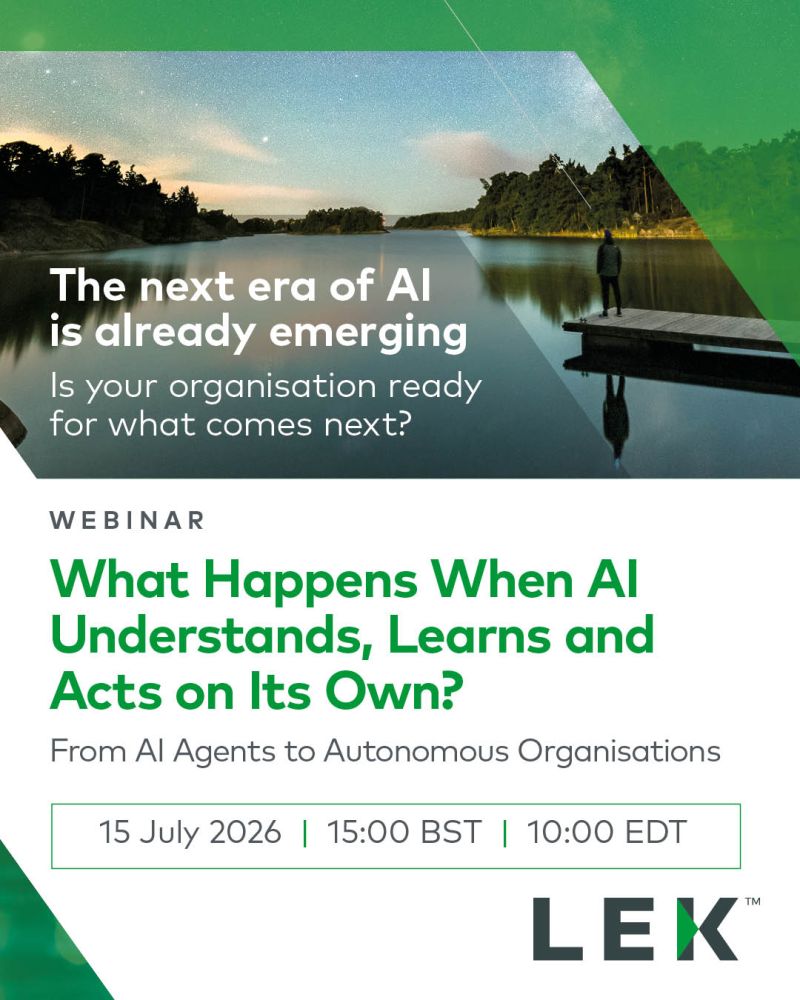
L.E.K. Consulting’s webinar, “What happens when AI understands, learns and acts on its own”, ran on Wednesday 15th July: Rob Wild (L.E.K. partner) hosting, with Somnath Biswas (Head of AI Products, The AA), Scott Breitenother (founder and chief executive of Kilo) and me.
The frame. Rob’s argument: you can see forward, because every big shift shows early signals well before mass adoption. Five are visible now: persistent memory, multimodal, causal world models, local models and goal orientation. On the first, his line of the afternoon: “We send it to university, it gets a degree called 5.6, it comes back, and it stops really learning.”
What expertise keeps its value. My answer: being a walking encyclopaedia is worth less, and a good first draft now costs nothing on almost every task. What grows is asking the right question, because your context beats the machine’s, and the discipline to check, edit and own what comes back. Not team leadership but AI leadership. Sam’s build: the premium on the how is gone; it moves to the what and the why, to knowing your customer and industry deeply enough to re-engineer rather than laying an AI veneer over what exists. His sleeper skill: change management. “Building a tool is easy... getting that user to trust an AI output” is the hard part. Rob added brand: people trust a known company’s AI recommendation over a chatbot’s.
Local versus cloud. Scott’s future is a routing layer, not a side: simple requests never leave your laptop, the hardest go to the frontier, confidential work goes to your private model, the middle goes to cheap open-weight models. My contrarian addition: frontier intelligence will always sit ahead of local, because frontier-level innovation takes enormous money, and per task it is dirt cheap. A $200 run of a frontier model buys the equivalent of many human days of work.
Five to ten years out. Sam: physical AI at the edge, interfaces beyond chat, and an agent-to-agent nexus. “My finance agent talks to my NatWest agent... talks to the Uber agent.” Then AI becomes a commodity, like spreadsheets: less of a thing to talk about at all. Scott: a fork in the road, between a grey, locked-down future with “only three different stores to buy your AI from” and a technicolour one of model choice, open source and AI on your own terms. “The next couple of years are going to be very telling.” Me: I no longer think the shiny future arrives by default. The democratising wave I expected did not happen, because leverage turned out to demand investment, focus and discipline most firms have not been willing to find. It is the most radical change to how work gets done we have ever seen, and it is slower and more concentrated than I expected. Rob took the middle: hoping for the technicolour future, watching half his clients build for it and half lock themselves in.
The audience. Polled on which shift would hit their business hardest, they picked causal world models and goal orientation, ahead of memory and multimodal, with local models last.
The questions. On hallucinations, Scott: a spectrum, not a switch, and you manage it the way you manage people: multiple models from different labs checking each other, deterministic business checks underneath, and the same standard of confidence you would ask of any human. On whether AI makes organisations fragile, me: be resilient to outages, but used well this makes people and organisations smarter, not more fragile. Sam: swapability by design, always a plan B. Scott: the technology changes a lot, but not the fundamentals; keep every lesson about single points of failure.
V. The thread underneath
The same people hold both halves. The reader with the bleakest five-year forecast calls the technology enormously exciting and has given up trying to reconcile the two. The investor who fears a conflictual society is the one moving fastest through the window of arbitrage. The panel that named the risks spent an hour visibly enjoying the tools. Nobody in this record resolves that tension, and this page does not either. That is Saturday’s job.
Reader contributions gathered between 30th May and 15th July 2026, lightly edited for length, attributed by role type only under the Chatham House Rule. Two contributions were written up from conversations. Panel remarks come from the panel; the webinar was public, and the panelists are named accordingly.