What the insight world thinks about AI
Notes from three days at TMRE, Denver, 5th to 7th October 2026
This is the longer companion to this week's essay, Professional toe-treading. It pulls together what I heard across four very different rooms at TMRE, the annual gathering for consumer insight people, and what a large share of the AI sessions said when I went back through them.
I. Four rooms
Monday: the main conference. Keynotes and case studies on the main stage and in the breakout rooms: the scheduled conference programme.
Tuesday: the Backstage Boardroom. A small room of senior client-side insight leaders, which I chaired. We ran it under the Chatham House rule: you can share what you learned, not who said it. Nothing from it below is attributed.
Wednesday: the Executive Retreat, senior insight leaders from large consumer businesses plus a handful of research suppliers, off-site and also under the Chatham House rule. It's the fifth I've hosted in person.
Wednesday: AI in Action Summit ran a full day of sessions on AI for marketing and insight. I was at the retreat, so I've worked from the summit's session captions since.
II. Five things the rooms said
1. Being bypassed came up in every room.
Some people in both closed rooms worried about being replaced, including where junior roles go. A concern that kept coming back was being routed around. The day after, someone gave me a name for it: professional toe-treading. The FT has been writing about it: people using AI to do parts of each other's jobs, "messily and organically". Leaders worried that colleagues across the business, now able to get a plausible answer from a chatbot, will start acting as researchers. One had to push back on AI-generated recommendations that another department had sent to leadership. One objected to suppliers pitching directly to executives and defining the problem before the insight team is in the room. Another worried that strategy teams could use AI to take over insight work.
Toe-treading cuts both ways, though. When a colleague can do part of your job, a handoff disappears, and an AI transformation leader I worked with separately this week thinks handoffs are a big reason companies don't see the productivity their people do. Insight teams can tread on toes too, into strategy and into the brief itself.
In her public keynote on Monday, Pamela Forbus of Mondelez warned where this can end: an insight team produces a superb AI-assisted summary, and nine months later it becomes part of a centralised business services team running a self-serve system.
So what for your team: map who in your business now answers consumer questions without you, and go and sit with them rather than policing them. Then decide which neighbouring jobs your own team should be doing.
2. The savings question covers one destination out of four.
In the same public keynote, Forbus put it most plainly. Her boss and her CFO want a number for how much AI will save. "They haven't asked me what to do with the savings yet."
In the retreat, a supplier described AI as making research faster and cheaper. One client-side leader said it had changed their work rather than cut their costs. Another described reinvesting the time in more research, not less.
AI's new capability can go to four places: the same work done cheaper, the same work done better, work nobody could do before, and someone else's work, a colleague's or a supplier's, including work once bought from consultants, contractors and agencies. Usually only the first gets measured. The last is happening anyway, by default.
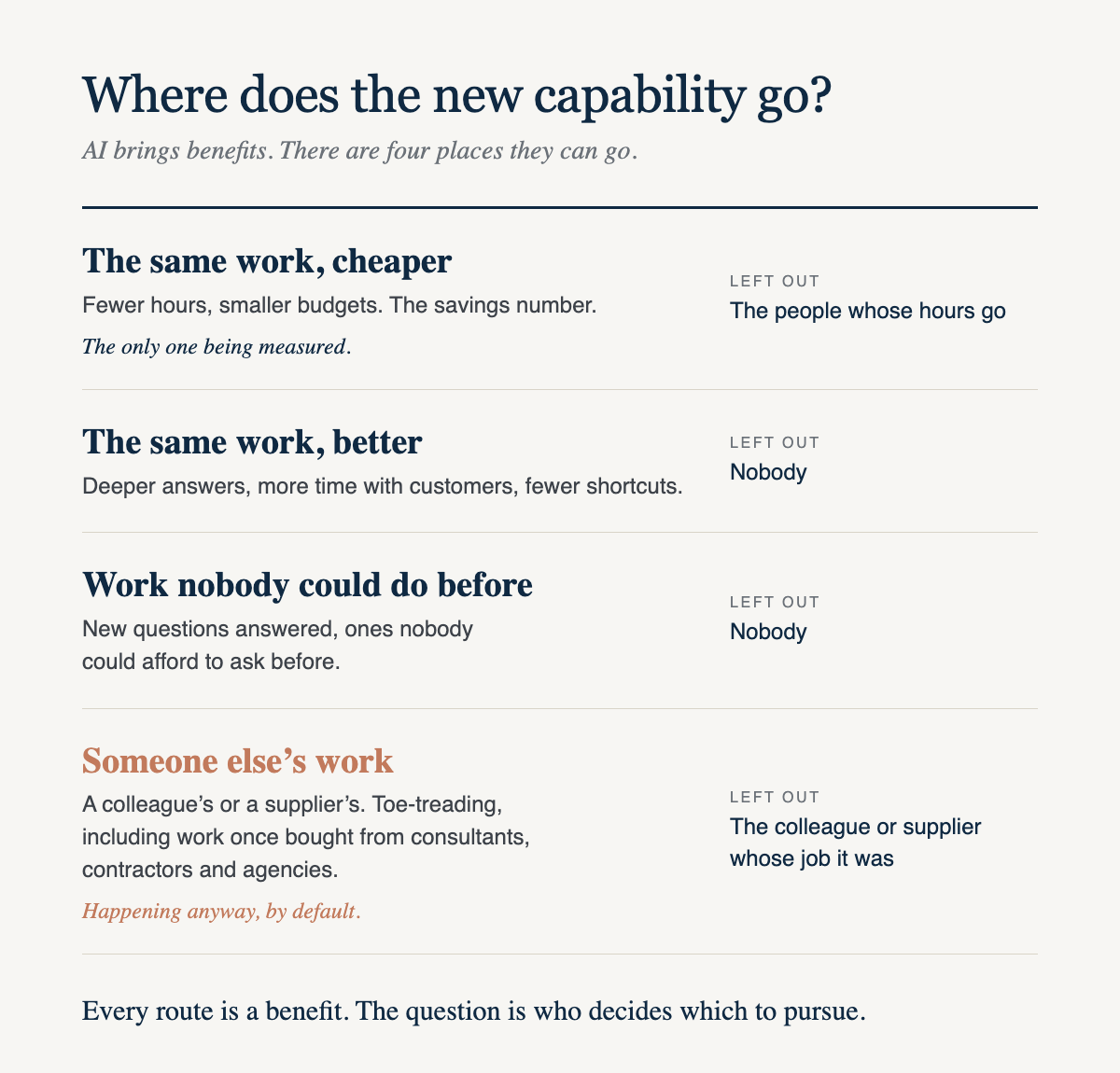
So what for your team: write down, in a sentence your boss could repeat, where your team's new capability should go, including whose toes you'll tread on. Say it before you're asked for the percentage.
3. Speed is now the price of being in the conversation.
A warning repeated in more than one room: if you can't get into the conversation fast enough, the business moves on without you. Leaders expect it "better, faster, cheaper", or they'll try to do it themselves. The counterweight, also repeated, was that faster answers raise the question of whether they're right, and that someone has to own the difference.
So what for your team: decide which questions you'll answer in hours, which in weeks, and say so in advance.
4. The apprenticeship problem is about judgement, not tasks.
The worry wasn't only that junior roles shrink. It was that the work juniors used to do was how they learned to judge, and leaders are still working out how to replace that. Leaders in the retreat proposed mentoring, shadowing, permission to challenge existing work and permission to fail. On the summit stage, one vendor said it was now hiring less for operational roles and more at the customer-facing and engineering ends.
So what for your team: give each junior a piece of work where they must disagree with something, and say why.
5. Trust in fast answers is the open question.
Accuracy, generic output, fraud in online samples, echo chambers and consumer backlash against AI all came up. The most useful practical answer came from a public session: RealTruck dates and labels the evidence behind its research agents, retires stale findings, compares agent answers with panel answers, and keeps pricing, purchase forecasts and final validation off limits.
So what for your team: for any AI tool that answers questions from your research, know how old its evidence is and what it isn't allowed to answer.
III. What the stage sold, and what clients reported
| On stage | What public-session speakers reported |
|---|---|
| Synthetic respondents and digital twins that can be surveyed instantly | Keplar described building more than 10,000 digital twins for Clorox just over a year earlier: "It's very low cost. But it didn't work." They "lack the living context that surrounds real human decisions." Clorox moved to AI-moderated conversations with real people |
| "maybe 60, 70, 80%" of what's asked through surveys "will be replaced by something better", including conversations with real people (a vendor forecast) | YouTube Shopping's UX research lead still values surveys; RealTruck keeps panels and larger population studies; MassMutual stopped an early persona and library pilot that didn't cite its evidence reliably |
| Agents that write the questionnaire, find the respondents and run the study | RealTruck uses research-grounded agents for exploration and screening, with restrictions. Separately, MassMutual described team members checking everything both ways until it became "a full time job" |
| Research libraries that anyone in the business can query | Clorox is building a queryable knowledge base, with wider access to it still a governance question rather than a finished rollout |
| AI-built demand spaces and growth frameworks, "70 to 80%" accurate: "if the CMO is happy with that 70 or 80%, why are you arguing with the final 20%?" | The same speaker insisted researchers still set the scope, verify the sources and own the scoring and the brief |
One claim from the stage met its answer in the closed rooms. One vendor sold "decision infrastructure"; the decision was exactly what insight leaders there said they had to own.
The most honest line of the summit came from a vendor asked whether it offered digital twins. It does. "I hate the product. It's pointless. It doesn't have flavor or magic. But you know, we want to pay bills too."
IV. Synthetic respondents: a short ledger
Where they were said to help:
- Narrowing a long list of early ideas to a short list for real testing (RealTruck uses agents grounded in its own research for concept screening before going to its panel)
- Exploring a question before deciding whether it deserves fieldwork
- Boosting thin samples, with Burke reporting this did not add statistical power in their insurance example
Where they were said to fall short, or were fenced off:
- Predicting individual decisions: Keplar said digital twins lack the living context of real decisions
- RealTruck's reported restrictions: pricing, purchase forecasts and final validation are off limits for its agents
What to test before trusting one: whether its answers change the decision you'd make from real people; how old its source evidence is; what happens when consumers change and it doesn't.
V. Numbers said on stage
These are claims made in public sessions, not findings I've checked. Treat them accordingly.
| Number | What it was said to measure | Who said it |
|---|---|---|
| Four months to one week | Running a strategic research workflow (demand-space work) that traditionally took four months | Keplar, presenting with Clorox |
| More than 20,000 | Consumer conversations run for Clorox | Keplar |
| About 50% | Estimated acceleration in decision-making where the tools were used | Keplar, described as an estimate |
| 70%, up 20 points | User-experience researchers using AI in their work, 2026 against 2025, citing external research | YouTube Shopping's UX research lead |
| Almost 100% | User researchers concerned about accuracy and hallucination, citing User Interviews' 2025 State of User Research report | YouTube Shopping's UX research lead |
| Three weeks to hours | Customising and personalising website landing pages | AAA Club Alliance |
| Under 24 hours | A 400-response consumer study, run about a week earlier and shown as a demonstration in a parallel workshop | aytm |
VI. How the view has moved since 2025
The AI worry sat on top of an older one: whether the business thinks it needs insight at all. In my interviews with insight leaders ahead of it, the benefits were real but patchy and very few described a transformed team. Synthetic data barely came up in those interviews; I suspected because people weren't sure whom to trust.
Billed as an AI day, it turned out to be about role and value. The worry was speed crowding out understanding, and senior colleagues arriving with questions they had already checked with AI. Two futures were defended: guard the truth, or own the decision.
The fear has a clearer shape, and now a name: toe-treading. Being bypassed, by colleagues, suppliers and self-serve systems, came up in every room, and in Forbus's keynote, being asked only for the efficiency number. Synthetic data is now on stage, sold hard and doubted openly. An answer that kept coming up was to get closer to the decision, not further from it.
VII. Monday morning
- Write down where your team's new capability should go, before anyone asks for the savings number.
- Find the people answering consumer questions without you, and help them do it well.
- Set response times by question type, and publish them.
- Give junior colleagues work that requires them to disagree.
- For every AI tool on your research, know the age of its evidence and its no-go questions.
For the longer view, my notes from all six Executive Retreats since 2022, theme by theme, are on the Audience Strategies site, along with the full notes from this week's retreat.